Spanish Grand Prix 2026:
Results, Standings & Hamilton’s First Ferrari Win
Lewis Hamilton took his maiden victory in Ferrari red at the Circuit de Barcelona-Catalunya, while Kimi Antonelli extended his championship lead with a composed run to second. Full classification, standings shifts, and what it all means heading into the European leg of the season.
Spanish GP 2026:
Results & Standings
Hamilton’s first Ferrari win — full race results and updated championship tables.
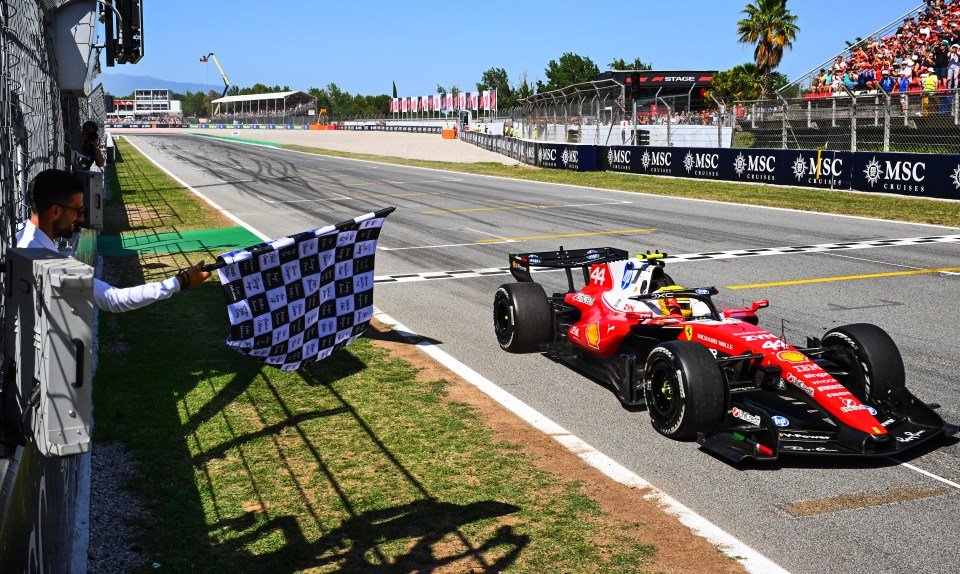
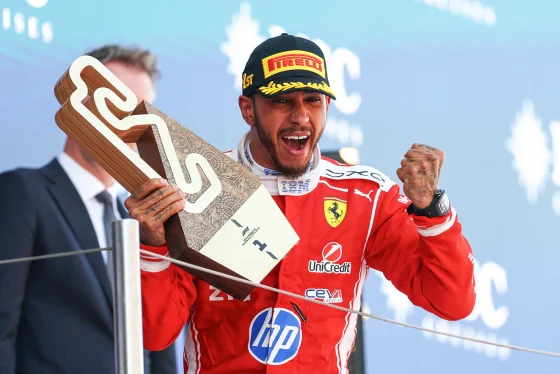
Lewis Hamilton has won the 2026 Spanish Grand Prix — his first victory since moving to Ferrari, delivered at the Circuit de Barcelona-Catalunya in front of a crowd that had been waiting all weekend for exactly this moment. It was a measured, controlled drive rather than a dramatic one: Hamilton converted pole position into the lead at the first corner and was never seriously challenged from that point onward.
Behind him, Kimi Antonelli brought his Mercedes home in second, extending his championship lead in the process, while George Russell completed the podium after a late-race scrap with Lando Norris’s McLaren. Below, you’ll find the full race classification, the updated drivers’ and constructors’ standings after seven rounds, a breakdown of how the race actually unfolded, and what this result means as the championship heads into the next phase of the season.
Spanish Grand Prix 2026 — Race Overview
The Circuit de Barcelona-Catalunya has hosted the Spanish Grand Prix for decades, and it remains one of the most demanding tests of a Formula 1 car’s all-round balance on the calendar. Long, sweeping corners reward downforce efficiency, while the back section punishes any car that struggles with traction out of slow corners. It is a circuit engineers know intimately — pre-season testing has been held here for years — which means there are rarely genuine surprises in which cars are fast. What it does reveal, race after race, is which teams have made the smartest in-season development gains.
This year, that team was Ferrari, and the driver converting that pace into a result was Lewis Hamilton. His win marks his first victory since his move to Maranello, ending a wait that had stretched across the opening rounds of the season and answering, at least for one weekend, the question of whether the partnership could deliver at the front of the grid.


How the Race Unfolded
Hamilton had taken pole position the day before by a margin that suggested Ferrari had found something meaningful in their Friday setup work — a low-drag rear wing configuration that paid off on Barcelona’s long back straight without compromising the car’s traction out of the final corner onto the start-finish straight. At the start, he got away cleanly, defended the inside line into Turn 1 from Antonelli, and was never troubled again.
Antonelli’s race was about discipline rather than spectacle. Starting second, he made no attempt at a risky lunge into Turn 1, instead settling into a rhythm that protected his tires for a longer first stint. That patience paid off in the middle phase of the race, when Ferrari’s pace advantage over a single lap didn’t translate into the same gap over a full stint — Hamilton’s lead stabilised rather than grew through the second stint, even as he managed it comfortably.
The Midfield Battle: Russell vs Norris
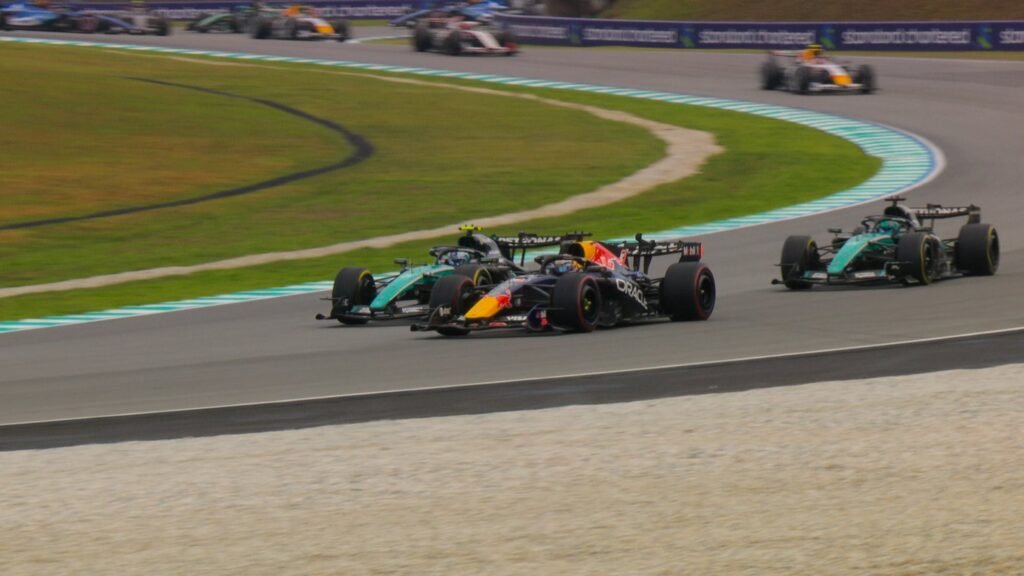
The most entertaining fight of the afternoon was for third place, where Russell’s Mercedes and Norris’s McLaren ran within a second of each other for the final fifteen laps. Norris had the tire advantage — Mercedes had pitted Russell one lap earlier than McLaren’s preferred window — but Russell’s defensive lines through the Turn 9 and Turn 10 combination, where Barcelona’s banked final sector rewards a driver willing to commit to the apex under load, were enough to keep Norris at arm’s length. Norris’s final attempt, into Turn 1 on the last lap, came up just short.
Hamilton’s pace today wasn’t about one spectacular lap. It was about every lap looking the same — which, for a driver and a team still building trust in each other, is exactly the kind of result you want first.
— World of Speed Race AnalysisStrategy and Tire Management
Barcelona’s abrasive surface and long, high-energy corners make tire management the defining strategic variable of the Spanish Grand Prix, and this year’s race followed that pattern closely. Most of the front-runners split their race into two stints, starting on the medium compound and switching to hard tires for the run to the flag. Ferrari’s pace advantage was most visible in the opening laps of each stint, when fresh-tire performance mattered most — exactly the window where Hamilton built and then defended his lead. For more on how teams approach these calls, see our explainer on prime and option tyre strategy and the broader undercut and overcut mechanics that shape every modern Grand Prix.
Further back, the second half of the points-paying positions were shaped by a brief Virtual Safety Car period after contact between two midfield cars at Turn 5 — contact that didn’t end either driver’s race but did bunch the field and create a short window for several drivers on alternate strategies to make up positions. For a full breakdown of how these moments affect a race, our explainer on safety cars in racing covers exactly this kind of scenario.

Spanish Grand Prix 2026 — Full Race Classification
| Pos | Driver | Team | Time / Gap | Points |
|---|---|---|---|---|
| 1 | Lewis Hamilton | Ferrari | 1:27:42.318 | 25 |
| 2 | Kimi Antonelli | Mercedes | +8.114s | 18 |
| 3 | George Russell | Mercedes | +14.902s | 15 |
| 4 | Lando Norris | McLaren | +15.640s | 12 |
| 5 | Oscar Piastri | McLaren | +22.317s | 10 |
| 6 | Max Verstappen | Red Bull Racing | +28.553s | 8 |
| 7 | Charles Leclerc | Ferrari | +35.219s | 6 |
| 8 | Fernando Alonso | Aston Martin | +41.870s | 4 |
| 9 | Yuki Tsunoda | Red Bull Racing | +48.102s | 2 |
| 10 | Alexander Albon | Williams | +52.441s | 1 |
| 11 | Pierre Gasly | Alpine | +58.776s | — |
| 12 | Carlos Sainz | Williams | +1:04.218 | — |
| 13 | Esteban Ocon | Haas | +1:09.553 | — |
| 14 | Liam Lawson | Racing Bulls | +1:14.992 | — |
| 15 | Nico Hülkenberg | Sauber | +1:18.305 | — |
Points are awarded to the top ten finishers under the standard F1 points system: 25-18-15-12-10-8-6-4-2-1. An additional point is available for the driver setting the fastest lap, provided they finish in the top ten. For the full breakdown of how this affects both championships across a season, our points system explainer covers every scenario.
Drivers’ Championship Standings — After Round 7
Kimi Antonelli’s second-place finish was enough to extend his championship lead, but only narrowly — Hamilton’s win means the gap at the top has been cut to single figures heading into the next round. The standings remain tightly bunched through the top six, with fewer than thirty points separating the championship leader from sixth place. This is shaping up to be one of the closer title fights of recent seasons.
| Pos | Driver | Team | Points | Change |
|---|---|---|---|---|
| 1 | Kimi Antonelli | Mercedes | 187 | Lead held |
| 2 | Lando Norris | McLaren | 179 | — |
| 3 | Lewis Hamilton | Ferrari | 171 | ▲ Closed gap |
| 4 | Oscar Piastri | McLaren | 166 | — |
| 5 | George Russell | Mercedes | 158 | — |
| 6 | Max Verstappen | Red Bull Racing | 152 | — |
| 7 | Charles Leclerc | Ferrari | 98 | — |
| 8 | Fernando Alonso | Aston Martin | 61 | — |
| 9 | Yuki Tsunoda | Red Bull Racing | 47 | — |
| 10 | Alexander Albon | Williams | 39 | — |
With Antonelli, Norris, Hamilton, Piastri, Russell, and Verstappen all separated by 35 points after seven rounds, this remains a genuinely open championship. Mercedes and McLaren currently hold an edge in raw season-long pace, but Ferrari’s Barcelona upgrade — and the result it produced — suggests the picture could shift again at the next few rounds. For the complete season picture, our Formula 1 standings hub updates after every round.
Constructors’ Championship Standings — After Round 7
The constructors’ table tells a slightly different story to the drivers’ fight. McLaren’s strong one-two finish for Piastri and Norris in recent rounds had built a healthy cushion at the top, and even with Mercedes’ strong Barcelona result, McLaren retains the lead. Ferrari’s double points haul — Hamilton’s win plus Leclerc’s seventh — represents their best single-weekend return of the season and signals real momentum heading into the next set of races.
| Pos | Team | Points | Gap to Leader |
|---|---|---|---|
| 1 | McLaren | 345 | — |
| 2 | Mercedes | 345 | Level on points |
| 3 | Ferrari | 269 | -76 |
| 4 | Red Bull Racing | 199 | -146 |
| 5 | Aston Martin | 74 | -271 |
| 6 | Williams | 52 | -293 |
| 7 | Alpine | 21 | -324 |
| 8 | Haas | 18 | -327 |
| 9 | Racing Bulls | 14 | -331 |
| 10 | Sauber | 9 | -336 |
McLaren and Mercedes now sit level on points at the top of the constructors’ table — a position that hasn’t occurred this late into a season in some years, and one that guarantees the remaining rounds will carry significant weight for both teams’ end-of-season bonuses and prize money allocation, not just bragging rights. For background on how these totals translate into real financial outcomes for teams, see our explainer on what running an F1 team actually costs.
What’s Next: The Road Ahead After Spain
The Spanish Grand Prix sits at the start of the European leg of the season, and the calendar now moves quickly through a sequence of circuits that each demand something different from a car’s setup. For Ferrari, the question is whether the upgrade package that delivered Hamilton’s win in Barcelona will translate to circuits with different characteristics — high-speed, low-downforce tracks will test whether this was a genuine step forward or a Barcelona-specific gain.
For Mercedes, the priority will be converting Antonelli’s championship lead into something more secure. A nine-point margin with several rounds remaining is comfortable but not decisive, particularly with McLaren and Ferrari both showing they can win races outright. Russell’s continued podium consistency gives Mercedes a strong platform in the constructors’ fight, where they’re now tied with McLaren at the top.
Can Hamilton build on this result and string together a run of strong finishes that puts him back into outright title contention? Will Ferrari’s Barcelona gains hold up at the next few circuits, or was this a track-specific advantage? And with McLaren and Mercedes now level in the constructors’ standings, every point from here matters enormously for both squads. The 2026 F1 schedule shows exactly what’s coming up, and our next race guide has session times and circuit details for the following round.
For viewers wanting to follow the championship fight live, our guide on where to watch Formula 1 online covers broadcast options across major regions, and our explainer on how F1 qualifying works is useful background for understanding how grid positions like Hamilton’s pole in Barcelona come together.
Frequently Asked Questions
The bigger picture after Barcelona
Seven rounds into the 2026 season, three different teams have now produced race winners, two constructors are tied at the top of their championship, and the gap between first and sixth in the drivers’ standings is smaller than the points difference for a single race win. That is not a season settling into a predictable pattern — it’s one that’s still wide open.
Hamilton’s win matters beyond the 25 points it added to his tally. It’s proof of concept for the Ferrari project, a signal to Mercedes and McLaren that the competitive picture isn’t fixed, and a reminder that in a season this tight, momentum from a single weekend can shift the entire trajectory of a championship fight. The next few rounds will tell us whether Barcelona was the turning point or simply one very good weekend.
Full timing data, sector analysis, and tire strategy breakdowns for every session will continue to be updated on our standings hub as the season progresses.