Rally Estonia 2026 Shakedown Results: Fastest Drivers, Full Times & Early Takeaways
Elfyn Evans and Sami Pajari shared the Kastre benchmark as Toyota locked out the first five places. Here is the complete 49-car timing order and what the short, rapid test really told us.
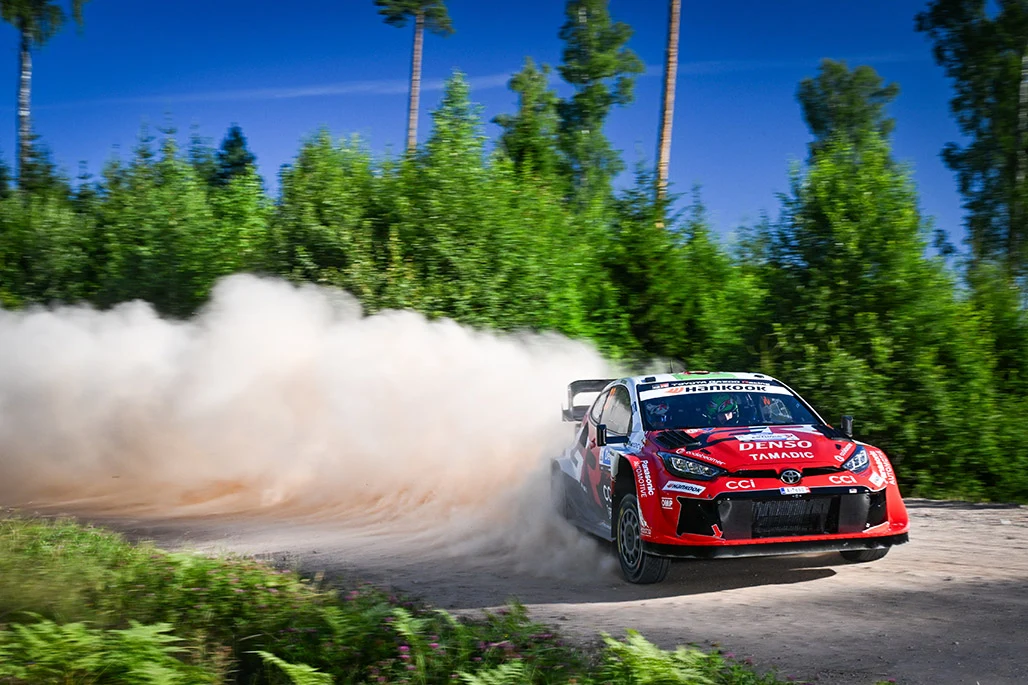
The Rally Estonia 2026 shakedown results produced a dead heat at the top. Elfyn Evans and Scott Martin were classified first in the No. 33 Toyota GR Yaris Rally1 with a best run of 1 minute 55.6 seconds. Sami Pajari and Marko Salminen matched that time exactly in the No. 5 Toyota.
Takamoto Katsuta was only one tenth slower, Oliver Solberg followed at two tenths, and Sébastien Ogier completed an extraordinary Toyota top-five sweep. Robert Virves was the fastest Rally2 driver at 2:02.8, placing 12th overall in the Škoda Fabia RS Rally2.
Elfyn Evans and Sami Pajari shared the fastest Kastre time at 1:55.6. Evans appeared first in the published timing order, while Pajari was second on the identical mark. Katsuta completed the top three at 1:55.7, just 0.1 seconds behind.
Rally Estonia 2026 Shakedown Results at a Glance
The Friday morning shakedown took place on the 4.08-kilometre Kastre test. The first car was scheduled for 8:01 a.m. local time in Estonia, which was 1:01 a.m. Eastern Daylight Time for viewers in the United States. The compact timing mattered because the competitive rally began later the same day rather than after a long overnight pause.
Shakedown is not a points-paying stage. It is a controlled chance to confirm the car, test small setup adjustments and make sure the crew is physically and mentally ready. Even so, Kastre was fast enough to expose hesitation. A two-tenth gap represented only a tiny difference in confidence, line choice or grip, while a larger deficit could reflect a conservative run, a setup test or simply traffic and surface evolution.
The benchmark was 1:55.6 over 4.08 kilometres. That works out to an average of roughly 127.1 km/h, or 79.0 mph. The figure is impressive because average speed includes acceleration, braking and changes of direction rather than measuring only the car’s peak speed.
Full Rally Estonia 2026 Shakedown Times
The table below lists every recorded shakedown time in the published Kastre timing order. Evans is shown first and Pajari second despite their identical 1:55.6 marks. The gap column is calculated from that shared benchmark. Class colors separate Rally1, Rally2 and Rally3 machinery so the different performance levels remain easy to read.
Shakedown classifications should not be treated like a competitive stage result. Crews can complete different programmes, use different setup directions and choose whether to chase a representative time. The table is still valuable because it shows the fastest run each crew placed on the board before the rally began.
| Pos. | Car | Driver / Co-driver | Vehicle / Class | Best time | Gap |
|---|---|---|---|---|---|
| 1 | #33 | Elfyn EvansScott Martin | Toyota GR Yaris Rally1Rally1 | 1:55.6 | — |
| 2 | #5 | Sami PajariMarko Salminen | Toyota GR Yaris Rally1Rally1 | 1:55.6 | — |
| 3 | #18 | Takamoto KatsutaAaron Johnston | Toyota GR Yaris Rally1Rally1 | 1:55.7 | +0.1 |
| 4 | #99 | Oliver SolbergElliott Edmondson | Toyota GR Yaris Rally1Rally1 | 1:55.8 | +0.2 |
| 5 | #1 | Sébastien OgierVincent Landais | Toyota GR Yaris Rally1Rally1 | 1:56.1 | +0.5 |
| 6 | #11 | Thierry NeuvilleMartijn Wydaeghe | Hyundai i20 N Rally1Rally1 | 1:56.4 | +0.8 |
| 7 | #16 | Adrien FourmauxAlexandre Coria | Hyundai i20 N Rally1Rally1 | 1:57.5 | +1.9 |
| 8 | #4 | Esapekka LappiEnni Mälkönen | Hyundai i20 N Rally1Rally1 | 1:57.7 | +2.1 |
| 9 | #95 | Jon ArmstrongShane Byrne | Ford Puma Rally1Rally1 | 1:58.1 | +2.5 |
| 10 | #55 | Joshua McErleanEoin Treacy | Ford Puma Rally1Rally1 | 1:58.2 | +2.6 |
| 11 | #22 | Mārtiņš SesksRenārs Francis | Ford Puma Rally1Rally1 | 1:58.3 | +2.7 |
| 12 | #23 | Robert VirvesJakko Viilo | Škoda Fabia RS Rally2Rally2 | 2:02.8 | +7.2 |
| 13 | #36 | Jaspar VaherRait Jansen | Toyota GR Yaris Rally2Rally2 | 2:04.3 | +8.7 |
| 14 | #27 | Jan SolansRodrigo Sanjuan | Škoda Fabia RS Rally2Rally2 | 2:04.5 | +8.9 |
| 15 | #42 | Tuukka KauppinenSebastian Virtanen | Toyota GR Yaris Rally2Rally2 | 2:04.5 | +8.9 |
| 16 | #28 | Lauri JoonaAntti Linnaketo | Škoda Fabia RS Rally2Rally2 | 2:05.5 | +9.9 |
| 17 | #25 | Emil LindholmGabriel Morales | Škoda Fabia RS Rally2Rally2 | 2:05.6 | +10.0 |
| 18 | #37 | Mikko HeikkiläKristian Temonen | Škoda Fabia RS Rally2Rally2 | 2:05.9 | +10.3 |
| 19 | #21 | Teemu SuninenJanni Hussi | Toyota GR Yaris Rally2Rally2 | 2:05.9 | +10.3 |
| 20 | #24 | Fau ZaldivarMarcelo der Ohannesian | Škoda Fabia RS Rally2Rally2 | 2:05.9 | +10.3 |
| 21 | #26 | Gus GreensmithJonas Andersson | Toyota GR Yaris Rally2Rally2 | 2:05.9 | +10.3 |
| 22 | #38 | Patrick EnokSilver Simm | Škoda Fabia RS Rally2Rally2 | 2:06.0 | +10.4 |
| 23 | #40 | Karl Martin VolverAnnika Sõna | Toyota GR Yaris Rally2Rally2 | 2:06.1 | +10.5 |
| 24 | #29 | Yuki YamamotoJames Fulton | Toyota GR Yaris Rally2Rally2 | 2:06.1 | +10.5 |
| 25 | #39 | Egon KaurErmo Veltson | Toyota GR Yaris Rally2Rally2 | 2:06.1 | +10.5 |
| 26 | #20 | Roope KorhonenAnssi Viinikka | Toyota GR Yaris Rally2Rally2 | 2:06.3 | +10.7 |
| 27 | #32 | Giovanni TrentinPietro Elia Ometto | Škoda Fabia RS Rally2Rally2 | 2:06.4 | +10.8 |
| 28 | #31 | Mille JohanssonJohan Grönvall | Škoda Fabia RS Rally2Rally2 | 2:06.7 | +11.1 |
| 29 | #30 | Arthur PelamourguesBastien Pouget | Hyundai i20 N Rally2Rally2 | 2:07.4 | +11.8 |
| 30 | #35 | Romet JürgensonSiim Oja | Ford Fiesta Mk II Rally2Rally2 | 2:07.8 | +12.2 |
| 31 | #41 | Joosep Ralf NõgeneAleks Lesk | Toyota GR Yaris Rally2Rally2 | 2:08.0 | +12.4 |
| 32 | #44 | Shotaro GotoJussi Lindberg | Toyota GR Yaris Rally2Rally2 | 2:08.6 | +13.0 |
| 33 | #34 | Bernhard ten BrinkeTom Woodburn | Toyota GR Yaris Rally2Rally2 | 2:08.9 | +13.3 |
| 34 | #59 | Urmo AavaSilver Kütt | Toyota GR Yaris Rally2Rally2 | 2:10.4 | +14.8 |
| 35 | #43 | Takumi MatsushitaPekka Kelander | Toyota GR Yaris Rally2Rally2 | 2:12.0 | +16.4 |
| 36 | #50 | Tymek AbramowskiJakub Wróbel | Ford Fiesta Rally3Rally3 | 2:13.9 | +18.3 |
| 37 | #48 | Rio OgataMikael Korhonen | Renault Clio Rally3Rally3 | 2:14.9 | +19.3 |
| 38 | #51 | Nataniel BruunPablo Olmos | Ford Fiesta Rally3Rally3 | 2:15.3 | +19.7 |
| 39 | #49 | Kanta YanaguidaJuho Koski-Lammi | Renault Clio Rally3Rally3 | 2:15.3 | +19.7 |
| 40 | #45 | Johannes KeferböckIlka Minor | Toyota GR Yaris Rally2Rally2 | 2:15.4 | +19.8 |
| 41 | #46 | Ugur SoyluMehmet Yalçin | Škoda Fabia RS Rally2Rally2 | 2:15.7 | +20.1 |
| 42 | #53 | Kerem KazazCorentin Silvestre | Ford Fiesta Rally3Rally3 | 2:16.3 | +20.7 |
| 43 | #62 | Esmar-Arnold UntArro Vahtra | Ford Fiesta Rally3Rally3 | 2:16.9 | +21.3 |
| 44 | #54 | Jarkko NikaraTomiya Maekawa | Renault Clio Rally3Rally3 | 2:17.4 | +21.8 |
| 45 | #58 | André MartínezMatias Aranguren | Ford Fiesta Rally3Rally3 | 2:19.5 | +23.9 |
| 46 | #61 | Luca HoelblingFederico Fiorini | Škoda Fabia RS Rally2Rally2 | 2:20.7 | +25.1 |
| 47 | #57 | Nicolas OttoHugo Magalhães | Ford Fiesta Rally3Rally3 | 2:21.2 | +25.6 |
| 48 | #60 | Isak HatanmaaDitte Kammersgaard | Ford Fiesta Rally3Rally3 | 2:28.5 | +32.9 |
| 49 | #63 | Mika KarppanenKati Pereläinen | Renault Clio Rally3Rally3 | 2:31.0 | +35.4 |
Timing note: 49 crews recorded a time in the published shakedown classification. The order above follows the WRC Ralli event-timing page, including Evans ahead of Pajari on the shared fastest mark.
Rally1 Analysis: Toyota’s Top-Five Sweep Was the Big Headline
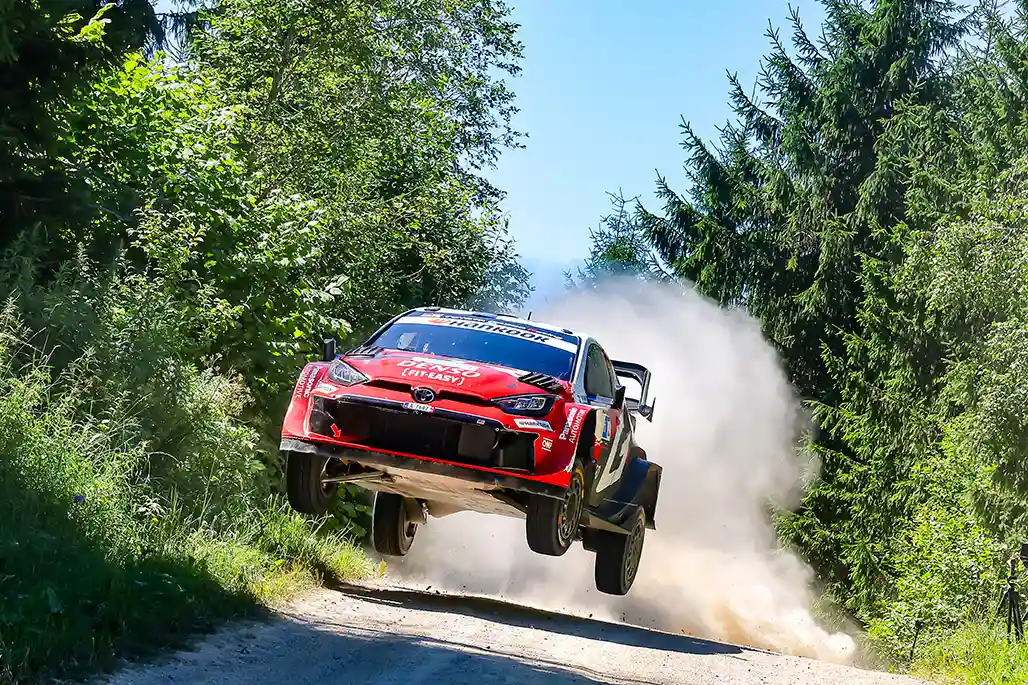
A shared fastest time was noteworthy, but the more important manufacturer signal was the shape of the first five positions. Every Toyota GR Yaris Rally1 finished ahead of the best Hyundai and Ford. Evans and Pajari led, Katsuta sat only 0.1 seconds away, Solberg was 0.2 back and Ogier was half a second from the benchmark.
On a test lasting less than two minutes, those gaps were small enough to show that all five Toyota crews had immediate access to speed. They were not proof that every driver had the same rally-winning pace. They did, however, show a platform that responded cleanly to the high-speed gravel, crests and rapid direction changes associated with Estonia.
Elfyn Evans: fastest in shakedown, but facing the hardest Friday job
Evans reaching 1:55.6 confirmed that the championship leader had no basic speed problem. The bigger issue was his road position once competition began. As the first Rally1 car on the loose Friday stages, he had to sweep gravel from the line for the crews behind. That role turned the shakedown leader into a driver fighting conditions rather than only rivals.
The later rally result proved why a shakedown headline cannot be separated from road order. Evans ended Friday ninth, 49.8 seconds behind Pajari, despite sharing the fastest time only hours earlier. He recovered to sixth by the finish and still strengthened his championship lead. His weekend was a lesson in context: raw pace was present, but the competitive surface did not offer him the same opportunity.
Sami Pajari: the tie was an early sign of genuine confidence
Pajari’s identical 1:55.6 looked even more significant in hindsight. Toyota reported that he was already happy with the feeling of the car during shakedown and did not need a major change. When the timed rally began, that confidence translated immediately. He won every stage on Friday, led from start to finish and eventually claimed his first WRC victory.
He won 12 of the rally’s 18 stages and beat Solberg by 19.5 seconds. That does not mean shakedown predicted the precise outcome. It means the short test captured something real: Pajari was comfortable enough to produce speed without appearing to fight the car. In a rally where commitment over crests matters, that calm platform is often more valuable than a dramatic single run.
Takamoto Katsuta: one tenth from fastest, then tyre trouble
Katsuta’s 1:55.7 made Toyota’s top three almost inseparable. His shakedown pace suggested he could join the lead battle, but his competitive rally changed after tyre damage on Friday. He was forced out of contention and later faced the extra burden of opening the road. He finished 21st overall rather than converting his early speed into a top result.
This contrast is another reason to avoid calling shakedown a forecast. It measures preparedness at a specific moment. It cannot account for tyre damage, an impact, a mechanical problem or the road-order consequences that follow an incident.
Oliver Solberg and Sébastien Ogier completed the Toyota lockout
Solberg was only 0.2 seconds slower than the shared benchmark. He then backed up that pace with second place in the rally, plus maximum points from Super Sunday and the Power Stage. Ogier’s 1:56.1 placed him fifth in shakedown and he also finished fifth in the rally, making his result the closest one-to-one match between the early order and the final classification.
The first five positions came from five different Toyota crews, not one exceptional run hiding a weaker package. That depth was reinforced when Pajari and Solberg later finished first and second, Ogier took fifth, and Evans recovered to sixth despite sweeping the road on Friday.
WRC2 and Rally2 Shakedown Results: Robert Virves Led the Chase
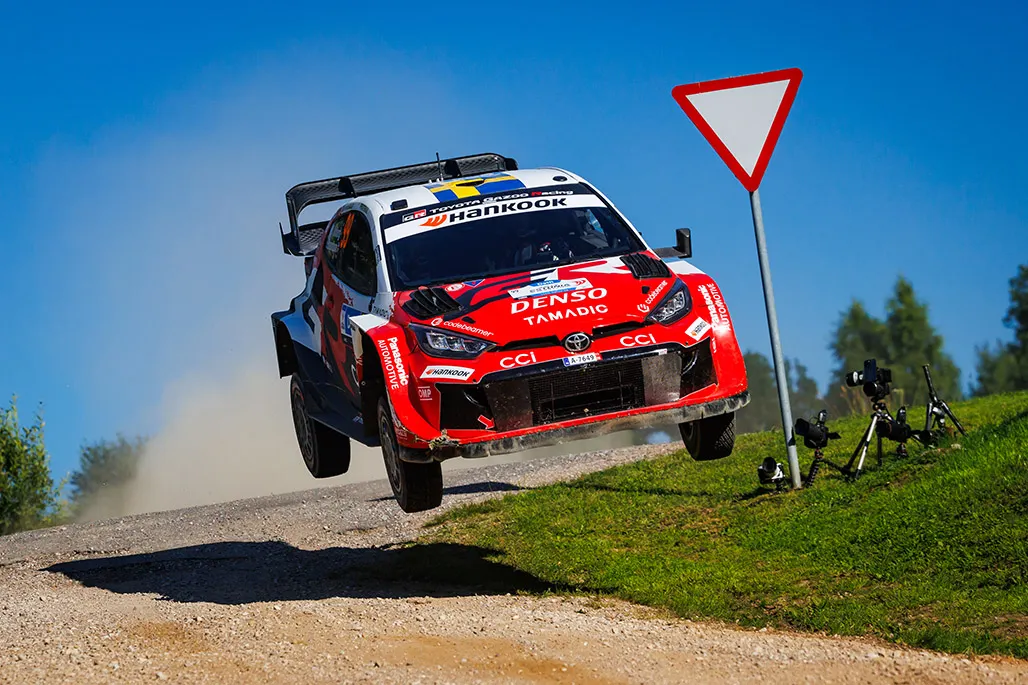
Robert Virves and Jakko Viilo were the quickest Rally2 crew, stopping the clock at 2:02.8 in their Škoda Fabia RS Rally2. That placed them 12th overall, directly behind the 11 Rally1 cars. Virves was 7.2 seconds slower than the fastest Rally1 benchmark but 1.5 seconds clear of the next Rally2 crew.
Jaspar Vaher was second among the Rally2 runners at 2:04.3 in a Toyota GR Yaris Rally2. Jan Solans and Tuukka Kauppinen then shared 2:04.5. The first ten Rally2 cars were covered by just 3.2 seconds, from Virves at 2:02.8 to Patrick Enok at 2:06.0.
Fastest Rally2 crews
1. Robert Virves — 2:02.8
2. Jaspar Vaher — 2:04.3
3. Jan Solans — 2:04.5
3. Tuukka Kauppinen — 2:04.5
What followed in the rally
Virves converted the early signal into a home WRC2 victory. He finished 10th overall and beat Teemu Suninen by 7.6 seconds in class. That made his shakedown performance one of the session’s most meaningful indicators.
The Rally2 field was large and highly competitive. Škoda, Toyota, Hyundai and Ford machinery all appeared in the classification. Local knowledge was also visible. Virves, Vaher, Patrick Enok, Karl Martin Volver, Egon Kaur and other Estonian crews were able to attack familiar fast-road characteristics from the beginning.
However, even this group showed the limits of a short test. Vaher was outstanding in shakedown and later won a WRC2 stage on Friday, but his rally ended after he went wide and hit a tree on Saturday. Virves, by contrast, combined speed with the consistency needed to turn an early benchmark into a class win.
Robert Virves was the fastest Rally2 driver at 2:02.8, ranking 12th overall. The Estonian and co-driver Jakko Viilo later won WRC2 by 7.6 seconds and finished 10th in the overall rally classification.
Hyundai and M-Sport Ford: What Their Shakedown Gaps Said
Thierry Neuville was the first non-Toyota driver in sixth. His 1:56.4 was only 0.8 seconds from the front, so Hyundai’s leading car was not far away. Adrien Fourmaux followed at 1:57.5, while Esapekka Lappi completed the Hyundai group at 1:57.7.
That order did not fully describe Hyundai’s potential. Fourmaux improved during the rally and finished third, with Neuville fourth after a close team-mate battle. Lappi finished eighth. The shakedown suggested Toyota had the cleanest immediate package, but Hyundai still had enough speed to put two cars on the edge of the podium fight.
M-Sport Ford occupied positions nine through 11. Jon Armstrong set a 1:58.1, Joshua McErlean recorded 1:58.2 and Mārtiņš Sesks posted 1:58.3. The three Puma Rally1 cars were separated by only two tenths, although the quickest was 2.5 seconds from the benchmark.
Sesks’ morning also showed that shakedown is not consequence-free. He went off and received a 20-second penalty before the rally had settled into its main rhythm. He still recovered to finish seventh overall, but the incident reduced what might otherwise have been a stronger result. A session that does not award stage time can still shape the weekend through damage, penalties and lost confidence.
Shakedown did not decide Rally Estonia, but it exposed three truths early: Toyota was comfortable, Pajari had a natural rhythm, and the gap between a clean test and a complicated rally could open within hours.
Five Early Takeaways From the Rally Estonia Shakedown
1. Toyota’s speed was broad, not dependent on one driver
A manufacturer can top shakedown because one driver takes more risk than the rest. That was not the pattern here. Five Toyota drivers filled five positions within half a second. The spread was narrow enough to indicate a strong base setup across several driving styles.
The rally result supported that reading. Toyota finished first and second with Pajari and Solberg, while Ogier and Evans placed fifth and sixth. The team did not convert the top-five shakedown sweep into the same final order, but it remained the strongest overall package.
2. Pajari’s shared fastest time carried more meaning than it first appeared
Pajari did not simply produce one quick run. Team comments after Friday described a driver who had been comfortable since shakedown and had not required a significant setup correction. He then won all seven Friday stages and created a 14.7-second overnight lead.
That sequence matters to analysts. A fast shakedown time can be noise. A fast time combined with positive feedback, minimal setup concern and immediate competitive stage wins is a much stronger signal. Pajari’s 1:55.6 was the opening chapter of a controlled weekend, not an isolated flash.
3. Evans proved speed but could not escape road order
Evans’ classified P1 was useful because it separated driver pace from Friday conditions. He was capable of matching the rally winner on a more equal shakedown surface. Once he had to open loose stages, his competitive times dropped relative to those starting behind.
For fans reading a shakedown table, this is the key correction. The quickest driver in the warm-up may face the worst road in the rally. Estonia’s dry gravel punished the first car by forcing it to clear loose material and reveal a cleaner line for rivals.
4. Virves was not only quick for a local driver; he was the clear Rally2 reference
Virves led the Rally2 field by 1.5 seconds and was the first non-Rally1 car in the order. The gap was meaningful on a stage under two minutes long. He then delivered across the event and won WRC2, which strengthened the value of his shakedown performance.
Local knowledge helped, but it did not guarantee success. The class remained close, and several crews with strong early times later encountered incidents or changing form. Virves combined familiarity with clean execution.
5. The full table mattered more than the top line
The headline was a tie, but the full times showed the structure of the field. Toyota’s sweep, Hyundai’s compact three-car group, Ford’s two-tenth internal spread and the 7.2-second step from Rally1 to the quickest Rally2 car all offered useful clues.
Further down, the timing sheet also showed how varied the programmes were. Some Rally2 and Rally3 crews were separated by tiny margins; others were far from the class reference. That does not automatically identify poor performance. A shakedown run can be interrupted, conservative or focused on a specific mechanical check.
What Shakedown Results Mean in the WRC
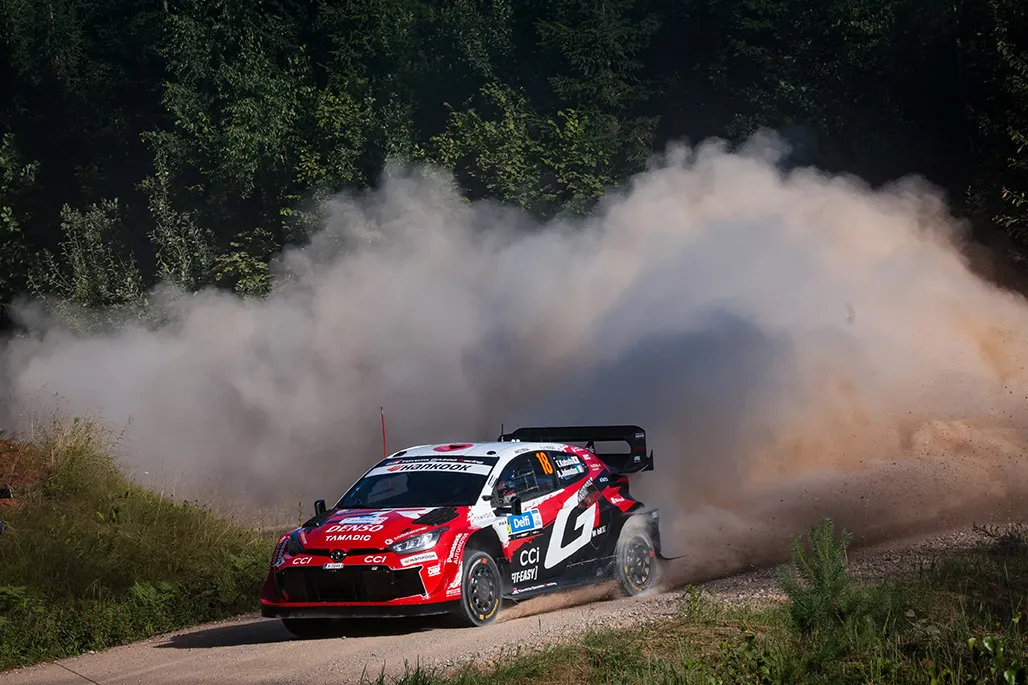
A WRC shakedown is a short pre-event test on a road chosen to resemble the rally’s competitive conditions. Crews use it to confirm that the car behaves as expected after reconnaissance and pre-event preparation. They can assess braking stability, traction, differential response, suspension movement, tyre pressures and the accuracy of their pace notes.
The fastest time attracts attention because it is easy to understand. Yet the most valuable information may be hidden. A crew can deliberately compare settings rather than chase the leaderboard. A driver may complete one run on a safer setup, return to service for a change and use the next pass to evaluate balance rather than absolute speed.
Why later runs are often faster
Loose gravel can make the first pass slower because the early cars sweep material from the ideal line. As more vehicles pass, the surface may compact and the racing line can become cleaner. Drivers also build familiarity with the exact grip changes and refine their approach to braking points, crests and jumps.
That is why comparing best times without run sequence can mislead. Evans and Pajari reached the shared benchmark after the stage had developed. Their speed still mattered, but it should not be compared directly with a driver whose best attempt came under different surface conditions or with a different test plan.
Why shakedown is not qualifying
Unlike qualifying in circuit racing, shakedown does not set the normal competitive starting order and does not award championship points. The rally’s road order follows championship and sporting rules rather than the warm-up leaderboard. A crew can finish last in shakedown and still win the rally.
For a clear explanation of how timing is recorded across motorsport, see our guide to how race timing works. Rally timing differs from lap racing because crews start stages at intervals and compete against the clock rather than sharing the same physical track position.
Why incidents still matter
Although the times do not count toward the rally total, the activity is real competition machinery at real speed. A crash can damage the chassis, suspension or aero package before the first stage. Teams may have limited time to repair the car. An incident can also create a penalty or force a crew to begin the rally with reduced confidence.
That risk connects to the wider causes described in our explainer on what causes crashes in motor racing. In rallying, changing grip, narrow margins and pace-note commitment make a small misjudgment especially costly.
Shakedown Position Compared With the Final Rally Result
The comparison below shows why the Kastre times were both valuable and incomplete. Pajari and Solberg carried their early speed into the top two, while Ogier, Lappi and Armstrong finished in the same broad part of the order. Evans and Katsuta moved in the opposite direction because road position and tyre trouble mattered more than their shakedown pace.
| Driver | Shakedown | Best time | Final rally | Main context |
|---|---|---|---|---|
| Elfyn Evans | P1 | 1:55.6 | P6 | Opened the road on loose Friday gravel |
| Sami Pajari | P2 | 1:55.6 | P1 | Won 12 of 18 stages and led throughout |
| Takamoto Katsuta | P3 | 1:55.7 | P21 | Tyre damage removed him from contention |
| Oliver Solberg | P4 | 1:55.8 | P2 | Won Super Sunday and the Power Stage |
| Sébastien Ogier | P5 | 1:56.1 | P5 | Consistent return to Estonia |
| Thierry Neuville | P6 | 1:56.4 | P4 | Fought Fourmaux for the podium |
| Adrien Fourmaux | P7 | 1:57.5 | P3 | Converted improved pace into a podium |
| Esapekka Lappi | P8 | 1:57.7 | P8 | Finished where the early order placed him |
| Jon Armstrong | P9 | 1:58.1 | P9 | Managed early tyre damage after a heavy landing |
| Mārtiņš Sesks | P11 | 1:58.3 | P7 | Recovered despite a 20-second penalty |
| Robert Virves | P12 overall | 2:02.8 | P10 overall / WRC2 P1 | Converted the Rally2 benchmark into class victory |
The best interpretation is not that shakedown “worked” for some drivers and “failed” for others. It measured initial speed. The final rally measured speed, road order, tyre survival, reliability, stage management and decision-making over more than 300 competitive kilometres.
Kastre’s 4.08 Kilometres: Why the Test Was So Revealing
The official spectator information divided the shakedown into recognizable viewing areas. Uniküla covered the opening part, where cars reached maximum acceleration before a deceptive left-hand corner. Paluküla offered a long view across changing elevation and several bends. Kurista covered the winding final section.
That combination made Kastre useful without pretending to reproduce every challenge of Rally Estonia. The test asked the car to accelerate hard, remain settled over elevation changes and rotate through linked corners. Those traits matter on fast Estonian gravel, where a driver needs confidence before committing to a crest whose exit may not be visible.
The 127.1 km/h average of the fastest run also shows that Kastre was not a low-speed systems check. It was a proper high-speed exercise. For readers learning the language of racing lines, our guide to what an apex means in racing explains how line choice affects corner speed. In rallying, that choice is complicated by loose surfaces and a road that changes after every car.
Aerodynamic stability also matters at these speeds, even though rally cars operate differently from circuit machines. The basic relationship between airflow and grip is covered in our downforce explainer. Rally1 cars must balance that high-speed support with suspension travel and durability over crests, ruts and landings.
How Fans Should Read a WRC Shakedown Table
- Start with the class. Rally1, Rally2 and Rally3 cars have different performance levels. Overall position alone does not show who led each category.
- Look at the spread, not only P1. Five cars within half a second can reveal more than one outlier at the top.
- Check the road and run sequence. Later passes may benefit from a cleaner line and greater familiarity.
- Read team comments. A driver who reports a balanced car may be in a stronger position than someone who set a similar time while fighting the setup.
- Consider road order for the real rally. The shakedown leader may be forced to sweep loose gravel once competition starts.
- Do not ignore incidents. Damage or a penalty can matter even though the shakedown time itself is not added to the rally total.
- Compare the result afterward. The difference between shakedown and the rally teaches which early signals were genuine.
Readers new to rallying can also use our overview of how car racing works and the profile of famous race car drivers for broader context. The story of Ken Block’s rally influence is another useful entry point into the culture and precision of the discipline.
Rally Estonia 2026 Shakedown FAQ
Elfyn Evans and Sami Pajari shared the fastest time of 1:55.6. The published timing order placed Evans first and Pajari second. Takamoto Katsuta was third at 1:55.7, only one tenth behind.
The benchmark was 1 minute 55.6 seconds over the 4.08-kilometre Kastre test. That equals an average speed of approximately 127.1 km/h, or 79.0 mph.
Robert Virves was the fastest Rally2 competitor at 2:02.8 in the Škoda Fabia RS Rally2. He ranked 12th overall and later won WRC2 at his home event.
No. Shakedown times do not count toward the rally’s competitive total. The session is used for setup and systems checks, although a crash, damage or sporting penalty can still affect the weekend.
Conclusion: Toyota’s Sweep Was Real, but Pajari Supplied the Strongest Signal
The Rally Estonia 2026 shakedown results began with a tie and ended with a deeper story. Evans and Pajari shared 1:55.6, Katsuta was one tenth behind, and Toyota controlled the first five positions. That was a genuine sign of manufacturer strength.
The session did not predict the final order. Evans faced road sweeping, Katsuta suffered tyre damage and Sesks carried the consequence of a shakedown off. Yet Pajari’s comfort was real. His shared benchmark became seven straight Friday stage wins, then a controlled maiden WRC victory.
Virves delivered the clearest class-level forecast by leading Rally2 in Kastre and later winning WRC2. The lesson for fans is simple: use shakedown to identify confidence, package strength and class references, but never mistake a two-minute test for the full rally.
Sources
- WRC Ralli event timing — Rally Estonia 2026 Kastre shakedown classification
- WRC Delfi Rally Estonia official programme — shakedown date and start time
- Toyota Gazoo Racing WRT — Rally Estonia Day 1 report and shakedown context
- WRC official report — final result, stage wins and post-rally context
Published timing and official event reports were checked against one another. The table preserves the 49-car Kastre order shown by the event-timing source.