F1 Eras Explained: From V10s to Turbo Hybrids
The sound changed, the cars grew faster, safety transformed and Formula 1 moved from raw mechanical power to software-controlled energy.
Formula 1 is commonly divided by major technical resets: the front-engine years, rear-engine revolution, original turbo era, naturally aspirated V12 and V10 period, V8 era, turbo-hybrid age and the new 2026 electrical-heavy chapter.
An F1 era is more than an engine shape. It is a complete way of building, driving and racing a Grand Prix car.
The V10 years are remembered for sound and low weight. However, the 1980s turbo period delivered astonishing qualifying power.
The V8 era brought tighter engine controls, KERS and sophisticated exhaust aerodynamics. Meanwhile, the 2014 turbo-hybrid reset made energy recovery central to every lap.
Those labels are useful, but they can oversimplify history. Formula 1 rarely changes one system at a time.
Engine rules arrive beside new tire dimensions, fuel limits and aerodynamic restrictions. Safety standards also reshape the chassis.
Therefore, F1 eras explained properly requires more than comparing cylinder counts. The cars must be viewed as complete technical packages.
The 1950 championship began with front-engined cars and almost no modern safety equipment. By 2020, F1 cars exceeded 1,000 horsepower while carrying hybrid systems and carbon-fiber survival cells.
In addition, the driver’s job changed. Early racers managed manual gearboxes, heavy steering and unreliable brakes.
Later generations controlled differential maps, energy deployment and brake-by-wire systems. Yet the core test remained unchanged: complete a lap faster than everyone else.
This guide follows Formula 1 history by era. It explains the original turbo revolution, the V12 and V10 years, the V8 period and the turbo-hybrid age.
It also covers aerodynamics, tires, electronics, strategy and safety. Consequently, the story shows why old and modern F1 cars feel so different.
The Direct Answer: What Defines a Formula 1 Era?
A Formula 1 era begins when major rules change the car’s engine, aerodynamics, tires, safety structure or operating philosophy enough to create a distinct type of racing.
Fans often name eras after engines because sound makes the difference obvious. A V10 screams, while a turbo hybrid delivers a deeper and more complex note.
However, engine architecture is only one layer. The 2009 season changed dramatically because of aerodynamics, slick tires and KERS.
The 2017 cars became much wider and faster through corners. Yet they still used the same basic V6 hybrid formula introduced in 2014.
Regulations Create Technical Generations
Every rulebook gives engineers a different problem. Teams then discover the fastest interpretation.
Consequently, each regulation cycle develops its own visual language. Ground-effect cars look and behave differently from flat-bottom cars.
Dominant Teams Become Part of the Era
Technical rules do not guarantee equal results. One organization often understands the new formula before its rivals.
Lotus defined early ground effect. McLaren-Honda mastered the late turbo years, while Mercedes controlled the opening hybrid seasons.
Drivers Adapt to Different Demands
A 1980s turbo car demanded patience through severe lag. A V10 rewarded precise throttle control at extremely high engine speeds.
Modern drivers manage electrical energy, tire temperature and complex steering-wheel settings. Therefore, comparing talent across eras requires context.
The best way to understand F1 history is to ask what engineers were trying to solve. Sound, horsepower and lap time are results of that problem, not the complete story.
Formula 1 Eras at a Glance
F1 moved from supercharged and naturally aspirated post-war engines to rear-engine designs, 1.5-liter turbos, naturally aspirated V12s and V10s, 2.4-liter V8s and 1.6-liter V6 turbo hybrids.
| Period | Defining Power | Major Car Feature | Era Character |
|---|---|---|---|
| 1950–1959 | Supercharged 1.5-liter or naturally aspirated 4.5-liter engines, followed by 2.5-liter rules | Front engines and basic aerodynamics | Mechanical endurance and bravery |
| 1960–1976 | 1.5-liter, then 3.0-liter naturally aspirated engines | Rear engines and wings | Light cars and rapid aero discovery |
| 1977–1988 | 1.5-liter turbo engines against larger naturally aspirated rivals | Ground effect and rising electronics | Extreme boost and manufacturer warfare |
| 1989–1994 | 3.5-liter naturally aspirated V8, V10 and V12 engines | Active suspension and driver aids | Engine diversity and electronics |
| 1995–2005 | 3.0-liter naturally aspirated engines, increasingly standardized around V10s | Grooved tires, refueling and complex aero | High revs, low weight and unforgettable sound |
| 2006–2013 | 2.4-liter naturally aspirated V8 engines | KERS and blown diffusers | Compact engines and aero-led performance |
| 2014–2021 | 1.6-liter V6 turbo-hybrid power units | MGU-K, MGU-H and brake-by-wire | Efficiency, software and Mercedes dominance |
| 2022–2025 | V6 turbo hybrids with E10 fuel | Venturi tunnels and stronger ground effect | Closer following and heavier cars |
| 2026 onward | V6 turbo hybrid with 350kW MGU-K and no MGU-H | Active aero and advanced sustainable fuel | Electrical deployment becomes central |
1. The 1950s: Front Engines, Superchargers and Almost No Protection
The first championship cars were front-engined machines with narrow tires, basic brakes and little driver protection. Mechanical reliability often mattered as much as outright speed.
The 1950 World Championship opened at Silverstone. The winning Alfa Romeo 158 used a 1.5-liter supercharged inline-eight engine.
Formula 1’s official historical comparison lists that car at 709kg and about 350 horsepower. Meanwhile, drivers wore clothing that offered almost no crash protection.
The Engine Sat Ahead of the Driver
Early designers followed established Grand Prix practice. The engine remained in front, while a driveshaft ran beneath the cockpit.
That layout created a long nose and high seating position. It also limited how efficiently the car could distribute weight.
Reliability Shaped Every Race
Engines, gearboxes and brakes failed regularly. Therefore, drivers preserved machinery rather than attacking every lap.
Some races lasted far longer than modern events. Mechanics also worked with fewer diagnostic tools.
Safety Was Not a Design Priority
Tracks used hay bales and simple barriers. Drivers sometimes preferred being thrown from a burning car because fuel tanks offered limited protection.
Modern fans should not romanticize that danger. The courage was real, but the consequences were severe.
2. Rear Engines and the Birth of Aerodynamic F1
Rear-engine cars became the winning standard around the turn of the 1960s after Cooper proved that placing the engine behind the driver improved weight distribution and handling.
The rear-engine layout changed the shape of Formula 1. Cars became lower, shorter and more balanced.
Drivers could change direction more quickly. Moreover, engineers gained new freedom around the front of the chassis.
Three-Liter Engines Arrived in 1966
The 1966 rules doubled the naturally aspirated limit from 1.5 to 3.0 liters. Teams used V8, V12 and other layouts.
Ford’s Cosworth DFV soon became a defining engine. Its compact design also acted as a stressed structural member.
Wings Changed the Meaning of Grip
By the late 1960s, teams fitted wings to push cars onto the track. Early structures rose high above the bodywork.
Failures led to tighter controls. However, aerodynamic downforce had become essential and would never leave.
3. The 1970s: Ground Effect and the Underbody Revolution
It was the late-1970s and early-1980s period when teams shaped the underside of the car like an inverted wing and used skirts to seal low-pressure airflow.
Lotus showed that the floor could create huge downforce. The car no longer depended only on visible wings.
Venturi-shaped sidepods accelerated air beneath the chassis. Consequently, pressure dropped and the car was pulled toward the track.
Sliding Skirts Sealed the Floor
Skirts reduced air leakage under the car. That made the ground-effect system far more powerful.
However, any sudden loss of the seal could remove downforce instantly. Drivers faced violent changes in grip.
The Cars Became Physically Punishing
Stiff suspension protected the aerodynamic platform. Drivers absorbed heavy loads over bumps and curbs.
Therefore, the technology improved lap time while making the car harder on the body. Safety concerns eventually pushed the rules toward flat bottoms.
For a deeper technical explanation, read what downforce is.
4. The Original Turbo Era: 1977 to 1988
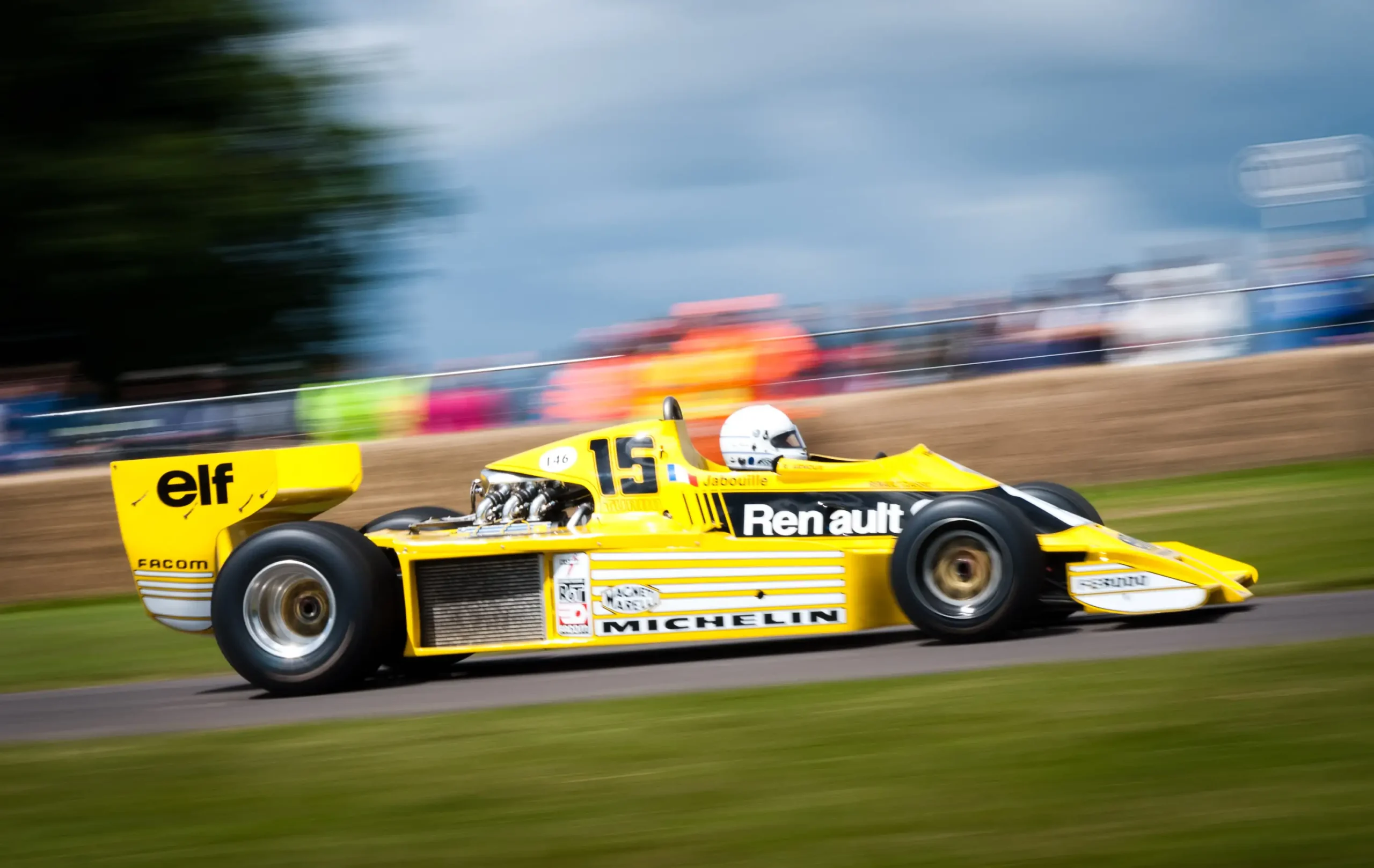
Renault introduced F1’s first turbo car in 1977. Turbo engines then grew into the dominant technology before the FIA banned them after 1988.
Renault’s RS01 looked like a gamble. Its 1.5-liter turbo V6 was unreliable and often produced smoke when it stopped.
However, the concept eventually worked. Rival manufacturers then realized that forced induction offered extraordinary potential.
Small Engines Produced Huge Power
The regulations allowed 1.5-liter turbo engines against 3.0-liter naturally aspirated units. Boost pressure transformed the smaller engines.
During the most extreme period, qualifying engines were widely estimated above 1,000 horsepower. Exact figures remain uncertain because dynos and public claims differed.
Qualifying Power Was a Separate World
Teams used high boost for only a few laps. Engines could be treated as short-life qualifying equipment.
Therefore, the Saturday car sometimes felt much stronger than the Sunday version. Reliability remained a constant concern.
Turbo Lag Defined the Driving Style
Power did not arrive instantly when the driver pressed the throttle. Exhaust flow first had to accelerate the turbocharger.
Drivers anticipated the delay and opened the throttle early. Then a sudden wave of torque reached the rear tires.
Fuel Limits Became a Performance Tool
The FIA reduced fuel allowances and limited boost. As a result, efficiency became part of the competition.
Drivers balanced speed against consumption long before modern hybrids. The original turbo era was not simply unlimited horsepower.
Honda and McLaren Closed the Era in Style
Honda became the leading late-1980s manufacturer. McLaren-Honda won 15 of 16 races in 1988.
The FIA then banned turbos for 1989. Cost, speed and safety concerns all shaped the decision.
5. 1989 to 1994: V8s, V10s, V12s and an Electronics Explosion
V12 engines appeared across several periods, but Ferrari, Honda, Lamborghini and Yamaha used them during the naturally aspirated years around the late 1980s and early 1990s.
The turbo ban created remarkable engine variety. Teams could choose different naturally aspirated architectures within the 3.5-liter formula.
Ferrari favored the V12. Renault and Honda helped prove the V10 could offer an excellent balance between power, weight and packaging.
The V12 Delivered Sound and Smoothness
Twelve cylinders produced frequent combustion pulses and a distinctive high note. The layout also delivered smooth power.
However, more cylinders meant more parts, length and fuel use. Packaging became harder as aerodynamics grew more important.
The V10 Became the Middle Ground
A V8 could be compact and light. A V12 offered refinement and rev potential.
The V10 sat between them. Consequently, it became the preferred architecture as the decade progressed.
Electronics Reached a Peak
Active suspension, traction control and anti-lock braking appeared in advanced cars. Williams combined these systems with outstanding aerodynamics.
The FW15C dominated 1993. However, the FIA banned major driver aids for 1994.
Paddle Shifting Changed the Cockpit
Ferrari introduced a race-winning semi-automatic gearbox in 1989. Drivers could shift without removing both hands from the wheel.
The concept spread across the grid by the mid-1990s. Learn how it works in the paddle-shifter guide.
6. The V10 Era: 1995 to 2005
The classic V10 period ran from the mid-1990s through 2005. From 2000, Formula 1 rules required naturally aspirated 3.0-liter V10 engines.
For many fans, this is the emotional center of Formula 1 history. The cars were light, narrow and brutally loud.
Engine speeds climbed toward 20,000 rpm. Meanwhile, manufacturers invested heavily in materials, combustion and pneumatic valve systems.
Why the V10 Worked So Well
The architecture balanced cylinder count against package size. It could rev higher than many V8 designs without the length of a V12.
Moreover, teams could use the engine as a structural part of the car. Weight and stiffness mattered as much as peak power.
Horsepower Rose While Weight Fell
Public estimates vary, but leading late-era V10s produced roughly 900 horsepower. Some qualifying specifications were reported higher.
However, power figures alone miss the experience. The engines delivered immediate throttle response without turbo lag.
Refueling Changed Race Strategy
Refueling returned in 1994 and became central to the V10 era. Teams could start with less fuel and run shorter, faster stints.
Therefore, strategy often focused on pit windows rather than tire preservation. A light car after a stop could undercut rivals through raw pace.
Grooved Tires Changed the Look
Slick tires disappeared in 1998. Grooves reduced the rubber contacting the track.
At the same time, car width narrowed. Engineers responded by extracting more aerodynamic grip.
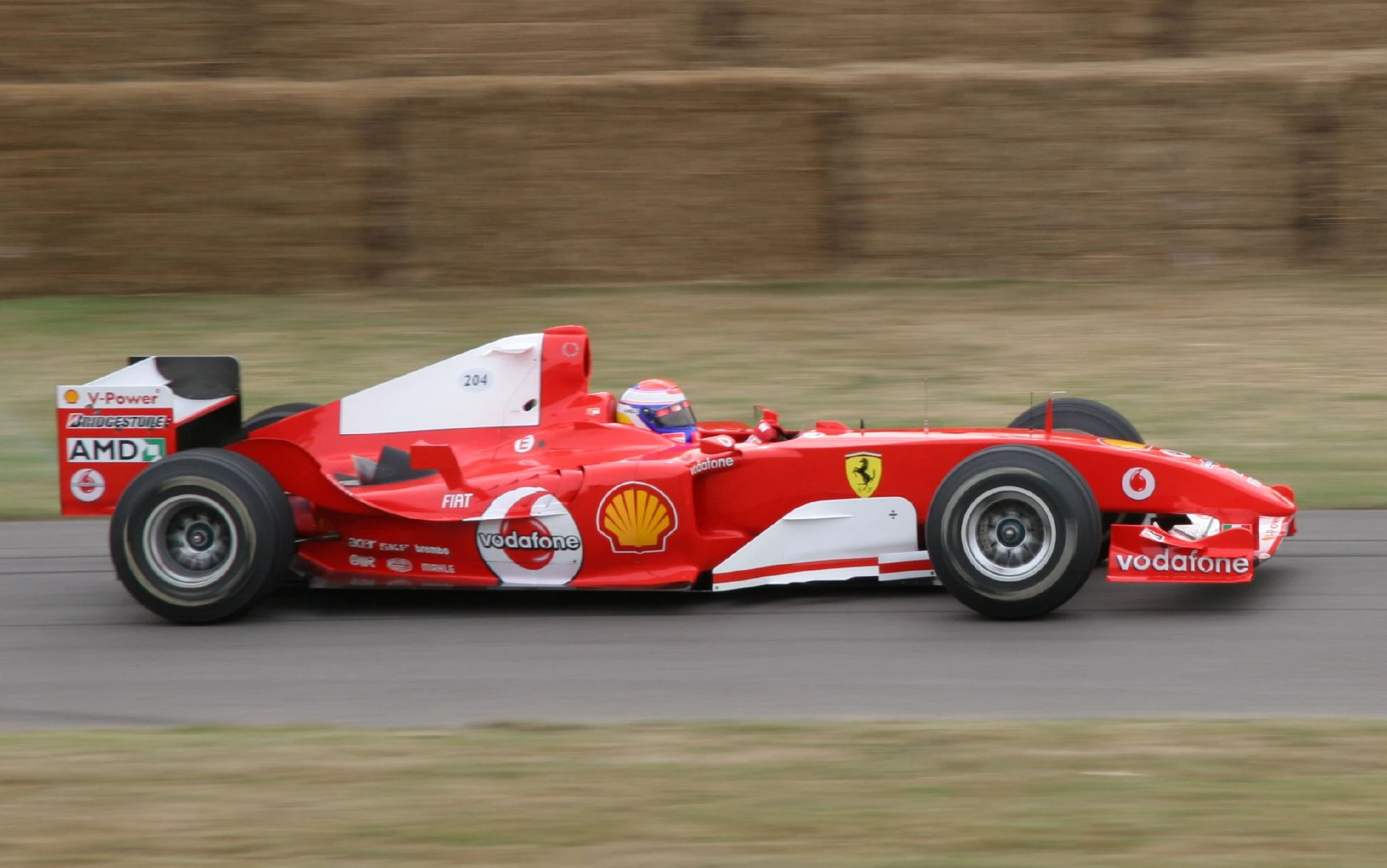
Ferrari Built the Era’s Defining Dynasty
Ferrari won six consecutive Constructors’ Championships from 1999 through 2004. Its organization became as important as its engine.
The F2004 represented the complete package: power, reliability, aero, tires and operational discipline.
Explore more background in Ferrari through the decades and the World of Speed Ferrari collection.
Why Do Fans Still Love the V10 Era?
Fans remember the extreme sound, high revs, lighter cars, visible driver movement and the variety of manufacturers competing during the period.
The sound was not background noise. It was a physical part of attending a Grand Prix.
A V10’s pitch climbed continuously with engine speed. Consequently, fans could hear throttle commitment and gear changes clearly.
The Cars Looked Compact
V10-era cars were shorter and lighter than modern hybrids. Their narrow bodies exposed suspension movement and driver input.
However, nostalgia can hide weaknesses. Dirty air, grooved tires and processional races still existed.
Mechanical Drama Was Easy to Understand
An engine failed with smoke. A missed shift or poor launch looked obvious.
Modern energy-management problems can be harder to read. Therefore, older cars often feel more direct to casual viewers.
Sound Does Not Equal Speed
V10 cars sounded faster than almost anything. Yet later cars generally recorded quicker laps because of tires, downforce and braking.
The comparison is emotional as well as technical. Both forms of performance deserve respect.
7. The V8 Era: 2006 to 2013
The FIA introduced 2.4-liter V8 engines in 2006 to reduce performance, control development and begin extending engine life.
The switch reduced displacement and cylinder count. However, the new engines still produced a sharp, high-revving sound.
Early V8s reached extremely high engine speeds. The FIA later set rev limits and froze major development areas.
The Era Became More Aerodynamic
As engine development tightened, teams found lap time around the bodywork. Front wings, floors and exhaust systems became increasingly sophisticated.
Consequently, the V8 period produced the double diffuser, F-duct and exhaust-blown diffuser.
KERS Arrived in 2009
Kinetic Energy Recovery Systems captured energy under braking. Drivers could then deploy a brief electrical boost.
The early systems were heavy and optional. Still, they marked Formula 1’s first competitive step toward modern hybridization.
Slick Tires Returned
The 2009 rules restored slicks after eleven seasons of grooves. Mechanical grip increased, although aerodynamic rules also changed.
In addition, the cars received simpler wings. The combination produced a dramatic visual reset.
Refueling Ended After 2009
From 2010, cars started races with all required fuel. Fuel tanks grew and opening-lap weight increased.
Strategy shifted toward tire life and track position. Pit stops became faster because no fuel hose was involved.
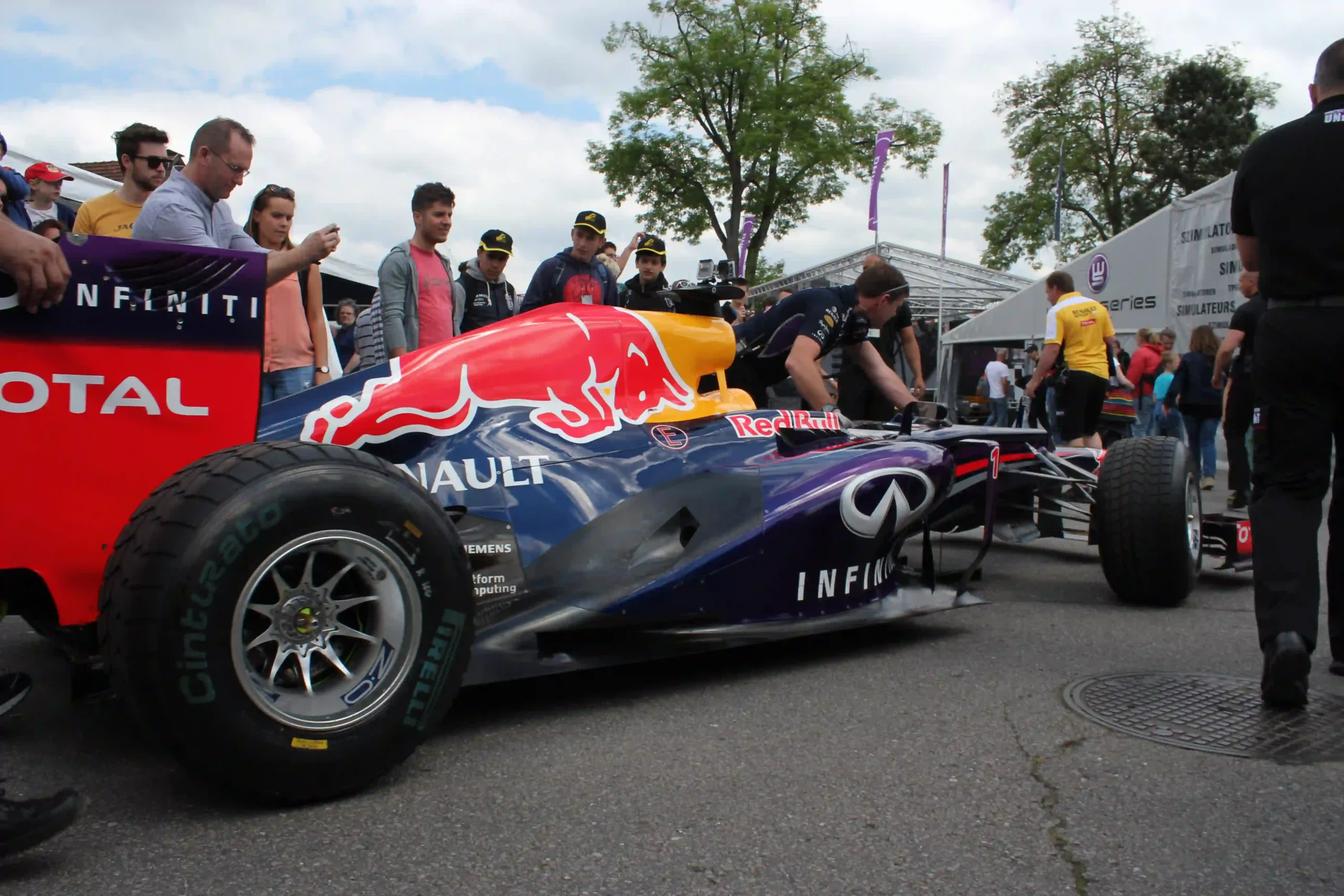
Red Bull Mastered the Final V8 Years
Red Bull and Renault won four consecutive Drivers’ and Constructors’ titles from 2010 through 2013. Aerodynamic integration was the key.
The team exploited exhaust flow and high-rake concepts. Read the Red Bull Racing history for more context.
8. The Turbo-Hybrid Revolution: 2014 to 2021
The 2014 rules targeted greater fuel efficiency, energy recovery and manufacturer relevance while maintaining high total power.
The 2014 reset replaced 2.4-liter V8s with 1.6-liter V6 turbo-hybrid power units. Formula 1 deliberately stopped calling them simple engines.
Each system combined an internal combustion engine, turbocharger, battery, control electronics and two motor-generator units.
The MGU-K Recovered Braking Energy
The MGU-K converted kinetic energy into electricity during braking. It could also drive the rear wheels during acceleration.
The 2014 specification allowed 120kW of electrical power. That was double the output of the earlier KERS system.
The MGU-H Managed Turbo Energy
The MGU-H connected to the turbocharger. It recovered energy from exhaust flow and could control turbo speed.
Therefore, it reduced lag while creating electricity. However, the system was complex and expensive.
Fuel Flow Became a Performance Limit
The rules restricted fuel mass and flow rate. Engineers sought more work from every unit of fuel.
Thermal efficiency became a central measure. Modern F1 power units eventually exceeded levels once considered unrealistic for racing engines.
Brake-by-Wire Balanced Regeneration
Rear braking changed as the MGU-K harvested energy. Electronic control helped maintain consistent pedal response.
Drivers still pressed the pedal normally. However, software balanced mechanical braking with electrical recovery.
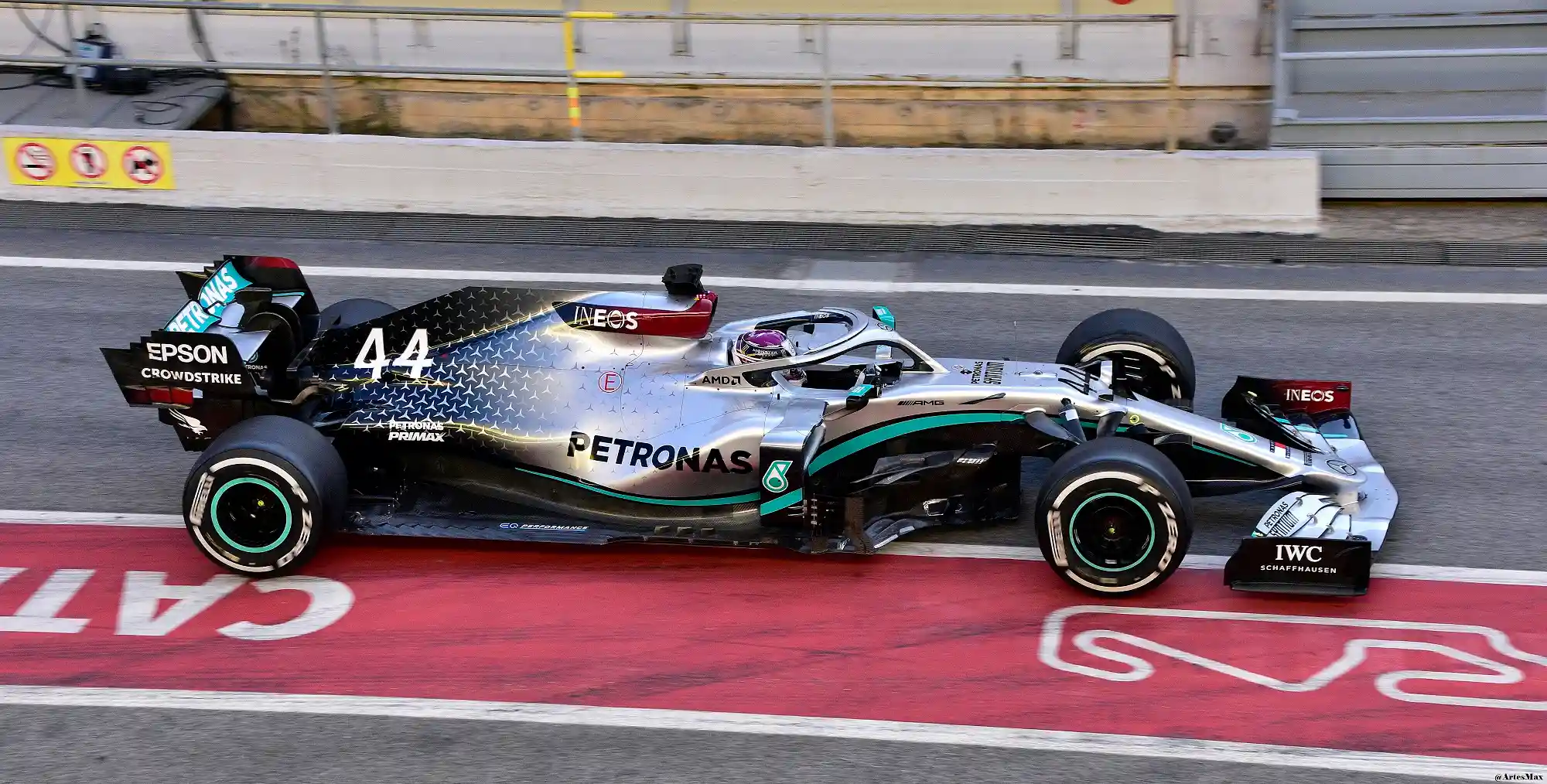
Mercedes Started With a Major Advantage
Mercedes won 16 of 19 races in 2014. It then captured eight consecutive Constructors’ Championships through 2021.
Its power-unit preparation, chassis organization and development depth defined the era. Rivals eventually closed much of the gap.
9. 2022 to 2025: Ground Effect Returns Without Changing the Engine Formula
The 2022 rules moved more downforce beneath the car through Venturi tunnels, simplified upper bodywork and aimed to reduce the performance loss when following another car.
The V6 hybrid power-unit architecture remained. Yet the cars looked and behaved very differently.
Large floor tunnels generated downforce. Wheels grew to 18 inches, and bodywork became more tightly controlled.
Following Became the Main Goal
Previous cars created a highly disruptive wake. A following driver lost front grip and overheated tires.
The 2022 package tried to send more disturbed air upward. Consequently, cars could race closer in many corners.
Porpoising Became the Early Problem
Some cars oscillated vertically as the floor repeatedly gained and lost downforce. The effect could be uncomfortable and destabilizing.
Teams adjusted floors, suspension and ride height. The FIA also introduced measures to address safety concerns.
The Cars Became Heavier
Larger wheels, stronger safety structures and hybrid components increased mass. Modern F1 cars therefore felt less delicate at low speed.
However, their high-speed performance remained exceptional. Downforce and tire grip still produced record-level pace.
10. The 2026 Era: More Electrical Power and No MGU-H
The 1.6-liter turbo V6 remained, but the MGU-H disappeared, MGU-K output rose to 350kW and every car began using advanced sustainable fuel.
The 2026 regulations opened another technical chapter. They retained the basic V6 turbo format but changed the energy balance.
Electrical output rose from 120kW to 350kW. Meanwhile, combustion-engine output reduced relative to the previous formula.
The MGU-K Became Far More Important
Drivers now depend heavily on electrical deployment. Harvesting, recharge and overtaking strategy influence each lap.
Therefore, battery control is no longer a supporting system. It is close to half of the performance concept.
The MGU-H Was Removed
The MGU-H was effective but extremely complex. Similar technology had not spread widely into road cars.
Removing it lowered one barrier for new manufacturers. It also changed turbo response and energy strategy.
Advanced Sustainable Fuel Became Mandatory
The new fuel uses sustainable components rather than new fossil carbon. It is designed as a drop-in liquid fuel.
Consequently, Formula 1 can develop high-performance combustion while reducing lifecycle emissions.
The Engine Era Now Includes Active Aero
The 2026 cars became smaller and lighter than their immediate predecessors. Active front and rear wings manage drag and downforce.
Thus, the latest era cannot be described by the engine alone. Electrical deployment and aerodynamics work together.
Current context: The FIA refined energy-management and race-start parameters during the 2026 season. That illustrates how a major regulation reset continues evolving after the first cars reach the track.
For supporting detail, read what ERS does in F1 and how the energy store works.
F1 Engine Eras Compared
V12s emphasized smoothness and sound, V10s balanced revs with packaging, V8s reduced capacity and added tighter controls, while turbo hybrids combine combustion with energy recovery and software.
| Engine Type | Typical Era | Key Strength | Main Weakness | Fan Memory |
|---|---|---|---|---|
| 3.5-liter V12 | Late 1980s to mid-1990s | Smooth power and distinctive sound | Length, weight and fuel use | Exotic Ferrari and Honda character |
| 3.0-liter V10 | Mid-1990s to 2005 | High revs with balanced packaging | High cost and fuel use | The classic screaming F1 sound |
| 2.4-liter V8 | 2006 to 2013 | Compact size and sharp response | Less torque and increasing development limits | Final naturally aspirated era |
| 1.5-liter turbo | 1977 to 1988 | Enormous boost potential | Lag, heat and reliability | Wild qualifying horsepower |
| 1.6-liter V6 turbo hybrid | 2014 onward | Efficiency, torque and electrical power | Complexity, weight and muted sound | Software-controlled performance |
Readers comparing layouts can also use the guide to V6, V8, V10 and V12 engines.
Why F1 Engine Sound Changed So Much
Turbochargers absorb exhaust energy, lower engine speeds reduce pitch and hybrid systems supply power that does not create combustion noise.
Sound depends on engine speed, cylinder count, firing order and exhaust design. A naturally aspirated V10 moved enormous volumes of gas at close to 20,000 rpm.
A modern turbocharger takes energy from that exhaust stream. Consequently, less acoustic energy reaches the tailpipe.
RPM Creates Pitch
More combustion events per second produce a higher frequency. V10 and V8 engines therefore created piercing notes at peak speed.
The 2014 V6s were limited to a lower maximum rpm. In practice, fuel-flow rules often kept them below that ceiling.
Turbo Systems Change Tone
Turbines smooth exhaust pulses and create their own whistle. The sound becomes deeper and more layered.
However, television microphones can exaggerate or flatten differences. Trackside sound is always more physical.
Noise Is Not the Same as Performance
A quieter car can still be faster. Hybrid torque and modern aerodynamics create performance without the same volume.
For road-car context, cylinder count, firing order and exhaust design explain why a V8 sounds different from a V12.
Formula 1 Aerodynamic Eras Matter as Much as Engines
F1 progressed from almost no downforce to wings, sealed ground effect, flat bottoms, diffusers, complex bargeboards and modern Venturi tunnels with active aerodynamic control.
The fastest engine cannot compensate for a weak aerodynamic platform. That lesson became clearer with every decade.
Visible wings started the revolution. Floors then became the larger source of stable downforce.
Every Aero Solution Creates a Wake
Downforce generation disturbs the air behind a car. A following driver then loses aerodynamic grip.
Therefore, modern regulations consider racing quality as well as peak performance. The 2022 and 2026 rules both targeted closer following.
Simulation Replaced Much Track Testing
Earlier teams could run private test programs throughout the season. Modern restrictions increased reliance on wind tunnels and computational fluid dynamics.
As a result, the factory became more important than ever. The race car is only the visible end of a large digital process.
Formula 1 Safety Eras: From Cloth Caps to Carbon Survival Cells
Safety advanced through fire-resistant clothing, crash testing, carbon-fiber monocoques, HANS devices, wheel tethers, stronger circuits and the Halo.
Early Formula 1 treated danger as unavoidable. Modern Formula 1 treats every serious incident as an engineering problem.
The shift took decades and often followed tragedy. However, the result is a far stronger survival environment.
The Carbon Monocoque Changed the Car
McLaren introduced the MP4/1 carbon-fiber monocoque in 1981. The material delivered high strength at low weight.
Every modern team now builds around a carbon survival cell. Read more in the F1 monocoque guide.
HANS Became Mandatory in 2003
The Head and Neck Support device limits violent head movement during a crash. It greatly reduces the risk of basilar skull injuries.
Drivers initially found it restrictive. Nevertheless, it became standard across professional motorsport.
The Halo Arrived in 2018
The titanium structure protects the cockpit from wheels, debris and other cars. Early criticism focused on appearance.
Real accidents quickly demonstrated its value. Learn more about the Halo in Formula 1.
Circuits Changed With the Cars
Runoff areas, energy-absorbing barriers and medical response improved. Wheel tethers and stronger impact structures reduced secondary dangers.
Consequently, modern drivers can survive impacts that would once have been unsurvivable. Speed increased, but protection improved more.
Tires, Refueling and the Strategy of Each Era
Strategy moved from reliability and fuel conservation to refueling sprints, then toward tire degradation, track position and hybrid energy management.
Every technical era creates a strategic era. The driver must manage whichever resource the rules make scarce.
Early Drivers Protected the Machine
Brakes, gearboxes and tires had limited life. Therefore, finishing often required deliberate mechanical sympathy.
A racer who attacked too early could lose the car later. Reliability shaped tactics more than computer models.
Refueling Created Sprint Races Within a Race
From 1994 through 2009, teams could change fuel load during pit stops. Short stints allowed lower weight and faster laps.
However, passing could occur through pit timing rather than on track. Safety concerns also remained around pressurized fuel systems.
Pirelli Made Tire Life Central
From 2011, rapidly degrading compounds encouraged multiple stops and pace management. Drivers learned to protect tire temperature and surface condition.
The undercut became a familiar weapon. Strategy therefore moved toward tire timing rather than fuel timing.
Hybrid Energy Added Another Resource
Since 2014, drivers and engineers manage battery state as well as fuel and tires. Deployment can attack, defend or improve lap time.
Thus, modern strategy is partly invisible. Broadcast graphics and team radio help fans understand the energy battle.
From Manual Gear Levers to Software-Defined Performance
Older cars demanded more manual control and offered less protection, while modern cars generate higher forces and require complex energy, tire and system management.
The question has no simple winner. Each generation tests a different group of skills.
Manual Gearboxes Punished Mistakes
Drivers removed a hand from the wheel and operated a clutch during shifts. A missed change could damage the engine.
Modern paddles are faster and more consistent. However, they allow drivers to focus on braking and corner placement.
Driver Aids Briefly Became Extremely Advanced
Early-1990s cars used active suspension, traction control and other electronic systems. The FIA banned many aids for 1994.
Traction control later returned before another ban. This cycle shows how Formula 1 balances innovation against driver influence.
Modern Cars Are Controlled by Maps
Differential behavior, brake balance and energy deployment can change corner by corner. Drivers make adjustments through complex steering wheels.
Therefore, the modern challenge is not physically simple. It combines elite driving with systems knowledge.
For the mechanical foundation, read turbocharged versus naturally aspirated engines.
Which Teams Defined Each Formula 1 Era?
Lotus shaped ground effect, McLaren-Honda led the late turbo period, Williams mastered early-1990s electronics, Ferrari ruled the early V10 years, Red Bull led the final V8 period and Mercedes opened the hybrid era.
Regulation changes create opportunity. They also expose weak organizations.
Mechanical and Turbo Icons
Lotus, Ferrari, McLaren, Williams and Brabham each introduced defining solutions before the 1990s.
V10 and V8 Leaders
Williams-Renault, McLaren-Mercedes, Ferrari, Renault and Red Bull all built championship periods.
Hybrid Leaders
Mercedes controlled the opening years, while Red Bull and Honda later became the reference combination.
Dominance Requires More Than an Engine
A strong power unit helps. However, chassis design, tires, strategy and reliability decide championships.
Ferrari’s early-2000s success came from complete integration. Mercedes achieved the same organizational advantage after 2014.
Rules Eventually Compress Advantages
Rivals copy concepts and recruit people. The FIA may also change regulations to manage performance or cost.
Consequently, no dynasty lasts forever. The next reset creates another chance.
See the most successful F1 teams and greatest F1 drivers.
Old F1 vs Modern F1: What Really Changed?
Modern cars create far more downforce, braking grip, data and safety, while older cars were lighter, simpler and more mechanically exposed.
Classic Formula 1
- Lighter cars and less steering-wheel complexity
- More manual mechanical control
- Greater engine variety and louder sound
- More frequent reliability failures
- Far lower crash protection
Modern Formula 1
- Higher downforce and stronger braking
- Hybrid power and detailed software control
- Extensive simulation and remote factory support
- Longer component life and tighter cost rules
- Carbon survival cells, HANS and Halo protection
Modern Cars Are Usually Faster Over a Lap
V10 cars were lighter and responsive. Yet modern tires, downforce and hybrid torque generally produce quicker circuit times.
Formula 1 compared 2013 and 2019 fastest race laps at Spa. The later hybrid car was more than four seconds faster while using less race fuel.
Older Cars Could Look More Dramatic
More wheelspin, movement and visible gear changes created theater. Reliability also added uncertainty.
However, dramatic behavior often meant lost energy. Modern engineers remove movement because stability produces speed.
Safety Changes the Acceptable Limit
An old car’s danger should not be treated as a performance advantage. Drivers deserve credit, but preventable injury is not entertainment.
Modern F1 can preserve bravery while using better engineering. That is one of the sport’s greatest achievements.
New readers can start with what Formula 1 is and how a Formula 1 car works.
Which Was the Best Formula 1 Era?
There is no objective best era. The answer depends on whether a fan values sound, close racing, innovation, driver input, safety or outright speed.
The V10 period wins many sound debates. The original turbo years offered astonishing engineering freedom.
The V8 era combined naturally aspirated engines with early hybrid technology. Meanwhile, modern F1 delivers the fastest complete cars and the best safety.
Choose by What You Value
- Best sound: The V10 and V12 periods.
- Wildest engine development: The original 1980s turbo era.
- Most visible strategy: The refueling years.
- Most efficient power: The turbo-hybrid era.
- Strongest driver protection: Modern Formula 1.
- Most important current reset: The 2026 electrical-heavy regulations.
Great Eras Include Flaws
The V10 years had processional races. The V8 years saw heavy aerodynamic dependence.
Hybrid racing began with a large competitive gap. Therefore, nostalgia should not erase the difficult weekends.
The Best Era May Be the One That Made You a Fan
Sound, drivers and team colors create personal memories. A technical ranking cannot reproduce that attachment.
Formula 1 survives because every era creates a new generation of fans. Reinvention is part of the championship’s identity.
Common Myths About Formula 1 Eras
“V10 Cars Were Always Faster Than Hybrids”
False. V10 cars were lighter and louder, but modern cars generally record faster laps through tires, downforce and braking.
“The 1980s Turbo Cars Made 1,400 Horsepower Every Race”
Misleading. Extreme claims usually refer to short qualifying specifications and are difficult to verify precisely.
“Hybrid Cars Are Mostly Electric”
Not in the 2014–2025 formula. The combustion engine remained the larger power source, although electrical contribution increased sharply in 2026.
“Old Drivers Had More Skill Because Cars Were Manual”
They used different skills. Modern drivers face higher forces, complex systems and extremely close performance margins.
“Ground Effect Is a New Idea”
False. Lotus transformed Formula 1 with ground effect in the late 1970s.
“Safety Made Formula 1 Easy”
False. Better protection reduces needless injury, but the cars remain physically and mentally demanding.
Formula 1 Eras FAQs
When was the Formula 1 V10 era?
The best-known V10 era ran from the mid-1990s through 2005. From 2000, the regulations required 3.0-liter V10 engines.
Why did Formula 1 stop using V10 engines?
Formula 1 adopted 2.4-liter V8 engines in 2006 to reduce performance, manage costs and extend engine life.
Why did Formula 1 introduce turbo-hybrid power units?
The 2014 rules emphasized fuel efficiency, energy recovery and manufacturer relevance while preserving very high total power.
Are modern F1 cars faster than V10 cars?
Modern cars generally set faster laps because of greater downforce, tire grip, braking and hybrid power. V10 cars were lighter and much louder.
Conclusion: Formula 1 Changes Because Standing Still Means Losing
F1 eras explained properly reveals a sport that never follows a straight line.
The 1950s began with front engines, basic brakes and little driver protection. Reliability often decided the result.
Rear-engine cars then changed weight distribution. Wings changed the meaning of grip.
Ground effect moved the main aerodynamic work under the floor. Consequently, engineers discovered downforce far beyond visible wings.
Renault introduced turbo power in 1977. What began as an unreliable experiment became the dominant technology.
By the 1980s, qualifying engines produced extraordinary power. However, lag, heat, fuel limits and reliability made them difficult to race.
The turbo ban restored naturally aspirated variety. V8s, V10s and V12s then competed within the same formula.
Ferrari preserved the sound and smoothness of the V12. Renault and Honda showed why the V10 offered a stronger all-round package.
Electronics also transformed the car. Active suspension and traction control briefly gave engineers enormous freedom.
The FIA banned major driver aids for 1994. Meanwhile, safety reform gained urgency after the tragedies at Imola.
The classic V10 period followed. Engines approached 20,000 rpm and produced around 900 horsepower in their strongest forms.
Refueling created short, aggressive stints. Grooved tires reduced mechanical grip and pushed engineers toward aerodynamics.
Ferrari built the era’s defining dynasty. Its advantage came from the full organization, not one component.
The V8 rules arrived in 2006. Engine speeds remained extreme, although rev limits and development controls tightened.
KERS appeared in 2009. That first electrical boost system became the bridge toward modern hybrid power.
Slick tires also returned. Refueling then disappeared after the 2009 season.
Red Bull mastered the final V8 years through aerodynamic integration. The RB9 closed the naturally aspirated era in 2013.
The 2014 rules changed the language of Formula 1. The engine became a power unit.
The V6 combustion engine worked with a battery, MGU-K and MGU-H. Fuel flow and energy recovery became performance limits.
Mercedes prepared better than anyone. It won eight consecutive Constructors’ Championships from 2014 through 2021.
The 2022 rules then restored stronger ground effect. Large underfloor tunnels helped cars follow more closely.
However, weight and porpoising created new problems. Every regulation solves one challenge while revealing another.
The 2026 era increased electrical power to 350kW and removed the MGU-H. Advanced sustainable fuel also became mandatory.
Therefore, Formula 1 now asks drivers to manage energy more visibly. Active aerodynamics also connect straight-line efficiency with battery use.
Sound remains the largest emotional difference. V10s created a pitch and volume that modern hybrids cannot reproduce.
Yet modern cars produce faster laps, stronger braking and far greater efficiency. They also protect drivers with carbon survival cells, HANS and the Halo.
Old Formula 1 demanded mechanical sympathy and accepted enormous danger. Modern Formula 1 demands systems knowledge and extreme physical precision.
Neither challenge is simple. They are different versions of the same competition.
The best era depends on the fan. Some choose the V10 scream, while others value turbo power or hybrid sophistication.
Ultimately, Formula 1’s greatest era may not be a single period. Its real achievement is the ability to reinvent itself without losing the race at its center.
Sources and Fact-Checking
This article was checked against official Formula 1 and FIA historical and technical material available on July 28, 2026. Horsepower figures from older eras remain estimates because teams often withheld data and qualifying specifications had extremely short operating lives.