Why Is Monza Called the Temple of Speed?
The nickname comes from more than modern top speed. Monza was created to push cars beyond known limits, and every era has added another record, risk and racing legend.
Monza is called the Temple of Speed because its layout and history revolve around maximum velocity. Long straights, few corners, historic banking and low-downforce F1 setups have produced record top speeds, record average laps and some of the fastest Grands Prix ever held.
Monza does not merely allow speed. The circuit was built around the pursuit of it.
Autodromo Nazionale Monza opened in 1922. It became the world’s third permanent motor racing circuit after Brooklands and Indianapolis.
Moreover, the first layout combined a road course with a high-speed oval. The complete route measured 10 kilometers.
That concept made Monza both a race venue and an engineering laboratory. Manufacturers tested engines, tires, brakes and chassis under sustained load.
The modern Grand Prix circuit retains the same philosophy. It measures 5.793 kilometers and contains only 11 corners.
Cars spend about 80 percent of a lap at full throttle. They regularly exceed 350 km/h before the opening chicane.
However, the nickname is not simply a marketing phrase. Monza repeatedly supports it with measurable records.
Juan Pablo Montoya reached 372.2 km/h there in 2005. He also produced Formula 1’s fastest average lap during 2004 practice.
Then, in 2025, Max Verstappen won the fastest World Championship Grand Prix in Formula 1 history.
His average speed reached 250.706 km/h, or 155.791 mph. That surpassed Michael Schumacher’s 2003 Monza benchmark.
Meanwhile, the old concrete banking remains visible behind the modern circuit. It connects current low-drag cars with Monza’s most extreme era.
What Does “Temple of Speed” Mean?
The phrase describes Monza’s status as motorsport’s most famous high-speed venue. Its long straights, low-drag setups, historic oval and record average speeds make outright velocity the circuit’s defining feature.
The word “temple” suggests a place devoted to one idea. At Monza, that idea is speed.
Other circuits contain faster individual corners. Some may produce comparable top speeds under unusual conditions.
However, no active Formula 1 track combines Monza’s sustained throttle time, record averages and century of speed-focused history.
The Layout Supports the Nickname
The modern circuit has only 11 corners. Long acceleration zones connect most of them.
Consequently, teams remove wing angle and chase aerodynamic efficiency. Every unnecessary unit of drag costs lap time.
The Records Support the Nickname
Monza has staged Formula 1’s fastest average race and fastest average lap.
Moreover, the circuit’s official maximum-speed figure remains 372.2 km/h. These are distinct but connected records.
The Atmosphere Supports the Nickname
Fans hear cars at full load for long periods. Engine noise travels through the trees of Monza Park.
Meanwhile, the chicanes compress the field after each long straight. The rhythm feels violent rather than flowing.
Long Straights
Cars spend most of the lap accelerating or running at maximum deployment.
Low Drag
Teams bring special wings and trim the car for straight-line speed.
Historic Proof
Banking, records and more than a century of racing support the name.
Who First Used the Nickname?
No widely accepted official record identifies one person who coined the English phrase.
Therefore, it is safer to treat “Temple of Speed” as a description that grew from Monza’s established reputation.
The circuit now uses the phrase as part of its official identity.
Why Monza Was Built for Speed in 1922
Construction began in May 1922, and the circuit opened on September 3. About 3,500 workers completed the venue in only 110 days. The Italian Grand Prix followed one week later.
The Automobile Club of Milan approved the project in January 1922. It wanted to celebrate the club’s 25th anniversary.
Italian manufacturers also needed a permanent test facility. Public-road races could not provide consistent engineering conditions.
A Circuit and a Development Center
The original plan included different forms of mechanical stress. Long, fast sectors tested power and durability.
Meanwhile, the road course tested suspension, brakes and handling. This dual purpose shaped Monza’s character.
Construction Took Only 110 Days
About 3,500 workers, 200 wagons and 30 trucks supported the build.
A temporary railway moved materials through the park. Consequently, the complete circuit rose at extraordinary speed.
The Original Route Measured 10 Kilometers
The road course measured about 5.5 kilometers. The high-speed loop added another 4.5 kilometers.
Two elevated curves connected straights measuring roughly 1,070 meters each.
Theoretical maximum speed reached about 180 to 190 km/h. That was remarkable for 1922.
Why the Park Location Matters
The circuit sits inside the Royal Park of Monza, northeast of Milan.
The trees provide a distinctive setting. However, the protected landscape also limits expansion and shapes safety work.
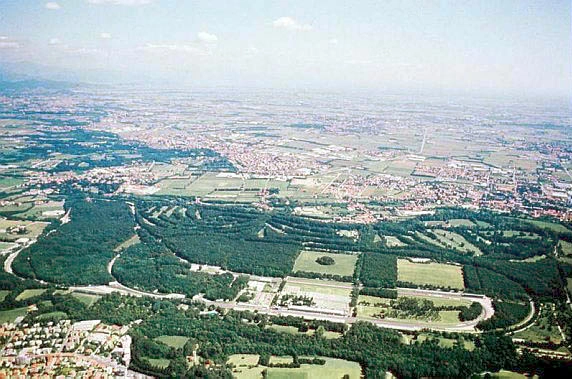
The Historic Banking Made Speed Visible
The surviving concrete banking formed part of Monza’s high-speed oval. The 1955 version used curves with gradients reaching about 80 percent. It was designed for theoretical speeds near 285 km/h and formed part of a 10-kilometer combined course.
Monza’s banking is the physical symbol of the Temple of Speed.
The concrete structures rise above the trees like an abandoned monument. Even without cars, the angle communicates danger.
The 1955 Oval Recreated the Original Vision
Monza rebuilt its high-speed track in 1955. The new oval measured 4.25 kilometers.
Its banked curves used reinforced concrete. The upper sections reached a gradient of roughly 80 percent.
The Combined Circuit Reached 10 Kilometers
Formula 1 cars used both the road circuit and oval during selected Italian Grands Prix.
Drivers crossed between the sections and passed beneath the banking. The lap placed huge loads on cars and tires.
Why Formula 1 Stopped Using It
Speeds increased quickly, while suspension and tire technology struggled with the rough surface.
Moreover, the banking created severe vertical loads. Safety concerns ended its World Championship role after 1961.
Is the Banking Still Visible?
Yes. The structures remain inside the circuit grounds.
Visitors can see sections near Curva Alboreto and above the modern road before Ascari.
Therefore, every Grand Prix still carries the outline of the old oval in the background.
Why the Modern Monza Layout Is Still So Fast
Monza combines four major acceleration zones with only 11 corners. Most turns either require heavy braking or preserve strong exit speed. Cars spend about 80 percent of the lap at full throttle, keeping average speed exceptionally high.
The current circuit does not need the oval to produce extraordinary velocity.
Its shape creates repeated acceleration from slow chicanes to maximum speed.
The Main Straight Measures Nearly 1.2 Kilometers
The official distance from Curva Alboreto to the first chicane is 1,194.4 meters.
Cars reach their highest speed before braking for Variante del Rettifilo.
Only 11 Corners Interrupt the Lap
Monza contains seven right-hand and four left-hand turns.
By comparison, many modern circuits contain 18 or more. Fewer corners leave more distance for acceleration.
Four Major Acceleration Sections Define the Rhythm
Slow Chicanes Increase the Contrast
Monza is not one continuous flat-out run. The chicanes create enormous braking events.
Consequently, the car repeatedly drops from maximum velocity to low speed. That contrast makes the straights feel faster.
| Monza Fact | Official Figure | Why It Matters |
|---|---|---|
| Circuit length | 5.793 km | A long lap with unusually few corners. |
| Number of corners | 11 | More distance remains available for acceleration. |
| Track width | About 10–12 m | Wide braking zones support late passing moves. |
| Main straight | 1,194.4 m | Cars reach maximum speed before Turn 1. |
| Full-throttle portion | About 80% | Average speed remains Formula 1’s highest. |
| Maximum recorded speed | 372.2 km/h | The circuit rewards minimum drag. |
Why F1 Cars Use Low-Downforce Wings at Monza
Teams reduce wing angle to cut aerodynamic drag on the long straights. Monza-spec wings improve top speed and acceleration. However, they also reduce braking stability, corner grip and traction.
Monza creates Formula 1’s most extreme downforce compromise.
A larger wing adds grip. However, it also creates drag during most of the lap.
Rear Wings Become Thin and Flat
Teams manufacture special low-drag packages for Monza.
The main plane and flap carry less angle. Endplate details also target efficient airflow.
The Front Wing Must Match the Rear
Removing rear load changes the aerodynamic balance.
Therefore, engineers reduce front-wing load as well. Otherwise, the rear becomes unstable.
The Floor Still Produces Important Load
Modern Formula 1 cars generate substantial downforce beneath the chassis.
This allows teams to reduce visible wing levels while keeping some corner performance.
Low Downforce Makes Braking Harder
Downforce falls as the driver slows. The tires then carry more of the stopping task.
Moreover, the car can move under braking because the wings provide less stabilizing force.
Low Downforce Makes Curbs More Difficult
The chicanes reward aggressive curb use. However, a stiff car can bounce and lose traction.
Engineers must balance platform control with enough mechanical compliance.
Very low to reduce drag and protect straight-line speed.
Essential because several stops begin above 300 km/h.
Must absorb curbs without weakening aerodynamic control.
Electrical power must be spread across several long straights.
Full-throttle running stresses the power unit and brakes.
Strong exits determine how quickly maximum speed arrives.
Our guides to downforce, wing angle and car handling explain these compromises.
The Records That Prove Monza’s Speed
Modern F1 cars regularly exceed 350 km/h at Monza. Juan Pablo Montoya reached 372.2 km/h in 2005. His 2004 practice lap averaged 260.6 km/h, while Max Verstappen won the 2025 race at an average 250.706 km/h.
Different records measure different forms of speed. Monza leads in several categories.
Maximum Speed: 372.2 km/h
Monza lists Montoya’s 2005 McLaren-Mercedes run as its maximum-speed record.
This figure refers to one point on the circuit. It does not describe an entire lap.
Fastest Average Formula 1 Lap
Montoya completed a 2004 practice lap at an average 260.6 km/h.
The lap showed how little time the car spent below high speed.
Fastest World Championship Grand Prix
Max Verstappen won the 2025 Italian Grand Prix in 1:13:24.325.
His average speed reached 250.706 km/h. Formula 1 described it as the fastest World Championship Grand Prix.
The Previous Record Also Belonged to Monza
Michael Schumacher won the 2003 race at an average 247.585 km/h.
Therefore, Monza held both the old and new benchmark.
The Official Race-Lap Record
Rubens Barrichello set a 1:21.046 race lap in 2004.
His average speed was 257.320 km/h. That record reflects race conditions rather than practice trim.
| Record Type | Driver | Year | Figure |
|---|---|---|---|
| Maximum recorded speed | Juan Pablo Montoya | 2005 | 372.2 km/h |
| Fastest average F1 lap | Juan Pablo Montoya | 2004 practice | 260.6 km/h |
| Fastest World Championship GP | Max Verstappen | 2025 | 250.706 km/h |
| Previous fastest GP | Michael Schumacher | 2003 | 247.585 km/h |
| Official race-lap record | Rubens Barrichello | 2004 | 1:21.046 |
Top speed alone does not make Monza special. The real signature is sustained velocity. The car reaches high speed repeatedly and carries an exceptional average across the whole lap.
Why Braking Matters as Much as Top Speed
The Temple of Speed is also a circuit of violent deceleration.
Drivers cannot gain from a fast straight if they miss the braking point that follows it.
Rettifilo Is the Biggest Stop
Cars arrive near maximum speed after the main straight.
They then slow for a tight right-left chicane. This creates the strongest overtaking opportunity.
Brake Stability Protects Lap Time
The rear tires become lightly loaded during hard braking.
A low-downforce setup makes the car more nervous. Therefore, brake balance needs precise control.
Long Straights Help Cooling
Monza’s braking events are severe but separated.
Airflow on the straights removes heat. This differs from circuits with repeated braking and little recovery time.
Lock-Ups Carry a Large Penalty
A small lock-up can force the driver across a chicane escape road.
Moreover, a flat-spotted tire creates vibration during the next high-speed section.
Our guides to brake balance, out-braking and flat spots cover those risks.
Monza Corner Guide: Where Speed Is Won and Lost
| Corner | Character | Why It Matters |
|---|---|---|
| Variante del Rettifilo | Slow right-left chicane | The biggest braking zone and best passing location. |
| Curva Grande | Long, fast right-hand sweep | Preserves momentum toward Roggia. |
| Variante della Roggia | Fast-entry left-right chicane | Tests braking accuracy, curb use and traction. |
| Lesmo 1 | Medium-speed right-hander | Requires rotation without losing rear stability. |
| Lesmo 2 | Faster right-hander | Exit speed shapes the run toward Ascari. |
| Variante Ascari | Fast left-right-left sequence | A clean line adds speed for the following straight. |
| Curva Alboreto | Long final right-hander | Balances commitment and main-straight exit speed. |
Curva Grande Preserves Momentum
Drivers accelerate through the long right-hand curve after Turn 1.
The car carries low wing, so front grip can feel light. Nevertheless, lifting costs speed all the way to Roggia.
The Lesmos Reward Exit Speed
Lesmo 1 needs rotation. Lesmo 2 needs confidence and early throttle.
A poor exit from the second Lesmo damages speed for a long distance.
Ascari Is the Technical Centerpiece
The left-right-left sequence is faster than the opening chicanes.
Drivers attack the curbs while controlling a low-downforce car. One correction can ruin the next straight.
Parabolica Became Curva Alboreto
Monza renamed its final corner in 2021 to honor Michele Alboreto.
The former Ferrari driver won five Grands Prix and the 1997 24 Hours of Le Mans.
However, many fans still use the historic Parabolica name.
Why Slipstreaming and Tow Battles Matter
A following car enters the reduced-pressure wake behind another car. It needs less energy to overcome drag and gains straight-line speed. Monza’s long straights amplify this effect, making the tow valuable in qualifying and racing.
Monza’s low-drag cars still create a useful wake.
The following driver can close quickly when both cars use similar electrical deployment.
Qualifying Tow Battles Can Become Messy
Drivers want another car ahead on the straight. However, nobody wants to provide the tow.
Consequently, cars may slow while preparing laps. Traffic and timing then become difficult.
The First Chicane Is the Main Passing Zone
The attacker gains slipstream down the main straight.
Heavy braking then creates time to move alongside. The wide approach supports late moves.
Roggia Offers a Second Chance
A strong exit from the first chicane carries momentum through Curva Grande.
The following driver may attack under braking for the second chicane.
Overtake Mode Changes the 2026 Approach
From 2026, Overtake Mode replaced DRS as the following-car aid.
Eligible drivers receive extra electrical deployment. Monza’s long straights give that advantage time to build.
Our guides to slipstreaming, ERS and DRS history explain these tools.
How Tire and Pit Strategy Work at Monza
Monza often supports a one-stop race. However, tire behavior depends on compounds, temperature and neutralizations.
Long Straights Reduce Continuous Tire Load
The tires spend significant time traveling straight.
Therefore, they receive less sustained lateral force than at circuits such as Silverstone.
The Chicanes Stress Braking and Traction
Front tires absorb huge braking forces. Rear tires then manage acceleration over the curbs.
Consequently, lock-ups and wheelspin can create localized damage.
Curva Grande and Alboreto Add Lateral Load
Monza is not purely stop-start. Its long right-hand corners still stress the outside tires.
Drivers must protect them while running minimal wing.
Pit-Lane Loss Encourages Long Stints
An extra stop costs track position. Therefore, teams prefer one stop when degradation permits.
However, a Safety Car can reduce that loss and change the best strategy.
Fresh Tires Can Recover Positions
Monza offers several realistic passing zones.
As a result, teams have more strategic freedom than at narrow street circuits.
Our guides to pit stops, undercut and overcut strategy and Safety Car timing explain those choices.
Why Monza Means So Much to Ferrari and the Tifosi
Monza hosts Ferrari’s home Grand Prix and places the team before Italy’s most passionate racing crowd. The Tifosi fill the stands in red, celebrate beneath the podium and turn a fast circuit into a national sporting event.
Speed gives Monza its technical identity. Ferrari gives it emotional force.
The Italian Grand Prix is the team’s home race. Fans arrive from across Italy and beyond.
Who Are the Tifosi?
“Tifosi” is the Italian word used for devoted supporters.
In Formula 1, it usually refers to Ferrari’s passionate fan base.
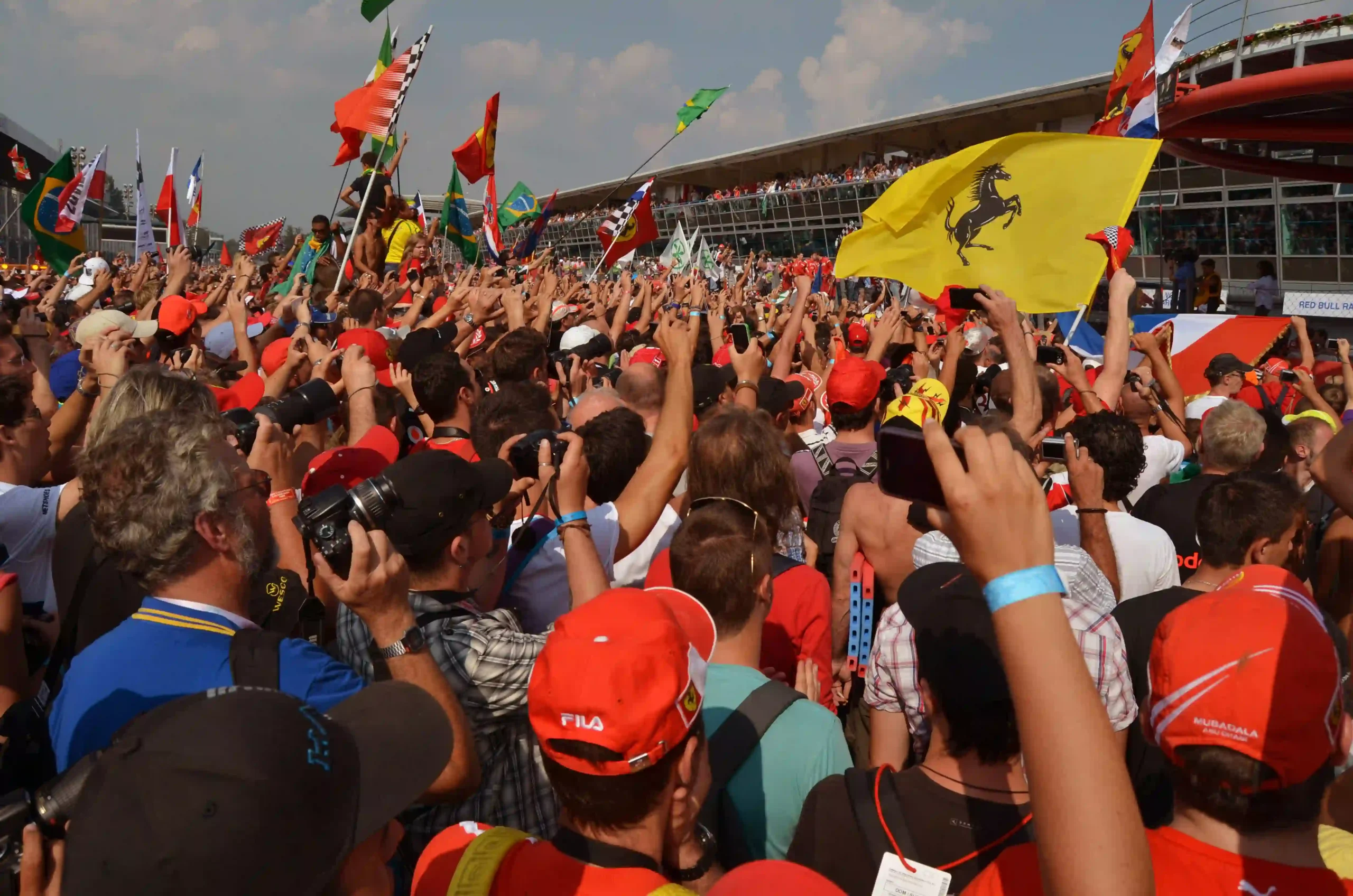
The Podium Creates a Unique Scene
After the race, fans enter the main straight beneath the podium.
Flags cover the track. The ceremony becomes a vast public celebration.
Why Monza Is Ferrari’s Spiritual Home
Ferrari is based in Maranello, not Monza.
Nevertheless, the circuit is where the team meets its largest home audience under World Championship pressure.
Explore the site’s Ferrari collection, Ferrari history and most successful F1 team guide.
Why Chicanes Were Added to the Temple of Speed
Chicanes were added to reduce average speed and create controlled braking points as Formula 1 cars became faster. They preserved Monza’s long straights while lowering corner-entry speeds and improving safety.
Monza’s speed created prestige. It also created serious danger.
As power and tire grip increased, the original flowing road circuit became harder to defend safely.
The 1972 Changes Broke Up the Straights
Temporary chicanes appeared at the start-finish section and before the Ascari area.
Later redesigns created more permanent solutions. The details changed, but the safety goal remained.
Chicanes Did Not End the High-Speed Identity
Cars still accelerate for most of the lap.
Moreover, the braking zones added overtaking opportunities and technical difficulty.
Runoff and Barriers Continued to Evolve
Gravel traps, tire barriers and modern impact structures improved protection.
Curva Alboreto also gained asphalt runoff in 2014, creating debate about consequence and safety.
The Banking Became a Monument
Preserving the oval keeps Monza’s story visible without exposing modern cars to its risks.
This balance allows the venue to honor speed while meeting current standards.
Monza Received FIA Recognition in 2026
In April 2026, the FIA awarded the circuit its highest three-star Road Safety Index rating.
Monza became the second racetrack worldwide to receive that recognition.
The award concerns wider mobility operations. Nevertheless, it shows the historic venue continues modernizing.
Our guides to racing crashes, gravel traps and the FIA cover the safety framework.
What Monza Means in the 2026 Formula 1 Era
The 2026 Italian Grand Prix is scheduled for September 4–6.
It remains Round 13 on the official calendar as of July 24, 2026.
Active Aerodynamics Change the Equation
The 2026 cars use Corner Mode and Straight Mode.
Therefore, they can carry corner load before reducing drag on designated straights.
Monza Still Demands an Efficient Base Car
Active aero does not remove chassis drag, cooling resistance or floor sensitivity.
Moreover, the bodywork must remain stable at very high speed.
Electrical Energy Is More Important
The 2026 power units place greater emphasis on electrical output.
Monza’s repeated straights make deployment planning critical. Drivers cannot use maximum assistance everywhere without managing energy.
Overtake Mode Should Be Effective
The system gives eligible following cars additional deployment.
Long straights provide time for that advantage to become visible. However, the defender still controls line and braking position.
The 2025 Race Sets the Modern Benchmark
Verstappen’s 250.706 km/h average shows that safety changes have not erased Monza’s speed.
Instead, engineering progress continues to renew the nickname.
Current context: The 2026 Italian Grand Prix had not taken place when this article was updated. The latest completed Formula 1 race at Monza was the record-breaking 2025 event.
Common Myths About the Temple of Speed
“Monza Is Fast Because of One Straight”
False. The circuit contains several long acceleration zones.
Moreover, the small number of corners keeps the average speed high across the full lap.
“Drivers Remove All Downforce”
False. The car still needs grip for Curva Grande, Ascari and Curva Alboreto.
Teams reduce wing levels, but they cannot ignore braking stability or traction.
“Formula 1 Still Uses the Banking”
False. The modern Grand Prix circuit passes near and beneath the oval.
However, Formula 1 no longer races on the banked concrete sections.
“Top Speed and Fastest Lap Are the Same Record”
False. Top speed measures one point on the track.
Average lap speed includes every braking zone and corner.
“Monza Has No Technical Corners”
False. The chicanes require braking accuracy and curb control.
Ascari and Curva Alboreto punish a poor low-downforce balance.
“The Tifosi Support Only Italian Drivers”
False. Their strongest loyalty is usually to Ferrari.
Drivers from many countries have received enormous support while racing in red.
Why Is Monza Called the Temple of Speed? FAQs
Why is Monza called the Temple of Speed?
Its long straights, few corners, low-downforce setups, historic banking and record average speeds make velocity the circuit’s defining feature.
Is Monza the fastest circuit in Formula 1?
Yes. Monza is generally the fastest active F1 circuit by average lap and race speed. Cars spend about 80 percent of the lap at full throttle.
What happened to the old Monza banking?
Formula 1 stopped using the combined oval after 1961. The concrete banking survives inside the park as a historic structure.
Why do F1 cars use small wings at Monza?
Small, low-angle wings reduce drag on the straights. The compromise improves top speed but reduces braking stability and corner grip.
Conclusion: Monza Earned the Temple of Speed Name
Understanding why Monza is called the Temple of Speed begins with its original purpose.
The circuit was built in 1922 to host racing and high-speed development.
Its first 10-kilometer layout combined a road circuit with an oval.
Therefore, speed formed part of Monza’s design from the beginning.
The 1955 banking pushed that philosophy further.
Its concrete curves reached an extreme gradient and supported a combined 10-kilometer course.
Formula 1 later stopped using the oval for safety reasons.
However, the banking still rises above the current track as a monument.
The modern 5.793-kilometer layout keeps the same identity.
It has only 11 corners and several long straights.
Cars spend roughly 80 percent of each lap at full throttle.
Consequently, teams bring the smallest wings and lowest-drag packages of the season.
That choice creates another challenge.
Drivers must brake from extreme speed with less aerodynamic stability.
They also attack curbs while controlling a nervous car.
Monza’s records provide measurable proof of the nickname.
Juan Pablo Montoya reached 372.2 km/h in 2005.
His 2004 practice lap averaged 260.6 km/h.
Then Max Verstappen won the 2025 Italian Grand Prix at a record 250.706 km/h average.
That race replaced Michael Schumacher’s 2003 Monza benchmark.
The Temple of Speed therefore owns both generations of the record.
Yet Monza is not simply a straight-line test.
Rettifilo, Roggia and Ascari demand braking precision and curb control.
Curva Grande and Curva Alboreto require commitment with minimal wing.
Slipstreaming also shapes qualifying and racing.
Drivers fight for a tow before attacking the heavy braking zones.
Ferrari and the Tifosi add the emotional layer.
The post-race crowd beneath the podium turns the circuit into a national celebration.
Meanwhile, modern safety changes allow the venue to keep evolving.
The 2026 FIA Road Safety Index award showed that Monza is not trapped in its past.
Active aerodynamics and electrical deployment will change how future cars achieve speed.
Nevertheless, the goal remains the same.
Every team arrives trying to remove drag, perfect braking and reach the limit first.
That century-long devotion is why the nickname endures.
Monza is not called the Temple of Speed because of one record.
It earned the title through an entire history built at full throttle.
Sources and Verification
This article was checked against official circuit, Formula 1 and FIA material available on July 24, 2026. This is a static source list and contains no interactive verification feature.