First Look at Formula 1’s New
Madring Circuit for the Spanish GP
A 5.416km hybrid street circuit, a 24% banked corner unlike anything else on the calendar, and Formula 1’s return to Madrid after 45 years. Here’s everything confirmed about Madring.
Madring Circuit: F1’s New Spanish GP Home
A 5.4km hybrid circuit with a 24% banked corner — F1 returns to Madrid after 45 years.
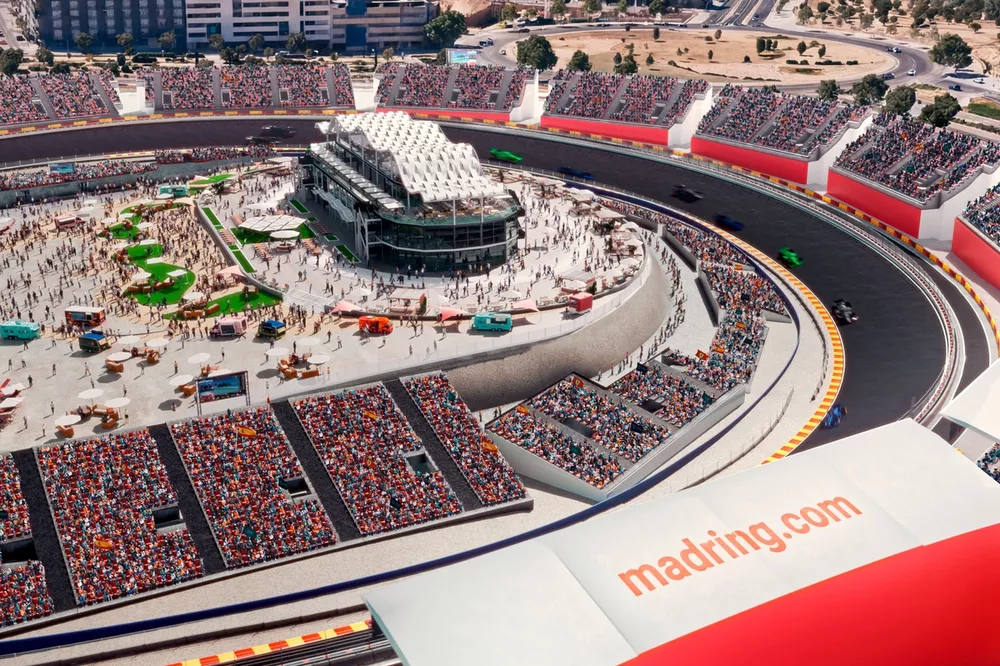
Formula 1 returns to Madrid for the first time since 1981 this September, and the venue waiting for it bears almost no resemblance to anything currently on the calendar. The Madring circuit threads through the IFEMA exhibition complex and the Valdebebas district in the northeast of the city, blending tight urban street sections with a purpose-built, high-speed northern loop.
At 5.416 kilometres with 22 corners, Madring will host the Spanish Grand Prix from September 11 to 13, taking over from the Circuit de Barcelona-Catalunya, which keeps its own June date on the calendar. Therefore, Spain becomes only the fourth country, alongside Italy, the United States, and historically others, to host two Grands Prix in a single season. Here’s everything confirmed about the layout, the headline corner everyone is talking about, and what drivers have already said after walking the track.
What Is the Madring Circuit?
Madring, officially the Circuito de Madring, is a new street circuit built around the IFEMA Madrid exhibition centre in the Barajas district, just five minutes from Adolfo Suárez Madrid-Barajas Airport. The venue carries an FIA Grade 1 certification, the top safety and design classification required to host a Formula 1 World Championship round, and construction has run at a cost of approximately €83.2 million.
The project marks the first new circuit to join the F1 calendar since Las Vegas debuted in 2023, and Madrid becomes the first major European capital to host a Grand Prix. The name itself is a deliberate hybrid — “Madring” fuses the city’s name with “ring,” the term long associated with iconic European racing circuits, while echoing the show-circuit branding established by Miami, Las Vegas, and Abu Dhabi.
Madring will also host Formula 2 and Formula 3 races during the Spanish Grand Prix weekend, with Formula 3 set to conclude its season at the venue. The facility hosts a 110,000-person capacity with the possibility of future expansion to 140,000, and roughly 90% of fans are expected to reach the venue by public transport via the Feria de Madrid metro stop.

Madring Track Layout: Corner by Corner
Madring splits cleanly into two distinct characters. The southern section, built around the IFEMA exhibition halls, feels distinctly urban — tight 90-degree corners, limited run-off, and the start-finish straight squeezed between paddock buildings. Meanwhile, the northern section, a purpose-built 2.2km stretch through Valdebebas, opens up into fast, flowing corners with genuine racing run-off and space for large fan zones.
The lights go out on a 523-metre start-finish straight, with just 252 metres separating pole position from the braking zone into Turn 1 — a setup organisers expect to produce intense opening-lap action. From there, the track transitions through Turn 3, a fast right-hander named Hortaleza after the surrounding Madrid neighbourhood, launching cars onto the 839-metre Ribera del Sena straight where speeds exceed 320 km/h.
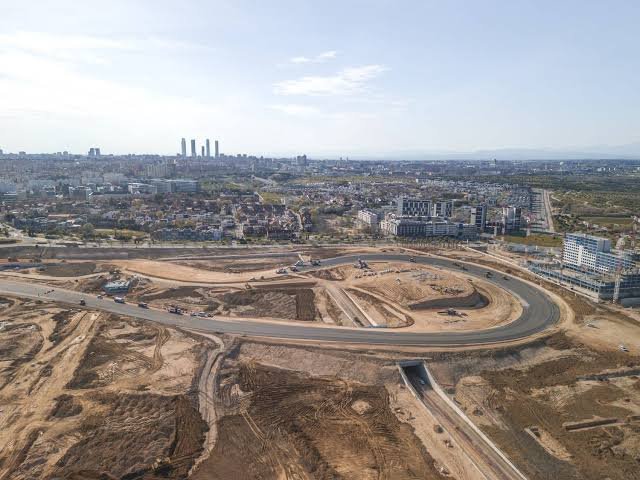
Two short tunnel sections connect the southern IFEMA portion to the Valdebebas expansion area, passing beneath an elevated motorway. Furthermore, Carlos Sainz, who took part in the circuit reveal as an official event ambassador, described the layout as combining tight street sections with a genuinely open, high-speed character — a deliberate design choice he says he pushed organisers toward personally.
La Monumental: The Corner Built to Define Madring
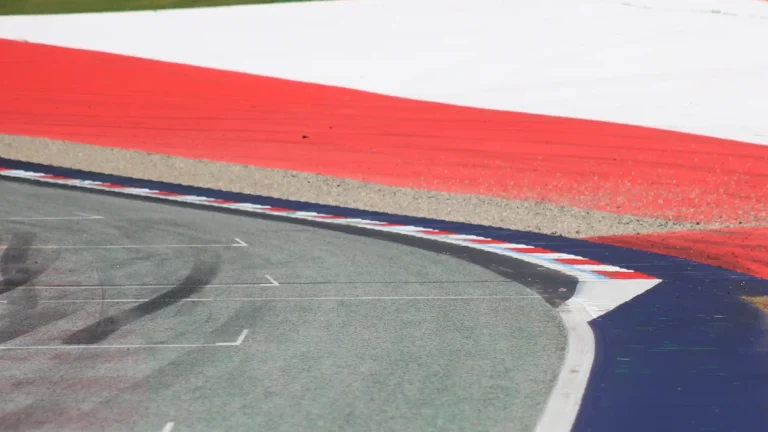
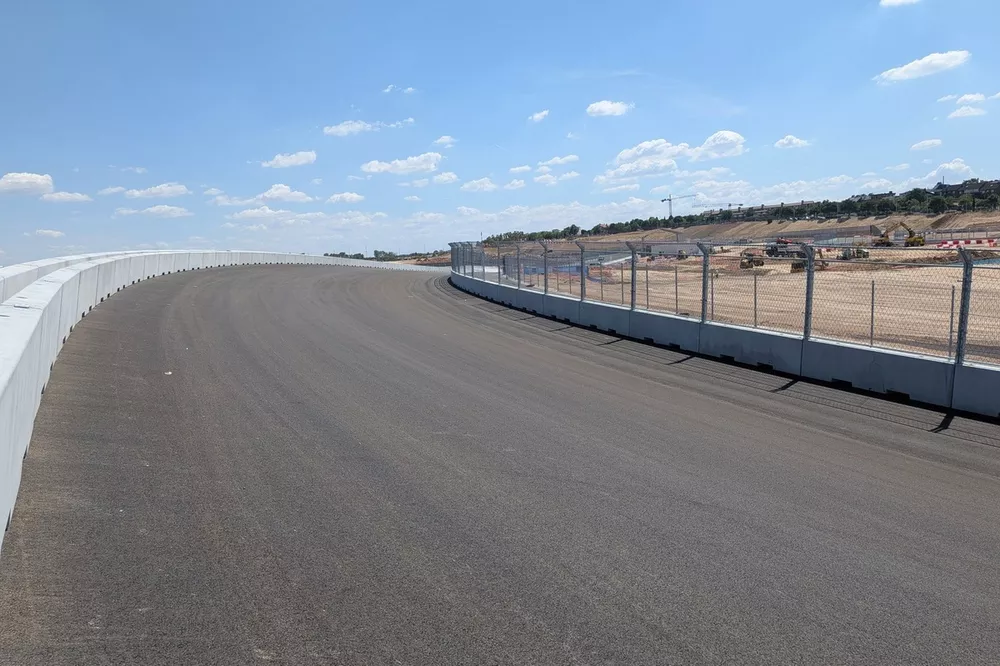
Every modern Grand Prix venue needs a signature image, and Madring’s is La Monumental — a 550-metre banked corner reaching a 24% incline, the maximum permitted under current track design regulations and the steepest corner anywhere on the 2026 calendar. The turn forms a 270-degree arc around the purpose-built northern section, rising up to 10 metres in height through its span.
Unlike a uniform oval-style banking, La Monumental changes through elevation and camber as it progresses, opening progressively before finishing with a blind, uphill exit. Drivers are expected to enter at roughly 280 km/h, and Sainz has suggested the corner could be taken completely flat out by the fastest cars, creating a genuine slipstream and overtaking opportunity into the tight left-hander that follows.
“The banking will allow you to maybe position the car higher up or lower down if you want to get clean air, but if you stay tucked you will produce quite a bit of slipstream.”
Paving La Monumental required more than 1,800 cubic metres of asphalt, produced locally in Vicálvaro and laid at 170 degrees using two next-generation pavers to achieve the precision the corner’s complex geometry demanded. For six seconds, drivers will hold a banking angle steeper than anything currently on the calendar — longer, organisers note, than most corners anywhere in modern Formula 1. To understand why banking angle matters so much for cornering speed, see our explainer on what is downforce and how it interacts with track geometry.
Why Madrid, and What Happens to Barcelona?
Madring does not actually replace the Circuit de Barcelona-Catalunya on the calendar in the way many fans initially assumed. Instead, Madrid joins Barcelona as a second Spanish round, with the long-standing Catalan venue retaining its traditional June date — running June 12–14, 2026 — while Madring debuts later in the year, on September 11–13.
This arrangement makes Spain only the third country on the 2026 calendar, alongside Italy and the United States, to host two Grands Prix in a single season. Therefore, the move reflects a deliberate F1 commercial strategy rather than Barcelona losing its place outright. The Spanish Grand Prix itself dates back to the 1950s, but Madrid’s own F1 history is far older than most fans realise — the city last hosted a round of the World Championship at the Circuito del Jarama in 1981, more than four decades before Madring’s debut.
The Spanish Grand Prix at Madring is the 16th round of the 2026 season, arriving immediately after the summer break as part of the calendar’s first post-break triple-header alongside Zandvoort and Monza. Imola was dropped from the 24-race calendar to accommodate Madrid’s arrival. See our full 2026 F1 schedule for the complete season order.
Local political reaction has been enthusiastic. Isabel Díaz Ayuso, President of the Community of Madrid, called the dual-race arrangement a sign that “Spain becomes one of the most powerful countries in the championship,” while Madrid Mayor José Luis Martínez-Almeida described the city as the “world capital of sport” ahead of the Grand Prix’s arrival.
What Drivers Are Saying About Madring
Carlos Sainz, born in Madrid and currently driving for Williams, has taken on an official ambassador role for the Grand Prix and has been the most vocal driver discussing the circuit publicly. Speaking after touring the under-construction venue, Sainz set genuinely high expectations for what the track could become.
“I think we can be the best circuit in the world and the best event of the whole calendar. There will be 24 or 25 races, and I honestly think along with Mexico, Miami, Las Vegas that do it very well — but sincerely I trust a lot in Madrid.”
Sainz has also been clear that the circuit’s design reflects genuine driver input rather than a layout shaped purely around spectacle. He has said he specifically requested organisers build a track with “character and charisma,” pushing back against the criticism that has followed some of F1’s newer venues for prioritising show value over technical challenge. The combination of La Monumental’s banking, the tight IFEMA urban section, and the flowing Valdebebas corners appears designed to directly answer that brief.
For context on how new circuits typically compare against established venues like Barcelona’s technical layout, our explainer on what is grip and oversteer and understeer in F1 covers the fundamentals that determine how a new track drives compared to familiar ones.
Attending the Race: Tickets, Access & What to Expect
Madring has been deliberately designed around public transport access, addressing one of the most common complaints about newer F1 venues built outside city centres. The Feria de Madrid metro stop delivers fans directly to the circuit entrance, while the Adolfo Suárez Madrid-Barajas Airport sits just five minutes away — a genuine logistical advantage over circuits that require lengthy shuttle journeys.
Interest has already proven strong well ahead of the inaugural race, with more than 70% of the circuit’s capacity reportedly sold before several newly revealed grandstand and hospitality sections went on sale. The race weekend itself runs the standard three-day F1 format, with Formula 2 and Formula 3 support races filling out the schedule alongside practice, qualifying, and the Grand Prix itself on Sunday, September 13.
Ticket categories range from general admission through Section 1 Gold grandstands overlooking the start-finish straight, pit lane, and podium. Covered grandstands are available with direct metro access, and the venue includes dedicated fan zones with food, entertainment, and merchandise areas throughout the weekend. For a broader look at how F1 race weekends are typically structured, see our guide on what is a Grand Prix and F1 qualifying explained.
Frequently Asked Questions
Verify This Information — High-Authority Sources
- Formula1.com — Official Spanish GP 2026 Page
- Madring.com — Official Circuit Website
- Madring — Official Circuit Layout & Corner Guide
- Wikipedia — Madring Circuit
- Wikipedia — 2026 Spanish Grand Prix
- ESPN F1 — Carlos Sainz Madring Interview
- Sky Sports F1 — Race Coverage
- Speedcafe.com — Circuit Construction Updates
Why Madring matters beyond a single new dot on the calendar
New Formula 1 venues live or die on whether they produce genuine racing rather than just a spectacular backdrop. What makes Madring worth watching closely is that it appears to have been designed with both goals in mind simultaneously — a banked corner unlike anything currently raced, multiple legitimate overtaking zones, and a layout shaped with direct input from a driver who grew up in the city it’s built in.
Whether La Monumental lives up to the hype Sainz has set will only become clear once cars are actually on track in September. However, the technical ambition behind the design — and the fact that Madrid secured a second Spanish round rather than simply displacing Barcelona — suggests this is a venue F1 is building for the long term, not just a one-off show race.
For the latest on how the 2026 season is shaping up before Madring’s debut, see our live Formula 1 standings and full season schedule.