Spa Formula 2 2026 Strategy Analysis
A detailed look at the Medium-versus-Supersoft decision, mandatory pit-stop windows, Safety Car risk, DRS trains, weather uncertainty, Sprint Race lessons and the championship choices facing the leading teams before Sunday’s Feature Race.
Spa Formula 2 2026 Strategy Analysis starts with one important fact: the Feature Race has not yet been run at the time of publication. Therefore, this is a verified pre-race tactical report, not a fictional post-race review. It uses Friday’s qualifying, Saturday’s Sprint, Pirelli’s official tire guidance, the FIA sporting regulations and the latest championship picture.
Pirelli’s baseline is clear. The fastest dry strategy on paper is Medium to Supersoft. However, Spa rarely rewards a plan that ignores traffic, DRS trains, Safety Cars or changing weather. The Supersoft may lose competitiveness after roughly six laps, while the Medium must survive a long opening stint without graining. That turns a simple one-stop requirement into a race of timing, positioning and restraint.
What Is the Best Spa Formula 2 2026 Strategy?
What was the expected winning strategy at Spa Formula 2 2026?
Pirelli identified Medium to Supersoft as the fastest dry Feature Race strategy on paper. The Medium should carry the car through the longer opening stint. The Supersoft then offers maximum grip for a short finish. However, a well-timed Safety Car could favor the reverse Supersoft-to-Medium approach.
The cleanest plan is to start on the Medium, protect it during the opening DRS phase, and delay the mandatory stop until the traffic picture improves. The final Supersoft stint should be short enough to use the tire rather than preserve it. That is the theoretical route. Real racing at Spa will test every part of it.
The reverse plan has a different purpose. A driver starting on the Supersoft can attack immediately, use the extra launch and braking grip, then stop after the six-lap minimum. That approach creates an early undercut. However, it risks rejoining inside a slow train and spending most of the race on the Medium.
Track position will decide which plan is actually faster. A Medium starter running in clean air can extend and build a tire offset. A Supersoft starter trapped behind another car may waste the compound’s best laps. Consequently, strategy is not only about degradation. It is about converting grip into usable lap time.
Medium → Supersoft
Protect the first stint, extend beyond the early traffic, and finish with the quickest compound.
Supersoft → Medium
Attack the start, create an early gap, then stop once the mandatory window opens.
Safety Car timing
A neutralization can remove pit-loss time, erase tire offsets and turn the weaker plan into the winning one.
For a basic explanation of the tactical language, read World of Speed’s guide to the undercut and overcut. The same ideas apply in Formula 2, although the mandatory tire rules and spec cars create a tighter strategic contest.
Formula 2 Tire Strategy at Spa: Medium vs Supersoft
Pirelli selected the Medium and Supersoft for the Belgian round. That is a compound step rather than two neighboring choices. The performance gap should be noticeable, particularly on low fuel. Meanwhile, the durability gap should force drivers to manage the Supersoft carefully if it appears early in the race.
Pirelli warned that graining could affect both compounds. It also suggested the Supersoft may lose competitiveness after about six laps. That estimate is not a fixed cliff for every driver. Clean air, track temperature, setup and driving style can move the useful window. Still, it tells teams that the red-walled tire is a short-stint weapon.
Why the Medium is more than a defensive tire
The Medium should be the foundation of the preferred plan. It offers better durability through Pouhon, Fagnes and Stavelot, where loaded corners punish a sliding car. Moreover, it lets the driver wait for a clean pit window rather than stopping as soon as the rules allow.
That flexibility has real value at Spa. One lap lasts almost two minutes. If a rival pits, the car staying out receives a long chance to exploit clear air. Therefore, the overcut can become powerful when the Medium remains stable. It fails quickly, though, if graining develops or traffic appears.
Why the Supersoft can win or ruin the race
The Supersoft offers stronger launch grip, shorter braking distances and better traction from La Source. It can also create a decisive late-race pace advantage. However, the tire needs space. A driver who rejoins behind a DRS train may overheat it while trying to pass.
The biggest risk is using the compound without gaining position. Six fast laps sound useful. Yet two laps spent behind a slower car can consume a large part of that advantage. Teams must map the pit exit against every midfield gap before committing.
Graining, sliding and the hidden cost of low downforce
Spa forces teams to compromise rear-wing level. Less wing improves speed on Kemmel and the run to the Bus Stop. However, the car can slide more through the second sector. That movement heats the surface and encourages graining.
A driver may feel fast on the straight while quietly damaging the tire through Pouhon. The lap time then disappears later in the stint. That is why the fastest speed-trap car is not automatically the best race car. World of Speed’s downforce explainer shows why this trade-off matters.

Sprint Race Strategy Analysis: Why Dürksen’s Plan Worked
What was the winning strategy in the Spa F2 Sprint?
Joshua Dürksen’s winning plan was to manage the tire while following, use Spa’s powerful tow to pass Sebastián Montoya and Martinius Stenshorne, then spend more of the tire once he led. Two Safety Cars erased his gaps, so the final strategic task was a clean restart and strong defense on the last lap.
Dürksen started in the leading group and did not waste the race by forcing an immediate move. Instead, he used the tow and DRS where they mattered. He passed Montoya on the Kemmel Straight, then waited before taking the lead from Stenshorne into Les Combes.
That patience protected the tire. In the official post-race press conference, Dürksen explained that he managed while running behind cars. Once in front, he used more tire to keep the lead. The distinction is important. Management is not simply driving slowly. It is saving performance for the phase that changes the result.

The lead was a strategic problem, not a safe position
Stenshorne learned the difficult side of leading at Spa. He had to push because Montoya attacked early. That prevented him from saving as much tire as he wanted. It also kept the following cars inside the tow.
Once Dürksen moved ahead, he tried to break the one-second window. The DRS effect was powerful enough that leaving Stenshorne close would invite another attack. Therefore, Dürksen’s first laps in front were more aggressive than his earlier laps in traffic.
This is a classic Spa paradox. The leader controls the line but supplies the slipstream. The following driver can save energy and attack later. World of Speed’s guide to slipstreaming explains the aerodynamic advantage.
Two Safety Cars destroyed every carefully built gap
The first Safety Car followed Cian Shields’ crash at Turn 7. The second came after a stoppage at Blanchimont. Each neutralization removed the advantage that the leaders had created. However, it also reduced the number of racing laps left on the tire.
That helped drivers who had managed well. It also gave the field one last chance. Dürksen controlled the final restart, while Tsolov attacked Montoya at La Source. Dunne then used the opening to gain another place through the Eau Rouge sequence.
The lesson for Sunday is not that a Safety Car always helps the leader. It depends on pit status. In the Sprint, there was no mandatory stop to complete. In the Feature, a neutralization can divide the field between cars that have satisfied the rule and cars that still owe a stop.
Confirmed Sprint top eight and strategic takeaway
| Pos. | Driver | Gap / Time | Strategy note |
|---|---|---|---|
| 1 | Joshua Dürksen | 41:53.482 | Managed in traffic, attacked at Les Combes, controlled restart |
| 2 | Martinius Stenshorne | +0.606s | Led early but spent tire defending and lost the tow advantage |
| 3 | Dino Beganovic | +1.273s | Avoided early overuse and advanced as rivals made errors |
| 4 | Nikola Tsolov | +1.798s | Used final restart to pass Montoya and protect title lead |
| 5 | Alexander Dunne | +3.357s | Capitalized on Montoya’s loss of momentum after La Source |
| 6 | Rafael Câmara | Official classification | Read the DRS train and collected useful Sunday data |
| 7 | Roman Bilinski | Official classification | Recovered from a poor start to score |
| 8 | Oliver Goethe | Official classification | Took the final point after late position changes |
For readers following the timing screen, the best clue was the gap to one second. The moment a leader escaped that range, the race changed. The guide to how race timing works helps explain why interval data can reveal the strategy before the television commentary does.
Feature Race Pit-Stop Strategy and the Critical Windows
The FIA regulations require one mandatory Feature Race pit stop. It cannot count until the driver has completed six laps. At least two wheels must be changed. The stop also cannot normally count during a Virtual Safety Car unless the car was already in pit entry or the pit lane when the VSC began.
Those details create a hard boundary. A Supersoft starter cannot simply stop on lap two after losing performance. The driver must reach the legal window. Meanwhile, a Medium starter can continue much longer and choose a stop based on traffic, tire condition and Safety Car risk.
A Supersoft car needs the tire to survive until its mandatory stop becomes valid. If the compound fades early, the driver may have to defend for several laps rather than pit immediately. That makes launch position and clean air especially valuable.
Window one: laps 7–9 for the aggressive undercut
This is the natural range for Supersoft starters. They can use the compound’s grip at the start, then switch to the Medium as soon as the rules allow. The undercut works if the car rejoins in clear air and the fresh Medium immediately produces stable laps.
The danger is traffic. A car exiting behind a slower group may lose several seconds before reaching Kemmel. Moreover, the Medium needs temperature. A cold out-lap through the first sector can reduce the expected gain.
Window two: laps 12–17 for balanced Medium starters
This range should suit drivers who begin on the Medium but do not want an extreme extension. It keeps the final Supersoft stint short enough for pace. It also offers time to watch how the early stoppers perform.
The team will compare the leader’s current lap against the projected pit-exit position. A stop becomes attractive when the driver can return ahead of a slower train. If that gap never opens, the team may extend further.
Window three: laps 18–20 for the overcut and late attack
This is the bold Medium-first plan. The driver runs long, ideally in clean air, and creates a strong tire offset for the finish. The final Supersoft stint may be only five to seven laps. That allows aggressive use without much concern for long-term degradation.
However, late stopping increases exposure to a badly timed Safety Car. If the neutralization arrives just after rivals have stopped, the long-running car may gain. If it arrives before the driver has stopped and closes the pit lane timing unfavorably, the same plan can collapse.
Why a VSC can be more awkward than a full Safety Car
A VSC reduces pit-loss time, yet the mandatory stop rule limits when it counts. A driver already entering the pits can benefit. A driver who reacts after the VSC starts may change tires but still owe the mandatory stop. That would turn one planned stop into two.
A full Safety Car is different. Cars can pit while the field compresses, and the stop can count if the other conditions are met. However, the order of cars at pit entry matters. Spa’s long lap means some drivers may have already passed the pit entrance when the incident occurs.
World of Speed’s Safety Car explainer covers the basic procedure. At Spa, the main strategic point is that neutralization timing can outweigh several laps of raw pace.
Pit crew performance is part of the strategy
The plan only works when the stop is clean. Formula 2 teams must change at least two wheels. A sticky nut, poor jack placement or unsafe release can remove the entire tire advantage. Therefore, the fastest strategic call can still produce a poor result.
The pit lane also creates stacking risk for teammates. If both cars arrive together, the second car may wait. Teams with drivers on opposite tire strategies can reduce that risk. The guide to how pit stops work explains the sequence and where time is lost.
How Weather Could Change Spa Formula 2 Strategy
The forecast checked at publication time called for a possible passing morning shower around Francorchamps, with mixed cloud through Sunday. That is not a guarantee of a wet race. However, teams cannot build a plan that assumes stable sunshine.
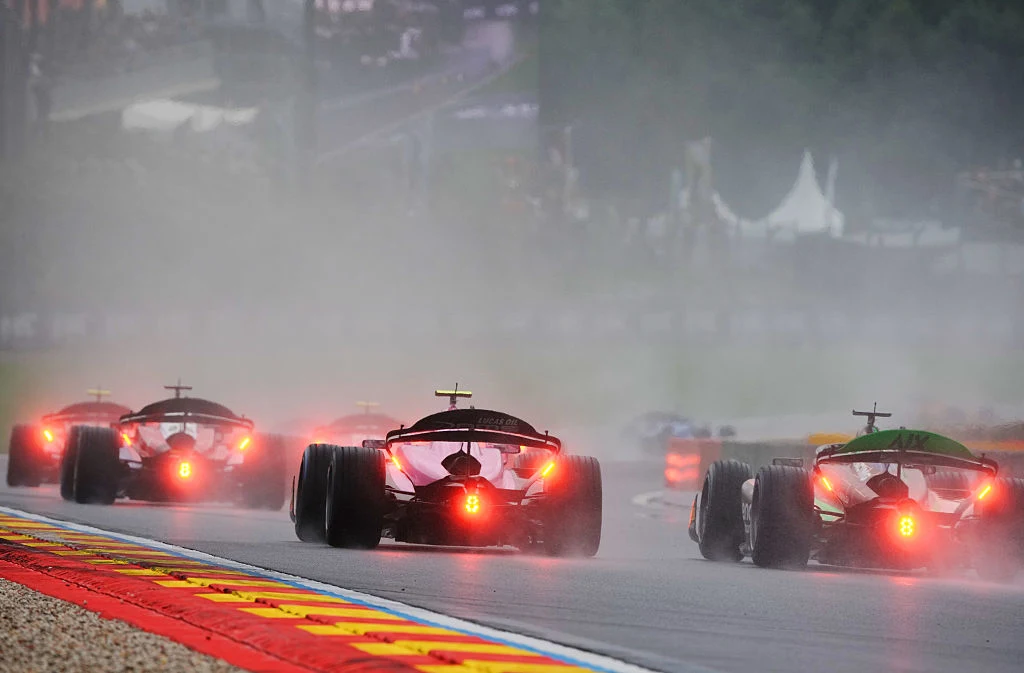
Cooler conditions can help the Supersoft avoid thermal overheating. At the same time, they can make warm-up harder after a pit stop. The Medium may need a careful out-lap before it reaches its best grip. Therefore, the undercut may be less immediate than expected.
A damp first sector can exist with a dry pit straight
Spa’s size creates local weather. Rain can reach Les Combes or Pouhon before the start-finish area. Drivers may receive warnings from the pit wall but still meet a different surface than expected. That makes the first lap on slicks especially difficult.
If rain arrives after the start, the team must judge crossover time. Pitting too early for wet tires costs heavily if the shower passes. Waiting too long can produce a dangerous lap on slicks. Since the circuit is 7.004 kilometers, one wrong lap lasts a long time.
Wet-weather use can change the dry-tire equation
Under normal dry conditions, Feature Race strategy requires both allocated dry specifications. Wet-weather running can alter that obligation under the regulations. Consequently, a genuine rain phase may remove the need to force a short Supersoft stint late in the race.
Teams will still prefer flexibility. Starting on the Medium gives a wider window to wait for weather. Starting on the Supersoft commits the driver to early tire management while the radar evolves. The best plan may be the one that leaves the most options open.
Look for mechanics carrying both slick and wet tires into the working area. Also watch sector times rather than the overall lap. A sudden loss in Sector 2 may reveal rain several minutes before the main camera shows it.
Team-by-Team Strategy Choices for the Leading Contenders
Rafael Câmara and Invicta Racing: control the race from pole
Câmara starts from pole after a 1:56.306 lap. He beat Tasanapol Inthraphuvasak by only 0.039 seconds. Therefore, Invicta cannot assume a pace margin. The team’s first job is to protect the lead through La Source without compromising the run to Kemmel.
Câmara’s Sprint provided valuable information. He finished sixth after spending much of the race in a DRS train. He said the race showed how to prepare overtakes and manage gaps. Those lessons matter because the pole sitter can become the tow provider on lap one.
The Medium-first plan suits a leader who can control pace. However, the car behind may undercut. Invicta must decide whether to cover the first serious stop or trust Câmara’s clean-air pace. Recent Spa form is strong, but strategy cannot rely on history alone.
Tasanapol Inthraphuvasak and ART Grand Prix: pressure without leading
Second place may be tactically useful at Spa. Inthraphuvasak can attack at La Source, yet he can also settle behind and receive the tow. ART must avoid spending the Supersoft or Medium in a pointless early battle.
If Câmara begins on the Medium, ART can mirror or split the strategy. A Supersoft start would create immediate pressure but require an early stop. A Medium start keeps the fight on track and opens the undercut later.
Alexander Dunne and Rodin Motorsport: use race pace, not desperation
Dunne starts third and sits one point behind Câmara in the championship after the Sprint. Rodin also moved to second in the teams’ standings. That raises the value of a strong finish. A risky strategy that produces a win chance but threatens a retirement may not be the best championship call.
Dunne showed sharp awareness on the final Sprint restart. He used Montoya’s compromised position and went side-by-side through the Eau Rouge area. In the Feature, he can pressure the front row while letting them spend tire fighting each other.
Nikola Tsolov and Campos Racing: defend a 22-point lead intelligently
Tsolov leads with 146 points. Gabriele Minì has 124. Tsolov starts fourth and does not need to win the race at the first corner. His Sprint pass on Montoya showed controlled aggression, but the Feature rewards a broader view.
Campos can use Tsolov’s position to respond rather than initiate. If the leaders stop early, he can extend. If a direct rival attacks with the Supersoft, he can protect track position. The priority is to score heavily without exposing the car to unnecessary contact.
Gabriele Minì and MP Motorsport: recovery requires a different rhythm
Minì retired from the Sprint and remains second in the standings. He needs to reduce the damage, but Spa punishes forced moves. A long Medium stint may offer the best route if he starts outside the immediate lead group.
The team should look for clean air and a tire offset. An early Supersoft attack could gain positions, yet it risks dropping into traffic after the stop. The recovery plan must prioritize net race time rather than visible overtakes.
Joshua Dürksen: Sprint winner with strategic confidence
Dürksen starts from the upper group after qualifying seventh before grid adjustments. His Sprint win confirmed strong race balance. More importantly, he showed that Invicta can manage the tire and create speed at the right moment.
A split strategy between Dürksen and Câmara would give Invicta more information. One car could cover the early undercut while the other extends. However, the team must avoid compromising either driver through stacking or shared pit timing.

Championship standings after the Sprint
The standings shape risk tolerance. Tsolov can accept a podium. Câmara and Dunne can gain more by attacking. Minì needs a recovery. Therefore, the same pit window may produce different decisions for each contender. The guide to how racing championships are scored explains why points context changes strategy.
How DRS and Overtaking Change the Strategy Calculation
Spa has three DRS zones for Formula 2 in 2026. The added zone begins after Turn 17 and runs toward the final chicane. That means a driver can attack on Kemmel and again near the end of the lap. The leader must defend without destroying the tires.
The most effective pass remains the run to Les Combes. A strong La Source exit creates the first part of the move. Eau Rouge and Raidillon then build the tow. DRS increases the closing speed on Kemmel. Therefore, the attack often begins a full sector before the braking zone.
That affects pit strategy. A driver on fresh tires does not need to complete every pass immediately. Staying within DRS can reduce the time lost behind a rival. Conversely, a car with old tires may use DRS to defend a position that raw cornering pace would not protect.
The new third zone adds another consideration. A driver who attacks too hard at Les Combes may overheat the tires before the final sector. Waiting until the Bus Stop could preserve the lap and reduce the chance of a counterattack. The best overtaking point depends on the next strategic objective.
World of Speed’s DRS explainer covers the core mechanism. Although the article focuses on Formula 1 terminology, the aerodynamic principle is the same.
How Qualifying Shaped the Spa Strategy Battle
Câmara took pole by 0.039 seconds over Inthraphuvasak. Dunne was third, Tsolov fourth and John Bennett fifth. That order places four different teams near the front. Therefore, no single team can control every strategic response.
The session also contained two red flags. Noel León spun at Raidillon. Laurens van Hoepen later stopped on the start-finish straight. The final runs became one-lap attempts, which rewarded drivers who could prepare the Supersoft quickly.
León later lost all his qualifying times for causing the first red flag. Emerson Fittipaldi and Cian Shields received 10-place penalties for yellow-flag infringements, while Rafael Villagómez received five places. Those decisions changed traffic patterns deeper in the field.
Grid position matters because the front runners can choose their pace. Cars starting in the midfield may need an alternative strategy to escape a DRS train. World of Speed’s article on grid position in racing explains the advantage.
The Feature Race winner has not started from pole in Formula 2’s last four Spa visits. Yuki Tsunoda in 2020 was the most recent pole sitter to convert. Strategy, traffic and Safety Cars have repeatedly broken the expected order.
Spa Formula 2 2026 Strategy Predictions
Most likely race-winning route
The safest prediction is a Medium start for the front runners, followed by a late Supersoft stop. Pole gives Câmara the best chance to control that plan. However, he must either break the DRS range or manage the threat without overusing the tire.
The ideal stop should come once the driver can rejoin in clean air. That may be between laps 14 and 18. A shorter final stint lets the Supersoft deliver qualifying-style grip without reaching the severe degradation phase.
Most likely surprise strategy
A midfielder may start on the Supersoft, gain several places, and stop as soon as the legal window opens. If a Safety Car follows soon afterward, that driver could gain track position while Medium starters face a compressed field.
The plan requires a strong start and a clean pit exit. Without both, the driver becomes trapped on the slower compound for most of the race. It is a high-variance option rather than a universal answer.
Biggest strategic failure risk
The largest danger is stopping into traffic. A fresh Supersoft can lose its best laps behind a DRS train. The driver then reaches clean air after the tire has already peaked. A slow stop produces the same problem.
Another risk is reacting to a VSC without understanding the mandatory-stop rule. A tire change made after the VSC begins may not satisfy the requirement. Teams must confirm the car’s position relative to pit entry before calling it in.
Drivers with the strongest strategic positions
Câmara has clean air and first choice from pole. Inthraphuvasak can use the tow. Dunne can watch the front-row fight. Tsolov has enough championship margin to avoid desperation. Dürksen has proven race balance and fresh confidence.
That does not guarantee a winner. Spa’s race can pivot on one shower or one Safety Car. A balanced prediction gives Câmara the highest probability, while Dunne, Tsolov and Inthraphuvasak remain credible. Dürksen becomes especially dangerous if Invicta splits strategies.
| Scenario | Likely beneficiary | Why | Main risk |
|---|---|---|---|
| Fully dry, few interruptions | Câmara / front-row Medium starters | Clean air and control over the late stop | Undercut from third or fourth |
| Early Safety Car after lap six | Supersoft starters | Can complete the stop with reduced time loss | Long Medium stint afterward |
| Late Safety Car | Drivers who already stopped late | Fresh Supersoft and compressed gaps | Limited laps to overtake |
| Passing shower | Teams that delay commitment | Flexibility to switch without wasting dry tires | One lap too late on slicks |
| Heavy DRS train | Long-running Medium starters | Can use track position and wait for clear air | Graining before the gap opens |
How to Follow the Strategy Live
- Record the starting tire. The first camera shot of the grid reveals which teams split their plans.
- Watch the gap to one second. DRS range will decide whether the leader can manage or must push.
- Track pit-exit traffic. A stop is only valuable when the driver can use the new tire.
- Remember lap six. Stops before the driver completes six laps do not satisfy the mandatory requirement.
- Separate VSC from Safety Car rules. The mandatory-stop treatment is not identical.
- Compare sector times. Sector 2 will show graining and balance loss before the overall lap becomes dramatic.
- Wait for final classification. Post-race penalties or technical checks can alter the result.
The Feature Race starts at 4:00 a.m. ET on Sunday, July 19. Official live timing is especially useful during the pit cycle. For broader context, see how laps are counted and how racing flags work.
Spa Formula 2 2026 Strategy FAQ
Conclusion: The Real Spa Formula 2 2026 Strategy Battle
The central answer in this Spa Formula 2 2026 Strategy Analysis is Medium to Supersoft. Yet the fastest theoretical plan will only work if the driver receives clean air, controls graining and avoids a badly timed neutralization.
The Sprint showed the tactical pattern. Dürksen saved tire while following, attacked when the tow was strongest, then used more performance after taking the lead. The Safety Cars removed his gaps, but a disciplined restart protected the result.
Sunday adds the mandatory stop and a much bigger points reward. Câmara has pole. Inthraphuvasak has the tow. Dunne and Tsolov can watch the front row fight. Minì needs recovery. Meanwhile, a morning shower remains possible. Therefore, the winning team will not simply choose the right tire. It will choose the right lap, the right traffic gap and the right level of risk.
At publication time, the Feature Race remains ahead. No winner or completed pit sequence is being presented as fact. This article will remain an accurate pre-race strategy guide rather than inventing an outcome before the lights go out.
Sources & Verification
All current results, tire guidance, regulations, qualifying details and championship figures were checked against official FIA Formula 2 and FIA material. Article status: updated after the July 18 Sprint Race and before the July 19 Feature Race.
- FIA Formula 2 — official Spa preview, technical notes, three DRS zones and Pirelli Medium/Supersoft strategy guidance
- FIA Formula 2 — official 2026 Spa Sprint Race report and championship standings
- FIA Formula 2 — official Spa qualifying report and confirmed pole time
- FIA — 2026 Formula 2 Sporting Regulations, including mandatory pit-stop and VSC provisions