Belgian Grand Prix 2026 Strategy Analysis: DRS Trains, Tyres, Safety Cars & Overtaking Zones
A complete tactical breakdown of the 2026 Belgian Grand Prix at Spa-Francorchamps — DRS zone mechanics, tyre degradation, safety car probability, and exactly where the race gets won.
Belgian Grand Prix 2026 Strategy Analysis: DRS, Tyres & Safety Cars
A complete tactical breakdown of the 2026 Belgian GP at Spa — DRS zones, tyre degradation, safety car odds, and where the race gets won.
The 2026 Formula 1 Belgian Grand Prix takes place from 17 to 19 July at Circuit de Spa-Francorchamps — moved one week earlier on the calendar compared to 2025, with the race itself starting at 15:00 local time on Sunday 19 July for 44 laps or 120 minutes, whichever comes first. Spa is the longest circuit on the entire F1 calendar at 7.004 km, and that single fact reshapes nearly every strategic decision teams will make across the weekend.
This is not a typical race weekend preview. This is a pure strategy breakdown — how the two DRS zones actually function together to create overtaking trains, why the tyre degradation pattern through Eau Rouge and Raidillon punishes aggressive two-stop calls, how often the safety car has historically intervened here, and why Spa’s notoriously fractured Ardennes weather can turn a clean strategic plan into chaos within three laps.
Furthermore, we will walk through every major overtaking zone on the lap, the historical strategy split between one-stop and two-stop approaches, and what the removal of traditional DRS under the 2026 regulations means for a circuit that has relied on it more than almost any other venue on the calendar.
Belgian Grand Prix 2026 — Full Weekend Schedule
All times below are Central European Summer Time (CEST / UTC+2), since Spa-Francorchamps sits in the Belgian Ardennes. For BST (UK), subtract one hour. For ET (US East), subtract six hours. For IST (India), add three and a half hours.
Spa-Francorchamps has moved one week earlier on the 2026 calendar compared to its 2025 slot, while retaining its position as the iconic mid-summer round of the championship. See the full 2026 F1 calendar for every round.
17 July
17 July
18 July
19 July
Race starts 15:00 CEST Sunday 19 July; runs 44 laps or 120 minutes, whichever is shorter. Practice times confirmed closer to race weekend.
DRS Trains and the Overtaking Zones That Define Spa
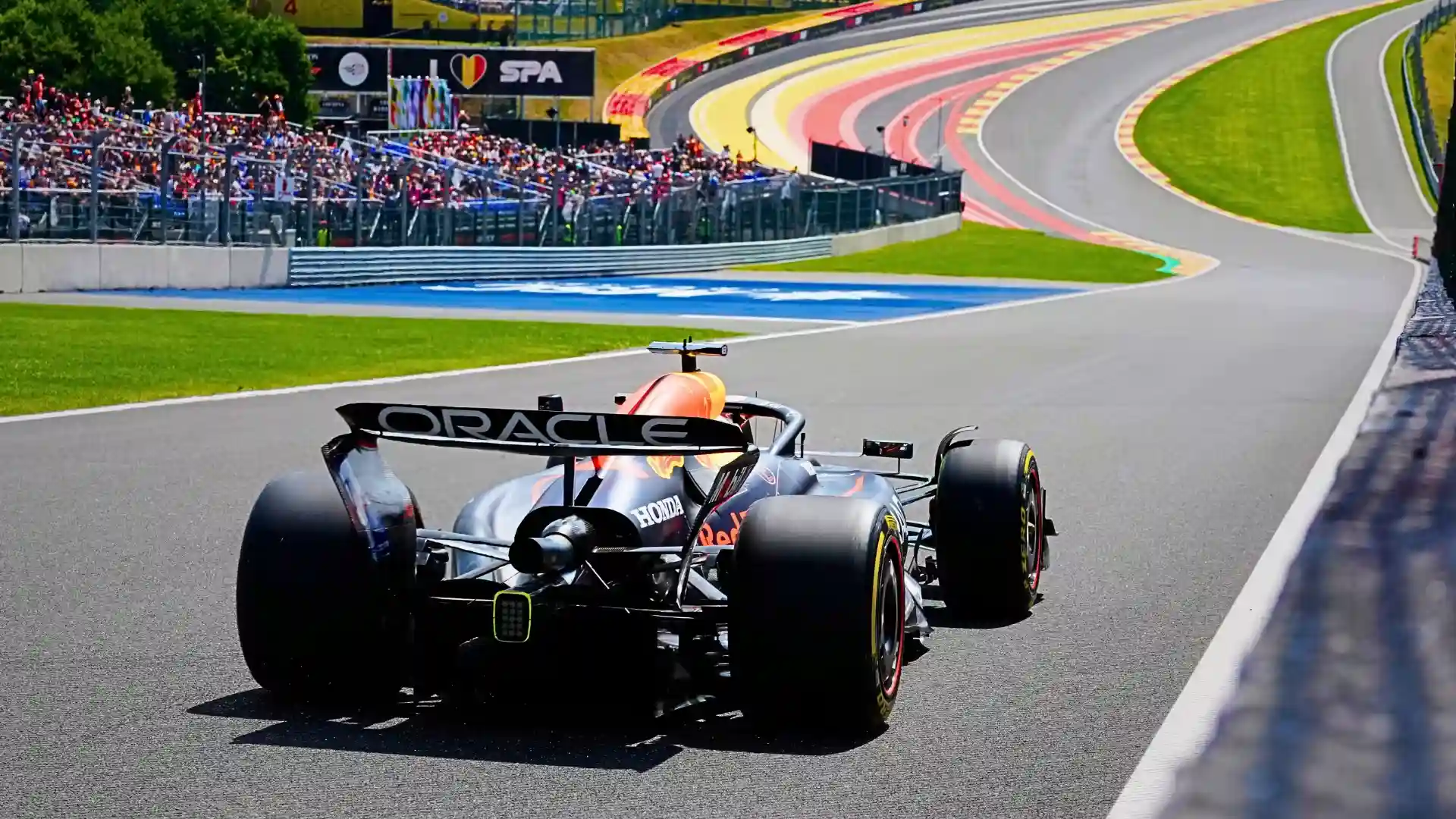
Spa-Francorchamps has two DRS zones, and the relationship between them is what creates the phenomenon strategists call the “DRS train.” The primary zone runs down the Kemmel Straight, immediately after the legendary Eau Rouge-Raidillon complex, with the detection point positioned before the cars even crest Raidillon. This is the longest, most decisive DRS zone on the entire calendar — cars hit speeds in excess of 330 km/h before braking for Les Combes at the top of the hill.
The second zone sits on the pit straight, giving cars an additional run into La Source — the tight first-gear hairpin that opens every lap. Consequently, a car that loses the tow on the Kemmel Straight often has a second chance heading into Turn 1 on the following lap. However, that second opportunity is far more contested, since La Source is the tightest corner on the circuit and overtaking there carries genuine contact risk.
The DRS train effect happens when three or more cars run close together through Eau Rouge. Because the cars are nose-to-tail, every following car gets a slipstream boost on top of its own DRS activation. This compounding effect means the entire train can carry more speed onto the Kemmel Straight than a single isolated car running alone — but it also means whoever is leading the train is acutely vulnerable, since every car behind effectively gets a bigger straight-line speed advantage than the leader can generate alone.
The Overtaking Zones — Corner by Corner
Beyond the two DRS zones, Spa offers several genuine passing opportunities that reward bravery and tyre confidence over pure straight-line speed. Understanding each one is essential to following the strategic chess match unfolding on track.
Because the Kemmel Straight DRS zone follows directly from Eau Rouge-Raidillon, the quality of a driver’s exit through that uphill sequence has an outsized effect on whether the subsequent overtake actually happens. A driver who compromises their line through Raidillon to defend position often hands the chasing car a bigger straight-line advantage than they intended — turning a defensive move into the very thing it was meant to prevent. To understand the underlying mechanics, see our full DRS explainer and how slipstream effects compound with DRS.
Tyre Strategy at Spa-Francorchamps
Spa’s tyre degradation profile is unlike anywhere else on the calendar, primarily because of the circuit’s sheer length. At 7.004 km, drivers complete fewer laps per stint than at almost any other track, which fundamentally changes the maths around when a pit window actually opens. Furthermore, the abrasive surface through Sector 1 — particularly through Eau Rouge and Raidillon, where lateral loads spike dramatically — generates significant front-left and rear-right tyre wear that compounds over a long stint.
Historically, the one-stop strategy on Medium-to-Hard compounds has been the dominant winning approach, used in roughly 60% of dry Belgian Grands Prix. The combination of a long lap and a circuit layout that doesn’t punish slightly-degraded tyres as severely as tighter, twistier tracks means teams that can stretch a single set of Medium tyres deep into the race often hold a structural advantage that’s difficult for two-stopping rivals to overcome on pure pace alone.
However, Soft compounds degrade quickly through the high-load corners of Sector 1, making them largely a qualifying-only tool rather than a viable race-stint option for most teams. The exception arrives when a Safety Car resets the field — at that point, a short, aggressive Soft stint becomes the preferred tactic for any car needing to attack through the pack on fresh, sticky rubber.
Strategy Probability Breakdown — Historical Belgian GP Pattern
Probabilities reflect historical Belgian GP strategy patterns at Spa-Francorchamps over recent seasons.
Because Spa’s lap is so long, the time lost in the pit lane represents a smaller percentage of total lap time than at a tighter circuit — which slightly reduces the raw power of the undercut compared to shorter tracks. However, the undercut remains effective when a car is struggling for rear tyre temperature, since a fresh set immediately closes the deficit on the long straights. Conversely, the overcut — staying out longer to benefit from a clear track and a later, cooler-temperature out-lap — works particularly well at Spa precisely because of the circuit’s length, giving the extending car more time to build a meaningful gap. See our full undercut and overcut explainer for the underlying mechanics.
How Pit Stop Timing Actually Plays Out
The pit window for the leading one-stopping cars typically opens around lap 18–22 of the 44-lap race distance, though this shifts considerably based on track temperature and how aggressively the front-runners pushed in the opening stint. Teams running a long first stint on Medium tyres are betting that their rear tyre management through Sector 2’s flowing corners will outlast rivals who pushed harder early. Moreover, understanding how pit stops work in racing more broadly helps explain why a seemingly small timing difference of two or three laps can be the entire race.
For two-stopping teams, typically those starting further back on the grid or running compromised setups, the strategy depends on aggressive opening pace to build a cushion before the first stop, followed by a second stint built around attacking through DRS-assisted overtakes on the Kemmel Straight. As a result, Spa rewards teams that build their entire race-day plan around exploiting that single DRS zone rather than trying to force passes elsewhere on the lap.
Spa doesn’t punish a slow tyre the way a tight street circuit does. It punishes a slow exit out of Raidillon onto the straight that decides everything.
— World of Speed Strategy Analysis, June 2026Safety Car Strategy — Spa’s Strategic Wildcard
Spa-Francorchamps has one of the highest Safety Car probabilities on the F1 calendar, and understanding why requires looking at the circuit’s layout honestly. The combination of high-speed corners with limited run-off in several sections, a long lap that increases the statistical chance of an incident occurring somewhere on track, and weather conditions that change rapidly across the Ardennes forest all push the probability higher than circuits with more forgiving, modern layouts.
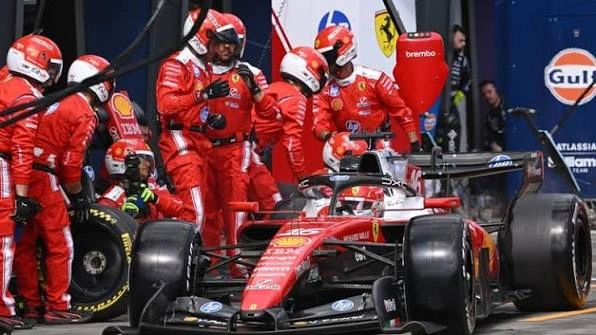
A Safety Car at Spa is strategically transformative in a way it isn’t everywhere. Because pitting under green-flag conditions costs a driver roughly 20-25 seconds of lost time relative to staying out, a Safety Car period effectively erases that penalty — every car can pit simultaneously while the field bunches up behind the Safety Car at reduced speed. As a result, teams sitting on marginal strategy calls watch the Safety Car probability obsessively, because a single intervention can completely rewrite the optimal plan.
Furthermore, the Virtual Safety Car (VSC) behaves differently and matters just as much. Under VSC conditions, cars must maintain a minimum lap time delta but continue circulating at reduced pace without bunching up behind a physical car. This means a pit stop under VSC, while still cheaper than a green-flag stop, doesn’t offer quite the same “free” advantage as a full Safety Car — understanding how safety car periods work in racing is essential to following why teams react so differently to the two scenarios.
La Source’s tight hairpin entry frequently produces opening-lap contact when the field is still bunched. Eau Rouge-Raidillon, taken at extreme speed, has historically been the scene of serious incidents when drivers misjudge the compression at the bottom of the dip. The Bus Stop chicane, with its tight, technical nature following a long high-speed run, also regularly catches drivers who carry too much speed into the braking zone. Teams build contingency strategies around all three locations before the race even begins.
How Teams React in Real Time
The teams that gain the most from a Safety Car period are rarely the ones with the fastest pit crew alone — they’re the ones whose strategists make the pit decision within seconds of the incident being flagged. Consequently, the gap between a team that reacts in the first lap of a Safety Car period and one that waits even one additional lap can be the difference between gaining four positions and losing two. This single decision point is, more than any other variable at Spa, where championships have shifted mid-race.
The Ardennes Weather Factor
No discussion of Belgian Grand Prix strategy is complete without addressing the Ardennes weather, because it genuinely behaves differently from almost anywhere else on the calendar. The circuit’s 7.004 km length means it physically spans enough terrain that rain can fall heavily on one section while another part of the track stays completely dry — a phenomenon drivers have described for decades and one that strategists must build contingency plans around before a single lap is run.
Consequently, a car can be on slick tyres through La Source and arrive at Eau Rouge to find standing water — a scenario that has produced some of the most dramatic and dangerous moments in the sport’s history. Teams monitor hyper-local radar data covering different sectors of the circuit independently, rather than relying on a single weather forecast for the whole venue, precisely because conditions diverge so significantly across the lap.
Moreover, this unpredictability means rain strategy at Spa isn’t a binary wet-or-dry decision the way it often is elsewhere. Teams frequently face a genuine three-way choice between Intermediate tyres, full Wet tyres, or staying on slicks and accepting reduced pace through one specific section while gaining time everywhere else. That calculation changes lap by lap as conditions shift, making Spa arguably the single hardest circuit on the calendar to call correctly from the pit wall.
Teams that build a single rigid strategic plan and refuse to adapt typically perform worse at Spa than teams willing to make in-race calls based on live data. The circuit’s combination of long lap length, high incident probability, and fractured weather patterns means the optimal strategy is rarely the one drawn up on Thursday — it’s the one recalculated in real time as the race actually unfolds.
Frequently Asked Questions
The Verdict: How the 2026 Belgian Grand Prix Will Actually Be Won
Spa-Francorchamps remains the purest test of strategic patience on the calendar. The 2026 race will almost certainly be decided not by the fastest single lap, but by the team that builds the most adaptable plan — one that accounts for the DRS train dynamics on the Kemmel Straight, manages tyre degradation through Sector 1’s punishing loads, reacts fastest to any Safety Car period, and stays flexible against weather that can change the entire calculation within three laps.
Historically, the one-stop strategy on Medium-to-Hard compounds gives teams the strongest baseline, but the circuit’s length and incident probability mean that baseline plan should be treated as a starting point rather than a fixed outcome. Furthermore, the team whose strategists make the fastest, clearest decision in the moment a Safety Car appears will likely gain more positions than any car managed to win through pure overtaking. That is the essential character of Spa — and why it remains, year after year, the circuit every strategist both loves and fears in equal measure.
About this analysis
Circuit specifications, race dates, and session details in this article are sourced from Formula1.com, the official Spa Grand Prix event site, and RacingNews365 as of June 2026. Strategy probability figures reflect historical patterns at Spa-Francorchamps over recent F1 seasons. Exact practice session times were not yet published at the time of writing and will be confirmed closer to the race weekend — always verify against the official FIA timing schedule before travel or broadcast planning.