London E-Prix 2026 Strategy Analysis: Tyres, Pit Stops, Safety Cars & Championship Impact
Why track position mattered so much at ExCeL, how Attack Mode and PIT BOOST changed the tactical picture, why conventional tyre strategy barely describes Formula E, and how Pascal Wehrlein turned London into a second world title.
The 2026 London E-Prix was not a race weekend you could understand by looking only at the finishing order. The season finale at ExCeL London compressed almost every difficult Formula E problem into two days: a narrow circuit, limited overtaking space, high contact risk, a championship fight, Attack Mode timing, energy targets and the strategic complication of PIT BOOST across the double-header format.
Pascal Wehrlein arrived in London third in the Drivers’ Championship, behind Jake Dennis and Mitch Evans. He left as a two-time Formula E World Champion. Saturday changed the entire title picture when Wehrlein converted pole into victory, Dennis finished second and António Félix da Costa took third. Sunday then became a survival exercise. Taylor Barnard won the finale, while Wehrlein finished outside the points but still did enough to secure the championship.
This analysis focuses on what actually mattered strategically. It also clears up a common mistake: Formula E tyre strategy is not an F1-style soft-versus-medium-versus-hard decision. In Season 12, every driver used the same Hankook iON all-weather specification. At London, the tyre discussion was about temperature, grip variation, lock-ups, damage and preserving a limited weekend allocation.
London E-Prix 2026 Strategy: The Quick Answer
The winning London E-Prix 2026 strategy was built around track position first, then energy and Attack Mode timing. At ExCeL, passing a car could cost several laps because the circuit offered few low-risk overtaking zones. That made qualifying unusually valuable. It also made every neutralisation important because a Safety Car or yellow period could erase a carefully built energy or time advantage.
London rewarded clean air, controlled energy use and well-timed Attack Mode more than raw overtaking. Drivers who became trapped in a train could have extra usable energy without a safe place to spend it. The title contenders therefore had to value qualifying, track position and risk control as highly as outright pace.
That sounds simple, but the London circuit makes those priorities fight each other. Saving energy can create a concertina effect. Attack Mode requires leaving the normal racing line to drive through activation loops. PIT BOOST can temporarily surrender track position. Meanwhile, the championship leader cannot treat a marginal move the same way as a driver with nothing to lose.
For readers new to the series, our guides to what Formula E is, how Attack Mode works and how racing championships are scored provide the basic framework. London is where all three ideas collide.
Why ExCeL London Creates Such an Unusual Strategy Problem
ExCeL London is unique in top-level world championship racing because the lap runs both inside and outside an exhibition complex. The transitions change the visual references for drivers. The surface character also changes around the lap. That matters because the same car can feel secure in one section and nervous a few corners later.
The final Season 12 weekend took place on August 15 and 16, 2026. Both races started at 3:05 p.m. local time, which was 10:05 a.m. Eastern Time for a U.S. audience. The venue hosted Rounds 16 and 17 and closed the GEN3 Evo era before Formula E’s move to the GEN4 regulations.
London’s geometry drives the strategy. The track has a high percentage of low- and medium-speed corners, heavy braking events and barriers close to the racing line. Those characteristics usually help regenerative braking because drivers repeatedly slow the car. However, they also make it difficult to convert saved energy into overtaking because the straights are short and the braking zones are often crowded.
That is why “having more energy” and “being able to use more energy” are not the same thing here. A driver sitting sixth may be more efficient than the car in fifth, but if the fifth-place car covers the inside line and exits cleanly, the energy advantage can remain theoretical. The driver behind may have to wait for Attack Mode, a mistake, traffic around a PIT BOOST sequence or a restart.
At London, usable track position is often worth more than theoretical pace. A faster car trapped in the wrong queue can spend half a race looking at the same rear wing.
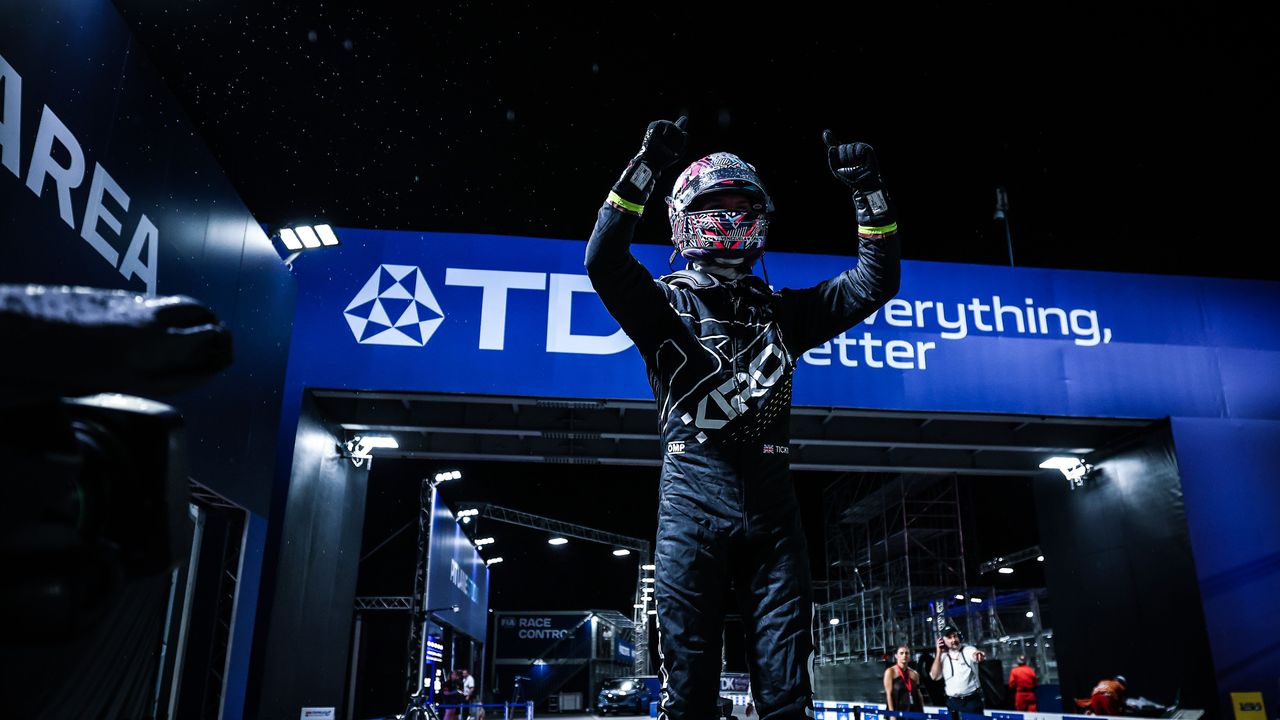
This is also why qualifying mattered so much to Wehrlein on Saturday. Pole removed the first major strategic problem. Instead of burning energy trying to pass in traffic, he could control the pace and force his rivals to solve the overtaking problem. For a broader explanation of why starting position matters, see our guide to grid position in racing.
London E-Prix 2026 Tyre Strategy: Why It Is Not an F1 Compound Game
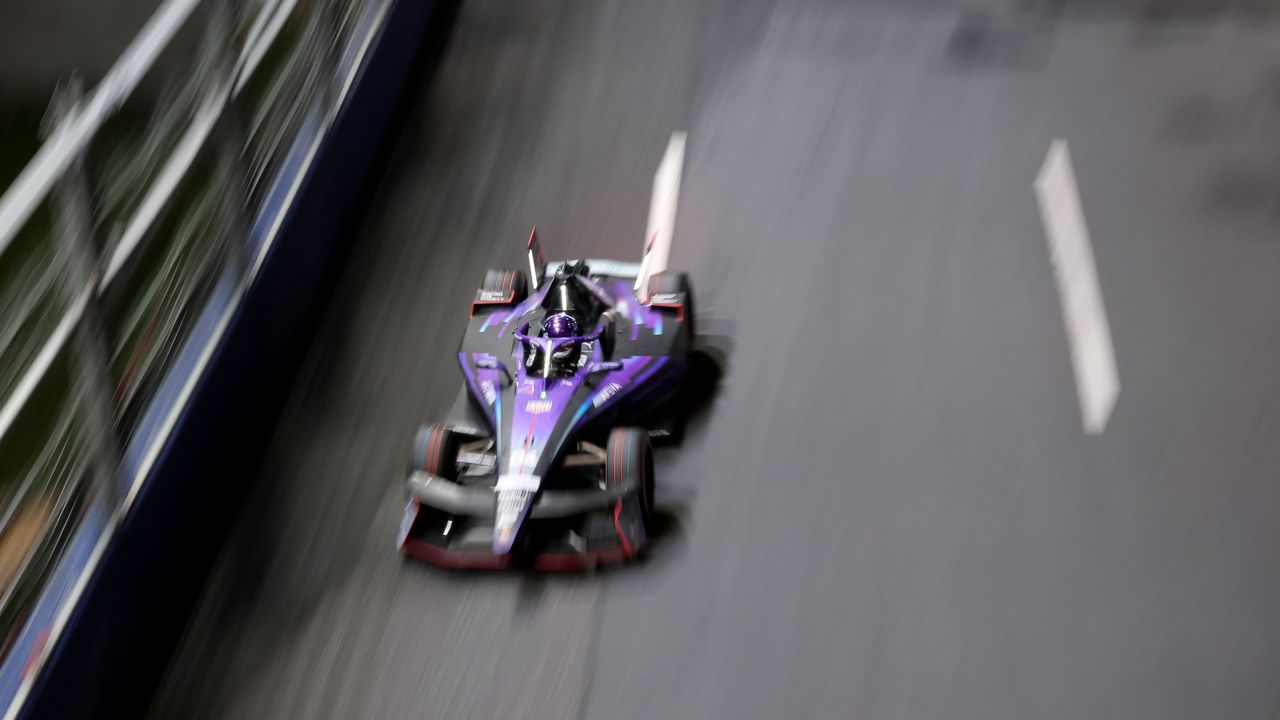
Tyres are important in London, but not because teams choose between soft, medium and hard compounds. Season 12 used a single Hankook iON all-weather tyre. Drivers had six new front and six new rear tyres across the double-header, so warm-up, damage, lock-ups and preserving the limited allocation mattered more than compound choice.
Formula E used Hankook’s 18-inch treaded all-weather tyre throughout the 2025/26 season. The tyre was designed to operate across dry and wet conditions and contained 35% recycled and sustainable materials. Formula E’s official rules limited each driver to six new front and six new rear tyres for a double-header. In practical terms, that means three sets must cover practice, qualifying and both races.
Therefore, there is no conventional tyre-stop undercut like we see in Formula 1. Teams are not pitting to switch from a soft to a medium. Instead, tyre strategy starts before the race. Engineers decide which tyres to cycle through practice, which set to protect for qualifying and how aggressively a driver can use the rubber without creating vibration or damage.
1. Warm-up versus energy efficiency
A tyre that is fully in its operating window gives the driver confidence under braking. However, aggressive weaving, acceleration and braking to build temperature uses energy. Formula E engineers therefore balance two competing needs: get the tyre ready enough for performance, but do not waste electrical energy doing it.
London complicates that trade because the indoor section is sheltered from wind and direct sunlight while the outdoor section is exposed. Surface differences also alter the available grip. A driver can arrive at the next corner with a slightly different tyre feel from the previous sector.
2. Lock-ups can become strategic damage
The Hankook tyre is durable, but a heavy lock-up can still create vibration and reduce confidence. On a narrow street circuit, a driver who becomes cautious on the brakes immediately becomes vulnerable. More importantly, a poor lock-up can cost track position that may be difficult to recover.
That is why tyre preservation at London is less about extending a “stint” and more about preserving braking performance and consistency. If the front axle stops giving the driver confidence, the car may still have plenty of battery energy but no safe way to attack.
3. Limited allocation rewards clean weekends
A double-header punishes unnecessary tyre damage. A flat spot on Saturday morning is not just a Saturday problem. It can affect how the remaining sets are allocated through Sunday qualifying and the final race. Drivers who avoid wall contact, deep lock-ups and unnecessary slides create more options for their engineers.
| Tyre factor | What mattered in London | Strategic effect |
|---|---|---|
| Single all-weather spec | No soft/medium/hard choice | Focus shifts to temperature, grip and damage |
| Six fronts + six rears | Allocation covers the full double-header | Practice mistakes can hurt Sunday options |
| Mixed surfaces | Grip feel changes around the lap | Setup compromise becomes critical |
| Heavy braking | Lock-up risk is high | Flat spots can reduce overtaking confidence |
PIT BOOST and Pit Stop Strategy: The Real Formula E Undercut
PIT BOOST is the reason “pit stop strategy” returned to Formula E vocabulary. The system provides a 10% energy increase, equal to 3.85 kWh, through a 30-second 600 kW ultra-fast charge. The total pit-lane loss is longer than the stationary time, so entering the pits is a major commitment. The benefit is additional usable energy for the rest of the race.
The FIA and Formula E also restrict when the boost can be taken. The car must be inside a specified battery state-of-charge window. Formula E’s published guide describes the operational range as below 60% and above 40% state of charge. Teams cannot simply stop whenever the traffic looks convenient.
Each team has one PIT BOOST rig. That prevents both cars from taking the charge at exactly the same time. Therefore, teammate spacing becomes a strategic constraint. If both cars enter the legal energy window together, one may have to stay out. That extra lap can be helpful if it creates clean air, or damaging if it drops the car into traffic.
What “undercut” and “overcut” mean in Formula E
An early PIT BOOST can act like an undercut when a driver gives up track position, receives the charge, then uses clean air and extra energy while rivals remain in traffic. A later stop can function like an overcut if staying out preserves track position and avoids rejoining behind slower cars. However, unlike a tyre undercut, the gain is not created by fresh rubber. It comes from traffic, energy and timing.
London magnifies this because the rejoin matters enormously. A driver can execute the stop perfectly and still lose if the car exits behind a train. Conversely, an early stop can look expensive for several laps and then become powerful once the field cycles through its own stops.
There is another layer. Attack Mode and PIT BOOST do not exist in isolation. Season 12 adjusted the Attack Mode framework around PIT BOOST races. The strategic question becomes: when should the driver take extra power relative to the charging stop? If Attack Mode is used too early, the driver may spend the temporary performance boost while still boxed in. If it is saved too late, a Safety Car or Full Course Yellow may shrink the time available to exploit it.
Wehrlein had already shown during the 2026 season how effective this sequencing could be. In Jeddah, Formula E’s official race report credited his win to timing PIT BOOST and Attack Mode correctly. Shanghai produced another example, with Wehrlein’s PIT BOOST timing helping him control the race before worsening weather and a Safety Car changed the picture. Those earlier wins are important context for London: Porsche arrived at the finale with a driver and operations group that had repeatedly executed this new strategic tool under pressure.
If you want the broader mechanics of racing stops, our guide to how pit stops work in racing explains the time-loss concept. Formula E simply adds an electrical energy transaction to the normal pit-lane calculation.
How Safety Cars and Yellow Flags Changed the London Strategy
A Safety Car compresses the field and usually reduces the energy needed to complete the same race distance at racing speed. That can weaken a driver who spent early laps saving energy to build a late advantage. It can also rescue a car that lost time, while making the restart and remaining Attack Mode timing far more important.
Safety Cars are particularly disruptive in Formula E because the race is an energy-management contest as well as a position contest. When the field slows, every car uses less energy. The advantage of a driver who carefully saved more energy during green-flag running can therefore shrink.
Saturday’s London race included yellow-flag and neutralisation moments that affected the strategic flow. Reports from the event noted a yellow period early in the race that hurt Mitch Evans’ position in the tactical cycle, while another incident involving Lucas di Grassi later in the race again influenced decision-making. The key point is not that every caution helps the same driver. It is that the timing of the interruption matters.
Imagine two cars separated by three seconds. Car A has spent ten laps saving energy and plans to use that reserve after Attack Mode. Car B has used more energy but sits close enough to remain in the fight. A Safety Car removes the three-second gap immediately. It also reduces the number of green-flag laps in which Car A can exploit its energy advantage. The careful saver may still be more efficient, but the race has taken away the time needed to cash in that advantage.
The reverse can also happen. A driver who loses time in traffic or during a PIT BOOST sequence can be pulled back into contention. That is why strategists constantly model “what if a Safety Car comes now?” rather than treating the race as one fixed plan.
Restarts are overtaking opportunities — and crash risks
A restart compresses the field into one small section of track. Tyres may be cooler. Brakes may feel different. Drivers know the first lap after green is one of the rare moments when rivals are vulnerable. At London, that produces opportunity and danger at the same time.
The title contenders could not evaluate those moves like midfield drivers. A fifth-place finish can win a championship. A zero caused by contact cannot. This is where the standard motorsport idea of “maximum attack” becomes misleading. The best championship strategy is sometimes to decline a move that would be correct in a normal race.
For a basic explanation of neutralisations, see what a Safety Car does in racing and our guide to racing flags.
Why Overtaking Is So Difficult at the London E-Prix
London’s biggest strategic problem is that the race can produce a large pack without producing easy overtakes. The indoor-outdoor circuit is narrow, the barriers are close, and many corners do not provide a safe second line. A driver can be close enough to attack yet still lack the geometry needed to finish the pass.
That creates what strategists sometimes describe as a “track position premium.” The value of being ahead rises because the following car needs a larger performance advantage than it would at a wide permanent circuit. The leader can place the car defensively, manage energy and force the pursuer to choose between waiting and attempting a high-risk move.
Why Attack Mode is not a guaranteed pass
GEN3 Evo gives drivers an extra 50 kW and all-wheel drive during Attack Mode, but the activation itself costs track position because the driver must leave the conventional racing line to pass through the activation zone. A driver can gain power and lose places in the same moment.
The ideal activation therefore depends on traffic. If a gap exists behind, a driver may be able to take Attack Mode and retain position. If the field is compressed, the same activation can drop the car several places. The extra power then has to be used simply to recover what was lost.
London’s short straights make this harder. The driver may reach the next braking zone with more power but not enough overlap. The safest choice can be to wait another corner. That burns precious Attack Mode time.
Energy trains can look slow but be strategically rational
Formula E races sometimes produce periods when the front of the field drives below the maximum possible pace. This is not a lack of performance. It is a deliberate attempt to save energy, avoid leading the air and keep tactical flexibility.
At ExCeL, that behaviour can create a tightly packed train. The leader controls the pace, while cars behind save energy in the slipstream and wait for the moment when Attack Mode, PIT BOOST or a rival mistake changes the order. If the pack is twenty cars long, the race can move from calm to chaotic within one lap.
The physics are familiar to anyone who follows other forms of racing. Our explanation of slipstreaming covers the basic advantage of following another car. However, Formula E adds an energy-management incentive: following can save both aerodynamic drag and electrical energy.
Why qualifying remains a strategic weapon
Wehrlein’s Saturday pole was not simply a qualifying statistic. It removed traffic from his opening stint and let Porsche dictate the first tactical questions. Dennis, Evans and the other title rivals had to react to the leader rather than forcing the leader to react to them.
This is why a London race strategy begins hours before the start. Setup choices that improve one-lap confidence may be worth more than a small theoretical efficiency gain if they move the car from eighth to third on the grid. On a circuit where passing is expensive, qualifying position can save energy all afternoon.
Saturday, Round 16: How Wehrlein Took Control of the Championship
Saturday was the strategic turning point of the weekend. Wehrlein started from pole for Porsche and won the race. Jake Dennis finished second for Andretti, while António Félix da Costa completed the podium for Jaguar. The victory lifted Wehrlein to 169 points and into the championship lead with one race remaining.
The importance of the win goes beyond the 25 points. Entering London, Dennis led the championship on 146 points, with Evans on 144 and Wehrlein on 141. That meant Wehrlein began the finale five points behind Dennis. By Saturday night, the situation had reversed. Wehrlein was the driver everyone else had to chase.
From a strategy perspective, pole allowed him to control the opening phase. The driver at the front can decide whether to push, save or back the field into a pack. The cars behind have to monitor both their own energy and the risk that the leader suddenly increases the pace.
Reports from the race also highlighted the role of Porsche teammate Nico Müller in the tactical picture. Team cars do not need to block illegally to affect a race. Simply occupying the right track position, defending normally and forcing rivals to spend energy while overtaking can protect the lead car.
Mitch Evans had one of the worst possible outcomes for a title challenger: not a retirement, but a race in which the strategic rhythm went against him. He finished eighth. That kept him mathematically alive, yet it left him with much more work on Sunday.
| Saturday result | Driver | Team | Strategic meaning |
|---|---|---|---|
| 1 | Pascal Wehrlein | Porsche | Converted pole; took championship lead |
| 2 | Jake Dennis | Andretti | Limited damage; stayed within five points |
| 3 | António Félix da Costa | Jaguar | Strong team score in Teams’ title fight |
| 8 | Mitch Evans | Jaguar | Lost ground before the finale |
Sunday, Round 17: Barnard Won the Race, Wehrlein Won the Championship
Sunday produced the classic championship paradox: the race winner and the biggest winner were different people. Taylor Barnard took his first Formula E victory for DS PENSKE, passing Nyck de Vries late in the race. De Vries finished second and Edoardo Mortara third, completing a double podium for Mahindra.
For Barnard, the result was historic. At 22 years and 76 days, he became Formula E’s youngest race winner. His late move on de Vries showed exactly what successful London overtaking requires: enough performance advantage, the correct moment and the confidence to finish the move before the narrow track closes again.
Wehrlein’s race was much less glamorous. He finished outside the points. Yet championship strategy is not judged by one finishing position. His Saturday victory had created the buffer. Dennis’ difficult Sunday and the failure of the other contenders to score enough meant Wehrlein could secure the title without a top-10 finish.
This is a useful lesson for strategy analysis. A driver fighting for a race win asks, “How do I maximise this race?” A driver fighting for a championship asks, “What result do I need relative to the other contenders?” Those are different optimization problems.
Jake Dennis entered Sunday only five points behind Wehrlein. He started deep in the field and eventually finished 18th after a difficult race that included late drama. That removed the strongest immediate threat to Wehrlein. Mitch Evans finished fourth, collecting a substantial score, but it was not enough to overturn Wehrlein’s advantage.
Jaguar still had a major reason to celebrate. The team secured the Teams’ Championship. That outcome underlines how Formula E rewards two-car execution. Even when an individual driver title slips away, consistent scoring from both cars can win the team crown.
Energy Management: The Hidden Variable Behind Every London Move
Formula E’s strategic language can sound unusual because “fuel saving” is replaced by electrical energy management. The principle is similar. Drivers have a finite amount of usable energy, so the fastest possible lap is not always the fastest way to complete the race.
Regenerative braking is central. Formula E states that nearly half of the energy needed to finish a race can be produced during the event through regeneration. GEN3 Evo can recover up to 600 kW under braking using front and rear powertrains. London’s repeated braking zones create many regeneration opportunities, but extracting them efficiently without compromising lap time requires precise control.
Drivers also use lift-and-coast. They lift the accelerator before the normal braking point, allowing the car to slow with less energy use before the major regenerative braking phase. In a pack, the aerodynamic tow can make this even more efficient.
The strategic challenge is knowing when to stop saving. A driver can finish with excess energy and still lose the race. The energy has value only if it can be converted into speed, position or defensive security before the chequered flag.
London makes this conversion difficult because traffic blocks the ideal line. The result is a race where the timing of an energy release can be more important than the size of the energy advantage itself.
For comparison with hybrid racing technology, our explainer on ERS in Formula 1 shows how another championship stores and deploys recovered energy. Formula E pushes that logic much further because the complete propulsion system is electric.
Championship Impact: Why London Changed Everything Twice
The championship entered London with remarkable compression. Reuters reported that nine drivers were still mathematically in contention before the double-header. Dennis led with 146 points, Evans had 144 and Wehrlein 141. That meant one poor race could completely change the order.
Saturday did exactly that. Wehrlein’s victory moved him to 169 points. Dennis’ second place kept him close on 164, while Evans’ eighth place left him needing a much larger Sunday swing. Suddenly the strategy for the final race became asymmetric.
Wehrlein did not need to beat everyone. He needed the championship equation to stay in his favor. Dennis needed to score enough to reverse a five-point deficit. Evans needed a strong result and help from results ahead. That changes how each driver interprets contact risk, Attack Mode timing and defensive moves.
Why championship pressure magnifies London’s overtaking problem
On a normal weekend, a driver may accept a 30% chance of contact if the move offers a large expected finishing-position gain. In a title finale, the same calculation can be irrational. A retirement has a far higher cost because there is no next round to recover the points.
That risk is especially serious at ExCeL. Many passes happen with the wall only a few meters away. A small touch can break steering, damage a wing or cause a puncture. The championship contender therefore has to judge not just whether a move is possible, but whether it is necessary.
Wehrlein’s final title margin over Dennis was five points according to post-race reporting. That makes Saturday’s win look even more important. The victory did not simply add points; it gave Wehrlein the strategic freedom to survive a poor Sunday result.
Jaguar won the Teams’ Championship
The Drivers’ Championship went to Porsche’s Wehrlein, while Jaguar secured the Teams’ title. That split result is a reminder that Formula E has multiple strategic championships running at once. A team may ask one driver to attack while the other protects a points position. It may value two solid finishes over one win and one retirement.
For readers following the full series, our Formula E schedule, Formula E teams guide and Formula E viewing guide provide the wider season context.
Five Strategy Lessons From the 2026 London E-Prix
1. Qualifying can be an energy-saving tool
Starting at the front is not only about avoiding traffic. It can reduce the amount of energy a driver must spend overtaking. Wehrlein’s Saturday showed how pole position can simplify the whole race model.
2. The best PIT BOOST timing is traffic-dependent
A theoretically optimal energy window is useless if the car rejoins behind a slow train. The most valuable pit decision is often the one that creates clean air, even if it is not the earliest legal stop.
3. Attack Mode should be treated as a passing window, not just a power number
The extra 50 kW and all-wheel drive matter only when the driver has room to use them. Activating into traffic can waste much of the advantage. London therefore rewards patience and awareness of gaps behind.
4. Safety Cars destroy deterministic strategy
No race plan survives every neutralisation. The best teams are not those with one perfect pre-race plan. They are the teams that update the plan fastest when the field is compressed.
5. Championship math changes acceptable risk
Wehrlein did not need to win Sunday. Once Dennis and other challengers ran into trouble, the correct decision was to protect the title outcome rather than chase an unnecessary race result. That distinction is the heart of championship strategy.
Fans who want more general tactical background can also read our explainers on how car racing works, race timing and how laps are counted.
London E-Prix 2026 Strategy FAQ
Conclusion: London Was a Track-Position Championship
The London E-Prix 2026 strategy story was not about finding a magic tyre compound or making a traditional two-stop call. Formula E demanded a different type of race intelligence. Drivers had to protect one all-weather tyre specification, regenerate energy, judge when to lift and coast, time Attack Mode, navigate PIT BOOST rules across the double-header and constantly recalculate the effect of Safety Cars and traffic.
ExCeL made every one of those decisions harder. Its narrow indoor-outdoor layout gave track position an unusually high value. Drivers could save energy and still remain trapped. They could activate extra power and have nowhere to use it. They could build a gap and lose it to a neutralisation.
Wehrlein’s weekend is the clearest example. Saturday was about execution: pole, control and victory. Sunday was about the championship equation. He did not need another win. He needed the remaining title contenders to fail to overturn the advantage he had created 24 hours earlier. That is exactly what happened, giving Porsche’s driver a second world championship.
Barnard’s first victory gave the final ExCeL race its own story, while Mahindra’s double podium and Jaguar’s Teams’ Championship ensured the finale was bigger than one driver. The result was a weekend where qualifying, energy, passing difficulty and championship pressure all mattered at once.
For Formula E, it also closed a chapter. The GEN3 Evo era ended in London, and the championship now moves toward the more powerful GEN4 generation. The cars will change. The strategic lesson will not: in electric racing, the fastest driver is often the one who knows exactly when not to be fast.