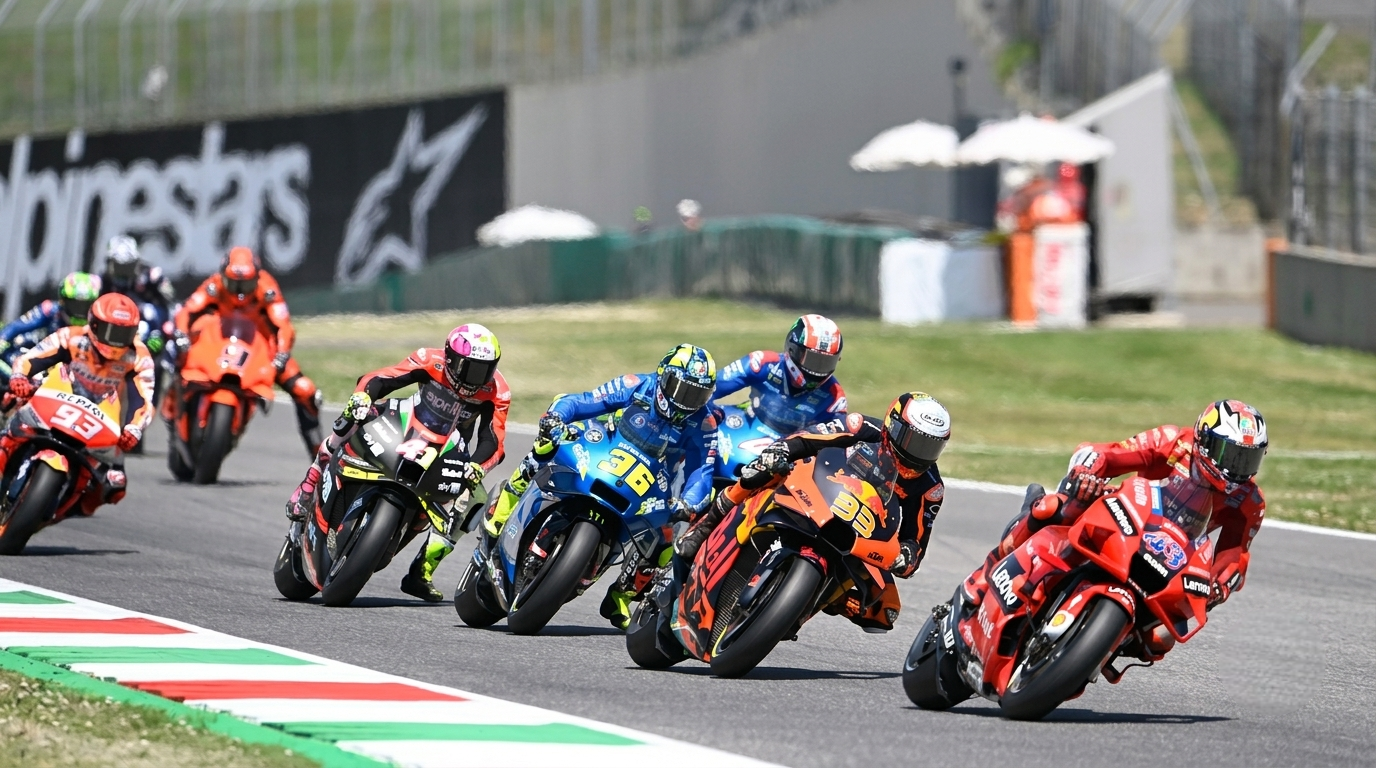
Italian Grand Prix MotoGP 2026:
Full Preview, Schedule & Analysis
Mugello turns the volume up every June and the 2026 edition arrives with the championship fight wide open. Here’s the complete guide — race weekend schedule, circuit breakdown, the riders and teams to watch, tyre strategy, and what the championship table looks like heading into the heart of Tuscany.
Italian GP MotoGP 2026:
Preview & Schedule
Championship fight, Mugello breakdown, rider analysis and everything you need for race weekend in Tuscany.
Every MotoGP calendar has moments that feel genuinely special — weekends where the combination of circuit, crowd, and championship drama creates something that stands apart from the rest of the season. Mugello is one of them. The Autodromo Internazionale del Mugello sits deep in the Tuscan hills, an hour north of Florence, and it delivers the fastest, most aerodynamically demanding lap in the entire MotoGP calendar. Top speeds here regularly exceed 340 km/h down the start-finish straight. Lateral G-forces through the Arrabbiata curves load the front tyre so hard that engineers spend Thursday night adjusting front-end geometry settings by fractions of a degree.
The 2026 Italian Grand Prix lands at Round 8 of the MotoGP World Championship with the title battle still genuinely unsettled. Ducati’s stranglehold on the grid continues — the Bologna manufacturer supplies multiple factory and satellite teams with versions of the Desmosedici GP26 — but Aprilia, KTM, and a resurgent Yamaha have all shown flashes of the pace required to disrupt the red machines at circuits where outright top speed matters less than corner-entry aggression. Mugello, where pure acceleration out of slow corners feeds directly into the longest sustained flat-out section on the calendar, is historically Ducati territory. But history, as this championship keeps proving, is a unreliable guide.
Event: Gran Premio d’Italia — MotoGP Round 8, 2026
Circuit: Autodromo Internazionale del Mugello · Scarperia e San Piero, Tuscany, Italy
Race Distance: 23 laps · 120.635 km
Sprint Race: 11 laps · 57.695 km (Saturday afternoon)
Defending Mugello Winner: Francesco Bagnaia (Ducati Lenovo Team) — 2025
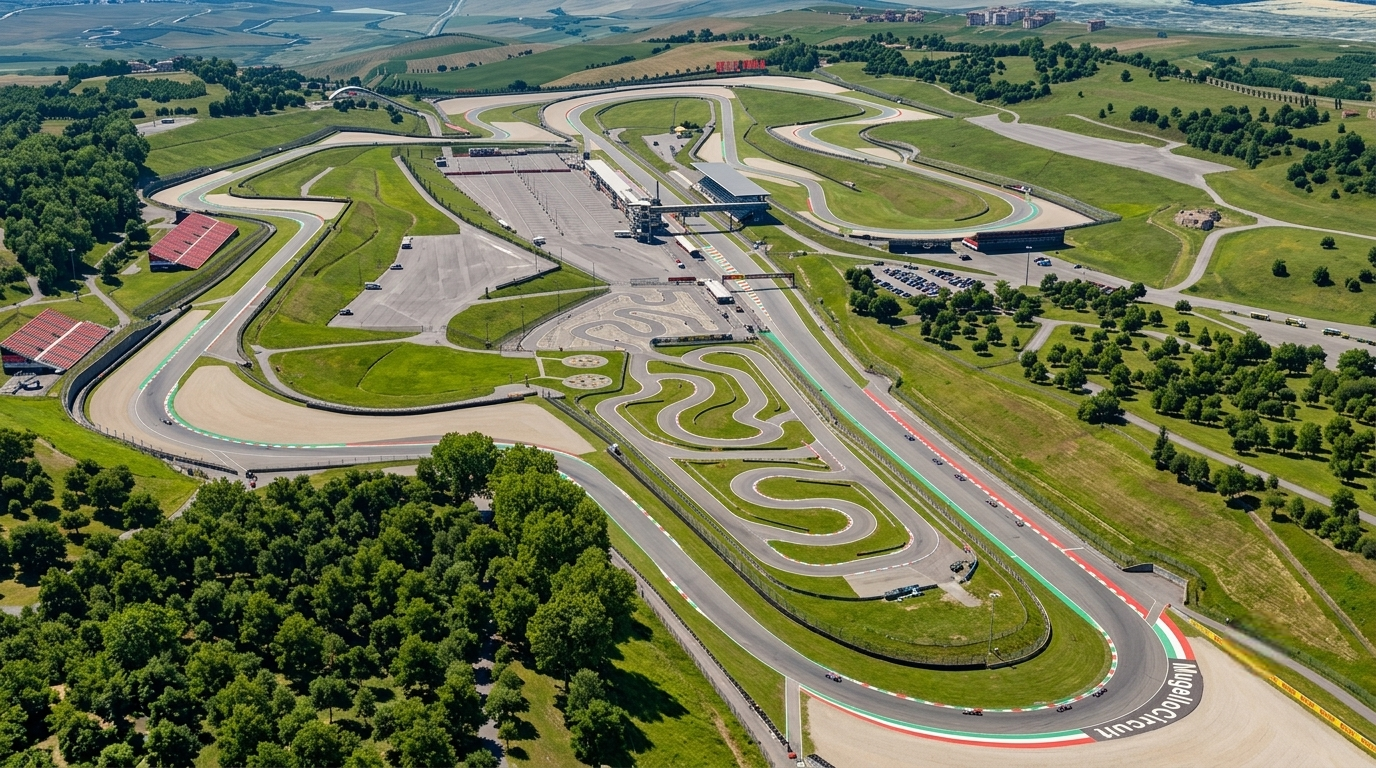
Mugello is a circuit that rewards a specific kind of bravery. The first sector is almost entirely flat-out — a sequence of fast curves where the difference between a lap record and a crash is measured in the precise moment a rider opens the throttle at the exit of San Donato. The long back straight that feeds into the Arrabbiata 1 and Arrabbiata 2 right-handers gives the Ducati its biggest advantage: the GP26 can accelerate harder out of slow corners and carry that speed further into the braking zone than any other bike on the grid. That physical fact shapes every strategy discussion before the season even starts.
What makes 2026 genuinely interesting is the narrowing of that gap. Aprilia’s RS-GP26 has demonstrated genuine top-speed competitiveness at circuits it historically struggled on. KTM’s front-end aggression suits the late-braking demands of Arrabbiata perfectly. And Jorge Martín, having taken the 2024 world title aboard a Pramac Ducati before moving to Aprilia for 2026, arrives in Tuscany determined to prove that his Mugello podiums in previous years were not purely machine-dependent.
Italian MotoGP 2026 — Full Weekend Schedule
The MotoGP race weekend at Mugello follows the standard 2026 Sprint format introduced across the full calendar, meaning riders face two separate competitive events — the 11-lap Sprint on Saturday afternoon and the full 23-lap Grand Prix on Sunday. Understanding this format is essential for following the session timing and the strategic decisions that Saturday’s result creates for Sunday’s race. Every session listed below is in Central European Time (CET / UTC+2 in June). International viewers should convert accordingly — UK is CET-1, East Coast US is CET-6.
5 June
5 June
6 June
6 June
6 June
7 June
7 June
Live coverage is available on Sky Sports MotoGP (UK/Europe) and MotoGP VideoPass worldwide. In Italy, Sky Italia carries every session. North American viewers can access MotoGP.com VideoPass which streams every practice, qualifying, Sprint and race live with English commentary. BT Sport and DAZN also carry MotoGP rights in various territories — check your local listings as broadcast deals vary by country. For a broader motorsport streaming context, see our guide on how different racing series work globally.
Mugello Circuit — Lap by Lap Analysis
The Autodromo Internazionale del Mugello has been part of the MotoGP calendar since 1976 in its current form and has been owned by Ferrari since 1988. That ownership explains the level of investment in the facility — it’s one of the best-maintained and most spectator-friendly circuits on the calendar. But the track itself is the real story. Five-point-two kilometres of flowing asphalt cut through the Mugello valley, rising and dropping through gradient changes that challenge suspension settings on every lap.
| Stat | Figure | Context |
|---|---|---|
| Circuit length | 5.245 km | One of the longest and fastest on the MotoGP calendar |
| Race laps (GP) | 23 laps · 120.6 km | Standard MotoGP race distance at Mugello |
| Sprint race laps | 11 laps · 57.7 km | Saturday’s Sprint — half the GP distance |
| Corners | 15 | Mix of high-speed sweepers and tight stop-and-go chicanes |
| Top speed recorded | 356.9 km/h | Ducati GP22 — Johann Zarco, 2022 qualifying; GP26 exceeds this |
| Lap record | 1:45.519 | Francesco Bagnaia — Ducati GP23 — 2023 qualifying |
| Main straight | ~1.1 km | Longest sustained flat-out section in MotoGP — 12+ seconds at full throttle |
| Key overtaking point | San Donato (T1) | The only realistic outright overtaking window — late braking into tight hairpin |
The Corners That Decide Everything
The Mugello main straight is 12 seconds at full throttle. In those 12 seconds, every aerodynamic advantage or disadvantage between manufacturers is laid bare. There’s nowhere to hide at 340 km/h.
Riders to Watch at Mugello 2026
The MotoGP grid in 2026 is the most talented it has been in a decade. A generation change at the top has placed Marc Márquez, Francesco Bagnaia, Jorge Martín, and Pedro Acosta as the primary championship contenders — four riders representing fundamentally different riding philosophies, all converging on a circuit that punishes exactly two things above all others: front-end timidity and rear-tyre aggression in the opening laps.
Francesco Bagnaia — Ducati Lenovo Team
Two-time MotoGP World Champion and the man who understands the Desmosedici’s throttle characteristics better than anyone except the Ducati engineers themselves. Bagnaia’s Mugello record is exceptional — two wins, three poles, and a pattern of dominant front-running that suggests the circuit genuinely suits his precise corner-entry style. His advantage at Mugello is specific: he runs the most aggressive front-end geometry setting of any Ducati rider, which allows him to rotate the bike into the Arrabbiata sequence without the brief mid-corner push that costs most riders a tenth on each passage. In 2026, with the GP26’s improved rear traction control calibration, that advantage should compound.
Watch his sector 2 time through the Arrabbiata sequence in practice. If he’s consistently 0.2 seconds faster than the field in that sector, Sunday’s race is almost certainly his to lose. If that gap closes to 0.1 or less — particularly from Martín on the Aprilia — expect a genuine fight to the flag. Understanding why pole position matters differently at each circuit is key to reading Saturday’s qualifying outcome correctly here.
Marc Márquez — Ducati Lenovo Team (GP26)
The eight-time world champion and the most naturally aggressive front-end rider in the history of the sport. Márquez’s Mugello record before his Honda years was remarkable — four wins between 2014 and 2019 using his trademark late braking into San Donato and commitment through the fast sections that other riders couldn’t match. Now on the GP26, having moved from the Gresini team to the full factory Ducati squad for 2026, Márquez has a machine that can actually absorb his riding style without the constant front-end instability that plagued his Honda years. The concern at Mugello specifically is that the GP26’s wheelbase geometry, optimised for Bagnaia’s smooth style, requires small setup compromises for Márquez’s more aggressive weight transfer. Whether the Ducati engineers have found that compromise over the winter will become apparent in FP2.
Jorge Martín — Aprilia Racing (RS-GP26)
The 2024 MotoGP World Champion made the most consequential rider move in recent memory when he left the Pramac Ducati — on which he won the title — to join Aprilia for 2026. Early season results have been mixed, as expected during a machine-learning process that typically takes at least half a season. But Martín’s natural Mugello pace — he’s podiumed here on machinery inferior to the Ducati — is a circuit-specific asset that exists independent of his current championship form. Aprilia’s RS-GP26 has shown genuine straight-line speed improvement, which at Mugello translates directly to top speed trap numbers that determine whether overtaking at San Donato is achievable or merely theoretical. See our piece on the broader dynamics of MotoGP crash risk and race management for context on how Martín balances aggression against tyre conservation.
Pedro Acosta — Red Bull KTM Factory Racing
Twenty-one years old and already carrying the weight of being described as MotoGP’s next generational talent. Acosta’s front-end aggression is arguably the most natural of anyone currently on the grid — his ability to carry speed into braking zones that most riders consider fixed reference points is a skill that appears genuinely innate rather than learned. The KTM RC16’s strength at Mugello is its front-end bite through the Arrabbiata sequence; its weakness is the top-speed deficit on the main straight relative to Ducati. In 2026, KTM has made significant aerodynamic gains that may have closed that gap enough for Acosta to run within Ducati’s slipstream into San Donato and mount a genuine late-braking attack.
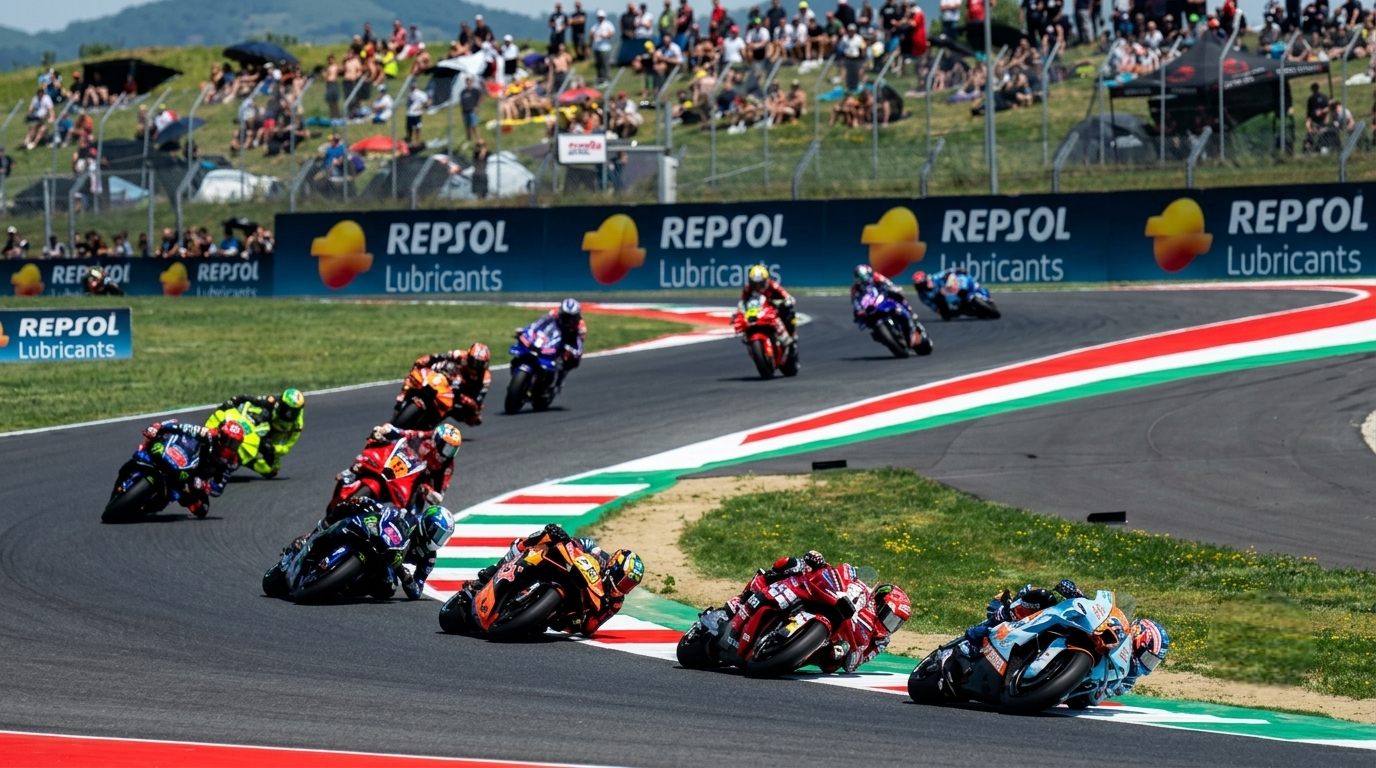
The Supporting Cast — Bastianini, Viñales, Quartararo
Enea Bastianini on the factory Ducati is always a threat at circuits where pure aggression on the opening laps pays off — Mugello’s long straights suit his style of building a gap before managing the closing stint. Maverick Viñales on the Aprilia has shown that when the RS-GP26’s front tyre window is right, he’s as fast as anyone in the first sector. Fabio Quartararo and Yamaha remain an intriguing wildcard: Mugello’s dependence on top-end speed is historically Yamaha’s weakest area, but the 2026 YZR-M1 development programme has produced measurable straight-line improvements that suggest the Japanese manufacturer may finally be competitive in the speed traps that define Mugello qualifying.
Teams, Machines & The 2026 Technical Battle
The 2026 MotoGP grid runs on five distinct engine configurations across four manufacturers, all operating within identical Maximum Power Output regulations. The spec-control areas — unified ECU, spec tyres supplied by Michelin — create a level of competitive tightening at the top of the grid, while manufacturer differences in chassis geometry, aerodynamic package design, and swingarm flex characteristics continue to separate the grid in ways that timing screens don’t fully capture.
| Manufacturer | Factory Team | Key Riders | Mugello Strength | 2026 Engine Config |
|---|---|---|---|---|
| Ducati | Ducati Lenovo Team | Bagnaia · Márquez | Top-end acceleration, traction out of slow corners | V4 · 1000cc |
| Aprilia | Aprilia Racing | Martín · Viñales | Corner speed, front-end consistency at high-speed | V4 · 1000cc |
| KTM | Red Bull KTM Factory | Acosta · Binder | Front-end aggression, late-braking into T1 | V4 · 1000cc |
| Yamaha | Monster Energy Yamaha | Quartararo · Rins | Chassis balance through the Arrabbiata pair | Inline-4 · 1000cc |
| Honda | HRC Castrol Honda | J.Mir · Di Giannantonio | Historical Mugello record; 2026 package improving | V4 · 1000cc |
The Ducati satellite structure deserves particular attention at Mugello. The VR46 Racing Team with Marco Bezzecchi, the Gresini Ducati with Álex Márquez, and the Pertamina Enduro team collectively field versions of the GP26 that, while not identical to the factory specification, represent machinery significantly faster than any competing manufacturer’s current-specification bike. When Ducati occupies six of the top seven positions on the grid — as it regularly does in 2025 and 2026 — the internal politics of team orders and whether satellite riders are truly racing the factory bikes becomes a legitimate championship storyline worth tracking. For context on how constructor titles work alongside rider championships, the racing championship scoring explainer covers the dual-points structure clearly.
All five manufacturers have introduced 2026-specification aerodynamic winglet packages for Mugello, the circuit where the trade-off between top-speed drag reduction and downforce for high-speed corner stability is most acute. At 340+ km/h on the straight, every square centimetre of additional wing area creates drag that costs tenths in the speed trap. Through the Arrabbiata sequence at 230 km/h, that same wing area generates the downforce that stops the front wheel from tucking. Teams run wind-tunnel-optimal packages for Mugello specifically — the settings used here are not used at any other circuit. Understanding what downforce does to a racing vehicle and how slipstreaming works on the main straight gives full context for reading the practice session speed trap data.
Race Strategy at Mugello — Tyres, Pace & How It Unfolds
MotoGP race strategy at Mugello is fundamentally different from most other circuits on the calendar because the race starts with all riders on fresh tyres and there are no pit stops for rubber changes. The entire strategic equation reduces to a single question: how hard can you push in the opening laps without destroying the rear tyre before lap 18? Get that balance wrong and the rider who looked fastest in practice is a sitting duck in the closing stages, passed by three bikes on fresher rubber in the final four laps.
Michelin Tyre Selection for Mugello 2026
Michelin nominates three front and three rear tyre compounds for each event, and the asymmetric nature of Mugello — heavy loading on the left side from the clockwise layout’s long right-hand corners — means compound choice is particularly nuanced here. The standard nomination for Mugello includes:
- Front: Soft (A), Medium (B), Hard (C) — most riders qualify on Soft, race on Medium or Hard depending on ambient temperature
- Rear: Soft (A), Medium (B), Hard (C) — race choice is typically Medium or Hard; Soft is viable in cooler conditions or for a gap-building first stint followed by conservation
Tyre Strategy Probability — MotoGP Italian GP
⚠ Probabilities based on historical Mugello compound data and 2026 practice temperature projections. Actual compound nomination subject to Michelin confirmation on Thursday evening.
Sprint Race Saturday — A Different Calculation Entirely
The 11-lap Sprint on Saturday afternoon is not a miniature version of Sunday’s race — it’s a completely different strategic exercise. With 11 laps, tyre management is almost irrelevant: the Soft rear can survive 11 aggressive laps even in June’s Tuscan heat. This creates an incentive for all riders to start on the Soft rear and extract maximum pace from lap one. The result is a race that’s essentially a qualifying lap repeated for 11 consecutive laps — whoever has the best single-lap pace on fresh rubber wins the Sprint. Crucially, Sprint results carry half-points, so a dominant Bagnaia could arrive at Sunday’s grid having already extended his championship lead by 12 points.
At Mugello, data from the past five seasons consistently shows the decisive performance drop beginning around lap 7–8 for riders on the Medium rear and laps 10–11 for riders on the Hard. The window between lap 6 and lap 14 is where the race is decided: a rider who protects their tyre through this period by being 0.3–0.4 seconds slower than their peak pace emerges in the closing laps with a 0.8–1.2 second per lap advantage over rivals who attacked early. Understanding how race timing reveals these strategy patterns is what separates watching the race from actually following it.
Italian Grand Prix MotoGP — Mugello History & Records
The Mugello Circuit has hosted the Italian Motorcycle Grand Prix continuously since 1994 in its current championship-grade configuration. Before that, the circuit ran a shorter layout and the Italian GP rotated between venues. But the modern Mugello era — thirty years of continuous MotoGP history in the Tuscan hills — has produced some of the sport’s most iconic imagery and most memorable race outcomes.
| Record | Holder | Figure | Year |
|---|---|---|---|
| Lap Record (MotoGP) | Francesco Bagnaia | 1:45.519 | 2023 (Qualifying) |
| Top Speed Trap | Johann Zarco | 356.9 km/h | 2022 (Ducati GP22) |
| Most Mugello Wins (MotoGP) | Valentino Rossi | 7 victories | 1997–2008 |
| Most Mugello Poles | Marc Márquez | 5 poles | 2013–2019 |
| Consecutive Wins | Valentino Rossi | 4 in a row | 2002–2005 |
| Fastest Race Lap (Premier) | Jack Miller | 1:46.896 | 2021 race fastest lap |
| First MotoGP Winner at Mugello | Max Biaggi | Winner | 1998 |
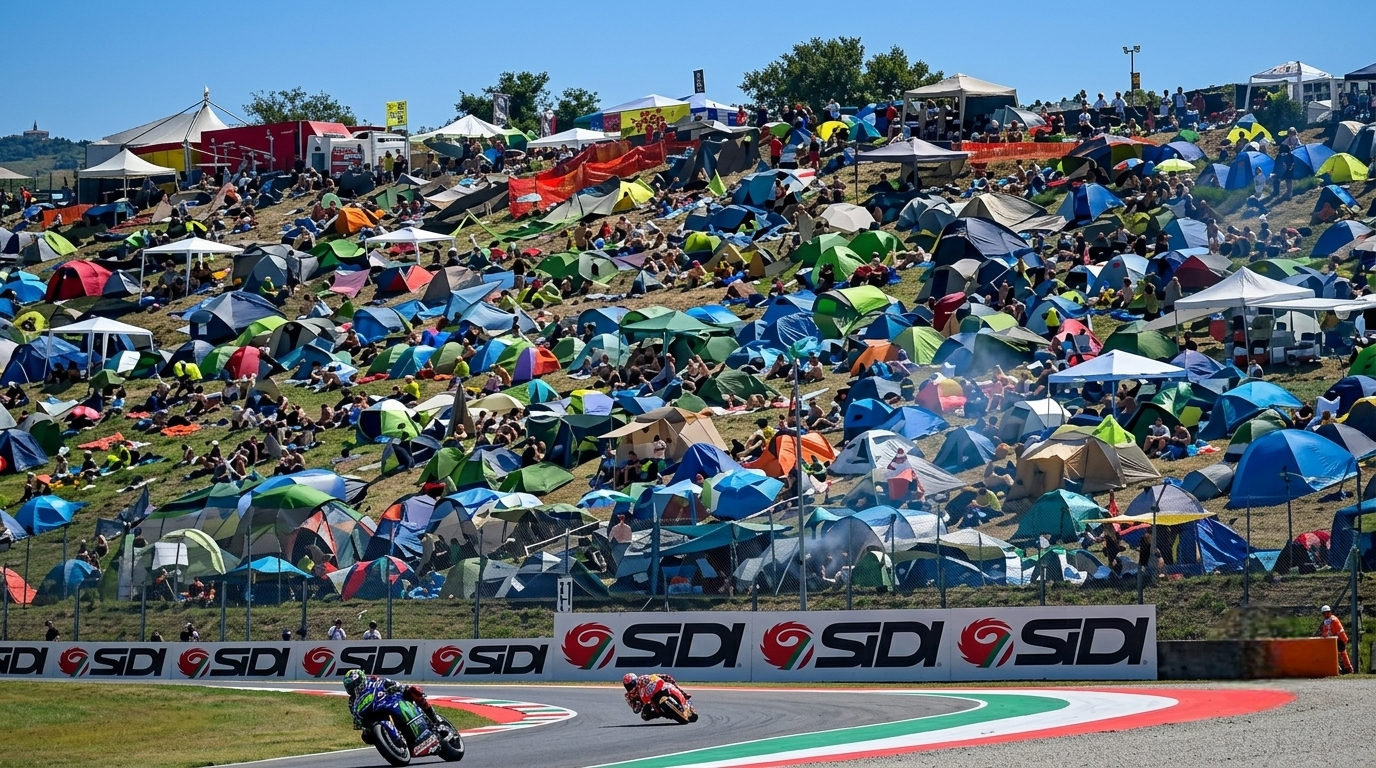
Valentino Rossi’s seven Mugello victories deserve a specific mention because they represent the most complete expression of what this circuit rewards. Rossi won here with Honda, Yamaha, and on inferior machinery where his circuit knowledge and crowd relationship gave him a psychological edge that analysts struggle to quantify. His home crowd — the Mugello bleachers are among the most partisan in motorsport — created an atmosphere that Rossi demonstrably performed better in than rivals, particularly in the late-race pressure situations where the circuit’s lack of genuine overtaking opportunities makes psychological composure as important as outright pace.
The modern Ducati era, beginning with Bagnaia’s 2022 victory, represents a shift in Mugello’s competitive profile. Where Rossi won through a combination of chassis balance and reading rear tyre degradation precisely, Bagnaia wins by building a gap in the first eight laps that the circuit’s overtaking difficulty makes impossible to close. The circuit hasn’t changed; the machine advantage has simply become large enough that tactical riding can replace defensive riding. For historical context on how motorcycle racing evolved alongside automotive racing, the history of motocross and its impact on road racing development offers fascinating parallel reading. The mid-century motorsports exhibit at the World of Speed Museum also covers the Italian racing tradition that made circuits like Mugello possible.
MotoGP 2026 Championship Standings Going Into Mugello
MotoGP’s Sprint format, introduced in 2023 and now fully embedded in the championship structure, has created a points landscape where each weekend offers a maximum of 37 points — 25 for a Sunday win, 12 for a Saturday Sprint win. Over a 21-round season, that means 777 maximum points are available. By Round 8 at Mugello, approximately one-third of the season’s points capacity has been distributed, and the championship table reflects which riders have managed the Sprint-race risk assessment correctly alongside their Sunday consistency.
Heading into the 2026 Italian Grand Prix, the championship picture from the first seven rounds shows Bagnaia and Márquez in the top two positions — the internal Ducati tension that their tightly matched form creates is one of the season’s compelling subplots. Martín’s Aprilia transition has been exactly as difficult as expected, with strong one-lap pace but inconsistent race performance as he learns the RS-GP26’s tyre window. Acosta on the KTM is the genuine title wildcard: three podiums in seven rounds on machinery that statistically shouldn’t be finishing that high is a statement about his innate ability to exceed his equipment.
A round 8 double — Sprint win Saturday, race win Sunday — delivers 37 points. At this stage of the season, with 14 rounds remaining after Mugello, a 37-point swing between the championship leader and second place shifts the effective title odds more significantly than any equivalent swing will in the final third of the season. If the Mugello winner is not the current championship leader, expect the paddock’s perception of who will win the title to shift meaningfully by Sunday evening. For context on how racing championship points systems work and why mid-season rounds carry disproportionate psychological weight, see our explainer. The Dutch TT Assen MotoGP preview following Mugello covers the next round’s championship implications in detail.
Frequently Asked Questions
Why the 2026 Italian Grand Prix is worth every minute of your Saturday and Sunday
Mugello does not produce boring races. The circuit’s layout — fast, demanding, with essentially one overtaking point at Turn 1 — creates races where the order is set early and defended brilliantly rather than shuffled at every corner, which means every lap tells you something about tyre management, rider composure, and team strategy rather than just raw speed. When the order does change, it changes because someone has made the most precise tactical call of their weekend. That’s the drama. It rewards the viewer who understands what they’re watching.
The 2026 edition arrives with the championship genuinely open, five manufacturers fielding competitive machinery, and the defining question of whether Ducati’s Mugello structural advantage can survive Aprilia and KTM’s most serious challenge to it in years. Saturday’s Sprint will give you the first competitive data point. Sunday will tell you everything about the 2026 title race.
Full race results, championship standings and round-by-round coverage at worldofspeed.org throughout the 2026 season.