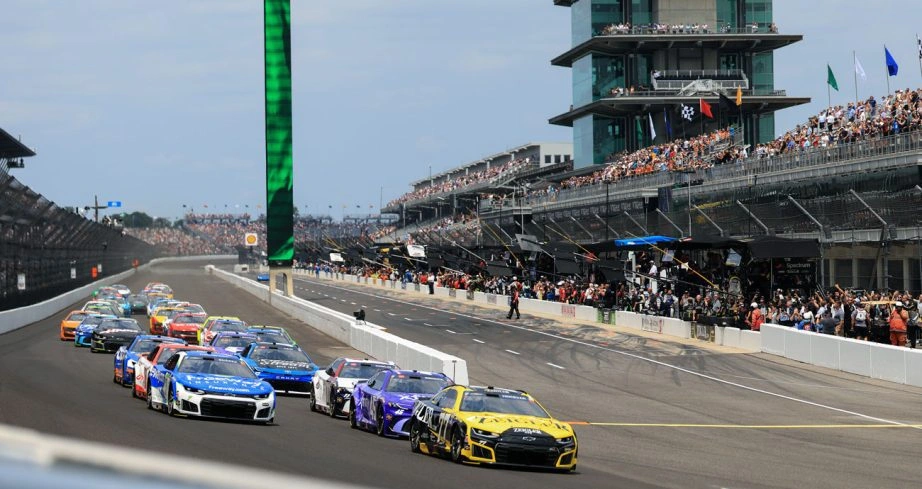
Brickyard 400 2026 Race Results:
Winner and Full Classification
Corey Heim won a tense 160-lap Brickyard 400 in the No. 67 23XI Racing Toyota, holding off Christopher Bell and Joey Logano after the decisive final restart at Indianapolis Motor Speedway.
Corey Heim won the 2026 Brickyard 400 at Indianapolis Motor Speedway, beating Christopher Bell by 0.287 seconds after a final 34-lap green-flag run. Heim started seventh, led a race-high 58 laps in the No. 67 23XI Racing Toyota and earned the second NASCAR Cup Series victory of his career in only his 15th start.
The result was bigger than a surprise win. Indianapolis exposed how valuable clean air and restart execution were with the current Cup car. Denny Hamlin appeared to have the race under control before the last caution, but Heim and Joey Logano organized the stronger outside-lane push on the decisive restart. Bell then chased Heim to the finish but could not create a clean passing opportunity.
Who Won the 2026 Brickyard 400?
Corey Heim won the Brickyard 400 on Sunday, July 26, 2026, at Indianapolis Motor Speedway. He started seventh and completed all 160 laps. The part-time 23XI Racing driver led four separate times for a race-high 58 laps, including the final 35 laps after taking control on the last restart sequence.
Heim’s winning margin over Christopher Bell was only 0.287 seconds. Joey Logano finished third, 0.972 seconds behind the winner. Chase Briscoe and Denny Hamlin completed the top five. Official results show that Heim’s winning Toyota spent much of the afternoon working through pit-cycle strategy before gaining the clean air that became decisive late.
Corey Heim won the 2026 Brickyard 400 in the No. 67 23XI Racing Toyota. Heim started seventh, led 58 laps and defeated Christopher Bell by 0.287 seconds. It was Heim’s second career NASCAR Cup Series win and his first Brickyard victory.
The performance gave Heim a rare combination of speed, patience and restart precision. Indianapolis often rewards the driver who controls the air rather than the car with the absolute fastest closing lap. Heim understood that reality during the final run. He focused on corner exits, protected the lead line and forced Bell to follow in turbulent air.
That matters because Bell was close enough to attack if Heim made a meaningful mistake. Bell later explained that he was waiting for exactly that opening. It never arrived. Heim had one visible loose moment late, but he recovered before Bell could place his Toyota alongside.
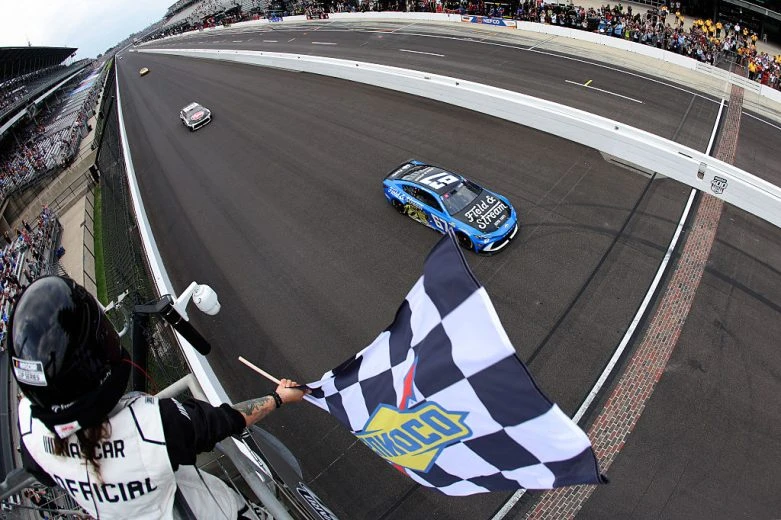
Brickyard 400 2026 Full Classification
The official Brickyard 400 2026 race results show 31 cars completing the full 160-lap distance. John Hunter Nemechek was 32nd, two laps down, while the final seven positions included damaged or retired cars. The table below combines the official finishing order with starting positions and laps led so the biggest gains and losses are easy to see.
| Pos | Driver | Car | Team | Mfr | Start | Gain/Loss | Laps | Led | Status |
|---|---|---|---|---|---|---|---|---|---|
| 1 | Corey Heim | #67 | 23XI Racing | Toyota | 7 | +6 | 160 | 58 | Running |
| 2 | Christopher Bell | #20 | Joe Gibbs Racing | Toyota | 23 | +21 | 160 | 0 | Running |
| 3 | Joey Logano | #22 | Team Penske | Ford | 19 | +16 | 160 | 0 | Running |
| 4 | Chase Briscoe | #19 | Joe Gibbs Racing | Toyota | 11 | +7 | 160 | 1 | Running |
| 5 | Denny Hamlin | #11 | Joe Gibbs Racing | Toyota | 5 | — | 160 | 14 | Running |
| 6 | Brad Keselowski | #6 | RFK Racing | Ford | 16 | +10 | 160 | 0 | Running |
| 7 | Josh Berry | #21 | Wood Brothers Racing | Ford | 26 | +19 | 160 | 1 | Running |
| 8 | Ryan Preece | #60 | RFK Racing | Ford | 34 | +26 | 160 | 1 | Running |
| 9 | Carson Hocevar | #77 | Spire Motorsports | Chevrolet | 1 | -8 | 160 | 31 | Running |
| 10 | Tyler Reddick | #45 | 23XI Racing | Toyota | 3 | -7 | 160 | 1 | Running |
| 11 | Chris Buescher | #17 | RFK Racing | Ford | 15 | +4 | 160 | 0 | Running |
| 12 | Ty Gibbs | #54 | Joe Gibbs Racing | Toyota | 4 | -8 | 160 | 46 | Running |
| 13 | Cole Custer | #41 | Haas Factory Team | Chevrolet | 12 | -1 | 160 | 0 | Running |
| 14 | Austin Cindric | #2 | Team Penske | Ford | 35 | +21 | 160 | 0 | Running |
| 15 | Zane Smith | #38 | Front Row Motorsports | Ford | 30 | +15 | 160 | 0 | Running |
| 16 | Shane van Gisbergen | #97 | Trackhouse Racing | Chevrolet | 25 | +9 | 160 | 0 | Running |
| 17 | Daniel Suárez | #7 | Spire Motorsports | Chevrolet | 2 | -15 | 160 | 1 | Running |
| 18 | Michael McDowell | #71 | Spire Motorsports | Chevrolet | 6 | -12 | 160 | 0 | Running |
| 19 | Alex Bowman | #48 | Hendrick Motorsports | Chevrolet | 8 | -11 | 160 | 0 | Running |
| 20 | Ricky Stenhouse Jr. | #47 | Hyak Motorsports | Chevrolet | 24 | +4 | 160 | 0 | Running |
| 21 | William Byron | #24 | Hendrick Motorsports | Chevrolet | 21 | — | 160 | 0 | Running |
| 22 | Noah Gragson | #4 | Front Row Motorsports | Ford | 33 | +11 | 160 | 0 | Running |
| 23 | Ross Chastain | #1 | Trackhouse Racing | Chevrolet | 22 | -1 | 160 | 5 | Running |
| 24 | Todd Gilliland | #34 | Front Row Motorsports | Ford | 36 | +12 | 160 | 0 | Running |
| 25 | AJ Allmendinger | #16 | Kaulig Racing | Chevrolet | 9 | -16 | 160 | 0 | Running |
| 26 | Ryan Blaney | #12 | Team Penske | Ford | 13 | -13 | 160 | 0 | Running |
| 27 | Erik Jones | #43 | Legacy Motor Club | Toyota | 14 | -13 | 160 | 0 | Running |
| 28 | Bubba Wallace | #23 | 23XI Racing | Toyota | 29 | +1 | 160 | 0 | Running |
| 29 | Austin Dillon | #3 | Richard Childress Racing | Chevrolet | 20 | -9 | 160 | 0 | Running |
| 30 | Ty Dillon | #10 | Kaulig Racing | Chevrolet | 28 | -2 | 160 | 0 | Running |
| 31 | Cody Ware | #51 | Rick Ware Racing | Chevrolet | 37 | +6 | 160 | 0 | Running |
| 32 | John Hunter Nemechek | #42 | Legacy Motor Club | Toyota | 17 | -15 | 158 | 1 | Running |
| 33 | Austin Hill | #33 | Richard Childress Racing | Chevrolet | 32 | -1 | 125 | 0 | Accident |
| 34 | Connor Zilisch | #88 | Trackhouse Racing | Chevrolet | 31 | -3 | 122 | 0 | Accident |
| 35 | Casey Mears | #62 | Beard Motorsports | Chevrolet | 38 | +3 | 121 | 0 | Accident |
| 36 | Riley Herbst | #35 | 23XI Racing | Toyota | 18 | -18 | 120 | 0 | Accident |
| 37 | Chase Elliott | #9 | Hendrick Motorsports | Chevrolet | 27 | -10 | 119 | 0 | Running |
| 38 | Daniel Dye | #78 | Live Fast Motorsports | Chevrolet | 39 | +1 | 93 | 0 | Accident |
| 39 | Kyle Larson | #5 | Hendrick Motorsports | Chevrolet | 10 | -29 | 43 | 0 | Accident |
Several of the most impressive finishes came from deep in the field. Ryan Preece advanced from 34th to eighth, a gain of 26 places. Christopher Bell moved from 23rd to second, while Austin Cindric rose from 35th to 14th. Josh Berry went from 26th to seventh and Joey Logano climbed from 19th to third.
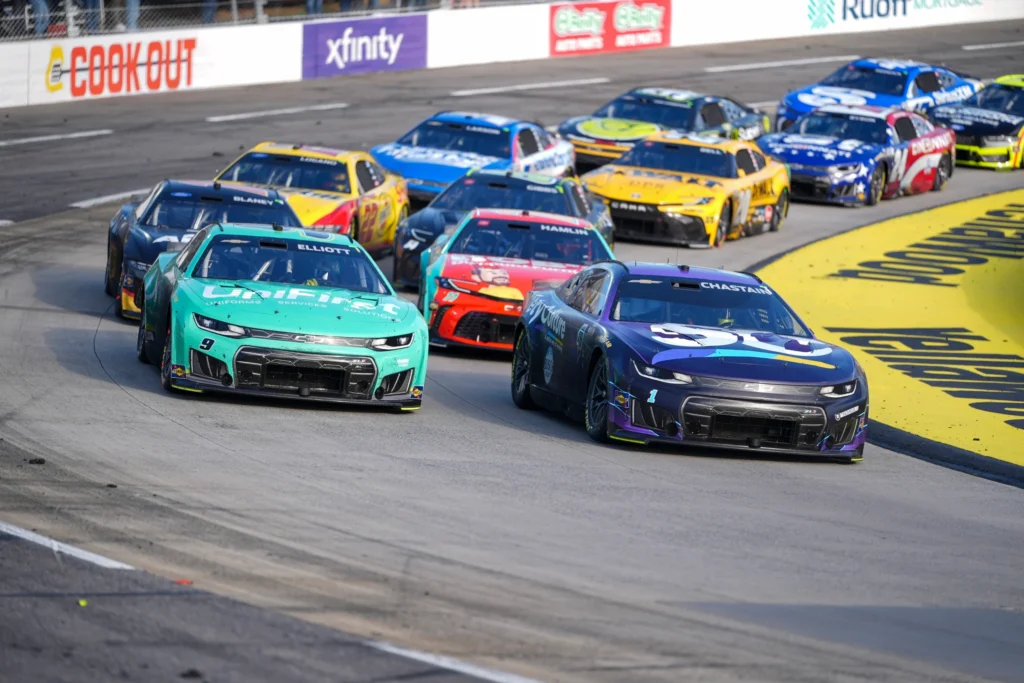
Those gains did not mean passing was easy. In fact, the opposite was true. Much of the movement came through pit sequencing, restart positioning and avoiding incidents. Once the field became strung out, the aerodynamic wake made it difficult to complete passes between similarly matched cars.
How the 2026 Brickyard 400 Was Won
Carson Hocevar started from pole after a 186.598 mph qualifying lap and immediately used clean air to control the opening run. He led the first 31 laps, a significant stretch at a track where the leading car can protect the front tires and control entry speed without fighting dirty air.
Daniel Suárez led Lap 32 during the first pit sequence, and Hamlin then led from Laps 33 through 39. Tyler Reddick briefly led Lap 40 before Heim cycled to the front for Laps 41 through 44. That first spell at the head of the field became important because it gave the 23XI team real information about how the No. 67 behaved in clean air.
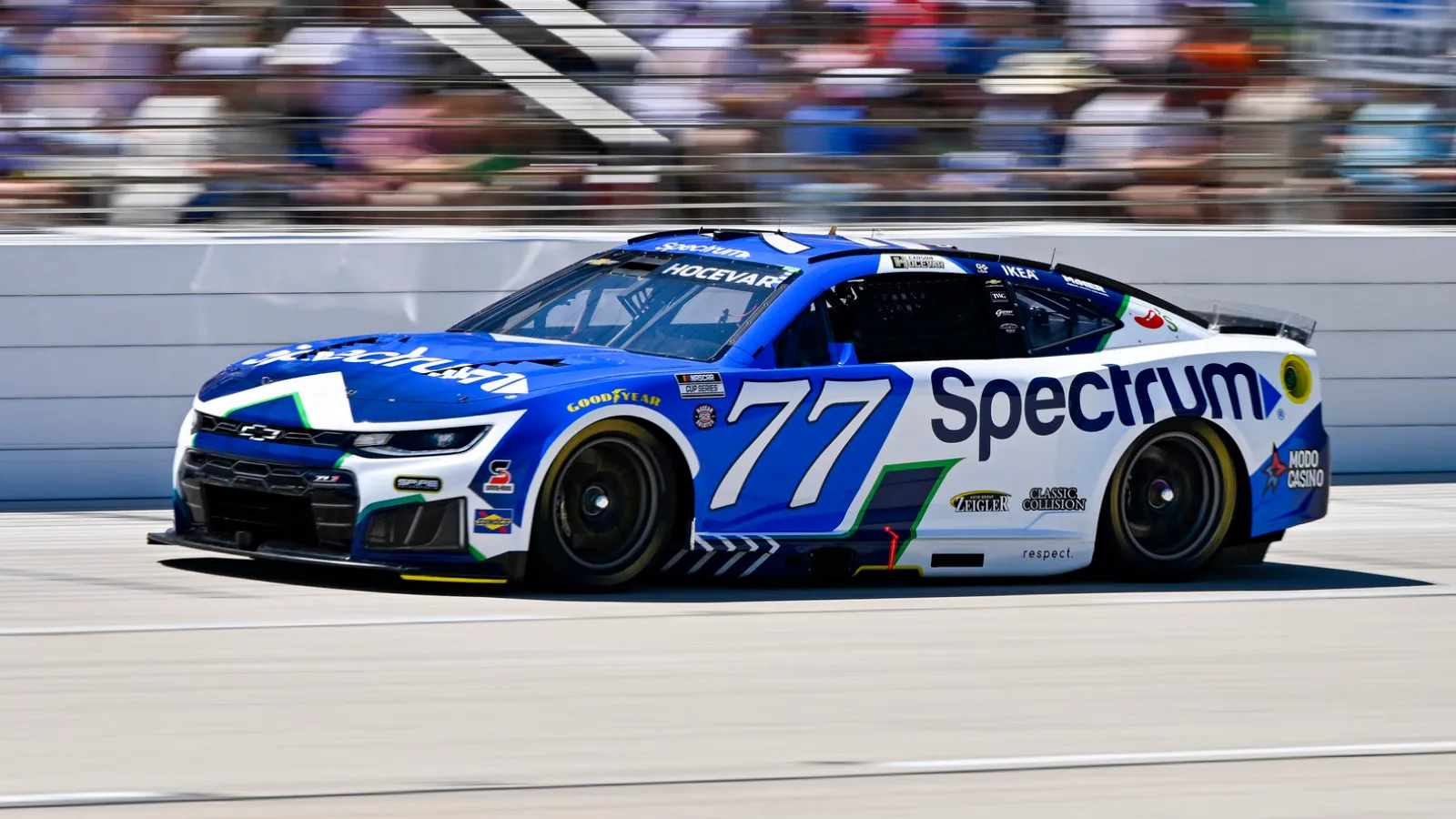
Larson’s Stage 1 strategy collapses on Lap 45
Kyle Larson looked like one of the smartest cars in the race during the first pit cycle. Hendrick Motorsports stopped the No. 5 Chevrolet early on Lap 28, and the undercut moved Larson into position to cycle toward the lead. With the first stage closing, he appeared set to collect a major points haul.
Then the left-rear tire lost air near Turn 3 on Lap 45. Larson’s Chevrolet snapped around and hit the outside wall hard. His race ended after only 43 completed laps, leaving the reigning series champion 39th. The incident also changed the stage because the caution erased the advantage Larson had created with his early stop.
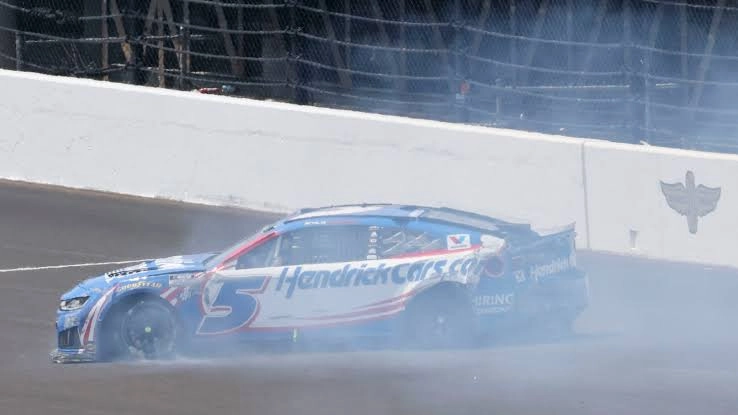
Ty Gibbs capitalized on the reset and won Stage 1 after a one-lap shootout to Lap 50. Heim finished second in the stage, followed by Michael McDowell, Hocevar and William Byron. Gibbs would eventually lead 46 laps, second only to Heim’s 58.
Stage 2 becomes a strategy race
The second stage followed a different pattern. Gibbs led from Lap 45 through 74, then Heim controlled another long stretch from Lap 75 through 91. John Hunter Nemechek, Josh Berry, Chase Briscoe and Ryan Preece each led during the pit cycle before Ross Chastain took over for Laps 96 through 100.
Stage 2 ended under caution after Daniel Dye crashed in Turn 3 on Lap 96. Chastain was scored as the stage winner, with Todd Gilliland second and Gibbs third. Hamlin, Heim, Hocevar, Preece, McDowell, Erik Jones and Suárez completed the stage top 10.
During that same sequence, the Hocevar-Heim rivalry briefly became visible. Heim was extending a run while Hocevar had fresher tires and was trying to recover a lap. Heim blocked the move before eventually pitting. It was aggressive, but it also demonstrated why track position was treated as a valuable asset throughout the afternoon.
Hamlin takes command before the final caution
The final stage started to tilt toward Denny Hamlin. After a debris caution around Lap 114, Heim’s longer Stage 2 run allowed his team to make a shorter fuel stop, putting the No. 67 in strong position. Hamlin nevertheless won the next restart and led from Laps 119 through 125.
At that point, the Brickyard 400 looked ready to become Hamlin’s long-awaited Indianapolis crown jewel. He had clean air, a fast Toyota and enough teammates nearby to control the restart lanes. The final caution changed everything.
On Lap 120, John Hunter Nemechek and Ryan Blaney made contact entering Turn 3. Blaney spun, and the incident expanded into a nine-car crash. The yellow erased Hamlin’s advantage and also changed the In-Season Challenge, because Blaney had been ahead of Todd Gilliland in their $1 million championship matchup.
Brickyard 400 2026 Stage Results
Stage points were important because Indianapolis arrived with the regular season moving toward its closing phase. Gibbs made the most of the first stage and later finished 12th, while Chastain’s second-stage win came during a strategy sequence that did not translate into a top-10 finish. Chastain ultimately finished 23rd.
Stage 1 — Lap 50
| Pos | Driver | Car | Result |
|---|---|---|---|
| 1 | Ty Gibbs | #54 Toyota | Winner |
| 2 | Corey Heim | #67 Toyota | 2nd |
| 3 | Michael McDowell | #71 Chevrolet | 3rd |
| 4 | Carson Hocevar | #77 Chevrolet | 4th |
| 5 | William Byron | #24 Chevrolet | 5th |
| 6 | Denny Hamlin | #11 Toyota | 6th |
| 7 | Daniel Suárez | #7 Chevrolet | 7th |
| 8 | Chase Briscoe | #19 Toyota | 8th |
| 9 | Chris Buescher | #17 Ford | 9th |
| 10 | Tyler Reddick | #45 Toyota | 10th |
Stage 2 — Lap 100
| Pos | Driver | Car | Result |
|---|---|---|---|
| 1 | Ross Chastain | #1 Chevrolet | Winner |
| 2 | Todd Gilliland | #34 Ford | 2nd |
| 3 | Ty Gibbs | #54 Toyota | 3rd |
| 4 | Denny Hamlin | #11 Toyota | 4th |
| 5 | Corey Heim | #67 Toyota | 5th |
| 6 | Carson Hocevar | #77 Chevrolet | 6th |
| 7 | Ryan Preece | #60 Ford | 7th |
| 8 | Michael McDowell | #71 Chevrolet | 8th |
| 9 | Erik Jones | #43 Toyota | 9th |
| 10 | Daniel Suárez | #7 Chevrolet | 10th |
Gibbs’ 46 laps led underline how strong the No. 54 Toyota was before the final stage changed shape. Hocevar’s 31 laps out front all came at the beginning, while Hamlin led 14 laps in two spells. Chastain led five, and Briscoe, Berry, Nemechek, Reddick, Preece and Suárez each led one lap.
Why Heim Won: Restart Execution, Clean Air and No Mistakes
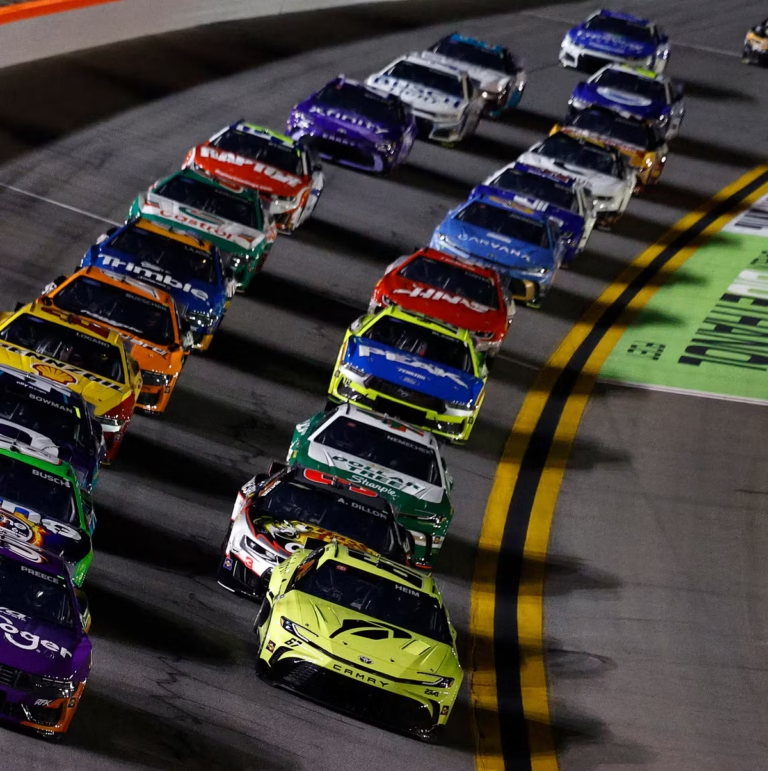
The most important moment of the Brickyard 400 was not a pass made during a long green-flag run. It was the organization of the two lanes before the final restart. Hamlin chose the preferred inside line, with Bell and Briscoe stacked behind him. On paper, that should have given Joe Gibbs Racing control.
Instead, the three JGR Toyotas became separated at exactly the wrong moment. Their bump-drafting sequence began too early, before Hamlin could accelerate inside the restart zone. The result was a fragmented launch. On the outside, Logano stayed connected to Heim’s rear bumper and delivered a sustained push that gave the No. 67 enough momentum to clear Hamlin.
Once Heim reached Turn 1 first, the aerodynamic picture changed. The No. 67 could run its preferred line in clean air, while Bell had to generate front grip through the wake. That makes a huge difference on the Indianapolis oval, where the flat, 90-degree corners punish a car that cannot rotate cleanly on entry.
Indianapolis rewarded the driver who owned clean air after the final restart. Heim’s job was not to run away — it was to make Bell spend every corner in disturbed air and never offer a clean overlap.
Bell’s second-place drive remains one of the strongest performances in the classification. Starting 23rd at Indianapolis usually forces a driver into a long afternoon of traffic management. Bell advanced 21 positions and still had enough pace late to pressure the winner. Yet the last step, actually clearing the leader, required either a significant tire advantage or a mistake from Heim.
Logano deserves equal attention. He started 19th, reached third and directly influenced the winning restart. His push was not just helpful — it was the difference between Heim entering Turn 1 alongside Hamlin or entering it with control of the lane. That is a strategic contribution that does not show up in the laps-led column.
Why passing remained difficult
The Brickyard’s 2.5-mile oval looks enormous, but its four corners are narrow in racing terms. Drivers approach at very high speed, brake into a relatively flat right-angle turn and need the car to rotate before accelerating down another long straight. When the front tires lose grip in another car’s wake, following closely through the corner becomes harder.
That is why restarts and pit cycles created more movement than traditional side-by-side racing. Drivers could make gains when the field was compressed, when tires had different ages or when two lanes formed. Once the cars spread out, equal-pace competitors often stayed in place. For a deeper primer, see World of Speed’s guide to oval-track racecraft and its explainer on slipstream and drafting.
The biggest movers in the final results
| Driver | Start | Finish | Positions Gained | Why it mattered |
|---|---|---|---|---|
| Ryan Preece | 34th | 8th | +26 | Largest forward move in the field. |
| Christopher Bell | 23rd | 2nd | +21 | Reached the winner’s bumper range late. |
| Austin Cindric | 35th | 14th | +21 | Recovered from a difficult qualifying position. |
| Josh Berry | 26th | 7th | +19 | Converted mid-pack start into top-seven result. |
| Joey Logano | 19th | 3rd | +16 | Reached podium and helped launch Heim on final restart. |
These results are a reminder that Indianapolis does not always reward qualifying position in a simple one-to-one way. Hocevar started first, led 31 laps and finished ninth. Suárez started second and finished 17th. Conversely, Bell and Logano turned lower starting positions into podium finishes by surviving the strategy cycles and being positioned correctly when the final caution arrived.
Major Incidents That Changed the Brickyard 400
Kyle Larson: from possible Stage 1 leader to 39th
Larson’s retirement was the most dramatic early reversal. His early pit stop had given Hendrick Motorsports a realistic chance to control Stage 1 through track position. When the left-rear tire failed, that strategic advantage disappeared instantly. Larson completed 43 laps and was classified 39th.
The timing was especially costly because Larson was five laps from the Stage 1 finish and had positioned himself to collect significant points. Instead, he scored essentially nothing from a day that had briefly looked like one of Hendrick’s strongest opportunities.
Chase Elliott: Turn 2 contact leads to the garage
Elliott’s afternoon deteriorated on Lap 60 after contact with Ricky Stenhouse Jr. sent the No. 9 Chevrolet into the outside wall beyond Turn 2. The impact damaged the right-rear toe link. The team attempted repairs, but Elliott eventually went to the garage and later returned 41 laps behind the leaders.
He completed 119 laps and was classified 37th. Combined with Larson’s last-place result, it was a bruising Indianapolis day for two of Hendrick Motorsports’ championship contenders.
Daniel Dye: Stage 2 ends under caution
Dye crashed in Turn 3 on Lap 96, bringing out the caution that carried the field to the Stage 2 finish. Because the field was in the middle of different pit strategies, the yellow locked Chastain into the stage victory. Dye completed 93 laps and finished 38th.
Ryan Blaney: the final caution changes two races at once
Blaney’s Lap 120 crash changed both the Brickyard 400 and the NASCAR In-Season Challenge. Contact with Nemechek triggered the multi-car accident, forcing Blaney to pit for repairs and restart deep in the field. Hamlin lost the comfortable lead he had built, while Gilliland suddenly became the favorite for the $1 million tournament prize.
Blaney recovered to finish 26th, but Gilliland was two positions better in 24th. That tiny finishing difference was worth $1 million to Front Row Motorsports.
Todd Gilliland Wins the $1 Million In-Season Challenge
Todd Gilliland did not need a top-10 finish to leave Indianapolis with one of the day’s biggest prizes. The 25th-seeded driver reached the championship round of NASCAR’s In-Season Challenge against third-seeded Ryan Blaney. The rule was simple: whichever driver finished ahead won the $1 million prize.
Blaney controlled that private battle for most of the race, but the Lap 120 accident changed the order. He required repairs and restarted behind Gilliland. Both drivers fought through traffic over the closing run, and Gilliland eventually finished 24th, two positions ahead of Blaney.
Todd Gilliland — 24th
Ryan Blaney — 26th
Gilliland won the five-round knockout tournament and the $1 million prize for Front Row Motorsports.
It was an unusual subplot for a crown-jewel race, because a battle in the mid-20s carried financial stakes larger than many fights near the top 10. It also kept attention on every restart and every damaged car after the leaders had settled into the final run.
2026 Brickyard 400 Race Statistics
| Statistic | 2026 Brickyard 400 | Context |
|---|---|---|
| Winner | Corey Heim | No. 67 23XI Racing Toyota |
| Race distance | 160 laps / 400 miles | 2.5-mile Indianapolis Motor Speedway oval |
| Winning margin | 0.287 seconds | Heim over Christopher Bell |
| Race time | 3 hr 8 min 21 sec | NASCAR published race summary |
| Average speed | 127.422 mph | Includes caution periods |
| Cautions | 5 for 27 laps | Multiple incidents shaped pit strategy |
| Lead changes | 15 | Among 11 different drivers |
| Most laps led | Corey Heim — 58 | Four separate stints at the front |
| Second-most led | Ty Gibbs — 46 | Stage 1 winner |
| Pole sitter | Carson Hocevar | 186.598 mph; finished ninth |
| Cars entered | 39 | All 39 started the race |
The numbers capture the unusual rhythm of the event. Eleven drivers led at least one lap, but only four drivers led more than five. Heim, Gibbs, Hocevar and Hamlin controlled most of the meaningful green-flag running. The remaining lead changes were largely created by staggered pit cycles.
For readers new to NASCAR timing, World of Speed’s guides to how laps are counted, how race timing works and how pit stops shape strategy explain why the official lead-change count can include brief one-lap leaders during pit cycles.
What the Result Meant for the 2026 NASCAR Season
Heim’s victory was unusual because the part-time driver was not the central figure in the Cup championship points race. The deeper championship consequence came from the drivers behind him. Hamlin finished fifth and extended his series lead to 84 points over Tyler Reddick, who finished 10th.
Ty Gibbs also left Indianapolis with an important achievement. His Stage 1 win, 46 laps led and 12th-place finish were enough for NASCAR to confirm that he had clinched a place in the Chase. Four regular-season races remained after Indianapolis.
For the latest points picture, see World of Speed’s 2026 NASCAR points standings. If you are following the weekly Cup schedule, the site’s NASCAR race start-time guide and NASCAR TV channel guide cover the next event for U.S. viewers.
Why Heim’s second Cup win matters
Indianapolis gave Heim a different kind of credibility from his first Cup win at Naval Base Coronado. A new street circuit rewards adaptability and confidence under uncertainty. The Brickyard rewards discipline at a venue every established organization already knows in detail. Heim beat championship-winning drivers and veteran teams on a track where experience normally matters.
He also did it while managing a car that became loose in clean air. That detail matters. A setup that is comfortable in traffic can become nervous once the front end gains clean airflow. Heim had to change his corner approach while simultaneously protecting against Bell and Logano. His ability to manage that transition is part of why 23XI Racing has already committed to making him a full-time Cup driver in 2027.
NASCAR’s post-race analysis emphasized Heim’s preparation, simulator work and patience in choosing the right path to a full-time opportunity. The Brickyard win did not create the prospect story. It confirmed it in one of the sport’s biggest races.
Where the 2026 Brickyard 400 Fits in Indianapolis History
The Brickyard 400 has been one of NASCAR’s crown-jewel races since Jeff Gordon won the inaugural event in 1994. The oval was replaced by the Indianapolis road course for three seasons, then returned to the 2.5-mile Speedway layout in 2024. Bubba Wallace won the 2025 edition before Heim became the 2026 champion.
For decades, Indianapolis often rewarded established champions. Gordon won five Brickyard 400s, Jimmie Johnson won four and Kevin Harvick won three. Tony Stewart, Kyle Busch and Dale Jarrett each won twice. Heim’s arrival therefore stands out: a 24-year-old part-time driver earned a place on a winner list dominated by some of the most accomplished names in modern NASCAR.
That history also explains why the post-race ritual matters. Brickyard winners stop at the start/finish line and kiss the exposed strip of bricks, connecting a modern stock-car race with the Speedway’s century-old identity. For broader NASCAR history, visit World of Speed’s archive on the rise of NASCAR and its feature on famous race-car drivers.
The 2026 race may be remembered less for a long side-by-side duel than for how it exposed the fine margins of modern Cup racing at Indianapolis. One mistimed restart push cost Hamlin his preferred lane advantage. One sustained push from Logano gave Heim the lead. One mistake from Heim might have handed Bell the win. None of those moments lasted long, but together they determined the entire result.
Brickyard 400 2026 FAQs
Conclusion: Heim Earned the Brickyard, Not Just the Break
The 2026 Brickyard 400 result in one view
Corey Heim won because 23XI Racing kept him in the strategy window, Logano delivered the decisive outside-lane push, and Heim made the lead almost impossible to attack once he had clean air. The caution created the opportunity, but the final run demanded execution. Bell stayed close enough to punish an error; Heim never gave him one big enough.
The final classification also tells several secondary stories. Bell and Preece produced huge recovery drives. Hocevar converted pole into 31 laps led but fell to ninth. Hamlin lost a realistic chance at the crown jewel when JGR’s inside-line restart coordination broke down. Larson and Elliott endured damaging incidents, while Gilliland turned 24th place into a $1 million victory of his own.
For a 24-year-old making only his 15th Cup start, winning Indianapolis is the kind of result that changes expectations. Heim entered the weekend as a highly rated part-time prospect. He left as a Brickyard 400 winner with two Cup victories and a clear argument that he is ready for a full-time 2027 campaign.