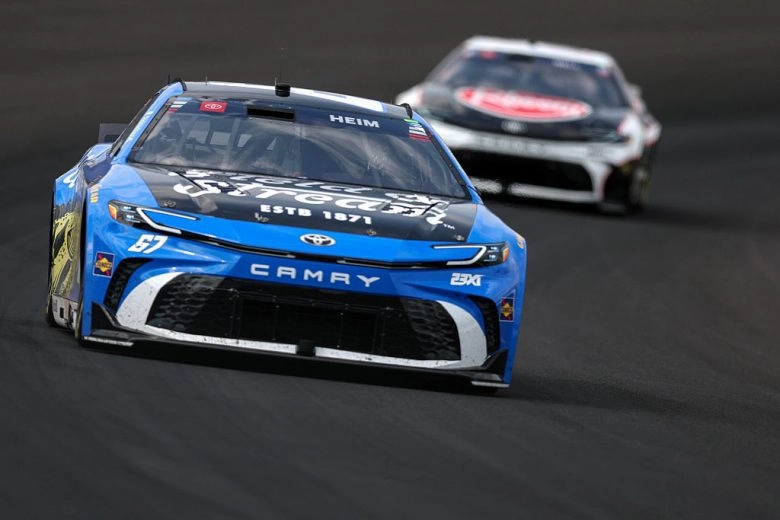
Brickyard 400 2026 Strategy Analysis: Track Position, Fuel & Cautions
Corey Heim did not win Indianapolis on speed alone. Pit-cycle timing, fuel allocation, yellow flags and one perfectly executed restart created the decisive track position.
The Brickyard 400 2026 strategy analysis begins with a simple fact: Corey Heim was not the obvious pre-race favorite, yet the No. 67 team repeatedly placed itself on the right side of the race’s biggest strategic swings.
Heim gained when Kyle Larson crashed during the first pit cycle. He later ran Stage 2 long, needed less fuel after the Lap 114 debris caution, exited pit road first and recovered the lead after the final yellow.
The decisive moment came on the last restart. Denny Hamlin owned the preferred inside lane, but Joey Logano pushed Heim’s outside line hard enough for the No. 67 Toyota to clear the No. 11 before Turn 2.
Track position created by fuel strategy and caution timing decided it. Heim then converted that position through a stronger final restart and kept Christopher Bell in dirty air for the last 34 green-flag laps.
Brickyard 400 Strategy Snapshot
Shorter Lap 114 stop
Running Stage 2 long meant Heim needed less fuel when the debris caution arrived.
Clean release mattered
The shorter stop placed Heim at the front before the final restart sequence.
Logano supplied the push
Heim cleared Hamlin while the JGR inside line mistimed its coordinated shove.
The official result lists Heim first, Bell second and Logano third. Briscoe and Hamlin completed the top five.
The race lasted three hours, eight minutes and 21 seconds at an average 127.422 mph. NASCAR recorded 15 lead changes among 11 drivers.
Heim led four times for 58 laps. Ty Gibbs ranked second with 46 laps led, while polesitter Carson Hocevar led the opening 31.
| Finish | Driver | Start | Laps led | Best lap | Strategic takeaway |
|---|---|---|---|---|---|
| 1 | Corey Heim | 7th | 58 | 49.55 | Winner by 0.287 sec. |
| 2 | Christopher Bell | 23rd | 0 | 49.78 | Closed late but remained in dirty air |
| 3 | Joey Logano | 19th | 0 | 49.96 | Key push launched Heim on final restart |
| 4 | Chase Briscoe | 11th | 1 | 50.05 | Part of JGR inside-line restart chain |
| 5 | Denny Hamlin | 5th | 14 | 49.95 | Lost lead and fell to fifth on final restart |
| 6 | Brad Keselowski | 16th | 0 | 50.37 | Solid track-position recovery |
| 7 | Josh Berry | 26th | 1 | 50.43 | Gained 19 positions |
| 8 | Ryan Preece | 34th | 1 | 50.43 | Gained 26 positions |
| 9 | Carson Hocevar | 1st | 31 | 49.86 | Led opening 31 laps from pole |
| 10 | Tyler Reddick | 3rd | 1 | 50.39 | Lead-lap top-10 finish |
Why Track Position Controlled Indianapolis
Indianapolis Motor Speedway is a 2.5-mile oval, but its strategy is closer to a giant precision circuit than a typical intermediate track. The long straights reward low drag, while the relatively flat corners still demand grip and downforce.
That compromise creates an aerodynamic problem. A car following closely loses useful air at the exact point where the driver needs front grip to rotate through the corner.
Clean air was a performance tool
Heim’s final run showed why the lead mattered. Bell could close when the No. 67 became loose, but finishing the pass required entering the corner in disturbed air.
Therefore, Heim did not need to be dramatically faster. He needed clean exits, predictable corner entries and enough control of the wake to prevent Bell from completing a run.
Track position started before race day
NASCAR’s pre-race crew-chief report described Indianapolis as a balance of straightaway speed, downforce and handling. Teams also had to factor fuel mileage into that compromise.
Legacy Motor Club crew chief Justin Alexander described the search for the correct lift-to-drag balance. Too much trim improves speed, but it can leave the car short of grip.
Pit-road location adds another strategic layer
Indianapolis has one of NASCAR’s most unusual pit roads. NASCAR reported a 24-foot-wide lane of travel, the narrowest on the Cup schedule.
The stalls are only 14 feet, 4 inches wide. Yet they stretch 46 feet, 6 inches long, and the entire pit road runs more than 2,500 feet.
That geometry encourages an accordion effect. A car entering or leaving a crowded stall can lose time even when the crew performs a clean service.
Strategy principle: position has compound value
At Indianapolis, one gained position can create another advantage. A car at the front receives cleaner air, controls corner entry and has more freedom to choose a pit window. Conversely, a car buried in traffic may need a more aggressive stop simply to escape the aerodynamic wake.
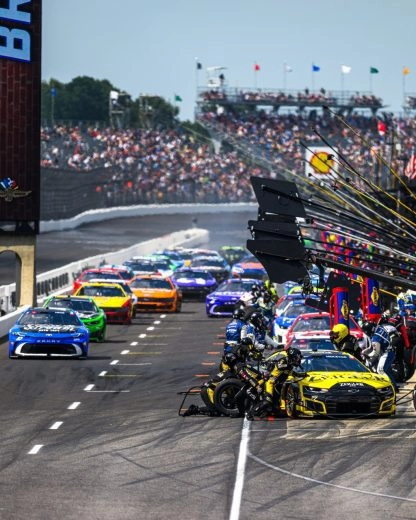
Stage 1 Strategy: Larson’s Undercut and Heim’s First Break
Larson attacked the first cycle early
Kyle Larson started 10th and quickly moved toward the front. His team then used an early stop around Lap 27-28 to attack the first green-flag cycle.
The move worked. NASCAR reported that Larson was positioned to cycle into the lead after the remaining front-runners completed their stops.
This is classic Indianapolis logic. Short-pitting gives up current position, but fresh tires and clean track can produce enough lap-time gain to jump rivals once they stop.
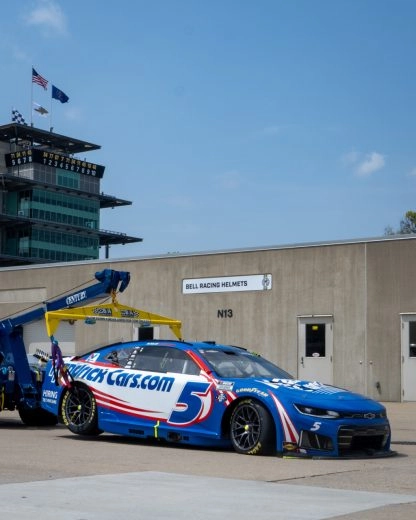
The risk appeared on Lap 45
Larson’s left-rear tire lost air entering Turn 3. The No. 5 Chevrolet backed into the outside wall while running second.
Instead of converting the undercut into the lead and likely Stage 1 points, Larson finished 39th. A strategy that had created track position disappeared in seconds.
Heim was on the opposite side of the same caution
Heim was already on pit road on Lap 44. When the yellow appeared one lap later, he gained positions as cars on track slowed and the cycle froze.
That timing allowed the No. 67 to restart near the front. Heim finished Stage 1 second after the one-lap dash behind Gibbs.
| Stage 1 | Driver |
|---|---|
| 1 | Ty Gibbs |
| 2 | Corey Heim |
| 3 | Michael McDowell |
| 4 | Carson Hocevar |
| 5 | William Byron |
| 6 | Denny Hamlin |
| 7 | Daniel Suárez |
| 8 | Chase Briscoe |
| 9 | Chris Buescher |
| 10 | Tyler Reddick |
Gibbs won the stage, followed by Heim, McDowell, Hocevar and Byron. Hamlin, Suárez, Briscoe, Buescher and Reddick completed the top 10.
The lesson is not that pitting before a caution is always better. It is that Indianapolis rewards teams that create multiple strategic paths instead of waiting for one obvious window.
Stage 2 Fuel Strategy: Why Heim Ran Long
The second stage was the foundation of Heim’s winning fuel strategy. Instead of mirroring every rival’s stop, the No. 67 remained on track longer and led from Lap 75 through Lap 91.
Running long can look defensive because the car eventually has to stop. However, the timing of the next caution determines whether that stored fuel advantage becomes valuable.
Long-running shifted the next fuel requirement
A car that pits later begins the next run with more fuel remaining at any fixed future lap. Therefore, Heim did not need the same amount of fuel as rivals when the field stopped under the Lap 114 debris yellow.
Less fuel means less stationary time. At a track where clean air matters, even a small time saving can turn into a much larger race-position advantage.
Stage 2 ended under caution
Daniel Dye crashed in Turn 3 on Lap 96, four laps before the stage end. The yellow lasted through Lap 100.
Ross Chastain won Stage 2 under caution, followed by Gilliland, Gibbs, Hamlin and Heim. Hocevar, Preece, McDowell, Jones and Suárez completed the stage top 10.
| Stage 2 | Driver |
|---|---|
| 1 | Ross Chastain |
| 2 | Todd Gilliland |
| 3 | Ty Gibbs |
| 4 | Denny Hamlin |
| 5 | Corey Heim |
| 6 | Carson Hocevar |
| 7 | Ryan Preece |
| 8 | Michael McDowell |
| 9 | Erik Jones |
| 10 | Daniel Suárez |
Stage points and race position pulled in different directions
Some teams needed stage points because of championship pressure. Others could sacrifice stage position to improve the final-stage fuel picture.
NASCAR’s pre-race crew-chief analysis specifically noted that recent Brickyards had produced true three-stop cars, four-stop cars, and late stops with right-side tires plus reduced fuel.
That variety mattered again in 2026. Heim’s long Stage 2 run was not just about leading laps; it changed the amount of fuel the No. 67 needed later.
Fuel strategy at Indianapolis is not only about making the finish. It is about buying track position by changing how long the next pit stop must last.
Brickyard 400 Cautions: 27 Yellow Laps Changed the Race
NASCAR recorded five cautions for 27 laps. That means 16.9% of the 160-lap race ran under yellow.
The raw number matters, but the timing mattered more. Two major cautions occurred near stage ends, while the last yellow erased Hamlin’s late advantage.
Larson’s caution changed Stage 1
The Lap 45 crash produced a four-lap yellow. NASCAR still returned the field to green long enough for a one-lap shootout before the Stage 1 finish.
Larson lost a potential lead. Heim gained track position. Gibbs gained the stage victory.
The Lap 96 yellow swallowed the end of Stage 2
Dye’s incident happened with four laps left in the stage. NASCAR could not complete the normal pickup, pit-road opening and restart process before Lap 100.
As a result, Stage 2 ended under caution. NASCAR later said this exact type of long yellow was part of an internal discussion about reducing caution duration.
The Lap 114 debris caution created the winning stop
This yellow was the strategic hinge of the final stage. Heim’s earlier long run meant he could take less fuel.
The No. 67 exited pit road first. That clean-air position mattered even though Hamlin would take the lead on the next restart.
The final caution erased Hamlin’s margin
John Hunter Nemechek and Ryan Blaney tangled entering Turn 3 on Lap 120. The accident collected nine cars and destroyed Blaney’s In-Season Challenge advantage.
For the race win, the yellow had another effect. Hamlin had just taken command, but the caution compressed the field and gave Heim another shot from the front row.
Hocevar converts pole into clean air
Carson Hocevar led the first 31 laps. That opening stretch showed how valuable the front of the field was before the first major pit cycle.
Larson short-pits from the lead fight
Kyle Larson stopped early and was positioned to cycle toward the lead. The call traded immediate track position for fresher tires and a cleaner next sequence.
Heim is already on pit road
Corey Heim was servicing the No. 67 when the race was about to change. Being committed to pit road mattered one lap later.
Larson loses a left-rear tire
Larson crashed in Turn 3 while running second. The caution destroyed his promising undercut but helped Heim gain positions as the field slowed.
Gibbs wins Stage 1
A one-lap dash after the Larson caution gave Gibbs the stage. Heim finished second after benefiting from his pit-cycle timing.
Heim stretches Stage 2
Heim led a long segment during the second stage. The longer fuel allocation became valuable later because it reduced what he needed at the next key stop.
Daniel Dye crash extends the yellow
Dye crashed with four laps left in Stage 2. The caution lasted through the stage finish, which changed the normal stage-break rhythm.
Chastain wins Stage 2 under yellow
Ross Chastain stayed at the front through the caution and collected the Stage 2 win while strategy groups reset for the final 60 laps.
Debris caution creates the winning pit-road race
Because Heim had run longer earlier, he required less fuel. That shorter service helped him exit pit road first.
Hamlin takes the lead on the penultimate restart
The JGR group executed well enough to move Hamlin ahead of Heim. The race then changed again almost immediately.
Nemechek–Blaney wreck erases Hamlin’s cushion
A multi-car crash entering Turn 3 produced the final caution. Hamlin’s track-position advantage disappeared and the field was compressed.
Outside line wins the push battle
Hamlin chose the preferred inside. Heim chose outside, received a sustained push from Joey Logano, cleared the No. 11 and controlled the final 34-lap run.
Dirty air protects Heim
Christopher Bell closed late, but Heim focused on corner exits and kept the No. 20 in turbulent air. The winning margin was 0.287 second.
Why NASCAR discussed shorter cautions afterward
Two days after the race, NASCAR said officials were examining ways to reduce caution duration. The Brickyard’s length makes the process difficult.
NASCAR explained that a yellow typically requires at least four laps at Indianapolis because the sanctioning body must collect the field, open pit road and set the double-file restart order.
One possible idea involved moving the Choose V location to save a lap at selected tracks. No immediate rule change was announced.
Final Restart: How Heim Beat Hamlin Before Turn 2
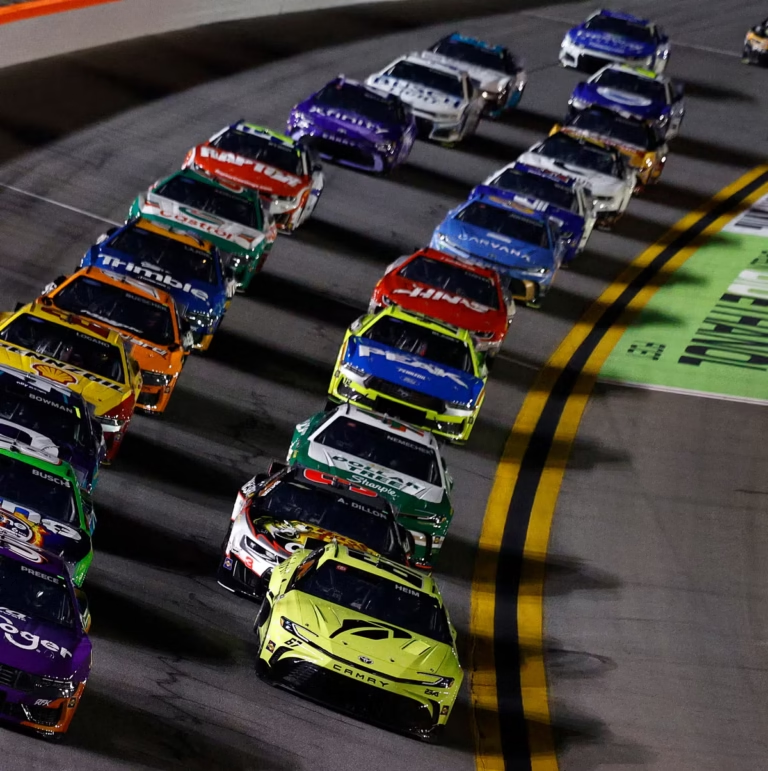
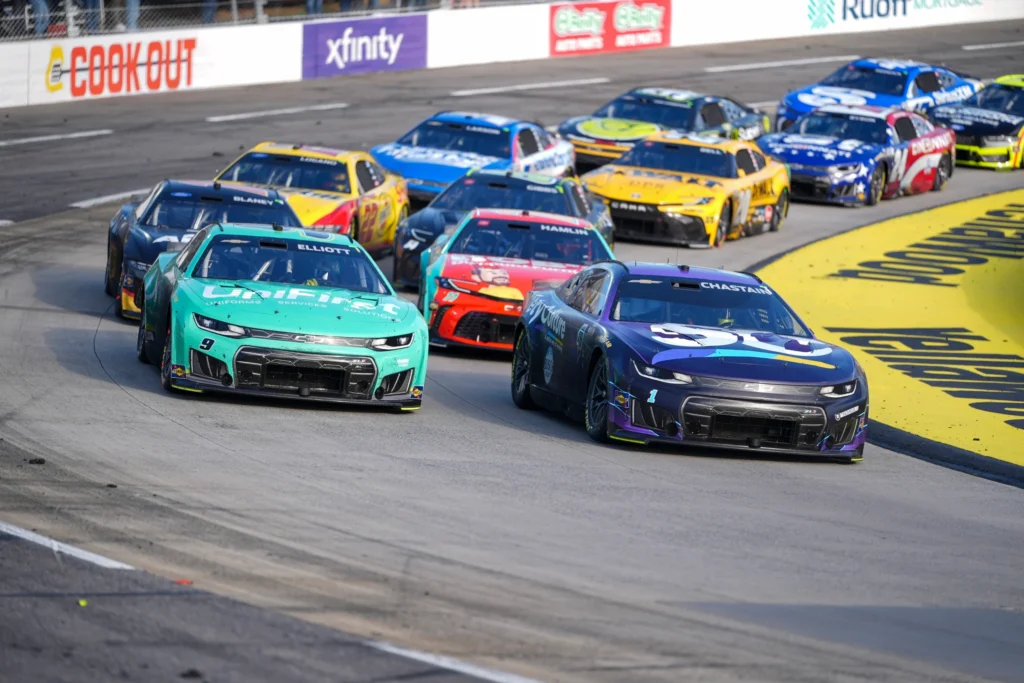
Hamlin entered the final restart with the most obvious positional advantage. He chose the preferred inside lane and had Bell and Briscoe, both JGR teammates, lined up behind him.
Heim chose the outside. Logano lined up directly behind the No. 67 and became the most important helper in the race.
The JGR chain started pushing too early
Before Hamlin reached the restart zone, Bell and Briscoe were already connected on the inside line. Hamlin could not accelerate early without risking a restart violation.
That timing made the inside group unstable. Instead of a single coordinated launch, the three Toyotas created bumper contact before the leader could legally commit.
Logano’s push was cleaner
On the outside, Logano gave Heim a sustained shove. The extra momentum allowed Heim to clear Hamlin and move across before the No. 11 could establish the inside run.
Hamlin then lost momentum while fighting in the marbles. He fell from the lead to fifth in one lap and remained there to the finish.
JGR had the numbers but not the timing
Bell later said the plan was to push Hamlin, not attack him. Briscoe also intended to keep the three-car line connected.
However, all three drivers described the timing as poorly coordinated. At Indianapolis, a push that arrives too early can be as damaging as no push at all.
Why the outside line won
Heim had a cleaner pusher-to-leader connection. Logano could build momentum behind the No. 67 while Hamlin had to manage the restart zone with two teammates compressing behind him. Heim converted that momentum into clear track by Turn 2.
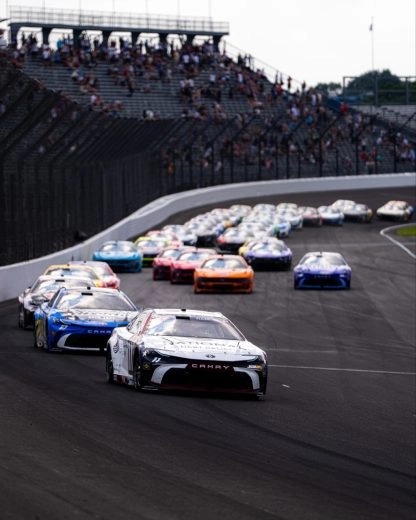
The Final 34 Laps: Why Bell Could Not Finish the Pass
The final run stayed green for 34 laps. Bell settled into second and gradually waited for Heim’s handling to deteriorate.
Heim later said the car became loose as conditions changed. That created one late opportunity for Bell to close to roughly a car length.
A following car needs more than a faster lap
Indianapolis punishes a car that loses front grip behind another vehicle. Bell could approach the rear bumper on straights, but the wake reduced his ability to rotate and maintain speed through the corner.
Heim’s defensive task was therefore simple to describe but difficult to execute. He had to protect exits and avoid the one large mistake that would give Bell clean air alongside.
The leader controlled the air
Heim focused on keeping Bell directly in the disturbed airflow. Over the final two laps, that approach stretched the gap again.
He won by 0.287 second. Bell finished runner-up for the sixth time in 2026, while Logano stayed close enough to take third.
Hamlin’s fifth place shows the cost of one restart
Hamlin still had race-winning speed. He led 14 laps and finished fifth, but a single poor launch removed the clean-air advantage he had created.
That contrast is the clearest explanation of Indianapolis strategy. Pace builds opportunity, while position determines whether that pace can be used.
Pit Strategy: Short-Pit, Long-Run and Fuel-Only Logic
Short-pitting: Larson’s early attack
A short pit moves a car off the racing surface before its direct rivals. The driver sacrifices current position but gains fresh tires and clear road sooner.
Larson demonstrated its upside. His early stop was expected to cycle him into the lead until the tire failure ended the attempt.
Running long: Heim’s Stage 2 investment
Running long keeps a car on track while others stop. It can create temporary leadership and, more importantly, change the fuel requirement of the next stop.
Heim’s strategy paid when the debris caution appeared. Because his fuel clock started later, he needed a shorter service.
Fuel-only or reduced-service stops
Indianapolis often creates scenarios where teams value time on pit road more than maximum tire grip. Recent Brickyards have featured cars taking right-side tires with less fuel or using varied three- and four-stop plans.
The 2026 race reinforced the principle. The fastest stop is not always the one with the fewest tires; it is the one that satisfies the car’s exact next-run requirement.
Why pit-road entry and release matter
The narrow lane increases congestion risk. A slow entry, blocked exit or accordion delay can erase the benefit of a theoretically superior strategy.
Therefore, crew chiefs have to combine fuel math with stall geometry. A clean stop in the wrong traffic pocket may still lose the race off pit road.
Lead Changes Show How Strategy Moved the Front
| Driver | Laps led | Times led |
|---|---|---|
| Corey Heim | 58 | 4 |
| Ty Gibbs | 46 | 2 |
| Carson Hocevar | 31 | 1 |
| Denny Hamlin | 14 | 2 |
| Ross Chastain | 5 | 1 |
| Chase Briscoe | 1 | 1 |
| Josh Berry | 1 | 1 |
| John Hunter Nemechek | 1 | 1 |
| Tyler Reddick | 1 | 1 |
| Ryan Preece | 1 | 1 |
| Daniel Suárez | 1 | 1 |
Hocevar led the opening 31 laps from pole. Hamlin then cycled to first for seven laps before several strategy leaders appeared during the opening pit sequence.
Heim led Laps 41-44, then returned for a 17-lap segment from 75-91. Gibbs controlled 46 total laps, while Chastain used the end of Stage 2 to lead five.
Later, Heim briefly led before Hamlin took control through the penultimate restart. The final restart flipped the lead back to Heim for the rest of the 160-lap race.
This sequence matters because not every lead change came from an on-track pass. Pit timing, stage strategy and caution sequencing repeatedly moved different cars to the front.
Six Strategy Lessons From the 2026 Brickyard 400
| Strategic lesson | What the race showed |
|---|---|
| Track position | Passing was difficult enough that clean air repeatedly outweighed small differences in raw lap speed. |
| Fuel allocation | Running long in Stage 2 reduced Heim’s required fuel at the Lap 114 caution and shortened his stop. |
| Caution timing | The same yellow can reward an off-sequence car and punish a conventional strategy. Larson and Heim showed both sides. |
| Restart execution | The final restart was decided by push timing before Turn 1, not by a conventional long-run pass. |
| Pit-road geometry | Indy’s narrow, long pit road makes stall location, accordion effects and clean release especially important. |
| Stage priorities | Teams had to choose between points at laps 50 and 100 or sacrificing stage position to improve the next fuel cycle. |
1. Track position is worth planning several laps ahead
Heim’s winning track position did not come from one stop. It came from a Stage 2 decision that reduced his fuel need more than 20 laps later.
2. Caution timing can reverse identical strategies
Larson’s early stop created a potential lead before mechanical failure. Heim’s timing around the same caution moved him forward.
Therefore, strategy evaluation must separate the quality of the call from the random event that follows it.
3. Restart organization is a team skill
JGR placed three cars in a line behind Hamlin but could not synchronize the push. Logano and Heim needed only two cars to create the winning launch.
4. Fuel is measured in seconds, not only laps
Teams often discuss fuel in terms of whether the car can reach the finish. At Indianapolis, the more important question may be how many seconds of fuel must be added during the next stop.
5. Dirty air can turn track position into defense
Bell was close enough to pressure Heim, yet the leader controlled the most useful air. That allowed Heim to defend without an aggressive block on every straight.
6. Stage racing changes the optimum strategy
Teams chasing championship points cannot always maximize final-stage position. Stage points at laps 50 and 100 can be valuable enough to justify staying out longer.
That is why different teams can make rational but opposite choices at the same moment.
Why Fuel and Cautions Keep Defining the Modern Brickyard
Indianapolis returned to the NASCAR oval configuration in 2024 after three seasons on the road course. Since then, late-race fuel and caution timing have repeatedly shaped the winner.
In 2024, teams used fuel conservation and late caution opportunities to manipulate the finish. Larson ultimately won after a race with multiple strategy groups.
In 2025, Wallace built a large advantage before rain reset the race. He then had to manage fuel through overtime to secure the victory.
The 2026 race added a third version. Heim’s advantage came from running long, shortening a later fuel stop and then protecting the resulting position through two restart cycles.
Different races, same Indianapolis equation
The exact winning call changes. However, every recent oval Brickyard has rewarded a team willing to think beyond the next stop.
At this track, fuel, caution timing and clean air are connected. A crew chief is not choosing one of them; the job is to predict how all three interact several laps later.
Brickyard 400 2026 Strategy FAQ
Conclusion: Heim Won the Strategy Race Before He Won the Sprint to the Bricks
The Brickyard 400 2026 strategy analysis shows why Indianapolis cannot be reduced to one fuel number or one restart.
Heim first gained from caution timing when Larson crashed during the opening pit sequence. He then created a later advantage by stretching his Stage 2 fuel run.
That earlier decision reduced the amount of fuel needed after the Lap 114 debris caution. The shorter stop put the No. 67 first off pit road and back into the clean-air fight.
Hamlin briefly reversed the advantage on the penultimate restart. However, the Lap 120 wreck erased his gap and forced another front-row launch.
JGR had three cars on the inside line, yet its push came too early. Logano’s cleaner shove launched Heim on the outside, and Hamlin fell from first to fifth.
Bell then spent the final 34 green laps waiting for a mistake. Heim made only a small one, recovered, and used dirty air to defend the lead.
The 0.287-second victory was narrow. The strategic chain behind it was not. Track position, fuel allocation, caution timing and restart execution all pointed in the same direction at the finish.
Sources & Official References
- NASCAR Wire Service — official race recap, winner, fuel strategy, stages and final restart
- NASCAR — JGR final-restart analysis and driver comments
- NASCAR — Indianapolis fuel, setup and pit-road strategy background
- NASCAR — official discussion of five cautions, 27 yellow laps and caution-duration review
Race finish, leaders, stage order, cautions, lap counts and strategy events are based on NASCAR’s official 2026 Indianapolis reporting and results. Analysis sections distinguish tactical interpretation from recorded race facts.