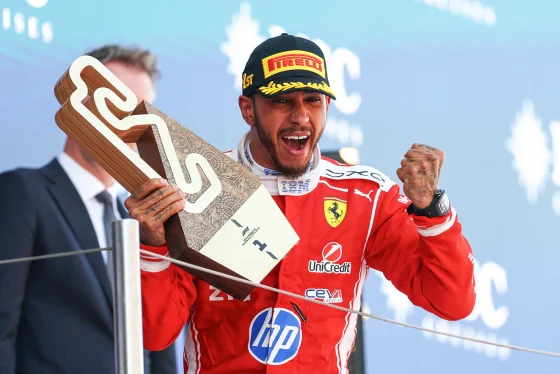
Lewis Hamilton Wins the 2026
Spanish Grand Prix for Ferrari
A three-stop gamble, a home-race retirement that triggered the decisive Virtual Safety Car, and a brutal late twist for championship leader Kimi Antonelli — here’s exactly how Hamilton won his first Grand Prix in Ferrari red.
Lewis Hamilton Wins the 2026 Spanish GP for Ferrari
A three-stop gamble and a late Virtual Safety Car carried Hamilton to his first win in Ferrari red — full results and analysis inside.
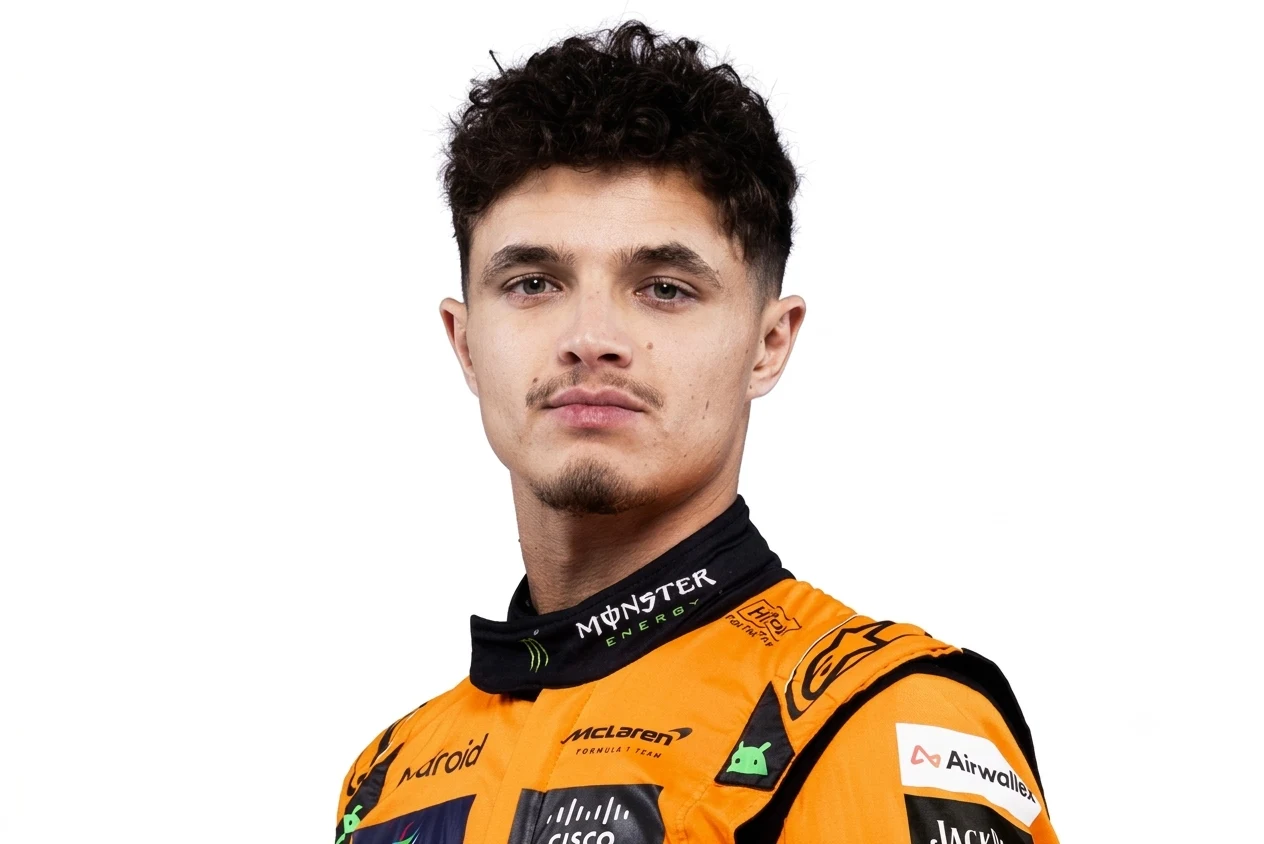
Lewis Hamilton won the 2026 Spanish Grand Prix at the Circuit de Barcelona-Catalunya on Sunday, taking his first Formula 1 victory for Ferrari and the 106th of his career. A bold three-stop strategy and a perfectly timed Virtual Safety Car carried him to a 19.561-second win over Mercedes’ George Russell, with Lando Norris completing an all-British podium for McLaren.
It ended a run of almost two years without a win for the seven-time champion, and it arrived on the same afternoon that championship leader Kimi Antonelli suffered the first real setback of his rookie title campaign. Below: how the race unfolded, the full classification, Saturday’s qualifying drama, the strategy call that decided everything, and what Barcelona means for the title fight heading into Austria.
How Hamilton Won: Inside Ferrari’s Three-Stop Gamble
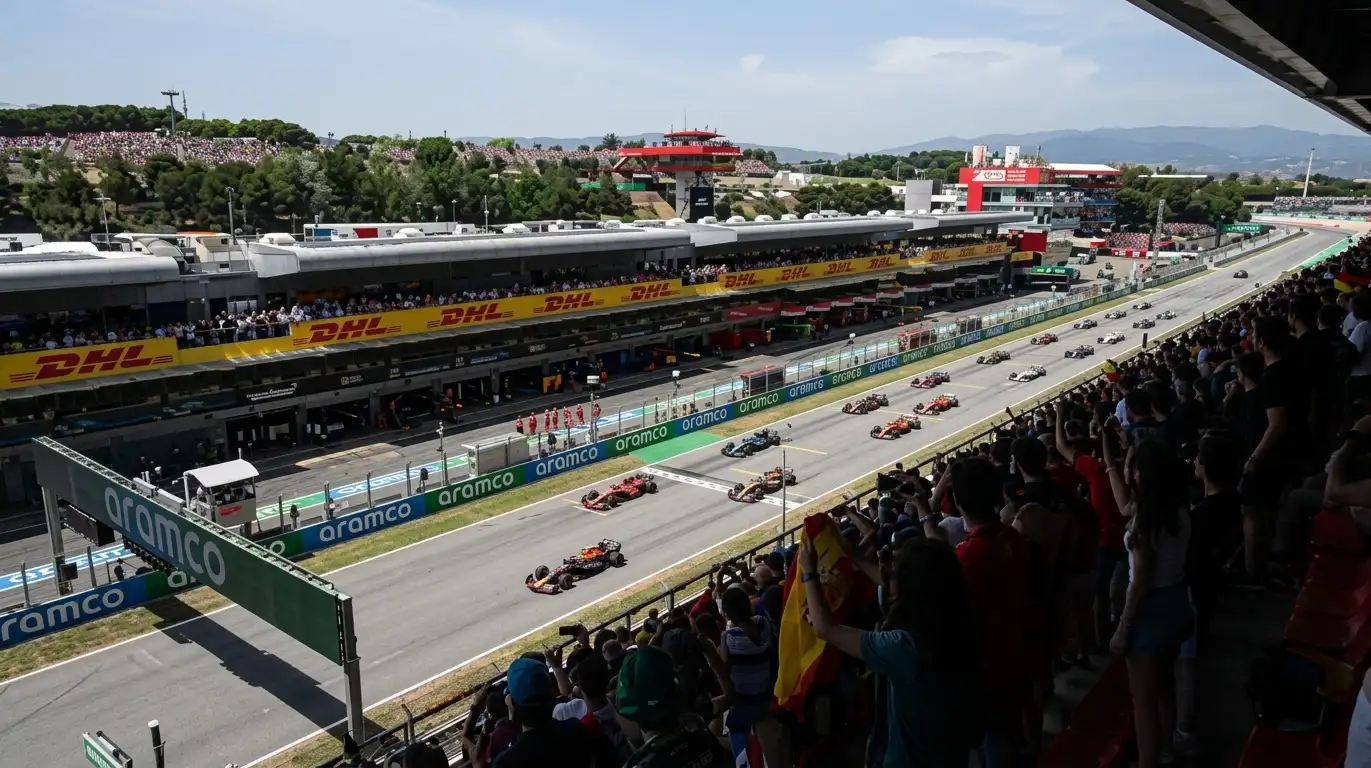
Barcelona delivered the hottest conditions of the 2026 season so far. Track temperatures were already past 50°C before the formation lap, and with Pirelli bringing a softer tyre allocation than last year, degradation was always going to decide the race. From pole, George Russell got the better start and held off Hamilton into Turn 1, with Kimi Antonelli, Lando Norris and Max Verstappen running in their grid order just behind.
Most of the field — including both Mercedes — started on medium tyres. Hamilton was one of the few front-runners to gamble on the soft compound for an aggressive opening stint, a call that set up everything that followed.
The Early Stops: Hamilton Goes His Own Way
The early degradation showed almost immediately. Russell set the race’s early pace but was reportedly losing close to two seconds across his first ten laps, while Norris complained his McLaren was “sliding everywhere” and Verstappen said his Red Bull was “wobbling” even on the straights. Hamilton pitted first, on lap 12, switching onto hard tyres — the move that quietly split Ferrari’s race away from the two-stop plan most of the grid was working to.
Russell pitted moments later and Mercedes executed the stop perfectly, holding the lead. Further back, Charles Leclerc’s second Ferrari pitted on lap 16 and Russell extended again to cover Oscar Piastri, but the order through the top seven held roughly as it had been before the stops.
The Second Stop That Changed the Race
Ferrari’s second roll of the dice came on lap 23. Hamilton came in again — this time onto fresh medium tyres — and emerged with a tyre advantage nobody else on track had. He immediately strung together a run of laps roughly 2.5 seconds faster than the cars ahead of him, briefly setting the fastest lap of the race in the process. When Norris ducked in for another set of tyres to protect his position, Mercedes had to react: both Russell and Antonelli pitted to cover him, and Hamilton inherited the net race lead with a buffer of around 16 seconds.
By pitting before his rivals, Hamilton effectively bought himself a fresher set of tyres at a point in the race when everyone else’s rubber was already past its best. This is the same principle behind the classic undercut — get to new tyres first, and the lap-time gain can be worth more than the time lost in the pits.
The Virtual Safety Car That Sealed It
With Ferrari needing one more stop to make the gamble pay off, the race handed them the perfect window. Fernando Alonso — already starting from the pit lane after a pre-race power unit change for his home Grand Prix — retired from the race, triggering a Virtual Safety Car. Ferrari called Hamilton straight in for fresh hard tyres, effectively a near-free pit stop under reduced speed, and he rejoined with just under three seconds in hand over Russell on tyres good enough to see out the final 24 laps.
As the laps ticked down, Hamilton consistently extended his advantage while Antonelli and Norris closed up behind Russell, with the Mercedes driver under investigation for repeated track-limits infringements. Then, with five laps to go, the championship leader’s race fell apart.
Antonelli’s Late Drama
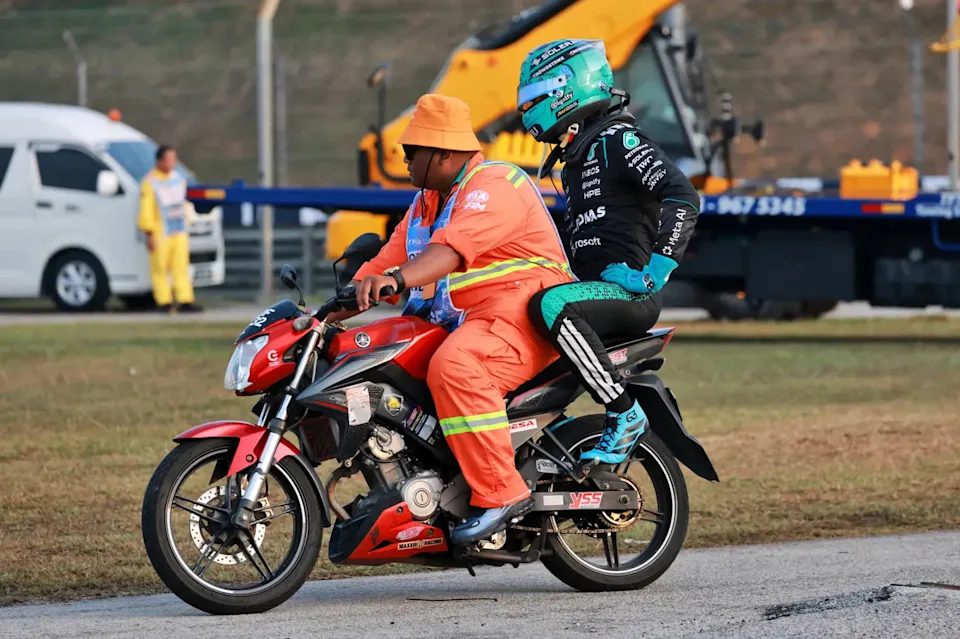
Antonelli forced his way past Russell for second place, breaking an end plate on his Mercedes in the process. Moments later his car slowed dramatically with a power unit failure and he pulled off track, ending his run of five consecutive race wins and bringing out a second Virtual Safety Car. In almost the same sequence, Leclerc retired from his own Ferrari after losing power steering. Hamilton’s lead over Russell was never threatened again, and he crossed the line 19.561 seconds clear for his first win in Ferrari red.
“I’ve got the greatest fanbase a sportsman could ever ask for.”
Speaking afterwards, Hamilton thanked Ferrari principal Fred Vasseur and the team for “believing in” him through what he described as a difficult first season in red, saying the changes the team had made through the year had gradually lifted his performance back to a race-winning level.


Full Classification — 2026 Spanish Grand Prix
Seven of the 22 cars on the 2026 grid failed to reach the chequered flag — one of the highest retirement counts of the season — with both Ferraris, both Aston Martins, and one car each from Mercedes, Audi, Haas and Cadillac among the casualties. Franco Colapinto’s eighth-place finish was demoted to 10th after a post-race penalty for failing to slow for yellow flags, promoting the Racing Bulls of Liam Lawson and Arvid Lindblad.
| Pos | Driver | Team | Result | Pts |
|---|---|---|---|---|
| 1 | 🏆 Lewis Hamilton | Ferrari | 1:32:28.105 | 25 |
| 2 | George Russell | Mercedes | +19.561s | 18 |
| 3 | Lando Norris | McLaren | +23.719s | 15 |
| 4 | Max Verstappen | Red Bull Racing | +40.497s | 12 |
| 5 | Oscar Piastri | McLaren | +58.661s | 10 |
| 6 | Isack Hadjar | Red Bull Racing | Finished | 8 |
| 7 | Pierre Gasly | Alpine | Finished | 6 |
| 8 | Liam Lawson | Racing Bulls | Finished | 4 |
| 9 | Arvid Lindblad | Racing Bulls | Finished | 2 |
| 10 | Franco Colapinto | Alpine | Finished · 10s penalty | 1 |
| 11 | Gabriel Bortoleto | Audi | Finished | 0 |
| 12 | Carlos Sainz | Williams | Finished | 0 |
| 13 | Esteban Ocon | Haas | Finished | 0 |
| 14 | Sergio Perez | Cadillac | Finished | 0 |
| NC | Alexander Albon | Williams | Not classified (-8 laps) | 0 |
| DNF | Kimi Antonelli | Mercedes | DNF Power unit, lap 62 | 0 |
| DNF | Charles Leclerc | Ferrari | DNF Power steering | 0 |
| DNF | Fernando Alonso | Aston Martin | DNF Power unit | 0 |
| DNF | Lance Stroll | Aston Martin | DNF Gearbox, lap 6 | 0 |
| DNF | Nico Hulkenberg | Audi | DNF | 0 |
| DNF | Valtteri Bottas | Cadillac | DNF Precautionary | 0 |
| DNF | Oliver Bearman | Haas | DNF | 0 |
For a refresher on how the points in that table are awarded — and why positions 11th and lower score nothing — see our F1 points system explained.
Saturday: How Russell Took Pole From Hamilton by 0.064s
Sunday’s grid was set in one of the tightest Q3 sessions of the year. George Russell, who arrived in Barcelona having failed to score in the previous two rounds and sat 68 points adrift of team-mate Antonelli in the standings, topped two of the three practice sessions and carried that form into qualifying. His final lap of 1:14.679 was good enough for his third pole of 2026 and the 10th of his career — but only just.
Hamilton, chasing his first pole since 2023, produced his best lap of the weekend at the perfect moment to split the Mercedes pair, missing out on pole by just 0.064 seconds. Antonelli ended up third, his lowest qualifying result of the season, 0.319 seconds off pole.
Q3 was also disrupted by a red flag after Charles Leclerc crashed at the Turn 4 exit — his third crash in eight days following an incident at his home Monaco Grand Prix. Leclerc, who had been fastest in Q2, walked away unhurt but was unable to set a time in Q3 and started 10th.
| Pos | Driver | Team | Best Lap | Gap |
|---|---|---|---|---|
| 1 | 🏁 George Russell | Mercedes | 1:14.679 | — |
| 2 | Lewis Hamilton | Ferrari | 1:14.743 | +0.064s |
| 3 | Kimi Antonelli | Mercedes | 1:14.998 | +0.319s |
| 4 | Lando Norris | McLaren | 1:15.001 | +0.322s |
| 5 | Max Verstappen | Red Bull Racing | 1:15.021 | +0.342s |
| 6 | Isack Hadjar | Red Bull Racing | 1:15.077 | +0.398s |
| 7 | Oscar Piastri | McLaren | 1:15.090 | +0.411s |
| 8 | Liam Lawson | Racing Bulls | 1:16.542 | +1.863s |
| 9 | Nico Hulkenberg | Audi | 1:16.657 | +1.978s |
| 10 | Charles Leclerc | Ferrari | No time | Q3 crash |
For the full breakdown of how the Q1–Q3 knockout format works and why every Q3 runner has to start the race on their Q2 tyre, see our F1 qualifying explained guide.
Strategy Breakdown: Why the Three-Stop Worked at Barcelona
The most useful way to understand Sunday’s result is to think of it as two different bets on the same problem. With track temperatures over 50°C, every car was going to lose performance as its tyres aged — the only question was how teams chose to manage that decline. Most of the grid, Mercedes included, planned around a conventional two-stop race: longer stints, fewer pit-lane time losses, and tyres nursed rather than pushed.
Ferrari bet the other way. By pitting Hamilton early and again on lap 23, they accepted the time cost of an extra pit stop in exchange for consistently fresher rubber than the cars around him — and it showed immediately in lap times roughly 2.5 seconds quicker than the leaders. That pace advantage is what forced Mercedes to react defensively rather than dictate the race on their own terms.
A Virtual Safety Car (VSC) forces every driver to slow to a set delta time without the safety car physically deploying on track. Because the field bunches up at reduced speed, a pit stop taken under VSC conditions costs significantly less time than one taken at full racing speed — which is exactly why Ferrari’s timing with Hamilton’s third stop was so valuable. Full explanation: what is a safety car in racing.
The tyre compounds themselves tell part of the story too. Pirelli brought its C2, C3 and C4 compounds to Barcelona — hard, medium and soft — and Hamilton used all three across his three stints, while most of the field used only two. For a primer on what the colour-coded compounds mean and how teams choose between them, see our prime and option tyre explainer.
SOFT MEDIUM HARD — Hamilton’s race used all three Pirelli compounds across laps 1–12, 24–41 and 43–66 respectively, the only driver in the top five to do so.
Title Fight Tightens: Standings After Barcelona
Kimi Antonelli still leads the Drivers’ Championship on 156 points despite his late retirement, but his advantage over Hamilton has been cut from 66 points to 41 — a 25-point swing in a single afternoon. Russell’s podium keeps him third on 106 points, just nine behind Hamilton and firmly back in the title conversation after a difficult few rounds. Leclerc’s retirement leaves him fourth on 75, with Norris (73) and Piastri (68) close behind in McLaren’s own internal battle, and Verstappen seventh on 55.
| Pos | Driver | Team | Points | Gap to Leader |
|---|---|---|---|---|
| 1 | Kimi Antonelli | Mercedes | 156 | — |
| 2 | Lewis Hamilton | Ferrari | 115 | -41 |
| 3 | George Russell | Mercedes | 106 | -50 |
| 4 | Charles Leclerc | Ferrari | 75 | -81 |
| 5 | Lando Norris | McLaren | 73 | -83 |
| 6 | Oscar Piastri | McLaren | 68 | -88 |
| 7 | Max Verstappen | Red Bull Racing | 55 | -101 |
| 8 | Pierre Gasly | Alpine | 41 | -115 |
| 9 | Isack Hadjar | Red Bull Racing | 34 | -122 |
| 10 | Liam Lawson | Racing Bulls | 28 | -128 |
In the Constructors’ Championship, Mercedes remains comfortably ahead, though Ferrari closed the gap by seven points in Barcelona — Hamilton’s 25 points minus the points Leclerc would have scored had he finished. For the complete, continuously updated picture across both championships, see our F1 2026 standings hub.
This was only the seventh race of a 24-round season, so a 41-point gap is far from decisive. But it’s the first time in 2026 that Antonelli’s championship lead has been cut rather than extended, and it gives Ferrari proof — for the first time this year — that their car can win outright rather than just score podiums.
What’s Next: Austria, June 26–28
With the Monaco–Barcelona double-header complete, the paddock now gets a short break before Round 8 of the 2026 season at the Red Bull Ring for the Austrian Grand Prix, running June 26–28. Given how close the gaps were through the midfield in Barcelona, and with Ferrari now with genuine race-winning form to carry into Austria, the next round looks set to be just as closely fought. For session times and where to watch, check our next F1 race guide and the full 2026 F1 schedule.
Frequently Asked Questions
One last thought on Barcelona
The headline is Hamilton’s first Ferrari win, and it deserves to be — two years is a long wait for a driver with his record. But the more interesting story for the rest of 2026 might be the one written in the strategy. Ferrari didn’t win this race by being the fastest car on Sunday; they won it by being the most willing to take a risk that most of the grid considered too costly. If that approach holds up at a circuit like Austria, where pit-lane time loss is shorter and overtaking is easier, Ferrari’s race-winning weekends may stop looking like one-offs.
For Antonelli, the lesson is different. Five wins in a row had made his title campaign look like a formality. One mechanical failure later, the gap is 41 points with 17 races still to run — comfortable, but no longer untouchable.