NASCAR’s 25-Car California Crash Explained: What Triggered the Massive Pileup?
Sam Mayer clipped the inside wall at Turn 1 on Lap 35, sending 25 cars into chaos at Naval Base Coronado. Here is the full breakdown — what caused it, who was hurt, how the wall broke, and what happened next.
NASCAR’s 25-Car California Crash Explained
Sam Mayer clipped the inside wall on Lap 35, triggering a massive pileup that stopped the race for 45 minutes.
On Lap 35 of the final stage of the United Rentals Driven to Serve 250, Sam Mayer clipped the inside wall at Turn 1 on a restart and triggered one of the biggest NASCAR wrecks of the 2026 season — a 25-car pileup that broke the retaining wall and red-flagged the race for 45 minutes.
The crash happened at Naval Base Coronado, NASCAR’s brand-new San Diego street course, during the NASCAR O’Reilly Auto Parts Series race on Saturday, June 20, 2026. Anthony Alfredo took the hardest direct hit and was stretchered from his car. The concrete retaining wall on the outside of Turn 1 was struck with such force it moved several feet. This is the full story — the cause, the chain reaction, every driver involved, and how the race ultimately ended.
The Story in Brief
The NASCAR California crash was not a superspeedway tangle or a racing-incident dispute. It was a single driver mistake on a restart — in a confined street-course corner with no runoff and a concrete wall inches away — that cascaded into one of the season’s most dramatic incidents.
Mayer had been running well all afternoon. He carried genuine pace heading into the final stage and admitted afterwards he consciously chose to raise his aggression level on the restart to compete for the lead. That decision, made in a split second entering the tight Turn 1 complex, sent everything sideways. Because street courses have zero margin for error at the wall, what might have been a minor brush at a conventional oval became a sequence of events that collected nearly the entire field.
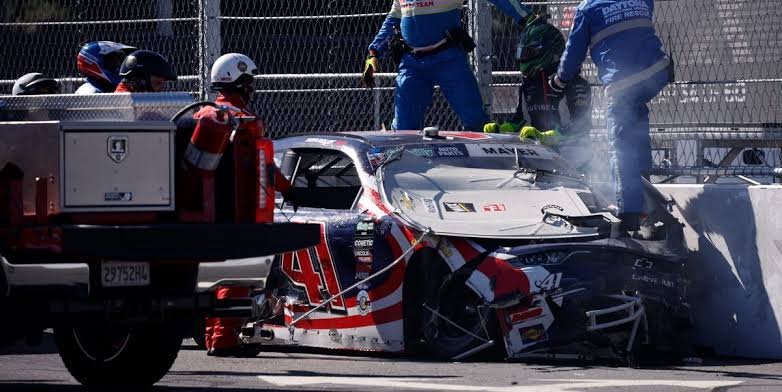
Sam Mayer clipped the inside wall entering Turn 1 on the restart at Lap 35. His car was immediately deflected across the nose of Anthony Alfredo’s car, driving both into the outside concrete retaining barrier at speed. The wall was struck hard enough to be pushed several feet off its base. NASCAR immediately displayed a red flag while safety crews responded.
What Caused the NASCAR 25-Car California Crash?
The race had already been eventful before Lap 35 arrived. Earlier in the afternoon, Corey Day struck a loose manhole cover at the new Naval Base Coronado street circuit, puncturing his radiator and triggering a first red flag while track workers welded down loose covers across the circuit. That 20-minute stoppage foreshadowed the difficulty of running stock cars through public infrastructure — but nothing prepared the field for what came next.
When the green flag dropped for the final-stage restart, Mayer was positioned near the front. He had three top-five finishes from his previous four races and genuinely believed he could win. However, the approach to Turn 1 at Coronado is unforgiving — no tyre barrier softening the outside wall, no extended runoff to collect a sliding car. Mayer later explained that the visual references at the corner were also difficult, with no inside catch fence making it hard to judge the precise wall position when following other cars into the apex.
The Sequence: How One Clip Became a 25-Car Wreck
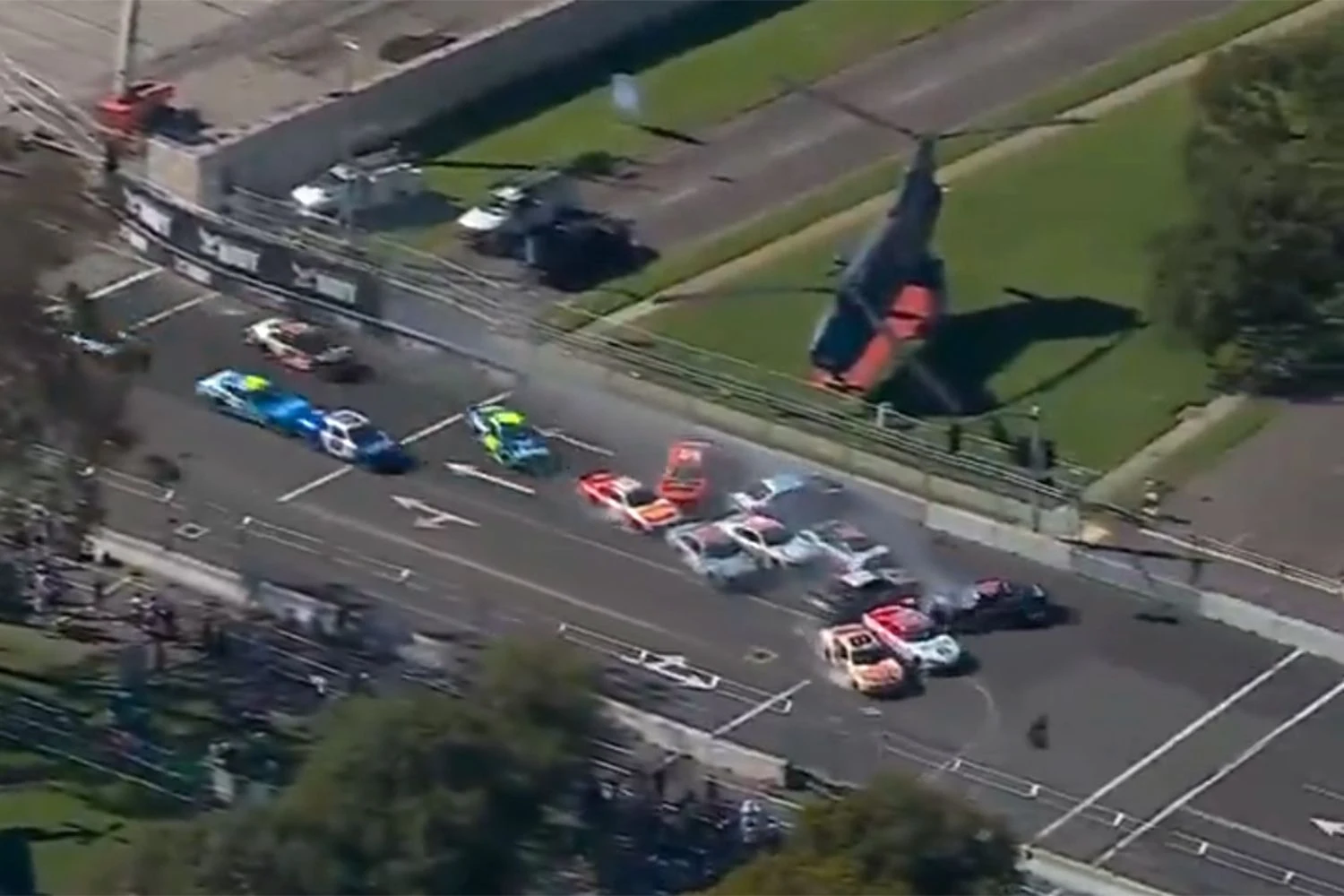
The mechanics of the crash were textbook street-course domino. Mayer’s car touched the inside wall — a contact that on an oval might have produced a spin or a caution flag. On a street course with a concrete wall on the outer edge, however, the deflection sent his car straight across the track at speed. Anthony Alfredo, directly alongside him, took the full force of the impact.
Together, the two cars hit the outer wall hard enough to physically move the concrete retaining barrier several feet. That alone would have been enough to stop the race. However, the greater problem was the cascade. Drivers stacked up behind the leaders on a restart have limited reaction time and even less space on a narrow street course. The entire group of cars following through Turn 1 had essentially nowhere to go. Some tried to brake; others had no room at all. Within seconds, roughly 25 cars were involved in varying degrees of contact, ranging from direct wall hits to secondary and tertiary collisions as the initial crash point blocked the circuit entirely.
“The visuals are hard here, with not having an inside catch-fence. It’s hard to see the inside wall when you’re following people. I just didn’t put my car in the right place.”
Sam Mayer — official NASCAR.com post-race interview, June 20, 2026Critically, NASCAR could not simply push the wall back into position. The retaining barrier required complete removal of the affected section and full replacement, which is a far more complex job than patching a tyre barrier or clearing debris from an oval. Workers spent the better part of 45 minutes replacing the wall before the race could resume under yellow-flag conditions.
NASCAR’s traditional oval and road-course venues typically feature tyre barriers, SAFER barriers, or extended gravel traps that absorb energy and give drivers a recovery path. Street circuits — like the Coronado layout — use temporary concrete barriers that cannot flex on impact. Moreover, the narrow track width means a crash at the front of the pack on a restart essentially blocks every car behind it simultaneously. For more on how crashes happen in motor racing, see our detailed explainer. NASCAR’s official website also published its incident report for the Coronado weekend.
Mayer’s Own Explanation
Mayer was visibly distressed after the incident and did not deflect responsibility. Speaking to media at the infield care centre, he acknowledged that he had deliberately chosen to push harder on the restart and paid the price for it. Furthermore, he noted the specific difficulty of the Coronado layout — the absence of an inside catch-fence made it genuinely harder to judge wall proximity when following cars into the corner at restart speeds.
His radio message immediately after the crash — recorded and reported by Motorsport.com — captured the emotional weight of the moment. Mayer called himself one of the worst racing drivers to touch the sport, a comment he would later soften but which reflected the immediate gut-punch of realising he had wiped out roughly the entire field. Alfredo’s gracious response — noting that Mayer had personally apologised to him at the infield care centre — gave the incident a human dimension that went beyond a simple driving error.
How the Race Day Unfolded — Full Timeline
Drivers Involved in the NASCAR Pileup
The following drivers were confirmed as involved in the Lap 35 pileup at the San Diego street course, with varying degrees of damage. The principal impact involved Mayer and Alfredo; secondary and tertiary collisions pulled in cars that had nowhere to avoid the initial wreck.
| Driver | Role in Incident | Injury Status | Damage |
|---|---|---|---|
| Sam Mayer | Initial trigger — clipped inside wall | Uninjured | Heavy — car destroyed |
| Anthony Alfredo | Direct secondary impact — hit head-on | Stretchered · Released | Severe — car destroyed |
| William Sawalich | Collected in initial chain reaction | Evaluated · Released | Heavy damage |
| Justin Allgaier | No room to avoid — collected | Uninjured | Race-ending damage |
| Sammy Smith | Caught in secondary collision | Uninjured | Significant |
| Brandon Jones | Secondary collision | Uninjured | Significant |
| Harrison Burton | Secondary collision | Uninjured | Significant |
| Sheldon Creed | Caught in chain reaction | Uninjured | Varying |
| Jesse Love | Caught in chain reaction | Uninjured | Varying |
| Brent Crews / Austin Hill / Austin Green / Ryan Sieg / Alex Labbe / Blaine Perkins / Dean Thompson / Jeb Burton / Andrew Patterson / Brennan Poole / Preston Pardus / Jeremy Clements / Rajah Caruth / Leland Honeyman Jr. / Brad Perez + others | Tertiary / cascade collisions | All Released | Varying — some minor |
“That was by far the biggest hit of my entire life by a mile, and I’ve hit pretty hard a few times. Just knocked the wind out of me, and I banged both my legs up a little bit. I’m feeling a lot better now. Sam apologised to me in there, so I guess it was his fault, but that’s a mess.” — Anthony Alfredo, infield care centre, June 20, 2026, via NASCAR.com.
Race Result — United Rentals Driven to Serve 250
Despite the chaos, the race ran to completion. Austin Hill delivered one of the day’s most dramatic moments with a last-lap pass on Taylor Gray entering Turn 3. It was Hill’s first career road-course NASCAR O’Reilly win and his second victory of the 2026 season. Crucially, it also marked Richard Childress Racing’s first win since the passing of Kyle Busch — an emotional moment for the entire RCR organisation.
| # | Driver | Team / Car | Notes |
|---|---|---|---|
| 1 | Austin Hill | #21 · 1-800-PACK-RAT Chevrolet · RCR | Last-lap pass on Gray at Turn 3 · First road course win |
| 2 | Taylor Gray | #54 | Led race-high 16 laps · Lost lead on final lap |
| 3 | Sheldon Creed | #00 | First top-10 at San Diego Street Course |
| 4 | Carson Kvapil | #1 | Contact with Gray while battling for lead late in race |
| 5 | Sammy Smith | #8 | Recovered from crash involvement |
| 6–10 | Love / Retzlaff / Green / Burton / Day | Various | Jesse Love, Parker Retzlaff, Austin Green, Harrison Burton, Corey Day |
Justin Allgaier remains the points leader by 224 points over Jesse Love after the race — though the crash ended his afternoon early. Furthermore, William Sawalich holds the final playoff spot by just 5 points over Brent Crews, making the championship implications of this race very real. For the full O’Reilly Auto Parts Series points standings, the Jayski race page carries comprehensive results data. Meanwhile, our own NASCAR 2026 points standings page tracks the championship picture race by race.
Austin Hill’s victory was particularly meaningful for Richard Childress Racing. Hill is driving the car previously associated with Kyle Busch, who passed away recently. RCR brought the team back to victory lane in San Diego — a moment with genuine emotional weight for the organisation beyond the points implications. Hill celebrated around the No. 8 car in victory lane, acknowledging what the win meant for the team.
What This Crash Says About NASCAR Street Course Racing
The San Diego crash will reignite a debate that NASCAR has been having with itself since it first introduced street courses. Supporters of the format point to exactly what happened in Coronado — unpredictability, dramatic racing, and an event that generated enormous attention across the weekend. Critics will point to the same incident and ask whether concrete walls and public infrastructure are an appropriate setting for high-speed stock-car restarts.
The truth, as it usually is in motorsport, sits somewhere in the middle. Street circuits bring NASCAR to new audiences and new environments. However, they also concentrate risk in ways that purpose-built circuits do not. A safety barrier on a proper racing venue is designed to absorb and redirect impact. A temporary concrete wall installed on a naval base is not. The Lap 35 crash at Turn 1 demonstrated exactly where that distinction matters most.
Moreover, the race produced two red flags — the manhole cover incident early and the Mayer crash later — raising genuine questions about infrastructure preparedness for the series’ newest venue. NASCAR has historically been good at learning from incidents like this. The full Motorsport.com incident report covers the technical details of the wall damage. Meanwhile, MotorBiscuit’s analysis of the circuit’s unforgiving nature is worth reading alongside our own piece.
The Cup Series also had its own Turn 1 crash on the same circuit later that weekend — Austin Hill entered the corner too deep, sliding into Connor Zilisch and Shane van Gisbergen. That incident produced a separate multi-car wreck and further damaged the retaining wall. Consequently, the same corner produced chaotic wrecks in both the O’Reilly and Cup races. That pattern is not a coincidence — it is an engineering and circuit-design reality that NASCAR will need to address ahead of any return to Coronado. To understand what causes crashes in motor racing more broadly, our crash causes explainer covers the physics and human factors involved.
Racing safety has improved enormously over recent decades — the halo device in F1, the HANS device in NASCAR, and the SAFER barrier system have all contributed to keeping drivers safer in heavy impacts. However, the Coronado crash illustrates that the venue itself remains a critical variable. You can build the safest car in motorsport and still face a scenario where a concrete wall on a restart provides no survivability margin whatsoever for the cars caught in the pile.
Frequently Asked Questions — NASCAR California Crash
The bigger question San Diego leaves behind
Sam Mayer is a talented driver who made a mistake under pressure at the worst possible venue for that kind of mistake. That is the honest summary of the Lap 35 incident. He took responsibility without hesitation, and both he and Alfredo will race again next week at Sonoma Raceway.
However, the conversation NASCAR needs to have is bigger than one driver’s error. When the same corner produces massive multi-car wrecks in both the O’Reilly and Cup races on the same weekend, that is a venue problem as much as a driving problem. Street courses are exciting — San Diego’s debut weekend proved that spectacularly. Furthermore, the racing was competitive and the crowd atmosphere at Naval Base Coronado was something the sport had not seen before. The challenge is making sure the setting remains as safe as the competition is thrilling.
Full NASCAR O’Reilly Series coverage continues at worldofspeed.org. The series returns at Sonoma Raceway on Saturday, June 27, at 5:30 p.m. ET on The CW.