NHRA U.S. Nationals 2026:
Schedule, TV Coverage & Live Stream Guide
The complete guide to the Big Go — every session time, FOX and FS1 broadcast window, live stream option, qualifying format, elimination draw, and what the championship picture looks like heading into the Countdown.
NHRA U.S. Nationals 2026:
Schedule & TV Guide
Every session time, TV window, and stream option for Indianapolis.
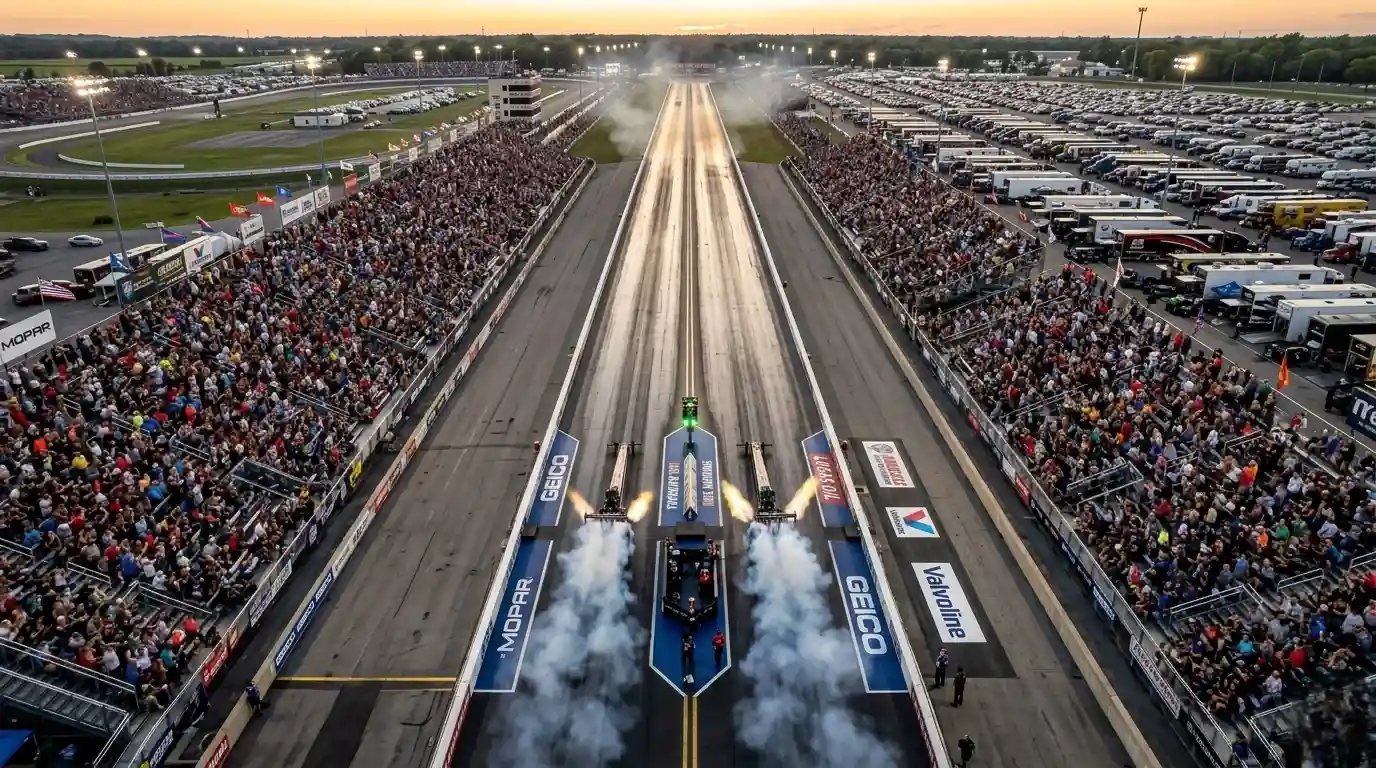
There is no event on the Mission Foods NHRA Drag Racing Series calendar that carries the weight of Indianapolis. The U.S. Nationals — the Big Go — has been running at Lucas Oil Indianapolis Raceway Park since 1961, and in 65-plus years it has never lost its status as the one race that defines a career. World championships have been secured here. Legends have been made in the final 1,000 feet of a Monday afternoon run that nobody in the grandstands will ever forget. The 2026 edition arrives with an even bigger points structure — effectively points-and-a-half for professional categories — making it the single most consequential weekend before the Countdown to the Championship begins.
This guide covers every piece of scheduling and viewing information you need: the full multi-day timetable from Friday qualifying through Labor Day Monday eliminations, the complete FOX and FS1 broadcast schedule, every live streaming option, how the qualifying format works, what each professional category looks like heading into the weekend, and a fan guide for anyone making the trip to Indy in person.
What Is the NHRA U.S. Nationals? The Big Go Explained
The NHRA U.S. Nationals is the oldest and most prestigious drag racing event in the world. It began in 1955 and settled permanently at Indianapolis in 1961, where it has remained ever since — outlasting rule changes, engine revolutions, venue renovations, and every competitive shift the sport has undergone in six decades. No other event on the calendar commands the same respect from drivers, crew chiefs, or fans. Winning here doesn’t just mean adding a Wally trophy to the shelf. It means something else entirely.
Indy is the one race that defines your legacy. If you haven’t won the U.S. Nationals, your trophy case is missing its heart.
In 2026, the stakes are higher than ever. The NHRA has restructured the points allocation at Indianapolis to a points-and-a-half format for all professional categories. Winning a round here earns 30 points instead of the usual 20. Reaching the final earns proportionally more across every round. For a driver sitting fifth in the standings arriving at Indy, a deep run through Monday’s eliminations can mathematically vault them into championship contention before the Countdown even begins. For the points leader, a first-round exit can compress a comfortable advantage into a fight. That pressure is what makes the atmosphere at Lucas Oil Indianapolis Raceway Park unlike anything else in American motorsport.
The event also functions as the final reset before the Countdown to the Championship — the six-race playoff that determines the NHRA world champions. The top ten drivers in each professional category after Indianapolis lock into the Countdown field. Everything that follows is reset to a compressed points window. The line between making the Countdown and missing it has been decided at Indy, in Monday’s final round, more times than the record books can easily count.

NHRA U.S. Nationals 2026 Full Schedule
The U.S. Nationals runs longer than any other event on the NHRA calendar. While most national events span three days, Indianapolis stretches across five to six days to accommodate the sheer volume of sportsman entries alongside the professional categories. The timeline below covers the professional nitro classes — Top Fuel and Funny Car — along with Pro Stock and Pro Stock Motorcycle. All times listed are Eastern Time. Sportsman categories begin competing earlier in the week; the professional programme fires up Thursday evening for the first session.
| Day | Session | Primary Network | Start Time (ET) | Notes |
|---|---|---|---|---|
| Thursday | Sportsman Qualifying Opens | FS1 | 10:00 AM | Early sportsman action; pro classes prep |
| Friday | Pro Qualifying — Session 1 (Night) | FS1 | 7:00 PM | “Night Under the Lights” — coolest track temps, fastest ETs |
| Saturday | Pro Qualifying — Sessions 2 & 3 | FS1 | 1:00 PM | Mission #2Fast2Tasty Challenge follows qualifying |
| Sunday | Pro Qualifying — Sessions 4 & 5 | FS1 / FOX | 11:00 AM | Final opportunity to crack top 16 ladder |
| Monday | Final Eliminations — All Pro Categories | FOX | 11:00 AM | Labor Day — Big Go Finals. Countdown bubble set. |
Friday evening qualifying — “Night Under the Lights” — is when the track conditions at Lucas Oil Indianapolis Raceway Park are at their most ideal. As temperatures drop after sunset, the air becomes denser, oxygen content rises, and the track surface grips harder. The result is almost always the quickest elapsed times of the weekend. A strong Friday night run sets the number-one qualifier early and forces rivals to chase the benchmark through four more sessions in warmer daytime conditions. Teams with the most aggressive tune-up gamble hardest on Friday night — and the biggest mechanical failures of the weekend tend to happen in this session too.
The race order on Monday eliminations day
Monday’s elimination sequence follows a fixed order that NHRA has used for decades. Top Fuel opens proceedings — the first pair lights the beams shortly after 11:00 AM ET, with the nitro smell immediately hitting the grandstands and signalling to everyone on the grounds that the real day has begun. Funny Car follows, then Pro Stock, then Pro Stock Motorcycle. Each category runs all four rounds sequentially before the next category begins its first round, meaning the Top Fuel champion is often crowned before the afternoon session is even half over. The final round of the day — whichever professional category closes out — typically runs mid-afternoon, giving the national FOX broadcast a clean conclusion window.
TV Schedule, FOX & FS1 Coverage Guide
The NHRA U.S. Nationals receives the most extensive broadcast package of any event on the Mission Foods Drag Racing Series calendar. FOX and FS1 split duties across the weekend in a structure that reflects the event’s tiered importance — qualifying and specialty sessions go to FS1’s cable audience, while the final eliminations on Labor Day Monday get the full national FOX network treatment, pushing the Big Go in front of millions of viewers who may tune in specifically because it’s the biggest race of the year.
| Network | Coverage Type | Days | Start Time (ET) |
|---|---|---|---|
| FS1 | Pro Qualifying Sessions 1–3 | Fri–Sat | 7:00 PM (Fri) / 1:00 PM (Sat) |
| FS1 | Pro Qualifying Sessions 4–5 | Sunday | 11:00 AM |
| FOX | Final Eliminations — All Pro Categories | Monday | 11:00 AM |
| NHRA.tv | Full wall-to-wall coverage — all sessions, all classes | Thu–Mon | All day |
| FOX Sports App | Live stream of FS1 and FOX feeds | Fri–Mon | Per session start |
Why Monday on FOX matters
The transition from FS1 to the main FOX network on Labor Day Monday is not just a broadcast logistics decision — it is a deliberate statement about what the NHRA considers the apex of its season. The national FOX audience for Labor Day Monday is significantly larger than FS1’s cable reach, and the production quality scales up accordingly: additional camera positions, more pit-lane reporters, wider commentary team, and the drama of the live championship picture being updated in real time on screen between rounds. For fans who only watch one session of the entire weekend, this is the one.

Live streaming options: how to watch without cable
Cable subscriptions are no longer the only way to catch the U.S. Nationals. The options below cover every viewer scenario from cord-cutter to hardcore fan who wants every sportsman run logged.
- NHRA.tv — The official subscription streaming service. Wall-to-wall coverage of every session, every category, including all sportsman classes that television skips entirely. The only way to see every single run of the entire weekend. Best option for hardcore fans who want raw, uncut coverage without broadcast structure.
- FOX Sports App — Free for verified cable/satellite subscribers. Streams FS1 and FOX live, matching broadcast times exactly. Login with your provider credentials and watch on any device.
- YouTube TV — Carries both FOX and FS1. No cable contract required. Suitable for cord-cutters who want the broadcast experience on smart TVs.
- FuboTV — Sports-focused streaming platform with FOX and FS1 in its base package. Good option for motorsport fans who already subscribe for other racing coverage.
- Hulu + Live TV — Includes both networks. Convenient if you already use Hulu for other content.
- DirecTV Stream — Premium tier includes FS1 and FOX with reliable stream quality for live sports.
The broadcast on FOX and FS1 is editorially curated — producers choose which runs to show, which interviews to cut to, and when to run commercial breaks. NHRA.tv is the opposite: continuous raw coverage with minimal editorial intervention. You see every run in every category including all the sportsman classes, the full pit walkabouts between rounds, and team radio chatter that never makes broadcast. If you care only about the final rounds on Monday, FOX is sufficient. If you want the full picture of how the weekend develops from Friday night through Monday afternoon, NHRA.tv is the right subscription. Check our NHRA TV schedule guide and what channel NHRA is on today for live broadcast updates throughout the weekend.
NHRA U.S. Nationals Qualifying: How It Works
Indianapolis uses five qualifying sessions for the professional categories — more than the three or four sessions standard at other national events. That extra track time exists because the sheer volume of entries at the Big Go means more cars competing for fewer spots in the 16-car elimination ladder, and because the atmospheric conditions across a five-day event can change dramatically from Friday night to Sunday afternoon. A car that posts a strong Friday night time on a cool, dense-air track may find itself squeezed out Sunday if rivals find better tune-ups in different conditions.

What “ET” and “60-foot time” mean and why they matter
Qualifying position is determined entirely by elapsed time — the time from when the front wheels break the stage beam to when the car crosses the 1,000-foot finish line. The current Indianapolis track record for Top Fuel sits near 3.628 seconds. A hundredth of a second in that window represents a meaningful performance gap. The 60-foot time — the elapsed time from the launch to the first timing marker sixty feet down the track — is what engineers watch most carefully. It measures how hard the car launched without spinning the rear tyres, and it accounts for roughly 40% of the total elapsed time. A car that posts a great 60-foot consistently is a car with a well-calibrated clutch pack and a crew chief who has read the track surface correctly. Understanding how race timing works across motorsport classes gives useful context for interpreting the numbers.
The number-one qualifier advantage: lane choice
The driver who sets the quickest time across all five sessions earns the number-one qualifier position and, with it, lane choice for every elimination round. Lane choice at Indianapolis is a genuine competitive variable. One side of the dragstrip typically offers fractionally better traction due to preparation chemistry, surface texture, or shade patterns across the day. Teams study which lane has been producing better 60-foot times throughout qualifying and factor that intelligence into their elimination strategy. The number-one qualifier chooses their preferred lane in round one, wins that right again in round two if they advance, and so on through the final. It is a compounding advantage that begins with a Friday night qualifying run.
At most NHRA national events, qualifying for the 16-car field is manageable — fields rarely overflow the cut line dramatically. At Indianapolis, the entry list for every professional category is substantially larger, meaning drivers who would comfortably make the field elsewhere can miss the cut entirely at the Big Go. A “DNQ” (Did Not Qualify) at Indianapolis is career-defining in the wrong direction. The psychological pressure this creates across five qualifying sessions — knowing one mechanical failure or rain delay could end your weekend before eliminations even begin — is something no other race produces in the same way. See our full U.S. Nationals archive for historical DNQ stories that still sting.
The Four Professional Categories at Indianapolis
The NHRA Mission Foods Drag Racing Series runs four professional categories at Indianapolis, each with its own engineering philosophy, competitive dynamic, and championship narrative. Here is what to know about each one heading into the 2026 Big Go.
Top Fuel vs Funny Car: the question new fans always ask
The physical difference is immediately visible once you know what to look for. A Top Fuel dragster is a long, open-wheel machine — you can see the driver exposed in the cockpit, the engine sits behind them, and the car looks like nothing a road-going vehicle ever inspired. A Funny Car has a carbon-fiber body shell that tilts forward as a single piece to give mechanics access to the engine, which sits in front of the driver. The body resembles a Dodge Charger, Toyota GR Supra, or similar production car depending on manufacturer affiliation. Both run the same 500-cubic-inch supercharged nitromethane engine. Both reach speeds over 330 mph. The aerodynamic drag from the Funny Car body typically means its elapsed times run a few hundredths behind equivalent Top Fuel machinery — but both represent the absolute limits of what internal combustion can produce in a racing context. Understanding what horsepower actually means gives useful context for appreciating what 11,000 of it feels like from a standing start.
For the full history of NHRA drag racing and how far the sport has evolved from its hot-rod roots to modern professional competition, our deep-dive archive is worth reading before the weekend. The top speed guide breaks down the numbers in detail, and how far Top Fuel cars actually race explains the 1,000-foot distance that replaced the quarter mile in 2008.

The Countdown to the Championship: what Indianapolis decides
After Monday’s final round closes out, the Countdown positions lock in. The top ten drivers in each professional category carry their points (reset to a compressed window) into the six-race playoff. Drivers eleven through twenty are eliminated from championship contention. The gap between tenth and eleventh can come down to a single round at Indianapolis — and there are drivers every year who spend the week before the Big Go knowing that a first-round exit on Monday ends their season’s championship ambitions entirely. For how racing championships are scored and the playoff mechanics across different series, our explainer covers the full structure.
Tickets, Attending & Indianapolis Fan Guide
Attending the NHRA U.S. Nationals in person is a genuinely different experience from watching any other motorsport event. The defining feature — and the one that makes NHRA unique across all of professional racing — is that every ticket is a pit pass. There is no separation between fans and the machinery. You can walk directly into the team trailers, stand close enough to watch mechanics rebuild a 500-cubic-inch engine from scratch between rounds, and have a conversation with a crew chief who just changed the entire fuel system in under twenty minutes. No other professional motorsport at this level lets fans inside the operation like this.
| Ticket Type | What’s Included | Best For |
|---|---|---|
| General Admission | Grandstand access + full pit pass all weekend | First-timers; families; budget-conscious fans |
| Reserved Grandstand | Assigned seating + pit access + better sightlines | Fans who want a guaranteed viewing position |
| VIP Suite / Hospitality | Premium enclosed seating, catering, trackside access | Corporate entertaining; premium experience seekers |
| Multi-Day Pass | Access across Thursday–Monday | Hardcore fans who want the full qualifying experience |
What to expect if you’re attending for the first time
The scale of the U.S. Nationals catches first-time attendees off guard. This is not a standard race day — it is a five-day motorsport festival that happens to include the most important drag race in the world at its climax. Arrive early on any day you attend: the pit walkways fill up fast as teams complete their post-run teardowns, and the best access to the working machinery happens in the hour immediately after a qualifying session ends. Bring ear protection — the nitro classes produce a pressure wave on launch that is physically felt in the chest cavity at close range, and after four rounds of Top Fuel on Monday morning your hearing will thank you for the foam plugs.
- Lucas Oil Indianapolis Raceway Park sits on the west side of Indianapolis — plan for 20–30 minutes from downtown hotels depending on traffic
- Monday elimination day draws the largest single-day crowd; arrive before 9:00 AM to navigate parking and pit entry without missing the first round
- The manufacturer midway and fan zones are worth an hour of exploration — interactive displays and technical exhibits from team sponsors run throughout the event
- Weather in Indianapolis in early September can swing from 95°F to 60°F across a single week — check the forecast and pack layers
- Tickets for the Big Go sell out earlier than any other NHRA event; secure them through the official NHRA website well in advance of the Labor Day weekend
Indianapolis has one of the richest motorsport heritage concentrations in the United States. The Indianapolis 500 has been running at the Brickyard since 1911. If motorsport history interests you beyond drag racing, the Indianapolis 500 winners archive traces that history in detail, and our famous race car drivers feature covers the legends who shaped American motorsport. For the broader context of how NHRA competition sits within the American racing calendar, our comparison of IndyCar vs F1 and the history of NASCAR round out the picture.
Frequently Asked Questions
Indianapolis doesn’t just host the biggest race in drag racing. It closes the regular season.
Five days, four professional categories, five qualifying sessions, and four elimination rounds that decide who races for the championship and who goes home. The points-and-a-half structure in 2026 makes every round on Monday worth more than at any other event all year. A single 3.6-second run has never meant more.
Whether you’re watching from the grandstands, tracking it on NHRA.tv, or catching the final rounds on FOX, the NHRA U.S. Nationals is the one event where the entire sport of drag racing stops and pays attention. Set your DVR for Monday. Better yet, be there.
For live results as they happen across the weekend, our live NHRA race results page updates in real time. For the next event on the 2026 calendar after Indianapolis, when is the next NHRA race has the date, location, and broadcast details.