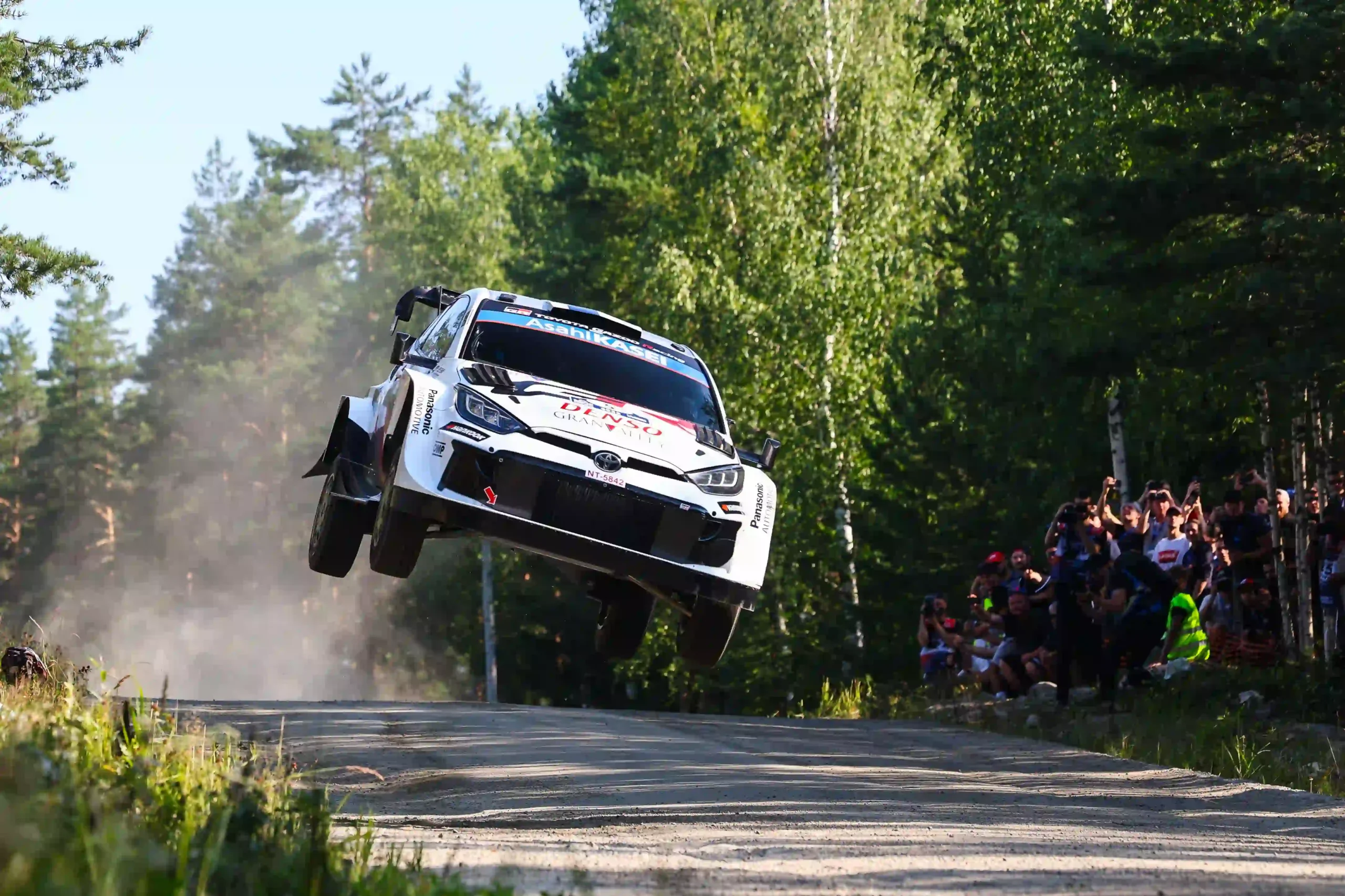
Rally Finland 2026: Full Schedule, Stage Timetable, TV Coverage & Streaming Guide
Every official stage time from Jyväskylä, converted for U.S. viewers, plus the 2026 route changes, Rally.TV options, television broadcasters and the stages that defined Finland’s anniversary itinerary.
Rally Finland 2026 returned to the roads around Jyväskylä for one of the most important editions in the event’s history. The 75th-anniversary WRC round ran from Thursday, July 30, through Sunday, August 2, with 20 competitive stages covering 316.04 kilometres of gravel.
This guide uses the official WRC Version 1.1 itinerary for stage times. Finland was on Eastern European Summer Time, or UTC+3, during the rally. For U.S. readers, every stage below is also converted to Eastern Daylight Time.
The event was more than a familiar high-speed sprint. WRC confirmed two new stages, more than half of the competitive distance changed from 2025, and a 61-crew entry headed by 11 Rally1 cars. That made the Rally Finland 2026 schedule especially important for fans trying to follow the full weekend.
Rally Finland 2026 at a glance
WRC Secto Rally Finland 2026 was Round 10 of the 14-event FIA World Rally Championship season. The service park remained in Jyväskylä, the traditional heart of the event, while the route spread across the fast gravel roads of Central Finland.
WRC describes Finland as a rally where average speeds routinely exceed 120 km/h. That number explains why the timetable matters. A stage can be more than 30 kilometres long, yet the fastest Rally1 crews cover huge distances in a remarkably short window.
How many stages were in Rally Finland 2026?
Rally Finland 2026 contained 20 competitive special stages covering 316.04 km. Ruuhimäki was a separate 4.12 km shakedown before competition began. The longest competitive test was the 30.02 km Himos-Jämsä stage, run twice on Sunday.
The event’s 75th anniversary also changed the character of the route. WRC’s official stage guide said two tests were new and more than half of the competitive distance differed from the previous year. That meant experienced crews could not simply rely on old rhythm and old video notes.
At the same time, the rally retained familiar names such as Laukaa, Saarikas, Parkkola, Päijälä, Västilä and Leustu. Harju continued as the compact city-centre super special, while Sunday moved to two runs of Himos-Jämsä.
Official WRC times were published in UTC+3. U.S. Eastern was UTC-4 during the event, so the ET conversion is seven hours earlier than the Finland start time.
Full Rally Finland 2026 schedule and stage timetable
The table below follows WRC’s official published itinerary. Stage start times are not estimates. They are the scheduled control times used for the 2026 event, with a separate conversion for U.S. Eastern viewers.
Streaming coverage can begin before the first car reaches the stage start. Rally.TV often opens a studio or pre-show window ahead of competition. Therefore, use the stage times below for the actual scheduled start and the streaming platform schedule for broadcast lead-in.
Thursday, July 30 — 2.58 competitive km
| Stage | Stage name | Distance | Finland (EEST) | U.S. Eastern (EDT) |
|---|---|---|---|---|
| Shakedown | Ruuhimäki | 4.12 km | 9:01 a.m. | 2:01 a.m. |
| SSS1 | Harju 1 | 2.58 km | 7:05 p.m. | 12:05 p.m. |
Friday, July 31 — 127.72 competitive km
| Stage | Stage name | Distance | Finland (EEST) | U.S. Eastern (EDT) |
|---|---|---|---|---|
| SS2 | Laukaa 1 | 18.16 km | 8:44 a.m. | 1:44 a.m. |
| SS3 | Saarikas 1 | 15.82 km | 9:45 a.m. | 2:45 a.m. |
| SS4 | Sydänmaa 1 | 19.04 km | 10:50 a.m. | 3:50 a.m. |
| SS5 | Hoho 1 | 9.55 km | 11:58 a.m. | 4:58 a.m. |
| SS6 | Laukaa 2 | 18.16 km | 2:48 p.m. | 7:48 a.m. |
| SS7 | Saarikas 2 | 15.82 km | 3:49 p.m. | 8:49 a.m. |
| SS8 | Sydänmaa 2 | 19.04 km | 4:54 p.m. | 9:54 a.m. |
| SS9 | Hoho 2 | 9.55 km | 6:05 p.m. | 11:05 a.m. |
| SSS10 | Harju 2 | 2.58 km | 7:05 p.m. | 12:05 p.m. |
Saturday, August 1 — 125.70 competitive km
| Stage | Stage name | Distance | Finland (EEST) | U.S. Eastern (EDT) |
|---|---|---|---|---|
| SS11 | Parkkola 1 | 16.76 km | 8:01 a.m. | 1:01 a.m. |
| SS12 | Päijälä 1 | 10.55 km | 9:42 a.m. | 2:42 a.m. |
| SS13 | Västilä 1 | 19.10 km | 10:36 a.m. | 3:36 a.m. |
| SS14 | Leustu 1 | 16.44 km | 12:05 p.m. | 5:05 a.m. |
| SS15 | Parkkola 2 | 16.76 km | 3:01 p.m. | 8:01 a.m. |
| SS16 | Päijälä 2 | 10.55 km | 4:42 p.m. | 9:42 a.m. |
| SS17 | Västilä 2 | 19.10 km | 5:36 p.m. | 10:36 a.m. |
| SS18 | Leustu 2 | 16.44 km | 7:05 p.m. | 12:05 p.m. |
Sunday, August 2 — 60.04 competitive km
| Stage | Stage name | Distance | Finland (EEST) | U.S. Eastern (EDT) |
|---|---|---|---|---|
| SS19 | Himos-Jämsä 1 | 30.02 km | 10:35 a.m. | 3:35 a.m. |
| SS20 | Himos-Jämsä 2 — Wolf Power Stage Power Stage | 30.02 km | 1:15 p.m. | 6:15 a.m. |
Friday carried the greatest number of separate competitive tests, with nine stages and 127.72 km. Saturday was nearly as long at 125.70 km across eight stages. Sunday looked short on paper with only two stages, but both Himos-Jämsä runs were 30.02 km, so the final day still contained 60.04 competitive km.
Thursday’s competitive distance was only 2.58 km because Ruuhimäki was shakedown rather than a points-paying special stage. Yet the day still mattered. It let crews check their cars at speed before the public opening on Harju that evening.
Do not confuse the Rally.TV programme start with the official special-stage start. A broadcast can begin early for studio coverage, interviews or the media zone. The official itinerary remains the reference for the first-car stage time.
Stage-by-stage route guide: what changed for 2026
Rally Finland is often summarized as “flat-out gravel and jumps,” but the 2026 route was more complicated. WRC’s stage guide combined fresh road with reversed classics, altered junction sequences and a Sunday finale that asked crews to attack one very long test twice.
Thursday: Ruuhimäki shakedown and Harju under the city lights
Ruuhimäki returned as the shakedown venue. The 4.12 km test used a wide main road, high-speed crests, a sandier technical section and the famous man-made jump near the finish. In 2026 it was used only for shakedown, not as a competitive special stage.
That distinction matters for viewers. Shakedown is still valuable live action, but it does not count toward the rally classification. Teams use it to confirm setup, tyre behaviour and systems before the event proper starts.
Harju then opened competition at 19:05 local time. The 2.58 km super special mixes Tarmac and gravel while threading through a city park. Frequent junctions and slower corners break the rhythm in a way that is very different from the flowing forest roads.
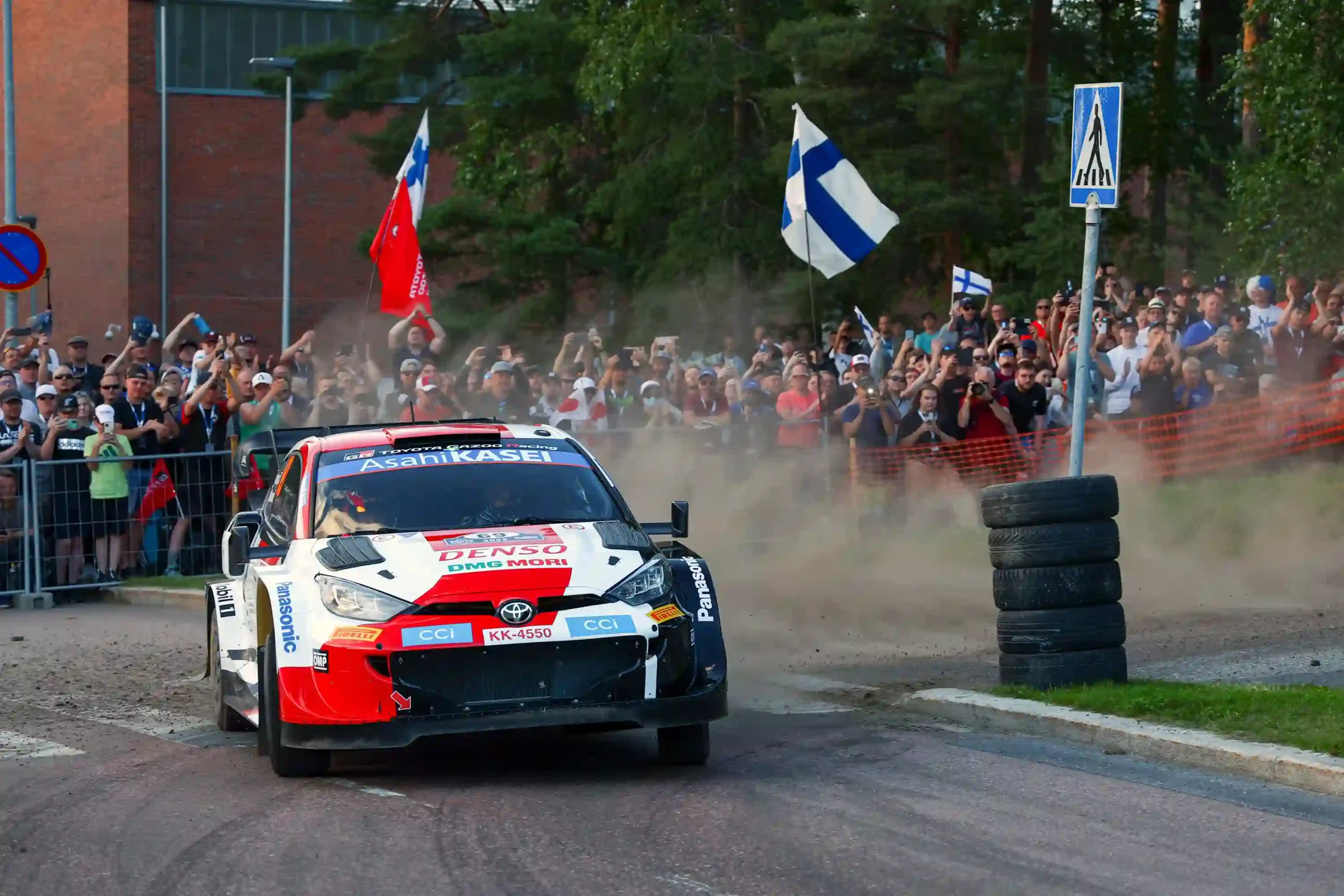
Harju returned again as SSS10 at the end of Friday. That gave spectators in Jyväskylä two short, accessible bursts of competition while the long forest stages decided most of the time gaps elsewhere.
Friday: Laukaa, Saarikas and the new Sydänmaa–Hoho combination
Friday was the first serious endurance test of the Rally Finland 2026 schedule. Laukaa ran twice over 18.16 km. WRC said the 2025 road was retained but reversed, changing how crests, braking points and the narrow technical middle section approached the crews.
Saarikas also ran twice. Its 15.82 km layout began very fast, narrowed through a more technical section and later opened into flowing road again. The name carried a warning because Ott Tänak had a heavy crash there in 2024.
The biggest route story was the arrival of Sydänmaa and Hoho. WRC described Sydänmaa as a new stage combining roads connected to the 2010 Sirkkamäki test and the Kalliokoski stage from the early 1990s. It mixed flowing medium-width road, ditches, long straights and several junction changes.
Hoho was also new for 2026. Its 9.55 km layout used roads from earlier Halttula versions. The stage repeatedly changed width and rhythm, moving from fast opening road to a tighter forest section before a quicker finish.
Those changes are important in rallying because familiarity has real performance value. Drivers know the road only through reconnaissance and pace notes, but repeated use of the same route helps crews understand where cambers change and where crests hide braking zones. New or reversed road reduces that historic advantage.
Saturday: Parkkola, Päijälä, Västilä and Leustu
Saturday contained 125.70 km and no city super special. It was a pure forest-stage day, split into two loops of four tests. The first car started Parkkola at 08:01 local time and ended the second Leustu run at 19:05.
Parkkola kept much of its 2025 identity but gained extra distance at the finish. WRC’s route notes highlighted a mix of wide cambered road, narrow technical sections, elevation changes and a major jump. The stage also carries history: Carlos Sainz crashed out of the lead there in 1991.
Päijälä was shortened and reversed for 2026. The version bypassed the classic Päijäläntie road and used Sappeentie and Liehuntie, roads last run in that direction in 2021. That created long flowing corners, repeated elevation changes and a more intricate final section.
Västilä also ran in the opposite direction to 2025, using a configuration WRC said had last appeared in 2001. Leustu, by contrast, was unchanged from 2025. Its wide flat-out sections and big jump near the latter part of the stage preserved some continuity in a route full of revisions.
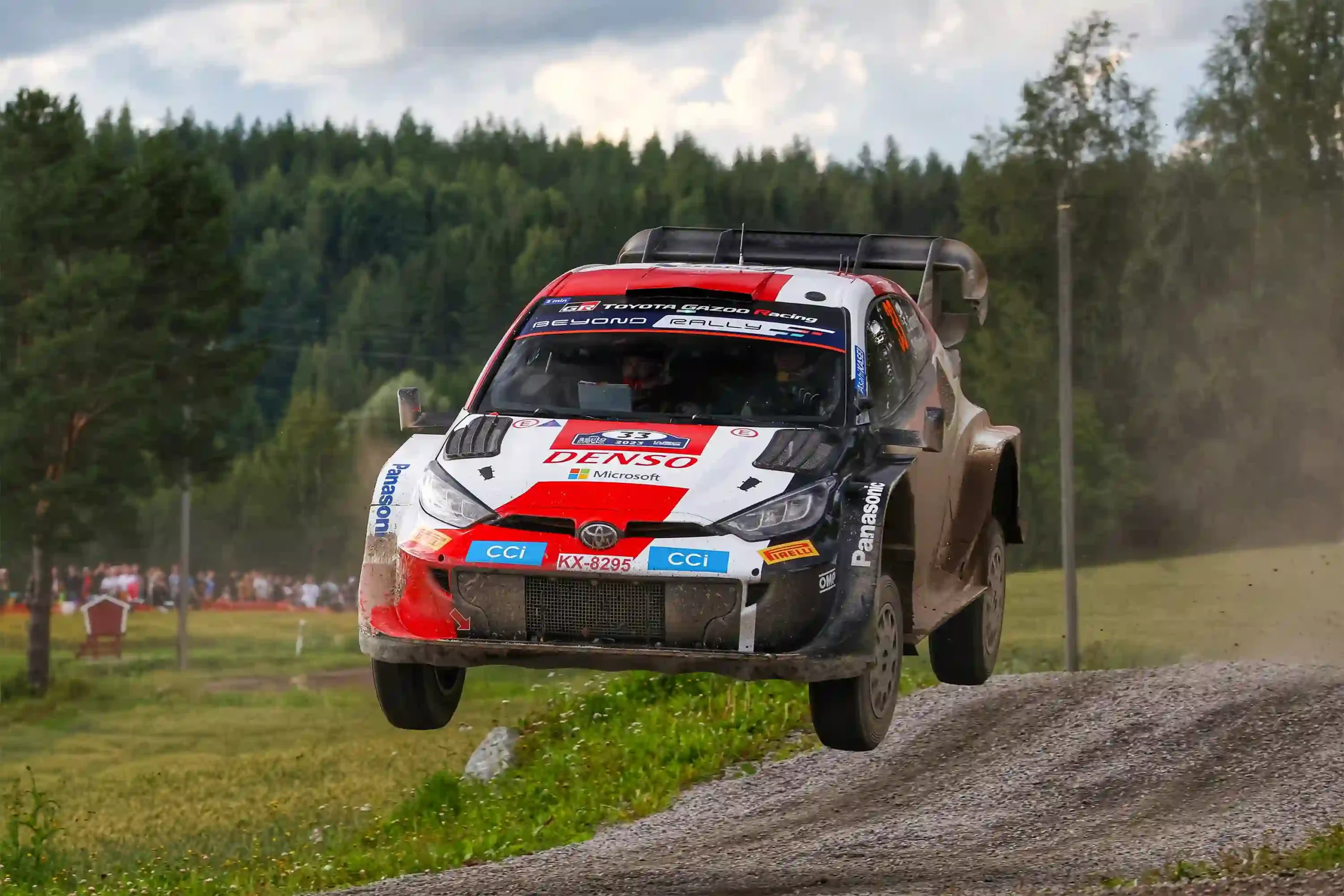
Sunday: two 30.02 km runs of Himos-Jämsä
Sunday was built around only one road name, but it was the longest stage of the rally. Himos-Jämsä measured 30.02 km and combined roads from the former Vaheri-Himos test, Patajoki and the 2023 Himos-Jämsä Power Stage.
The opening was wide, fast and flowing before narrowing through forest. Crests returned on a wider section, then the route moved through narrower roads and finished on the 2023 Power Stage section with a steep descent toward the Himos parking area.
SS19 started at 10:35 local time. The second pass started at 13:15 and served as the Wolf Power Stage. For U.S. East Coast viewers, that meant 3:35 a.m. EDT for the first run and 6:15 a.m. EDT for the finale.
Finland’s Sunday was short in stage count but not in consequence: two 30-kilometre tests left enough distance for pressure, tyre management and Power Stage points to matter.
Rally Finland 2026 TV coverage and streaming guide
For U.S. viewers, WRC’s official broadcast guide listed RACER, RACER+ and RACER Network. Those are the named American broadcast partners for WRC coverage. However, the guide does not promise that each outlet carries every special stage as a traditional TV programme.
That distinction is why Rally.TV matters. WRC explicitly states that every Rally Finland stage is available live and on demand on Rally.TV, along with onboard cameras and expert analysis. For a fan who wants the whole itinerary rather than selected television windows, that is the clearest all-stage option in WRC’s own information.
RACER / RACER+ / RACER Network
These services are the U.S. broadcasters named in WRC’s official territory guide. Check the individual platform listing for the exact programme window.
Rally.TV
WRC labels Rally.TV as carrying all stages live. Replays, onboard cameras and analysis make it the most complete option for following the entire event.
Red Bull TV
WRC’s broadcast guide also lists Red Bull TV globally. Coverage format can differ from the full all-stage Rally.TV product.
How could U.S. viewers watch Rally Finland 2026?
WRC listed RACER, RACER+ and RACER Network for the United States, while Rally.TV carried every stage live and on demand. Exact RACER programming windows should be checked on the relevant service because WRC’s territory list identifies broadcasters rather than a stage-by-stage channel assignment.
Rally Finland 2026 international broadcasters
WRC’s broadcast guide covered dozens of territories. The table below focuses on major markets most likely to search for a Rally Finland TV channel. Rights and packaging vary by country, so the broadcaster name is more reliable than assuming one universal channel.
| Market | WRC-listed broadcaster / service | Viewing note |
|---|---|---|
| United States | RACER, RACER+, RACER Network | Official U.S. territory partners |
| Canada | REV TV, RACER, RACER+, RACER Network | Multiple listed options |
| Finland | MTV3, MTV Urheilu, MTV Katsomo | Domestic home-rally coverage |
| United Kingdom | ITV, TNT Sport | WRC also lists several FAST channels |
| Ireland | ITV, TNT Sport | Territory guide listing |
| Australia | Stan | WRC-listed broadcaster |
| New Zealand | TVNZ | WRC-listed broadcaster |
| France | Canal Plus Sport | WRC-listed broadcaster |
| Germany | Sky | WRC-listed broadcaster |
| Italy | RAI, Sky Italia | Two listed broadcaster groups |
| Sweden | TV4, TV12, TV4 Play, TV4 Motor | Multiple linear/digital options |
Finland: MTV coverage and the Rally.TV-on-DAZN exception
Domestic viewers had the broadest local interest. WRC listed MTV3, MTV Urheilu and MTV Katsomo in Finland. The official broadcast guide separately noted that the Rally.TV product distributed through DAZN was excluded in several countries, including Finland.
That exclusion refers to the Rally.TV-on-DAZN distribution arrangement. It should not be read as a statement that WRC’s own Rally.TV event service disappeared, because the official Rally Finland page still promoted every stage live and on demand through Rally.TV.
Free-to-air and FAST-channel options
WRC also listed a group of free ad-supported streaming television channels in parts of Europe, including LG Channels, Rakuten TV and Samsung TV Plus. Pluto TV was listed for Italy, Spain and the UK. These services can be useful for highlights or packaged WRC programming, but they should not be confused with the guaranteed all-stage Rally.TV feed.
Rally Finland start times for U.S. viewers
Finland used Eastern European Summer Time during the event, seven hours ahead of U.S. Eastern Daylight Time. That made the rally an early-morning watch for Americans. The first Friday forest stage, Laukaa 1, began at 1:44 a.m. EDT.
Saturday was similar. Parkkola 1 started at 1:01 a.m. EDT, while the second Leustu run began at 12:05 p.m. EDT. The schedule therefore stretched across much of the morning for U.S. East Coast viewers.
Sunday was easier to follow. Himos-Jämsä 1 began at 3:35 a.m. EDT, and the decisive Wolf Power Stage began at 6:15 a.m. EDT. Fans who wanted only the final run did not need to stay awake through the night.
Finland minus 7 hours
13:15 in Finland became 6:15 a.m. EDT for the Sunday Power Stage.
Finland minus 10 hours
For a quick conversion from ET, subtract another three hours. Some early Finnish starts fall on the previous U.S. calendar date.
Finland minus 2 hours
Finland was UTC+3 and the UK was on BST, UTC+1, during the rally weekend.
Which sessions were easiest to watch live in the United States?
Harju was the friendliest major stage for U.S. viewers. Both the Thursday opener and Friday return were scheduled at 19:05 in Finland, which converted to 12:05 p.m. EDT. Those lunch-hour starts were far easier than the overnight forest loops.
The Sunday Power Stage was also practical at 6:15 a.m. EDT. By comparison, Friday’s opening loop demanded commitment from U.S. fans, with the first four stages starting between 1:44 a.m. and 4:58 a.m. EDT.
This is one reason on-demand access matters for WRC. Rally.TV’s replay function lets viewers follow the stages in order without relying on a single conventional television window. It also helps fans avoid spoilers if they cannot watch the overnight action live.
Who entered Rally Finland 2026?
WRC announced 61 crews for the 75th-anniversary edition, including 11 top-class Rally1 cars. Toyota brought five GR Yaris Rally1 entries across its main WRT and WRT2 operations. The driver group included Elfyn Evans, Takamoto Katsuta, Sébastien Ogier, Sami Pajari and Oliver Solberg.
Hyundai entered Thierry Neuville, Adrien Fourmaux and Finnish favourite Esapekka Lappi. M-Sport Ford fielded Josh McErlean, Jon Armstrong and Mārtiņš Sesks in Puma Rally1 machinery.
The field mattered because Finland rewards confidence and commitment more than almost any other WRC round. Local knowledge can help, but the route changes reduced the value of simply remembering the previous edition. New sections forced every crew to trust current reconnaissance and pace notes.
A 75th-anniversary edition with extra significance
The 2026 event celebrated 75 years since the first Rally Finland in 1951. The rally was originally known as the 1000 Lakes Rally and became part of the World Rally Championship when the series launched in 1973.
That history is not decorative. Finland helped define the image of modern rallying: high-speed gravel, blind crests, enormous jumps and crowds deep in the forest. WRC’s own event description says average speeds routinely exceed 120 km/h.
The 2026 route deliberately mixed that heritage with new content. Sydänmaa and Hoho gave the Friday leg fresh identity. Reversed versions of established stages changed familiar braking references, while Himos-Jämsä created a long Sunday test that still felt worthy of a classic Rally Finland finish.
Why Rally Finland is difficult even when the roads look smooth
Finnish gravel often appears cleaner and smoother than the rough surfaces seen on events such as Safari Rally Kenya or Acropolis Rally Greece. However, that does not make the challenge easier. The speed means small errors become large accidents very quickly.
Drivers also have to position the car before they can see the road beyond many crests. That makes the co-driver’s pace notes critical. A slightly wrong description of a corner can force a lift, cost time, or send the car off line at a speed where recovery is difficult.
Jumps add another layer. The fastest approach is not always the most effective if the car lands badly. Teams want enough control in the air and enough suspension stability on landing to carry momentum into the next braking or turning point.
WRC’s pre-event stage guide specifically identified two new stages and said more than half of the competitive distance had changed from 2025. That is why this schedule guide treats the 2026 route as a distinct edition rather than recycling the previous year’s itinerary.
How to follow Rally Finland beyond the live video
Live video is only one way to understand a WRC event. The official Rally Finland page also linked to live updates and live maps. Those tools are useful when several storylines move at once, because the running order and stage gaps can change before a television commentator has time to explain them.
Live timing is especially valuable in Finland. Gaps can appear tiny because the roads are fast, so a few tenths per kilometre can move a driver several positions across a long stage. Watching the splits gives context to a run before the finish time appears.
GPS live maps add another layer. Rally stages cover public roads over a large geographic area, not a compact circuit. A map helps viewers understand where a car is on a 20- or 30-kilometre test and why a stage takes much longer than a lap of a conventional racetrack.
Onboard cameras are unusually useful in Finland
Rally.TV’s onboard coverage is particularly revealing on Finland’s fast roads. The forward camera shows how little of the road is visible before many crests. It also makes the speed of the pace-note delivery easier to appreciate.
Watch the steering inputs as well as the jumps. The best crews often look calm through a sequence that feels violent from outside the car. That stability is the result of precise notes, confidence in the road position and a setup that allows the driver to maintain momentum.
Replays matter because of the U.S. time difference
The Rally Finland 2026 stage timetable was never designed around North American prime time. Many stages started while the U.S. East Coast was asleep. As a result, an on-demand product is more useful here than at a North American race that starts in the afternoon.
A practical strategy is to avoid social media after waking, open the replay from the first missed stage and follow the event sequentially. That preserves the competitive story and still lets viewers use live coverage later in the day for Harju or the final Power Stage.
How to read the Rally Finland 2026 timetable like a rally fan
A rally timetable is more than a list of start times. It shows how the competitive pressure is distributed. Friday and Saturday were the major mileage days in Finland, while Sunday concentrated the final points battle into two unusually long stages.
The repeated-stage structure also tells you when road evolution may matter. Friday’s Laukaa, Saarikas, Sydänmaa and Hoho each ran twice. Saturday’s four forest tests also repeated. The second pass can have more exposed rocks, deeper ruts or different grip after dozens of cars have crossed the road.
Weather can complicate that pattern. A shower between loops may clean one section while making another slippery. In Finland, shadows from dense forest can also hide moisture, so the visual appearance of the road is not always a perfect guide to grip.
Why the long Sunday stage changed strategic thinking
Many modern WRC Sundays are compact. Finland’s 2026 plan still had only two stages, but each measured 30.02 km. That meant the morning could not be treated as a ceremonial cruise to the finish.
A driver protecting a lead still had to survive more than 60 competitive kilometres. Meanwhile, anyone chasing Sunday points had a large enough distance to create a meaningful gap. The second run also carried Wolf Power Stage points, adding another incentive to attack.
Why Harju belongs in the schedule even though it is short
Harju accounted for only 5.16 km across its two appearances, a tiny portion of 316.04 km. Yet it served a different purpose. It brought the WRC cars close to the host city and gave spectators a compact, accessible stage with a mixed-surface character.
Its slower junctions also punish small errors. A driver can lose meaningful time by clipping a barrier, overshooting a braking point or struggling for traction. The stage therefore adds risk even though it is not long enough to decide the rally by raw pace alone.
Rally Finland 2026 FAQ
Conclusion: the complete Rally Finland 2026 viewing plan
Rally Finland 2026 rewarded viewers who understood the timetable
The 75th-anniversary edition packed 316.04 competitive kilometres into 20 special stages. Friday and Saturday carried most of the mileage, while the rally ended with two 30.02 km Himos-Jämsä runs and a 13:15 local-time Wolf Power Stage.
For U.S. fans, the key number was seven hours. Subtracting seven hours from the Finland timetable produced the correct Eastern Daylight Time conversion. That made many forest stages overnight viewing, but both Harju runs and the Sunday finish were much easier to follow live.
WRC’s broadcaster list named RACER, RACER+ and RACER Network in the United States. Meanwhile, Rally.TV remained the clearest option for viewers who wanted every stage live and on demand rather than selected television programming.
The route itself justified close attention. New Sydänmaa and Hoho stages, reversed classics and the long Himos-Jämsä finale made the 2026 edition different enough that an old Rally Finland timetable could not be reused safely. The official itinerary and current WRC broadcast guide are the references that matter.