Formula DRIFT Seattle 2026 Practice Report:
Driver Form, Car Setup & Qualifying Predictions
A data-led look at Evergreen Speedway, the drivers who arrived in form, the setup demands of the Seattle course and what qualifying revealed about the real competitive order.
Driver Form, Car Setup & Qualifying Predictions
Evergreen Speedway setup, driver form, qualifying pace and championship implications.
Formula DRIFT Seattle 2026 arrived at Evergreen Speedway as a crucial Round 6 weekend, with the championship compressed behind James Deane and the field facing one of the series’ most distinctive layouts. The official schedule put PRO practice on Friday, August 21, from 2:00 to 3:30 p.m. Pacific, followed by warm-up and qualifying. The measurable story that emerged was unusually clear: Deane converted his track knowledge and car balance into the top qualifying score, while Conor Shanahan and Branden Sorensen showed that the fight behind the championship leader was anything but settled.
This report separates what was officially published from what can reasonably be inferred from the running. Formula DRIFT’s public Seattle results page did not publish a standalone practice classification, so there is no invented practice leaderboard here. Instead, the analysis uses the official Seattle schedule, published qualifying scores, championship standings, driver and vehicle specifications, recent Formula DRIFT reports, and race reporting to explain what practice was really testing: high-speed stability, line commitment, transition control, tire behavior and the ability to turn a good setup into a repeatable qualifying run.
Practice Report: What Teams Were Actually Chasing
Evergreen is not a place where a driver can hide a nervous car. The long bank immediately exposes whether the rear platform is stable, whether the front tires retain enough authority to dictate the line, and whether the engine delivers power progressively enough for the driver to stay committed without washing toward the outside. That makes practice less about producing a headline score and more about creating a car that can repeat the same line run after run.
The official Formula DRIFT schedule listed PRO practice from 2:00 to 3:30 p.m. PT on Friday, August 21, followed by a separate warm-up and then qualifying from 7:15 to 9:45 p.m. PT. In other words, teams had a meaningful gap between their first practice window and the scored session. That gap is important because Evergreen’s surface, tire temperature and ambient conditions can change significantly as daylight fades and the event moves into its night-time format.
Why the first practice laps matter more at Evergreen
The first priority is finding the car’s usable high-line window. Evergreen’s banking rewards commitment, but simply driving higher is not enough. A driver needs the right combination of entry speed, angle and throttle so the car reaches the outside line without creating an unstable correction. If the rear steps too far, the driver can lose the line. If the car is too conservative, it may remain tidy but fail to demonstrate the commitment and proximity expected by the judges.
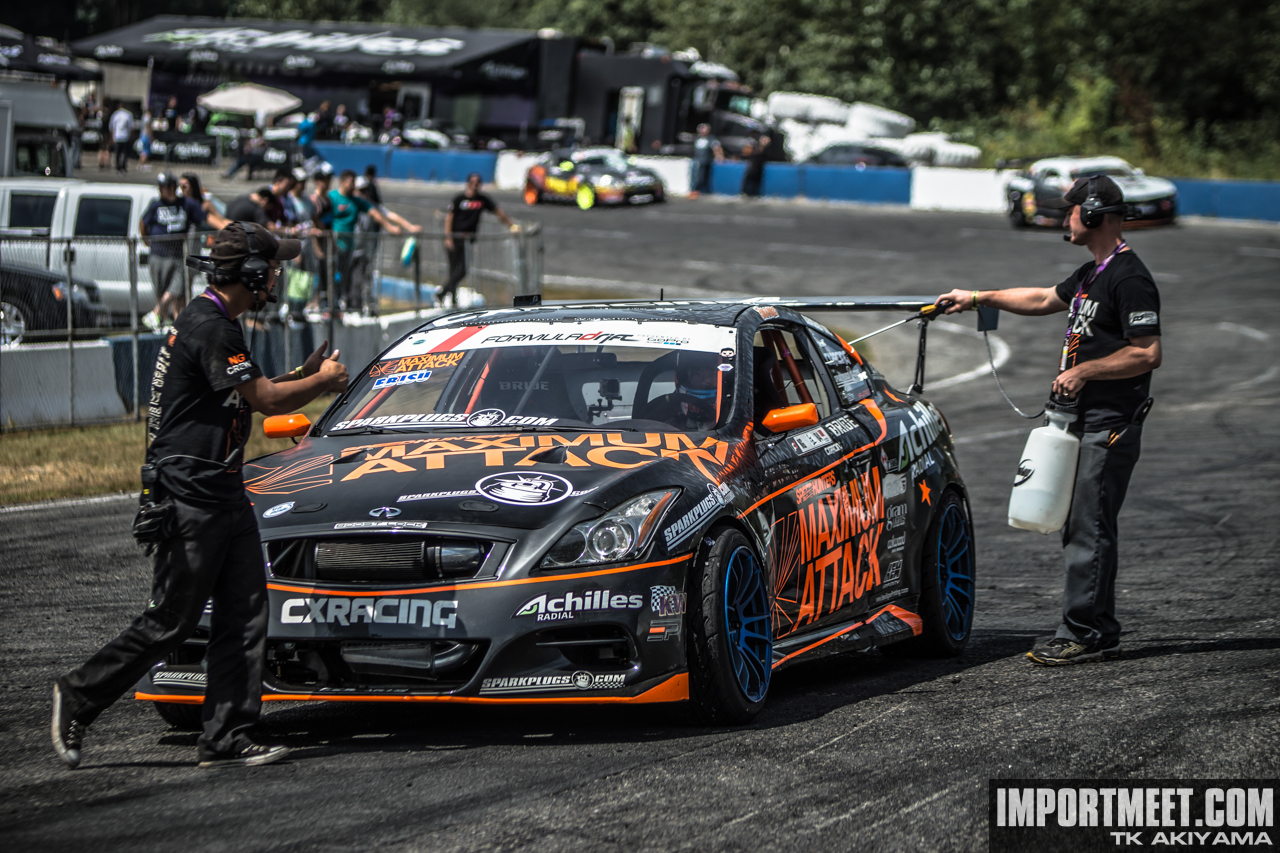
The second priority is the transition off the bank. That is where a setup that feels spectacular at the top can suddenly become difficult. The rear suspension has to accept a major load change while the front axle gives the driver enough steering authority to redirect the car. A car that is too soft can take a set slowly; one that is too stiff can become nervous over surface changes. The sweet spot is a platform that moves enough to maintain tire contact without delaying the driver’s next input.
What the 2026 Seattle weekend added to the setup problem
The 2026 event was also the first Formula DRIFT Seattle night event in the series’ 21-year history at the venue, according to RACER’s post-event report. That changes the engineering conversation. Teams were not only chasing a fast car; they had to understand how their tire and suspension behavior would carry from afternoon practice into a cooler evening qualifying session and then into Saturday’s competition.
The result was visible in the qualifying order. Deane, Conor Shanahan and Branden Sorensen were separated by only 1.44 points from first to third, with Jack Shanahan and Aurimas Bakchis also inside the top five. That compression is exactly what a good practice program should create: not a magical setup that produces one spectacular run, but a predictable platform that lets a driver attack the course without excessive correction.
Formula DRIFT’s public Seattle results page does not list a separate official practice classification. This article therefore does not invent practice positions or scores. Where the article discusses practice performance, it refers to the official session schedule, team/driver information, prior Evergreen evidence and the qualifying data that followed practice.
The 2025 Seattle benchmark still mattered
Last year’s Seattle event provides useful context. Formula DRIFT reported that the course was widened through Outer Zones 2 and 3 after two decades at Evergreen, with the objective of allowing smoother arcs and maintaining momentum. Overnight changes in 2025 refined the transition and moved the finish line slightly closer. That history matters because teams already understood the broad demands of the venue, but the details of the line and transition remained sensitive to setup.
Matt Field’s 2025 Seattle win was especially relevant to the 2026 field. Formula DRIFT’s current driver profile notes that Field won at Evergreen in 2025, while his 2026 Corvette is listed at 1,050 horsepower with GT Radial tires and Parts Shop MAX suspension. That combination gives him a credible mechanical baseline for a circuit where power is useful, but only if the driver can convert it into a clean, stable line.
Driver Form: Who Looked Ready for Seattle?
Driver form is more useful than a single practice impression. The strongest Seattle prediction comes from combining the championship table, recent results, historical Evergreen performance and the qualifying order. By that measure, five names stood out immediately: James Deane, Conor Shanahan, Branden Sorensen, Jack Shanahan and Aurimas Bakchis.
James Deane — the reference point
Deane entered Seattle as the championship leader and then confirmed that status by topping qualifying with 87.8 points. RACER reported that his final run earned a perfect score for drift angle. Formula DRIFT’s current standings list him first on 150 points, 21 ahead of Aurimas Bakchis, while his official driver profile lists the 2026 O’Reilly Pennzoil Ford Mustang RTR Spec 5-FD at 1,249 horsepower.
That combination makes Deane the obvious benchmark. He does not need to drive the most spectacular practice run every time. He needs a car that gives him confidence to carry speed into the bank, maintain the outside line and transition without losing the rear platform. His qualifying result suggests the setup window was already strong when the score mattered.
Conor Shanahan — the strongest immediate challenger
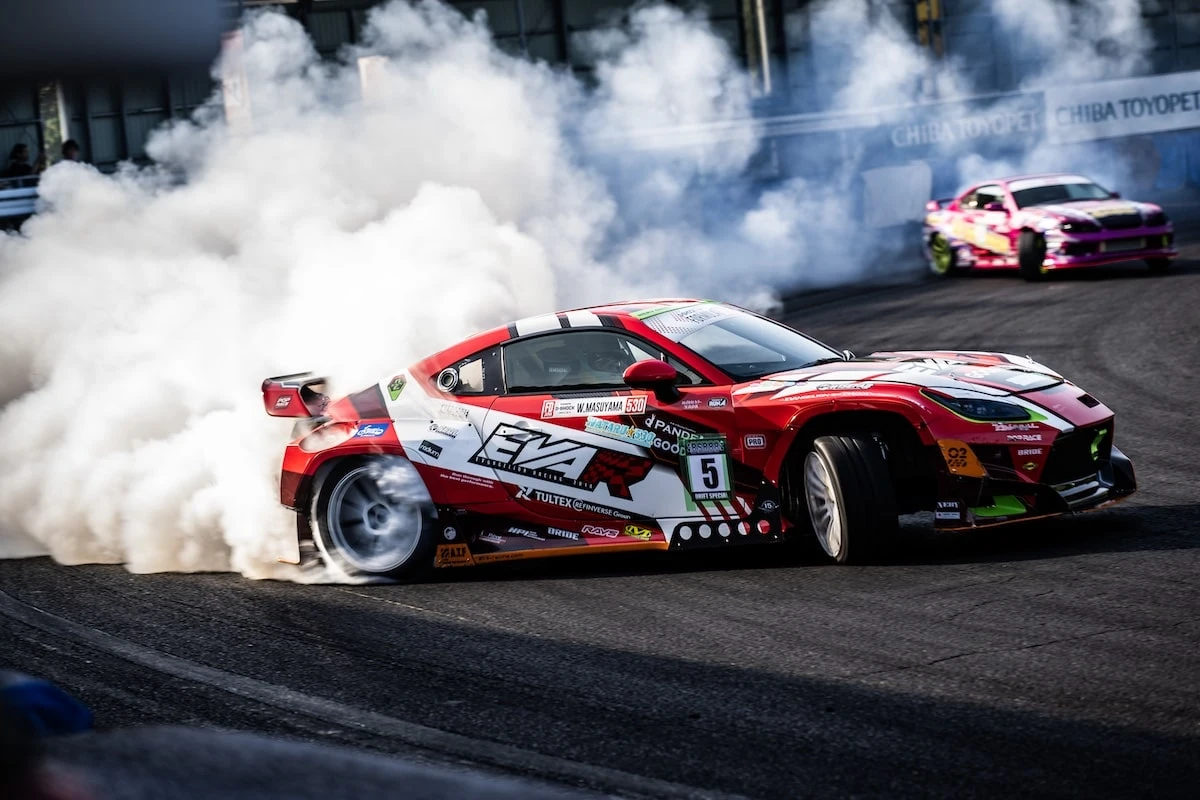
Conor’s 86.4 qualifying score was only 1.4 points from Deane, and he briefly appeared to have the top qualifying position before Deane’s final run. The Toyota GT86 is a very different tool from Deane’s Mustang, which makes the result even more instructive: Seattle did not belong to one particular powertrain philosophy.
Conor’s form was later validated by the competition itself. RACER reported that he won the Seattle round after defeating Fredric Aasbo in the Final. That post-event result makes his qualifying pace more than a prediction; it became the clearest sign that the GT86 package had both the speed and consistency to survive the tandem bracket.
Branden Sorensen — the quiet threat
Sorensen’s 86.36 was effectively tied with Conor for second on the published qualifying order. Formula DRIFT’s live scoring listed him third at 86.4, while RACER reported the underlying figure as 86.36. That small difference is a useful reminder to distinguish displayed rounded scores from more precise reported numbers.
Sorensen’s bigger story is championship momentum. He entered Seattle fourth in the published preliminary standings on 108 points, just two behind Jack Shanahan and two ahead of Conor. A strong qualifying run therefore carried both performance value and championship value. He had the speed to start near the front, but the bracket still demanded the discipline to convert that speed into clean tandem battles.
Jack Shanahan — speed without the headline
Jack qualified fourth with 83.7 points and entered the event third in the championship standings on 110. That is a strong position, even if the qualifying score left him 4.1 points behind Deane. His season form had already shown that the BMW package could produce elite single-car pace; the challenge in Seattle was translating that into consistent tandem execution.
Aurimas Bakchis — the biggest championship variable
Bakchis arrived second in the title race on 129 points and qualified fifth with 81.5. The gap to Deane in the championship was small enough that every Seattle mistake mattered. His Subaru BRZ remained one of the most important cars in the field, but the qualifying order suggested that he had not found quite the same single-run sharpness as Deane, Conor or Sorensen.
| Pos. | Driver | Qualifying | Championship before Seattle | Read |
|---|---|---|---|---|
| 1 | James Deane | 87.8 | 150 pts · 1st | Benchmark pace |
| 2 | Conor Shanahan | 86.4 | 106 pts · 5th | Immediate threat |
| 3 | Branden Sorensen | 86.36 | 108 pts · 4th | Title contender |
| 4 | Jack Shanahan | 83.7 | 110 pts · 3rd | Strong platform |
| 5 | Aurimas Bakchis | 81.5 | 129 pts · 2nd | Championship pressure |
| 6 | Adam LZ | 81.1 | 25 pts · 16th | Outside threat |
| 7 | Cole Richards | 81.0 | 56 pts · 10th | Top rookie qualifier |
| 8 | Ben Hobson | 80.8 | 44 pts · 13th | Momentum driver |
Evergreen Speedway Car Setup: What Matters Most
Evergreen punishes the wrong kind of confidence. A car can have enormous horsepower and still lose the judges if the driver cannot place it accurately. The setup target is therefore not maximum power. It is a controllable package that can generate enough wheel speed to maintain the drift while keeping the front axle responsive and the rear tires predictable.
1. Rear grip and throttle response
The rear axle has to accept a large amount of torque while the car is already loaded laterally. Too much grip can make initiation and rotation difficult; too little grip can create a car that is exciting but inconsistent. Teams therefore work around tire pressure, rear spring and damper behavior, differential settings and throttle mapping to find a repeatable balance.
2. Front-end authority
At Evergreen, steering response is part of the speed equation. A driver needs to make small corrections while keeping the car committed to the bank. If the front tires wash wide, the driver may need a larger correction, which costs both line accuracy and style. Alignment, caster, steering angle and front tire behavior all become important.
3. Suspension platform
The course asks the car to move from a heavily loaded bank into transitions and flatter sections. The suspension must absorb those changes without making the chassis unpredictable. This is why the best practice runs often look boring to an outside observer: a stable car gives the driver freedom to focus on the line rather than fighting the platform.
4. Tire temperature and pressure
Tire behavior is especially important because the event moved into a night qualifying format. The tire that feels perfect in afternoon practice can behave differently once track temperature falls. Teams need to understand how quickly the tire comes into its working range and how much pressure rises through a run. The correct answer is not universal; it depends on tire construction, car weight, power and driving style.
5. Engine power delivery
Published power figures illustrate the range in the field. Deane’s Mustang RTR is listed by Formula DRIFT at 1,249 horsepower, while Matt Field’s Corvette is listed at 1,050 horsepower. Those numbers are substantial, but Seattle demonstrates why dyno-sheet power is only one part of the equation. A driver must be able to meter the throttle while keeping the car on the intended line.
The most important setup compromise
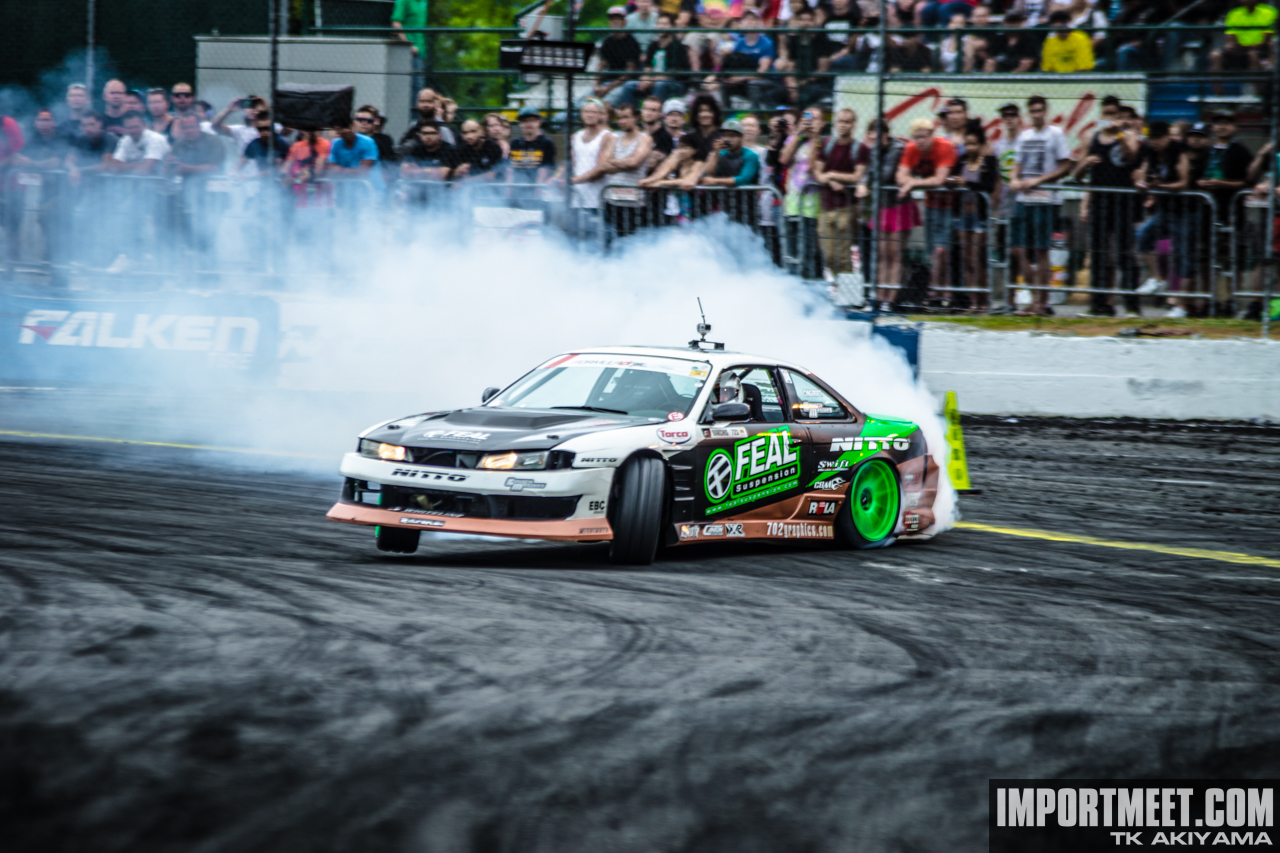
The central compromise is stability versus rotation. A car that rotates instantly can look spectacular, but if the driver has to catch it repeatedly, qualifying scores suffer. A car that is too stable can be easy to drive but may struggle to generate the angle and commitment required for a strong score. The best Seattle packages sit between those extremes.
That is why Deane’s qualifying performance is such a strong signal. The 87.8 score was not simply a demonstration of engine output. It indicated that the Mustang could produce the required angle while maintaining a precise line under the driver’s inputs. Conor and Sorensen being within roughly 1.4 points showed that two very different packages could reach the same competitive window.
Qualifying Predictions: What Practice Was Telling Us
Qualifying ultimately provided the cleanest answer to the practice question. James Deane led with 87.8, Conor Shanahan scored 86.4, Branden Sorensen 86.36, Jack Shanahan 83.7 and Aurimas Bakchis 81.46. The top three were separated by less than 1.5 points, while the top five were still within 6.4 points of pole.
The Seattle setup battle was not about finding one secret trick. It was about making a high-speed car predictable enough that the driver could attack the bank, protect the line and repeat the run when the score mattered.
Prediction 1: Deane was the safest qualifying pick
Deane’s championship position, Evergreen experience and 2025 runner-up result made him the logical favorite before the event. Ford Racing noted that Deane finished second at Seattle in 2025 and that Ford had won at the venue six times, most recently with Chelsea DeNofa in 2023. The 2026 qualifying result then backed the prediction with the highest score of the night.
Prediction 2: Conor was the biggest upside play
Conor’s fifth-place championship position understated his Seattle threat. He was already close enough to the top of the qualifying sheet to challenge Deane, and his later event win showed that the pace was not a one-run anomaly. For anyone assessing driver form, his Seattle weekend was arguably the strongest evidence that the Shanahan Toyota GT86 could be a championship-level package.
Prediction 3: Sorensen remained a genuine title factor
Sorensen’s third-place qualifying position was significant because he was already fourth in the championship. His 86.36 put him directly into the fight with the two Irish drivers ahead of him. The key question was whether he could turn that single-car pace into clean tandem execution without allowing the pressure of the championship to alter his driving rhythm.
Prediction 4: Bakchis needed the bracket to work in his favor
Bakchis was fifth in qualifying and second in points. That is not a bad starting position, but it left little margin for a mechanical problem or an early mistake. RACER later reported that Bakchis retired his Subaru BRZ with engine problems in the Top 32, demonstrating how quickly a championship contender can lose the benefit of a strong points position.
Prediction 5: Rookie Cole Richards deserved attention
Richards qualified seventh on 80.96, making him the leading rookie in Seattle qualifying. That was a meaningful result because it placed him ahead of established names such as Ben Hobson, Tommy Lemaire and Dylan Hughes. His later Top 16 exit after a handbrake problem did not erase the qualifying evidence: the Toyota GT86 package and Richards’ driving were capable of producing front-half pace.
Championship Impact: Why Seattle Mattered So Much
Seattle was Round 6 of an eight-round season, so the championship could not be treated as a normal mid-season event. There were only two rounds after Seattle: Las Vegas on September 24–26 and the Long Beach final on October 23–24. Every qualification point and every bracket advancement therefore had greater value than it would have earlier in the season.
Before Seattle, Formula DRIFT’s published preliminary standings had Deane first on 150, Bakchis second on 129, Jack Shanahan third on 110, Branden Sorensen fourth on 108 and Conor Shanahan fifth on 106. That was a five-driver championship story, not a two-driver fight.
The Seattle result reshaped that picture. RACER reported that Conor’s win moved him from fifth to second in the title race, while Aasbo’s runner-up finish moved him from seventh to sixth. Deane remained the championship leader, but his lead was reduced to five points after his Top 16 loss to Matt Field.
That is the most important lesson from the weekend. Qualifying pace is valuable, but tandem survival is what turns it into championship points. Deane had the best qualifying score and still left Seattle with his lead cut sharply because Field capitalized on a mistake in the Top 16. In Formula DRIFT, the fastest single-car run and the strongest championship weekend are not always the same thing.
Why Deane’s five-point lead is vulnerable
Deane’s position is still the one everyone wants. He has the best qualifying speed, the proven Evergreen record and a championship-winning team around him. But a five-point margin is not comfortable with two rounds remaining. A single early elimination in Las Vegas could hand the initiative to Conor, Bakchis, Sorensen or Jack.
Why Conor’s rise changes the title math
Conor’s Seattle victory was the most consequential development. He demonstrated that the pace seen in qualifying could survive the full bracket. Moving to second means he is no longer simply an outside contender; he becomes one of the drivers who can directly control Deane’s championship margin through tandem results.
Why Bakchis remains important despite Seattle trouble
Bakchis’ early mechanical retirement was damaging, but his pre-Seattle points position means he cannot be dismissed. Championship battles in Formula DRIFT often turn on one clean weekend. The Subaru’s underlying performance remains strong, and the team now has a clear mechanical problem to investigate before Las Vegas.
The manufacturers’ side of the fight
Formula DRIFT’s preliminary manufacturer standings before Seattle had Ford leading Toyota, followed by BMW, Nissan and Chevrolet. The official standings currently show Ford on 245, Toyota on 171, BMW on 115, Nissan on 74 and Chevrolet on 48. The tire table similarly lists GT Radial first on 291, followed by Nitto at 245, Kenda at 185 and Kumho at 135. These figures underline how the driver championship is also a technology and tire competition.
What We Learned From the Seattle Practice-to-Qualifying Window
- High-speed confidence is a setup property. Drivers cannot consistently attack Evergreen’s bank if the rear platform moves unpredictably. Practice is where that confidence is built.
- Power must be usable. Deane’s 1,249-hp Mustang and Field’s 1,050-hp Corvette show the headline numbers, but qualifying rewards placement, angle and style rather than dyno figures alone.
- Night conditions matter. The first Seattle night event made the transition from afternoon practice to evening qualifying particularly important for tire and suspension preparation.
- Qualifying does not guarantee championship points. Deane proved that with an 87.8 score followed by a Top 16 elimination. The bracket remains the decisive test.
- The championship is now a compressed five-driver fight. Deane, Conor, Bakchis, Sorensen and Jack Shanahan all have credible reasons to believe they can leave the final two rounds as champion.
If you are trying to predict the next Formula DRIFT qualifying order from Seattle, do not simply copy the championship standings. Evergreen exposed a different variable: which drivers can combine speed, line discipline and mechanical consistency. Deane had the best single-run package. Conor showed the strongest complete weekend. Sorensen remained one of the most credible threats. That distinction is likely to matter even more in Las Vegas.
Related Motorsport Reading
- How Racing Drivers Qualify
- F1 Qualifying Explained
- What Is Grid Position in Racing?
- How Racing Championships Are Scored
- What Is Car Handling?
- What Is Grip?
- What Is Torque?
- How Engine Displacement Affects Performance
- What Is a Limited-Slip Differential?
- Oversteer and Understeer Explained
- What Causes Crashes in Motor Racing?
- How Race Timing Works
- How Racing Flags Work
- NASCAR Sonoma 2026
- Famous Race Car Drivers
Formula DRIFT Seattle 2026 FAQ
What happened in Formula DRIFT Seattle 2026 practice?
Formula DRIFT scheduled PRO practice for Friday, August 21, from 2:00 to 3:30 p.m. PT, followed by warm-up and evening qualifying. The public Formula DRIFT results page does not provide a standalone practice classification, so there is no official practice leaderboard to reproduce. The strongest measurable practice-to-qualifying signal was the final qualifying order, led by James Deane.
Who was fastest in Formula DRIFT Seattle 2026 qualifying?
James Deane was fastest with 87.8 points. Conor Shanahan followed with 86.4 and Branden Sorensen was third with 86.36. Jack Shanahan was fourth at 83.7 and Aurimas Bakchis fifth at 81.46.
What is the best car setup for Formula DRIFT Seattle?
There is no single universal setup. Evergreen rewards a stable high-line car with strong front-end authority, predictable rear grip, responsive steering and a power delivery that can be modulated through the bank and transition. Tire pressure, suspension damping, alignment and differential behavior all have to be matched to the driver and tire.
Which drivers had the best form entering Seattle 2026?
James Deane was the championship leader and ultimately the top qualifier. Conor Shanahan and Branden Sorensen were the closest qualifiers to him, while Jack Shanahan and Aurimas Bakchis entered with strong championship positions. Cole Richards also stood out as the leading rookie qualifier in seventh.
Conclusion: Seattle Changed the Forecast
Formula DRIFT Seattle 2026 showed why Evergreen Speedway remains one of the most technically revealing venues on the calendar. The course demands speed, but speed without control is not enough. The drivers who succeeded were the ones who could combine a committed high-line run with precise transitions and enough mechanical consistency to survive the tandem bracket.
James Deane entered the weekend as the championship benchmark and left it still leading the standings, but the gap behind him became much less comfortable. His 87.8 qualifying score proved that the Mustang RTR package had the pace. Conor Shanahan’s qualifying run and eventual victory proved that the GT86 package had the complete weekend. Branden Sorensen remained firmly in the championship conversation, while Jack Shanahan and Aurimas Bakchis retained the speed needed to change the title fight in the final two rounds.
The most important lesson for Las Vegas is therefore simple: do not judge a driver only by practice impressions or a single qualifying score. The real performance indicator is whether the car remains predictable when the pressure rises. Seattle supplied that test, and the championship now moves forward with a much tighter competitive picture.
Sources & Reporting Notes
- Formula DRIFT — 2026 Seattle / Throwdown Schedule
- Formula DRIFT — Seattle Qualifying Live Classification
- Formula DRIFT — 2026 PRO Standings
- Formula DRIFT — James Deane Driver & Vehicle Profile
- Formula DRIFT — Matt Field Driver & Vehicle Profile
- Ford Racing — Formula Drift Seattle Preview, Aug. 18, 2026
- RACER — Deane Leads Seattle Formula DRIFT Qualifiers
- RACER — Conor Shanahan Bests Aasbo at Seattle Formula DRIFT
- RTR Vehicles — James Deane
- RTR Vehicles — 2023 Formula Drift Seattle Report
- Evergreen Speedway — Drift
- Formula DRIFT — 2025 Seattle Round Report
Editorial note: The article does not claim an official Seattle practice ranking because Formula DRIFT’s public results page does not publish one. Practice analysis is therefore based on the published schedule, driver/car data, historical Evergreen evidence and the subsequent qualifying and race reporting.