Budapest Formula 2 2026 Strategy Analysis
How Noel León’s lap-16 stop, a perfectly timed Virtual Safety Car and Gabriele Minì’s patient tire management decided Round 9.
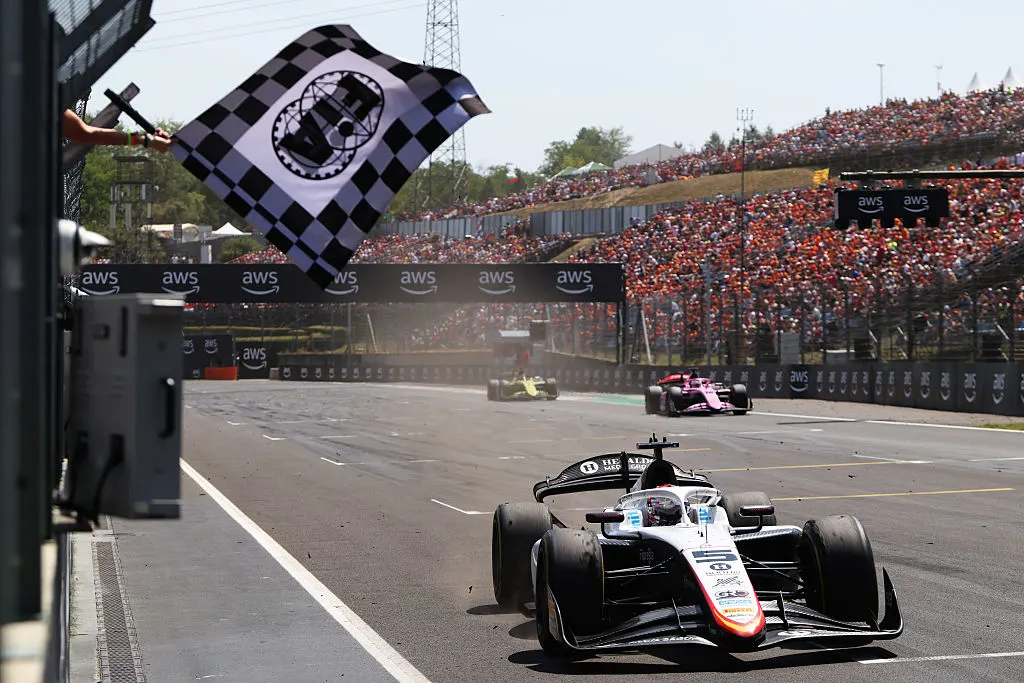
The Budapest Formula 2 2026 strategy battle turned on two different skills. Noel León and Campos Racing won Sunday through timing. Gabriele Minì and MP Motorsport won Saturday through patience.
León stopped at the end of lap 16. Seconds later, Rafael Villagómez stopped at Turn 12 and triggered a Virtual Safety Car. That sequence placed León in the net lead after the remaining front-runners completed their mandatory stops.
Minì’s Sprint victory followed another route. He stayed behind Sebastián Montoya, protected the tires and waited until lap 17. Once the performance gap opened, he used DRS and completed the winning pass.
Budapest Formula 2 2026 Strategy Analysis: The Core Lessons
The Hungaroring does not offer many easy overtakes. Therefore, teams must create positions through timing, tire life and track placement.
Maini controlled the opening Feature Race stint from pole. He led by more than four seconds on lap 10. On pure early pace, ART Grand Prix appeared to own the race.
However, León stayed close enough to remain strategically relevant. Campos then stopped him at the end of lap 16. The call looked aggressive because Maini still held a healthy advantage.
The VSC changed the calculation almost immediately. León had already entered the pits before the neutralization. As a result, he completed the stop without waiting behind the safety delta.
Meanwhile, Maini remained on track. He stopped at the end of lap 21 and rejoined behind León. The earlier four-second lead had disappeared.
Saturday rewarded a different plan. Minì sat within DRS range of Montoya but did not overuse the tires. He attacked only after the balance moved in his favor.
Consequently, Budapest produced two strategy templates. One depended on opportunistic pit timing. The other depended on controlled tire management.
Feature Race Strategy: How León Beat Maini
Maini built the ideal opening position
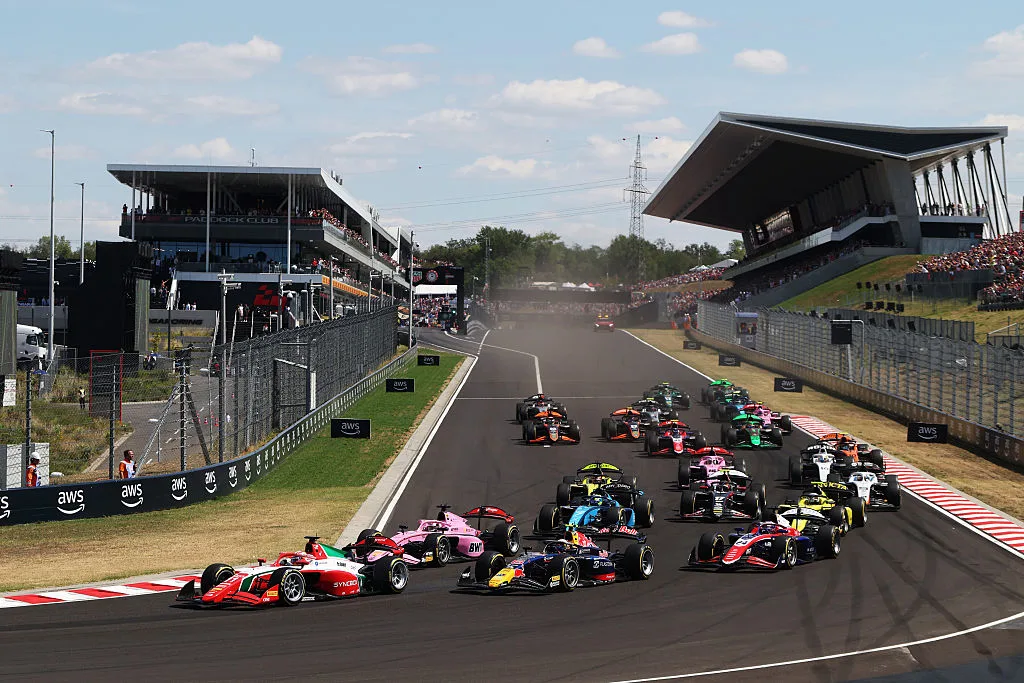
Maini covered Câmara into Turn 1 and retained the lead. León then passed Câmara and moved into second.
The opening order helped ART. Maini gained clean air, while León and Câmara fought behind him. By lap three, the lead measured 1.7 seconds.
By lap 10, Maini had created more than four seconds. That margin usually gives the leader control over the undercut.
However, the Hungaroring creates a problem. A driver can own the gap but still lose the race if a neutralization appears near the pit window.
Alternative-strategy runners changed the traffic picture
Tsolov and Inthraphuvasak started on the medium tire. Their pace improved as the soft compound lost performance.
Inthraphuvasak passed Dürksen on lap 14. The move showed that the medium had entered its stronger phase.
That crossover mattered to every soft starter. Teams now had to decide whether to stop early or risk losing time in traffic.
Minì triggered the first important stop
Minì stopped from eighth on lap 15 and fitted mediums. Dürksen responded immediately.
Invicta’s reaction worked. Dürksen rejoined ahead of Minì. That was a conventional undercut defense.
The exchange also clarified the pit lane time loss. Campos could now judge whether León had enough margin to stop without falling into damaging traffic.
Campos chose the aggressive lap
León stopped from second at the end of lap 16. At that moment, the call was not obviously superior.
Maini still held the lead. Câmara remained close enough to pressure León after the stops. Moreover, the medium runners had changed the midfield order.
Campos accepted those risks. The team believed an earlier stop offered a chance to attack Maini through tire warm-up and track position.
The timing became perfect when Villagómez stopped at Turn 12. Race control deployed the VSC just after León had rejoined.
Why the Virtual Safety Car Was So Powerful
A VSC forces every driver to stay above a prescribed minimum time. Cars on track therefore travel slower than normal.
A driver already in the pit lane can gain relative time. The pit stop still costs time, but rivals cannot complete a full-speed lap while that stop happens.
León entered before the VSC. That detail was essential. He did not stop under a neutralized condition that would have created a rules issue.
Instead, the neutralization began as he rejoined. Maini then had to circulate at the controlled delta.
The VSC ended on lap 18. Maini led physically by six seconds, yet León held the stronger net position.
Câmara stopped at the end of lap 20. He rejoined around six seconds behind León and with van Hoepen directly behind.
Maini finally stopped at the end of lap 21. He rejoined behind León, confirming the strategic swing.
This was luck, but not random luck
León later admitted that luck helped. However, Campos had already chosen to stop.
The team did not predict Villagómez’s retirement. It did create a position where any neutralization could deliver a major gain.
That distinction matters. Strategy cannot control incidents. It can place a driver where an incident becomes useful.
Why Maini could not simply pit one lap later
Once the VSC appeared, the opportunity had passed. Maini had already missed the cheap-stop window.
Stopping during the VSC also involved regulatory limits around the mandatory stop. Teams must respect the sporting rules governing when the required tire change can count.
ART therefore kept Maini out. The team then extended his stint to lap 21 and targeted stronger late pace.
Budapest Formula 2 Tire Strategy Explained
Soft tire: early track position, later vulnerability
The soft compound delivered better launch and early grip. Maini, León and Câmara used it to control the front group.
However, the soft began losing relative performance before the midpoint. Medium-shod cars then moved forward.
That crossover created the natural pit window. Minì stopped on lap 15. León followed one lap later.
Medium tire: slower opening phase, stronger middle stint
Tsolov and Inthraphuvasak chose the alternative route. They accepted a more difficult start and planned a longer first stint.
The medium became competitive around lap 14. Inthraphuvasak’s pass on Dürksen demonstrated the changing balance.
However, a long first stint only works if traffic remains manageable. At the Hungaroring, one slower car can erase the compound advantage.
Why the overcut was limited
The overcut depends on staying out and producing quick laps. Maini had clean air, but the VSC neutralized the main benefit.
Câmara also extended to lap 20. Yet he rejoined behind León by roughly six seconds.
Therefore, Budapest did not reward the traditional overcut. The event timing favored the earlier stopper.
Fresh tires were not enough for the final pass
Maini closed rapidly after his stop. A fastest lap reduced León’s lead to three seconds.
By lap 28, the gap was below two seconds. With five laps remaining, León, Maini and Câmara were separated by only 1.8 seconds.
Still, Maini could not pass. Dirty air reduced front grip through the linked middle sector.
León also protected the main straight. He exited the final corner well enough to deny a decisive DRS attack.
| Lap | Driver/Event | Strategic meaning |
|---|---|---|
| 14 | Inthraphuvasak passes Dürksen | Medium tire reaches stronger phase |
| 15 | Minì pits | First major soft-to-medium stop |
| 16 | León pits | Aggressive stop from second |
| 17 | VSC deployed | León gains decisive relative time |
| 20 | Câmara pits | Rejoins behind León |
| 21 | Maini pits | Returns behind León in net order |
| 28 | Maini within two seconds | Fresh-tire chase reaches final phase |
| 35+ | León defends | Track position defeats pace advantage |
Sprint Race Strategy: How Minì Managed the Win
Montoya protected the lead
Montoya started from reverse-grid pole. He defended successfully into Turn 1.
Minì stayed second, while Tsolov moved into third. The lead group quickly separated from the rest.
Minì entered DRS range by lap eight. However, he did not force a low-percentage move.
Tire saving created the later advantage
Minì followed within one second for several laps. That position exposed him to dirty air.
However, he avoided repeated lockups and heavy sliding. He kept enough tire performance for the final third.
Tsolov also saved tires early. By lap 13, he had returned to DRS range of Minì.
The pressure could have forced Minì into an early attack. Instead, he kept managing the gap.
The winning pass came on lap 17
Minì exited the final corner with stronger traction. He used DRS and forced Montoya to defend into Turn 1.
Montoya locked a tire under braking. Minì then completed the move through Turns 1 and 2.
Once ahead, Minì built a gap. His earlier patience now became a pace advantage.
The Montoya-Tsolov collision removed the nearest threat
Tsolov attacked Montoya on lap 21. The pair collided at Turn 1 and both retired.
The incident promoted Beganovic and van Hoepen. It also triggered a VSC.
Minì restarted with a 2.3-second lead. From there, he managed the gap and secured victory.
León’s VSC penalty showed the other side of neutralization strategy
León passed Dürksen after the restart but received a five-second penalty for a VSC infringement.
The penalty dropped him from the points. Therefore, the same neutralization tool that helped him on Sunday hurt him on Saturday.
Teams must manage both opportunity and compliance. A small delta error can remove the value of an otherwise strong drive.
Budapest Formula 2 Strategy by Team
Maximum reward
Campos stopped León at the exact moment needed to benefit from the VSC. Tsolov’s medium strategy still recovered seventh.
Strong pace, lost timing
Maini controlled the race but missed the neutralization window. Inthraphuvasak’s medium strategy produced fifth.
Patience on Saturday
Minì managed the Sprint perfectly. His early Feature stop was less effective after the VSC changed the order.
Double strategic threat
Câmara stayed in the winning fight. Dürksen successfully covered Minì’s undercut before fading later.
Campos Racing
Campos made the winning Feature Race call. The team stopped León before the VSC and then trusted him to defend.
Tsolov’s alternative medium strategy produced sixth points for seventh place. However, his Sprint collision limited the weekend.
ART Grand Prix
ART had the fastest early Feature Race package. Maini led comfortably and later set the fastest eligible lap.
Still, the team could not protect against the VSC. Inthraphuvasak’s longer medium stint recovered a strong fifth.
MP Motorsport
MP executed the best Sprint strategy. Minì’s tire management created the pass rather than simply waiting for an error.
Sunday was harder. The lap-15 stop placed Minì ahead of some rivals, but the VSC timing favored León instead.
Invicta Racing
Câmara remained close enough to challenge late. His pace placed pressure on Maini, but track position prevented a pass.
Dürksen’s response to Minì was sharp. However, later tire performance left him vulnerable to Inthraphuvasak, Beganovic and Tsolov.
Trident and DAMS
Van Hoepen combined strong pace with clean execution. He finished third in the Sprint and fourth in the Feature Race.
Beganovic also benefited from the Sprint collision. He then used solid late-race pace to finish sixth on Sunday.
Why Overtaking Is Difficult at the Hungaroring
The Hungaroring contains many linked corners. A driver who follows closely loses front downforce through the middle sector.
That loss increases understeer and tire temperature. Consequently, the chasing car often reaches the main straight with a weaker exit.
Turn 1 remains the main passing zone. Drivers need a strong final-corner exit, DRS and enough tire grip under braking.
Minì’s pass showed the ideal sequence. He created traction, gained the slipstream and forced a defensive lockup.
Maini’s failed late challenge showed the opposite. He had pace but could not stay close enough through the final corner.
Therefore, Hungaroring strategy begins with track position. A slower driver can remain ahead if corner exits stay clean.
Championship Impact of the Budapest Strategies
Tsolov left Budapest with 167 points. Minì moved to 147, while Câmara reached 145.
The Sprint changed the title picture first. Minì won and collected the fastest-lap bonus. Tsolov retired after the collision.
Sunday limited the damage for Tsolov. He used the medium strategy to finish seventh and score six points.
Câmara added another podium. His 20-point weekend moved him within two points of Minì.
León’s victory lifted him to fifth with 94 points. The result also strengthened Campos in the teams’ championship.
Campos reached 261 points. Invicta held 187, while MP Motorsport moved to 176.
The strategy consequences were therefore larger than one race. Minì and Câmara reduced Tsolov’s margin, while Campos expanded its team lead.
What Teams Learned Before Monza
Budapest rewarded downforce, tire protection and timing. Monza will require a different balance.
However, several lessons remain useful. Teams must still understand the neutralization window before committing to a stop.
They must also separate pace from position. Maini had stronger late speed, yet León had the place that mattered.
Minì’s Sprint showed the value of delayed aggression. Saving tires can create a pass that raw early pressure cannot.
Finally, Budapest reinforced the importance of clean execution. One VSC delta error cost León Sprint points. One perfectly timed pit entry won him the Feature Race.
Budapest Formula 2 2026 Strategy FAQ
What was the best strategy in Budapest Formula 2 2026?
León’s lap-16 stop was decisive. The VSC appeared immediately afterward and gave him the net lead.
Why is strategy important at the Hungaroring?
Passing is difficult because linked corners create dirty air. Track position and pit timing therefore carry extra value.
Did the undercut work in the Feature Race?
Yes. Dürksen covered Minì successfully. However, León gained the largest advantage through his pre-VSC stop.
How did Minì manage tire wear in the Sprint?
He stayed within DRS range without forcing an early move. He attacked on lap 17 when his tire advantage became clear.
Conclusion: Timing Won Sunday, Patience Won Saturday
The Budapest Formula 2 2026 strategy analysis has two clear winners. Campos won through pit timing. MP Motorsport won through tire management.
León entered the pits before the VSC and gained the net lead. He then defended against faster late-race pressure.
Maini did little wrong. He controlled the opening stint, closed rapidly after stopping and finished only 0.887 seconds behind.
Minì’s Sprint was more deliberate. He waited behind Montoya, preserved the tires and attacked when the advantage became decisive.
Both races showed why the Hungaroring rewards patience. Raw speed matters, but track position often matters more.
Budapest also proved that strategy is not only prediction. It is preparation for the moment when an unpredictable event changes the race.
Sources and Verification
- FIA Formula 2 official Feature Race report
- FIA Formula 2 official Sprint Race report
- FIA Formula 2 post-race interview with Noel León
- FIA Formula 2 official Budapest results page
Verification note: Pit laps, VSC timing, race order, finishing gaps and championship figures were checked against FIA Formula 2’s official reports and results.