Spa Formula 2 2026 Preview: Championship Contenders, Track Guide & Predictions
A complete, updated look at the 2026 Formula 2 battle in Belgium: the title picture after Saturday’s Sprint, Sunday’s Feature Race grid, Spa’s three DRS zones, Pirelli strategy, weather risk, overtaking points, and the drivers most likely to win.
The Spa Formula 2 2026 Preview now centers on Sunday’s Feature Race. Rafael Câmara starts from pole after a 1:56.306 qualifying lap, while championship leader Nikola Tsolov lines up fourth. Tasanapol Inthraphuvasak and Alexander Dunne start between them, creating a front group with speed, title pressure, and very different risk levels.
Saturday already showed what Spa can do to a Formula 2 field. Joshua Dürksen won the Sprint after two Safety Car periods and a final-lap restart. Gabriele Minì retired, Tsolov extended his championship lead, and Invicta Racing continued its strong run at this circuit. Therefore, Sunday is not a blank-sheet prediction. It is a strategic test built on real evidence from practice, qualifying, and the Sprint.
Spa Formula 2 2026 Preview: The Essential Picture
What is the Spa Formula 2 race?
The Spa Formula 2 race is Round 8 of the 2026 FIA Formula 2 Championship. It takes place at the 7.004-kilometer Circuit de Spa-Francorchamps as part of the Belgian Grand Prix weekend. The event includes a reverse-grid Sprint and a longer Feature Race with a mandatory pit stop.
The Formula 2 Belgian Grand Prix 2026 weekend arrives at an important point in the season. Spa is the final round before Budapest and the last major chance to build momentum before the championship enters its late-summer phase. The points leader has room to manage risk. His main rivals do not.
Nikola Tsolov reached Belgium after winning both Silverstone races. That double moved him to 141 points before Spa. He then finished fourth in Saturday’s Sprint, lifting his total to 146. Meanwhile, Minì retired and remained on 124. As a result, Tsolov carries a 22-point lead into the Feature Race.
Câmara and Dunne remain close enough to change the title story. Câmara sits third on 97 points, while Dunne has 96. They both start ahead of Tsolov on Sunday. Therefore, the opening laps are not only about the race win. They are also about stopping the leader from controlling another high-scoring weekend.
The Spa F2 Feature Race starts Sunday at 10:00 a.m. local time. That is 4:00 a.m. ET, 3:00 a.m. CT, 2:00 a.m. MT, and 1:00 a.m. PT. It is scheduled for 25 laps or 60 minutes plus one lap.
What Saturday’s Sprint told us
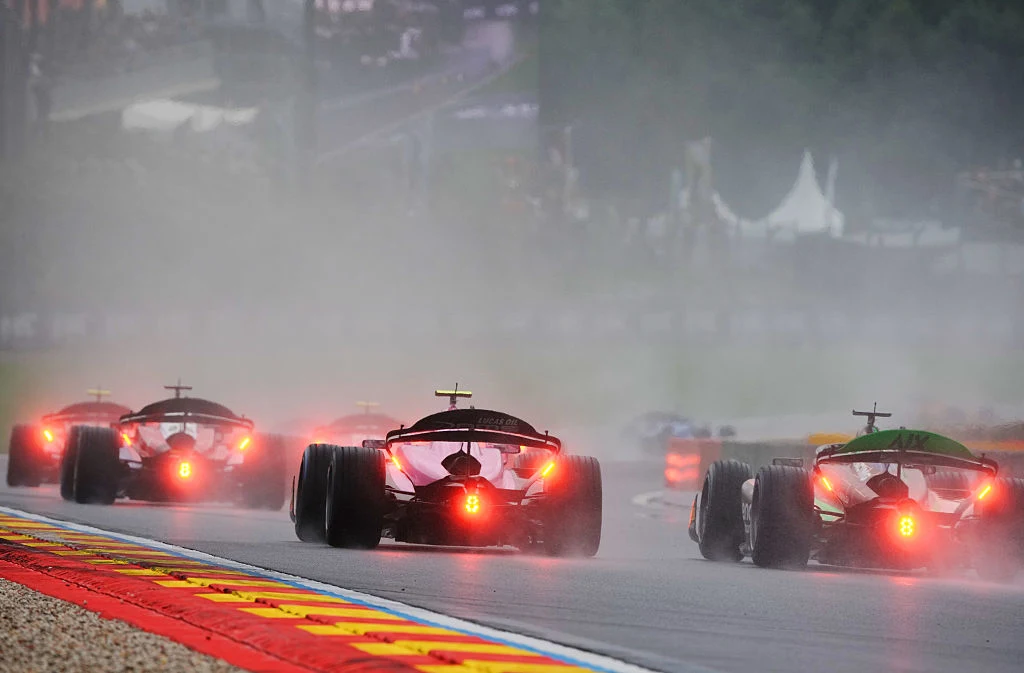
Dürksen’s Sprint victory gave the weekend a useful reference point. The Kemmel Straight remained the main passing route. DRS and slipstream created large closing speeds. Two Safety Car periods then compressed the field and produced a one-lap finish.
Stenshorne led before Dürksen passed him at Les Combes. Beganovic completed the podium. Tsolov moved past Montoya at La Source on the final restart and finished fourth. Dunne followed him through and took fifth, while Câmara finished sixth.
That sequence matters for the Feature Race. It showed that track position is valuable, but it is not secure. A driver who leads out of La Source can still become vulnerable on the climb through Eau Rouge and Raidillon. Moreover, a Safety Car can erase ten laps of careful gap building.

Spa F2 2026 Championship Contenders
Who are the championship contenders before Spa’s Feature Race?
Nikola Tsolov leads the 2026 Formula 2 standings with 146 points. Gabriele Minì is second on 124. Rafael Câmara has 97, and Alexander Dunne has 96. Those four remain the main championship contenders before Sunday’s Spa Feature Race.
Nikola Tsolov: the leader with the strongest margin
Tsolov has been the most productive driver in the championship. He entered Spa with six wins, one short of the single-season record held by Charles Leclerc and George Russell. His Silverstone double also gave him the ability to race Sunday with less desperation than his rivals.
That does not mean he can settle for fourth. Câmara and Dunne start ahead of him, while Minì needs a recovery drive. If Tsolov allows all three to outscore him heavily, the title fight tightens before Budapest. However, a podium would keep the championship firmly under his control.
Tsolov’s strongest weapon is not only speed. It is his ability to convert different race shapes. He has won from strong grid positions, handled restarts, and scored when direct rivals struggled. At Spa, that flexibility may be more important than being the fastest car for one lap.
Gabriele Minì: the contender under the most pressure
Minì entered the Sprint as Tsolov’s closest challenger. His retirement changed the risk balance. He now trails by 22 points and starts the Feature outside the leading group. Therefore, his race needs both pace and strategic imagination.
A reckless first lap would make the problem worse. Spa offers overtaking opportunities across 25 laps. Minì can use the tow, extend the first stint, or benefit from a Safety Car. His challenge is to attack without destroying the tyres or front wing.
Minì has already shown strong Feature Race form in 2026. Yet the Spa weekend has not followed his plan. A top-five finish would limit the damage. A podium would restore momentum. Another low score would turn Tsolov’s advantage into a serious championship cushion.
Rafael Câmara: pole position and a direct chance to re-enter the title fight
Câmara has the best starting position and perhaps the clearest route to victory. His pole lap was 0.039 seconds faster than Inthraphuvasak. It was also his fourth pole of the season, confirming his one-lap speed.
However, the recent Spa record warns against assuming pole equals victory. The last four Feature Race winners at Spa did not start first. Yuki Tsunoda in 2020 remains the most recent driver to convert pole into a Feature win at this circuit.
Câmara must therefore treat pole as control, not protection. He needs a clean La Source exit, careful battery use, and a first stint that does not expose him to an early undercut. Invicta’s recent Spa success helps. The team won both 2025 races and added Saturday’s 2026 Sprint.

Alexander Dunne: one point behind Câmara and close enough to strike
Dunne starts third and enters Sunday one point behind Câmara in the standings. That creates a direct battle inside the larger title race. A podium could move either driver into a stronger position before the next round.
Rodin showed race pace in the Sprint through Stenshorne. Dunne also made an assertive move through Eau Rouge and Raidillon on the final lap. That confidence matters at Spa, where hesitation costs speed all the way down the Kemmel Straight.
His main concern is the opening traffic pattern. Starting third can be awkward. The front row may run side by side into La Source, while Tsolov attacks from fourth. Dunne must protect the car before chasing the lead.
The teams’ championship adds another layer
Campos Racing leads with 215 points. Rodin Motorsport is second on 154, while MP Motorsport has 153. Invicta Racing sits fourth on 133, and ART Grand Prix is fifth on 91.
Campos can score through both Tsolov and León, although León starts at the back after losing all qualifying times. Rodin has Dunne near the front and Stenshorne in the top 10. Meanwhile, Invicta has pole sitter Câmara and Sprint winner Dürksen starting seventh.
The team battle will influence strategy. A team with two cars in contention can split tyre plans. It can also create pressure around pit-stop timing. One car may stop early to force rivals into a response, while the other extends.
Spa Formula 2 Feature Race Grid and Qualifying Analysis
Câmara took pole in a session interrupted by two red flags. León spun at Raidillon early, while Laurens van Hoepen later stopped on the start-finish straight. The final restart left the field with one decisive lap.
Inthraphuvasak came within 0.039 seconds of pole. Dunne qualified third, followed by Tsolov and John Bennett. Beganovic, Dürksen, Bilinski, and Stenshorne completed the next four places.
León originally qualified 10th. However, the stewards deleted all his times because he caused the first red flag. He was permitted to start behind the classified drivers. Sebastián Montoya therefore moved into 10th for the Feature Race.
| Grid | Driver | Team | Qualifying note | Race outlook |
|---|---|---|---|---|
| 1 | Rafael Câmara | Invicta Racing | 1:56.306 | Favorite |
| 2 | Tasanapol Inthraphuvasak | ART Grand Prix | +0.039s | Podium threat |
| 3 | Alexander Dunne | Rodin Motorsport | +0.186s | Title attack |
| 4 | Nikola Tsolov | Campos Racing | +0.393s | Points leader |
| 5 | John Bennett | TRIDENT | Best F2 qualifying | Needs clean first stint |
| 6 | Dino Beganovic | DAMS Lucas Oil | Strong Sprint podium | Race-pace contender |
| 7 | Joshua Dürksen | Invicta Racing | Sprint winner | High-confidence starter |
| 8 | Roman Bilinski | DAMS Lucas Oil | Points in Sprint | Strategy opportunity |
| 9 | Martinius Stenshorne | Rodin Motorsport | Sprint runner-up | Strong long-run signal |
| 10 | Sebastián Montoya | PREMA Racing | Promoted after León penalty | Reverse strategy option |
The grid above reflects the leading order after León’s qualifying times were deleted. Fittipaldi and Shields received 10-place penalties, while Villagómez received a five-place penalty for yellow-flag infringements.
Why the front row may not control the first lap
Spa creates an unusual opening. The pole sitter has the inside line for La Source. Yet the driver who exits behind can gain a stronger tow through Eau Rouge and Raidillon. That can make second place dangerous by Les Combes.
Câmara may prefer to lead through Turn 1, but he cannot use all available energy too early. Inthraphuvasak can pressure him without committing to a risky hairpin move. Dunne and Tsolov will then watch for any contact or compromised exit.
For a broader explanation, see World of Speed’s guide to grid position in racing and our breakdown of how racing drivers qualify.
Formula 2 Spa Track Guide
Why is Spa-Francorchamps famous?
Spa-Francorchamps is famous for its 7.004-kilometer lap, major elevation changes, high-speed corners, long straights, and unpredictable Ardennes weather. Eau Rouge and Raidillon create one of racing’s best-known climbs, while the Kemmel Straight produces major slipstream and DRS battles.
7.004 km / 4.35 miles
Spa is the longest lap on the 2026 Formula 2 calendar. A small error can cost time for almost two minutes.
19 turns
The layout combines a slow hairpin, high-speed direction changes, long loaded corners, and a final heavy-braking chicane.
Three in 2026
A third zone has been added after Turn 17 toward the Bus Stop, increasing late-lap attack opportunities.
La Source: the first corner and the first strategic decision
La Source is a slow right-hand hairpin. Drivers arrive with cold tyres and a full fuel load. Contact is common because the field compresses sharply after a wide start-finish straight.
The corner also shapes the next passing chance. A driver can defend the inside and still lose momentum on exit. The car behind then gains a tow through Eau Rouge and Raidillon. Therefore, the best La Source move is often the one that protects traction rather than the apex.
Eau Rouge and Raidillon: confidence with consequences
The climb begins with the left-hand Eau Rouge compression and rises through Raidillon. In dry conditions, Formula 2 drivers take the sequence at very high speed. However, the car becomes sensitive to ride height, steering correction, and crosswind.
A poor line hurts twice. It costs speed through the corner and then reduces momentum along Kemmel. Dürksen highlighted this before the weekend, noting that one lost corner can create a long straight-line penalty.
The sequence becomes even harder in mixed conditions. The bottom and top of the hill may have different grip. Drivers cannot always see the surface beyond the crest. That is why Spa demands commitment without removing judgment.
Kemmel Straight and Les Combes: the clearest passing zone
The Kemmel Straight is the main overtaking area. Slipstream begins before the crest, while DRS adds closing speed. Cars can arrive at Les Combes side by side at very high speed.
Saturday’s Sprint proved its importance. Stenshorne, Dürksen, Beganovic, Câmara, and others completed key passes in this zone. The attacking driver still needs control under braking because Les Combes leads directly into a direction change.
World of Speed’s slipstream explainer shows why the following car gains speed. At Spa, that effect can be strong enough to change the lead even when the front car exits La Source cleanly.
Bruxelles to Pouhon: where the setup compromise appears
The middle sector moves away from simple straight-line speed. Bruxelles requires braking while the car rotates downhill. Pouhon then asks for high-speed commitment through a long left-hand load.
Teams that trim too much wing may look fast on Kemmel but slide through this section. Sliding raises tyre temperature and accelerates wear. Meanwhile, a higher-downforce car can protect the tyres but become an easy target on the straights.
This is the central Spa engineering problem. The car must be efficient, not merely low drag. Read our guides to what downforce is and how angle of attack changes downforce for deeper context.
Blanchimont and the Bus Stop: the late-lap danger zone
Blanchimont is a fast left-hand section near the end of the lap. The tyres have already carried high load through Pouhon and Fagnes. A small mistake can end in a spin or barrier contact.
The Sprint’s second Safety Car followed a stoppage at Blanchimont. That incident created the final-lap shootout. It also showed why a race can change even after the leader has controlled most of the distance.
The Bus Stop chicane provides one final braking opportunity. The new third DRS zone begins after Turn 17 toward this area. Consequently, drivers may now arrive with a larger speed difference and another chance to attack before the line.
Spa rewards the car that is fast enough on the straights, stable enough in the middle sector, and gentle enough on its tyres to remain competitive after the pit stop.
World of Speed technical assessmentF2 Spa Race Strategy, Tires and Weather
What tire strategy is expected for Spa Formula 2?
Pirelli selected the Medium and Supersoft tires for Spa. The official pre-race analysis says Medium to Supersoft is the fastest dry strategy on paper. However, Safety Cars, traffic, or rain could make the reverse Supersoft to Medium sequence more effective.
Why Pirelli skipped a compound
Pirelli brought the Medium and Supersoft, leaving a compound gap between them. That creates a clear performance difference. The Supersoft offers stronger initial grip, while the Medium provides better durability.
The official preview warned that graining may affect both compounds. It also suggested the Supersoft could lose competitiveness after about six laps. Therefore, drivers who start on the softer tyre may face pressure near the earliest legal pit window.
The Medium should provide stronger closing pace over a long stint. However, it needs temperature. A cool track or Safety Car restart can make the first lap difficult. That matters when rivals are attacking with warmer Supersofts.
Medium to Supersoft: the fastest plan on paper
The expected baseline is a Medium start followed by a late Supersoft stint. This route protects the driver from early degradation and creates an attacking finish. It also allows the team to delay the stop while watching for a Safety Car.
However, the strategy has a weakness. A driver on Mediums may lose positions at the start. The Supersoft runners can attack immediately, and Spa’s DRS trains may make recovery difficult before the pit cycle.
Teams must also avoid stopping into traffic. A fresh Supersoft is valuable only when the driver can use it. Rejoining behind a slower group can waste the tire’s best laps.
Supersoft to Medium: the track-position plan
Starting on Supersofts gives the driver a stronger launch and more grip in the opening laps. That can be attractive for drivers outside the top five. An aggressive first stint may gain track position before an early stop.
The risk is degradation. If the tire begins to grain, lap time can fall quickly. An early stop then commits the driver to a long Medium stint. A later Safety Car could help rivals who stayed out.
This plan suits a driver who expects to pass early and then defend. It also suits a team willing to use one car as a strategic trigger. The first pit stop can force the leader to react.
The mandatory pit stop and the six-lap threshold
The Feature Race requires a pit stop under normal dry conditions. At least two wheels must be changed. The stop cannot count until the driver has completed six laps.
That rule narrows the early options. A driver with damaged Supersofts may want to stop immediately, yet the team must ensure the mandatory requirement is satisfied. A separate repair stop before the threshold can create a second pit visit later.
The stop also cannot normally count during a Virtual Safety Car unless the car was already entering or inside the pit lane when the VSC began. That detail can produce large gains or losses. Our guide to how pit stops work in racing explains the sequence.
Safety Car probability is impossible to ignore
Saturday produced two Safety Car periods. Spa has long recovery distances, high-speed impacts, and limited places to move a stopped car safely. Therefore, teams must build flexible plans rather than one fixed pit lap.
A full Safety Car after the six-lap threshold can create a cheap stop. However, it can also trap a driver who has just passed pit entry. With a 7.004-kilometer lap, the timing difference becomes significant.
Drivers who stop early may gain track position before the neutralization. Drivers who stay out may receive a cheaper stop later. The race can split into two groups with opposite tire age. See our safety car explainer for the key rules.
Spa weather forecast: cool and changeable
Race morning is expected to be cool, with temperatures around the low-50s Fahrenheit. Forecast data at the time of publication also showed a chance of showers around the morning period. However, the exact rain timing remains uncertain.
That uncertainty matters more at Spa than at a compact circuit. One sector can be damp while another remains dry. A driver may leave the pits on the correct tyre and reach wet asphalt several kilometers later.
Cool conditions can slow tire warm-up. They may also reduce thermal degradation on the Supersoft. Yet graining remains possible if drivers slide before the surface reaches its working range.
Spa forecasts can change quickly. Recheck the radar before the formation lap. A small shower could alter the dry-tire rule, pit timing, and the value of the Medium-to-Supersoft plan.
Three strategy battles to watch
Câmara vs Inthraphuvasak
The leader controls the first stop. The second-place car may attack through an undercut or a longer Medium stint.
Dunne vs Tsolov
They start third and fourth. Both must balance race victory against championship points and first-lap risk.
Minì and León
Both need alternative routes. A reverse strategy, early Safety Car, or wet phase could bring them back into contention.
Spa Formula 2 2026 Predictions
Who will win the Spa Formula 2 race in 2026?
Rafael Câmara is the leading Feature Race pick because he starts from pole and Invicta Racing has won the last three Formula 2 races at Spa. Nikola Tsolov is the strongest championship-based challenger, while Tasanapol Inthraphuvasak and Alexander Dunne have genuine podium pace.
Predictions at Spa need restraint. The circuit has not produced a pole-to-Feature-win conversion since 2020. Safety Cars are common enough to shape planning, and mixed weather remains possible. Therefore, the picks below are reasoned outcomes, not guarantees.
Why Câmara is the winner pick
Câmara controls the start and has a teammate with strong current form. Dürksen’s Sprint win gave Invicta data on tire behavior, restarts, and passing zones. The team also knows how to win at Spa from its 2025 double.
His challenge will be resisting the urge to over-defend. If he uses too much tire and energy before Les Combes, he may expose himself later in the stint. The best route is a clean start, a stable Medium pace, and a late Supersoft attack.
Why Tsolov may be the safest podium choice
Tsolov has scored across many race types. He does not need pole to control a Feature Race. Starting fourth also gives him a clear view of the first-corner battle.
If the front three fight, Tsolov can protect the inside and focus on exit speed. His team leads the standings and has strong operational form. Therefore, he may be better placed than the raw grid suggests.
Inthraphuvasak is the most credible surprise winner
Inthraphuvasak’s qualifying lap was not a lucky outlier. He missed pole by less than four hundredths. Starting second also gives him the ideal tow position if Câmara leads out of La Source.
The unknown is race conversion. ART must manage the pit window and keep him out of traffic. If the stop is clean, he can challenge for victory rather than simply defend a podium.
Dunne is the driver most likely to disrupt the title leader
Dunne starts one place ahead of Tsolov and trails Câmara by one championship point. He has every reason to attack. However, he also has more to lose than a driver outside the title picture.
His race may depend on Lap 1. If he keeps Tsolov behind, he can pressure the front row. If Tsolov passes, Dunne may spend the race reacting to Campos strategy.
Dark horses: Dürksen, Beganovic and Stenshorne
Dürksen starts seventh after winning the Sprint. He has confidence, clean evidence of race pace, and a car that works at Spa. A Safety Car near the pit window could move him into the podium fight.
Beganovic starts sixth and finished third on Saturday. DAMS also has Bilinski in eighth, which gives the team two strategic options. Stenshorne starts ninth but led much of the Sprint and finished second.
These drivers are not the leading picks because they start farther back. However, they have enough pace to punish mistakes by the front group. Spa rewards that patience.
Championship prediction after Spa
Tsolov is likely to leave Belgium with the lead. Even a modest points finish keeps him ahead unless Minì produces a major recovery and Tsolov fails to score. The more important question is the size of the margin.
Our prediction is that Tsolov’s lead remains above 20 points. Câmara should move closer to Minì if he converts pole into a podium. Dunne is also likely to stay within one strong weekend of third place.
The title will not be decided at Spa. Yet the race can define the chase. If Tsolov finishes ahead of Minì again, the pressure shifts heavily toward the MP Motorsport driver before Budapest.
Expect a controlled first stint rather than immediate pit chaos. The key window should arrive after Lap 6, when the mandatory stop becomes valid. A Safety Car between Laps 7 and 15 would create the biggest strategic split.
Seven Things to Watch in the Spa F2 Feature Race
- The La Source exit. The driver who gets the cleanest launch can control the tow into Kemmel.
- Câmara’s battery use. Defending too early may leave him exposed later on the straight.
- Tsolov’s risk level. He can attack for a win, but a clean podium may be better for the championship.
- Minì’s starting tire. His compound choice will reveal whether MP plans an early attack or a long recovery stint.
- The first legal pit window. Stops after six completed laps can count toward the Feature requirement.
- Safety Car timing. Saturday showed how quickly a neutralization can erase a stable race.
- Final classification. Post-race penalties can change Formula 2 points after the flag.
Use official live timing alongside the broadcast. It makes the pit cycle much easier to understand. Our guide to how race timing works explains the gaps, intervals, and sector colors.
Spa Formula 2 2026 FAQ
Conclusion: The Spa Formula 2 2026 Preview Points to a Strategy Race
The Spa Formula 2 2026 Preview begins with Câmara on pole, but the deeper story is more complicated. Spa has not rewarded a Feature pole sitter with victory since 2020. The circuit gives following cars a powerful tow, the Pirelli compounds create a clear strategy split, and Saturday’s Safety Cars showed how quickly the order can change.
Tsolov remains the championship favorite. He has a 22-point lead, strong recent form, and a fourth-place start. However, Câmara and Dunne begin ahead of him, while Minì must recover after a Sprint retirement. The race therefore combines a fight for victory with a direct test of title pressure.
Our winner pick is Câmara, with Tsolov, Inthraphuvasak, and Dunne forming the strongest challenge. Yet the decisive moment may not be the start. It may come after Lap 6, when the mandatory stop becomes valid and every team must judge tire life, traffic, weather, and Safety Car risk.
For U.S. viewers, lights out is at 4:00 a.m. ET on Sunday. Watch the gaps behind the leaders, not only the car in front. At Spa, the race often changes before the television timing tower catches up.
Sources & Verification
Standings, qualifying, Sprint results, penalties, tire information, circuit data, and schedule details were checked against official Formula 2 and FIA material. Weather information was checked close to publication and remains subject to change.
- FIA Formula 2 — official 2026 Spa preview, technical notes, DRS zones, Pirelli compounds and historical stat pack
- FIA Formula 2 — Spa-Francorchamps 2026 schedule, circuit length and Sprint classification
- FIA Formula 2 — official 2026 Drivers’ Championship standings after the Spa Sprint
- FIA — 2026 Formula 2 Sporting Regulations