Nashville INDYCAR 2026 Qualifying Results: Pole Winner and Full Starting Grid
Kyle Kirkwood defeated Nashville oval specialist Josef Newgarden by 0.0508 seconds, Team Penske placed two cars in the top three, and penalties reshaped the final rows of the 25-car grid.
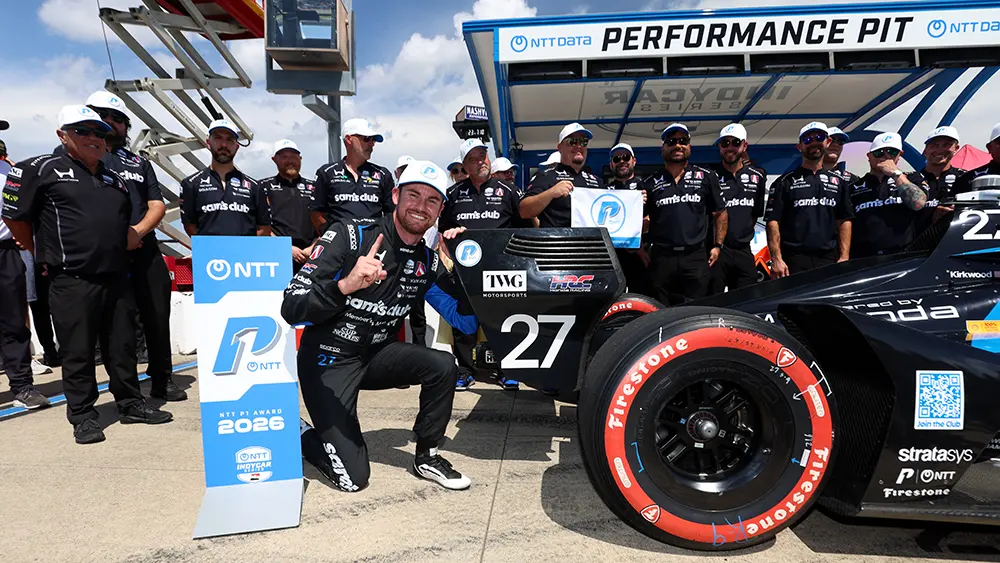
The Nashville INDYCAR 2026 qualifying results put Kyle Kirkwood on pole after the Andretti Global driver completed two laps in 47.5485 seconds. His average speed of 196.852 mph defeated Josef Newgarden by 0.210 mph and only 0.0508 seconds.
Scott McLaughlin placed a second Team Penske Chevrolet inside the top three. Alex Palou and Scott Dixon followed for Chip Ganassi Racing, while Alexander Rossi completed the third row for ECR.
The raw qualifying order was not identical to the official starting grid. Christian Lundgaard carried a nine-position engine penalty. David Malukas missed qualifying after his Practice 1 crash and also had an engine penalty. Therefore, Graham Rahal moved to 23rd despite failing to set a time.
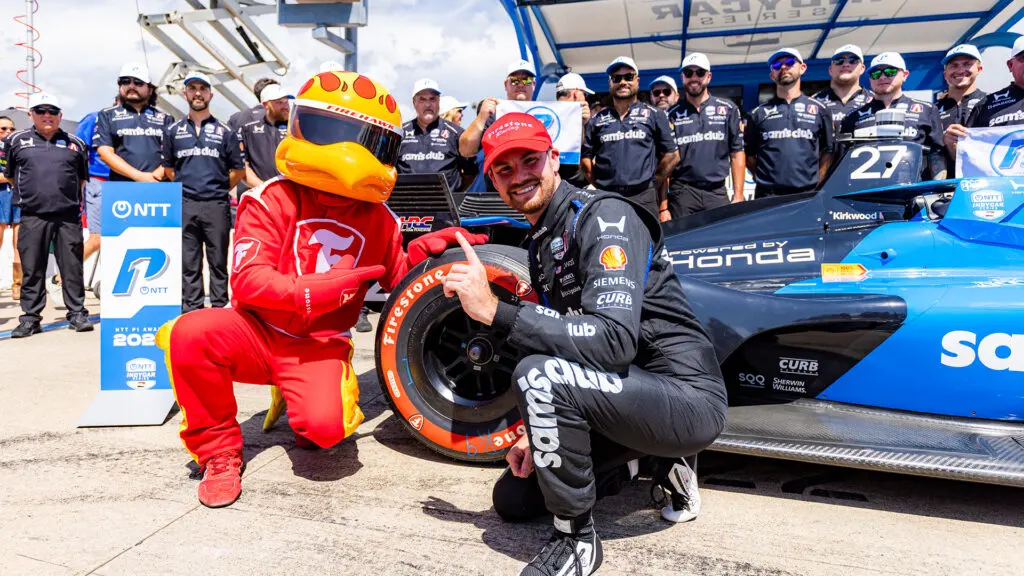
Kirkwood won the NTT P1 Award in the #27 Andretti Global Honda. His first lap was 23.7104 seconds, the only lap above 197 mph. A 23.8381-second second lap produced a two-lap average of 196.852 mph.
Nashville Qualifying at a Glance
Nashville Superspeedway is a 1.33-mile concrete oval in Lebanon, Tennessee. The short lap placed a premium on small details. A minor steering correction, added tire scrub or a slight lift could cost several grid positions.
Every driver received one qualifying attempt. Each run contained two consecutive timed laps. INDYCAR ranked the drivers by their average speed across the complete 2.66-mile distance.
The afternoon conditions raised the difficulty. INDYCAR reported 94°F air temperature and a track surface near 130°F. That heat reduced grip and made the trimmed qualifying setups more nervous through the corners.
The top five finished within 0.2549 seconds. Moreover, Power in 14th and Collet in 15th were separated by 0.0005 seconds. Schumacher and Rosenqvist were another 0.0031 and 0.0046 seconds behind Power.
That density made Kirkwood’s pole more impressive. He did not win because the field was spread out. Instead, he found a clear advantage inside one of the year’s closest oval qualifying sessions.
Kyle Kirkwood
He combined the session’s fastest first lap with enough second-lap stability to keep Newgarden behind.
Josef Newgarden
The Tennessee native led temporarily at 196.642 mph before Kirkwood’s late run.
Team Penske
Newgarden and McLaughlin gave Chevrolet two cars inside the first three starting positions.
How Kyle Kirkwood Won the Nashville Pole
Kirkwood entered qualifying as the Practice 1 leader. His Andretti Global team had already shown a quick low-fuel setup, and the driver had enough confidence to remain flat through the lap’s most difficult sections.
His first timed lap lasted 23.7104 seconds. That equaled 197.382 mph and was the only qualifying lap above 197 mph. The advantage gave Kirkwood a cushion before tire heat and surface friction affected lap two.
The second lap slowed to 23.8381 seconds. However, the combined 47.5485-second total remained 0.0508 seconds quicker than Newgarden. The average speed stood at 196.852 mph.
Why the first lap decided the contest
Kirkwood’s first lap was 0.0496 seconds faster than Newgarden’s. Their second laps were almost identical: Kirkwood recorded 23.8381, while Newgarden completed a 23.8393.
Therefore, the front-row margin came almost entirely from the opening lap. Kirkwood reached peak speed before the tires accumulated extra heat. He then protected the advantage with a clean second circuit.
The draw gave Kirkwood information, not free speed
Kirkwood ran second-to-last in the qualifying order. Palou followed as the final driver. A late draw allowed Andretti to study previous runs and temperature trends.
However, the surface was extremely hot, and later was not automatically better. The driver still had to control a low-downforce car over the concrete bumps. Kirkwood used the available information without giving away speed through hesitation.
Lap 1: 23.7104 seconds. Lap 2: 23.8381 seconds. Total: 47.5485 seconds. Average: 196.852 mph. Margin over Newgarden: 0.0508 seconds.
Full Nashville INDYCAR 2026 Qualifying Results
The table below shows the complete qualifying classification before grid penalties. It includes both timed laps, total elapsed time and average speed. The gap column compares each total with Kirkwood’s 47.5485-second pole run.
| Rank | Car | Driver | Team | Engine | Lap 1 | Lap 2 | Total | Avg. mph | Gap |
|---|---|---|---|---|---|---|---|---|---|
| 1 | #27 | Kyle Kirkwood | Andretti Global w/ Curb-Agajanian | Honda | 23.7104 | 23.8381 | 47.5485 | 196.852 | +0.0000 |
| 2 | #2 | Josef Newgarden | Team Penske | Chevrolet | 23.7600 | 23.8393 | 47.5993 | 196.642 | +0.0508 |
| 3 | #3 | Scott McLaughlin | Team Penske | Chevrolet | 23.8544 | 23.8795 | 47.7339 | 196.087 | +0.1854 |
| 4 | #10 | Alex Palou | Chip Ganassi Racing | Honda | 23.8694 | 23.8735 | 47.7429 | 196.050 | +0.1944 |
| 5 | #9 | Scott Dixon | Chip Ganassi Racing | Honda | 23.8829 | 23.9205 | 47.8034 | 195.802 | +0.2549 |
| 6 | #20 | Alexander Rossi | ECR | Chevrolet | 23.8591 | 23.9780 | 47.8371 | 195.664 | +0.2886 |
| 7 | #21 | Christian Rasmussen | ECR | Chevrolet | 23.8816 | 23.9749 | 47.8565 | 195.585 | +0.3080 |
| 8 | #66 | Marcus Armstrong | Meyer Shank w/ Curb-Agajanian | Honda | 23.9031 | 23.9550 | 47.8581 | 195.578 | +0.3096 |
| 9 | #76 | Rinus VeeKay | Juncos Hollinger Racing | Chevrolet | 23.9444 | 23.9489 | 47.8933 | 195.434 | +0.3448 |
| 10 | #28 | Marcus Ericsson | Andretti Global | Honda | 23.9441 | 23.9604 | 47.9045 | 195.389 | +0.3560 |
| 11 | #14 | Santino Ferrucci | A.J. Foyt Enterprises | Chevrolet | 23.9312 | 23.9871 | 47.9183 | 195.332 | +0.3698 |
| 12 | #5 | Pato O’Ward | Arrow McLaren | Chevrolet | 23.9034 | 24.0588 | 47.9622 | 195.154 | +0.4137 |
| 13 | #6 | Nolan Siegel | Arrow McLaren | Chevrolet | 23.9849 | 24.0282 | 48.0131 | 194.947 | +0.4646 |
| 14 | #26 | Will Power | Andretti Global | Honda | 23.9948 | 24.0473 | 48.0421 | 194.829 | +0.4936 |
| 15 | #4 | Caio Collet | A.J. Foyt Enterprises | Chevrolet | 23.9457 | 24.0969 | 48.0426 | 194.827 | +0.4941 |
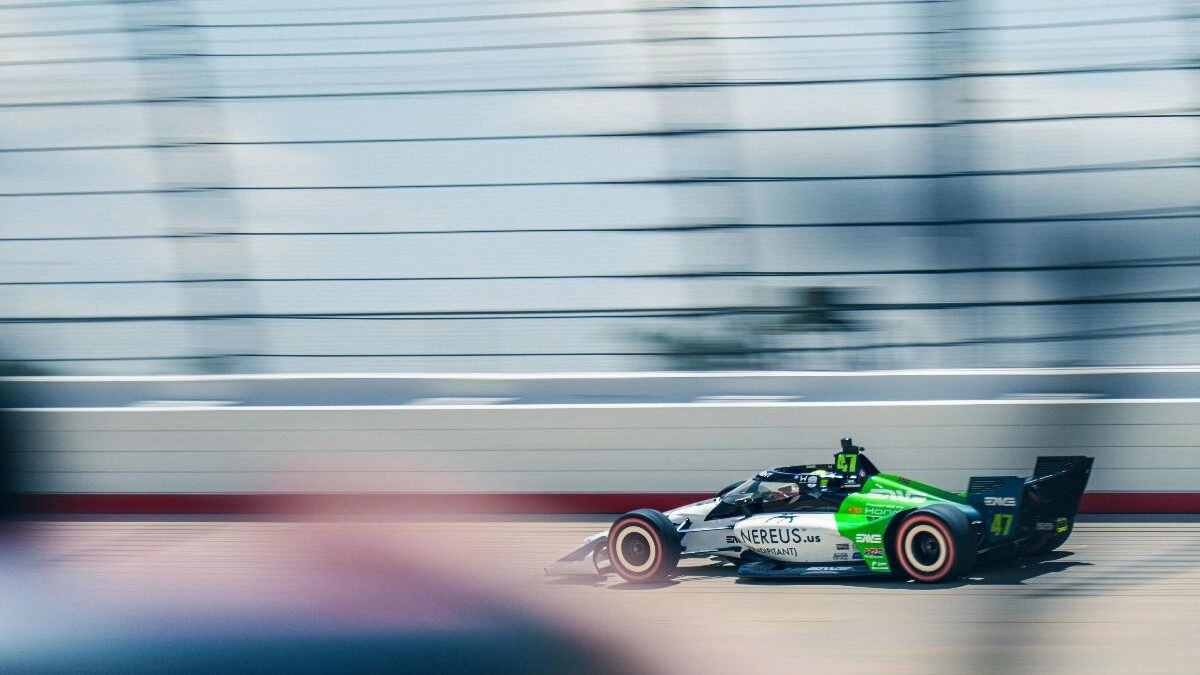
| 16 | #47 | Mick Schumacher | Rahal Letterman Lanigan Racing | Honda | 23.9714 | 24.0743 | 48.0457 | 194.815 | +0.4972 |
| 17 | #60 | Felix Rosenqvist | Meyer Shank w/ Curb-Agajanian | Honda | 24.0209 | 24.0263 | 48.0472 | 194.808 | +0.4987 |
| 18 | #8 | Kyffin Simpson | Chip Ganassi Racing | Honda | 24.1055 | 24.0539 | 48.1594 | 194.355 | +0.6109 |
| 19 | #7 | Christian Lundgaard | Arrow McLaren | Chevrolet | 24.0972 | 24.1288 | 48.2260 | 194.086 | +0.6775 |
| 20 | #45 | Louis Foster | Rahal Letterman Lanigan Racing | Honda | 24.0634 | 24.1641 | 48.2275 | 194.080 | +0.6790 |
| 21 | #77 | Sting Ray Robb | Juncos Hollinger Racing | Chevrolet | 24.1581 | 24.2401 | 48.3982 | 193.396 | +0.8497 |
| 22 | #18 | Romain Grosjean | Dale Coyne Racing | Honda | 24.2757 | 24.3261 | 48.6018 | 192.585 | +1.0533 |
| 23 | #19 | Dennis Hauger | Dale Coyne Racing | Honda | 24.3176 | 24.3760 | 48.6936 | 192.222 | +1.1451 |
| 24 | #12 | David Malukas | Team Penske | Chevrolet | — | — | No time | — | — |
| 25 | #15 | Graham Rahal | Rahal Letterman Lanigan Racing | Honda | — | — | No time | — | — |
The top six
Newgarden held provisional pole before Kirkwood’s run. His 196.642-mph average placed him 0.555 mph ahead of Penske teammate McLaughlin. The #3 Chevrolet completed its two laps in 47.7339 seconds.
Palou missed McLaughlin by 0.0090 seconds. Dixon followed at 195.802 mph, giving Ganassi fourth and fifth. Rossi ranked sixth and became the fastest ECR driver.
The closest midfield battle
Rasmussen and Armstrong were separated by 0.0016 seconds for seventh. Power, Collet, Schumacher and Rosenqvist then formed an even tighter four-car group from 14th through 17th.
Power beat Collet by 0.0005 seconds. Schumacher followed Power by 0.0036, while Rosenqvist was only 0.0051 behind Power. One small steering correction could have reversed all four positions.
Who lost the most speed on lap two?
O’Ward’s first lap was a competitive 23.9034 seconds. His second slowed to 24.0588, a drop of 0.1554 seconds. That fade left the Arrow McLaren driver 12th.
Collet slowed by 0.1512 seconds, while Rossi lost 0.1189. In contrast, Simpson improved on lap two by 0.0516 seconds. Rosenqvist also improved slightly.
Oval qualifying rewards two complete laps. A brilliant opening circuit can be lost if the rear tires or handling balance fade before the second finish line.
Official Nashville INDYCAR 2026 Starting Grid
The official starting grid differed from the qualifying classification near the back. Lundgaard qualified 19th but carried a nine-position penalty for an unapproved engine change. Because the field contained 25 cars, he moved to 24th.
Malukas did not attempt a qualifying run after his heavy Practice 1 crash. He also carried an engine penalty and was placed 25th. Rahal failed to run because his car could not maintain fuel pressure, but he advanced to 23rd once the penalties were applied.
| Grid | Car | Driver | Team | Engine | Grid note |
|---|---|---|---|---|---|
| 1 | #27 | Kyle Kirkwood | Andretti Global w/ Curb-Agajanian | Honda | Pole |
| 2 | #2 | Josef Newgarden | Team Penske | Chevrolet | Qualified 2nd |
| 3 | #3 | Scott McLaughlin | Team Penske | Chevrolet | Qualified 3rd |
| 4 | #10 | Alex Palou | Chip Ganassi Racing | Honda | Qualified 4th |
| 5 | #9 | Scott Dixon | Chip Ganassi Racing | Honda | Qualified 5th |
| 6 | #20 | Alexander Rossi | ECR | Chevrolet | Qualified 6th |
| 7 | #21 | Christian Rasmussen | ECR | Chevrolet | Qualified 7th |
| 8 | #66 | Marcus Armstrong | Meyer Shank w/ Curb-Agajanian | Honda | Qualified 8th |
| 9 | #76 | Rinus VeeKay | Juncos Hollinger Racing | Chevrolet | Qualified 9th |
| 10 | #28 | Marcus Ericsson | Andretti Global | Honda | Qualified 10th |
| 11 | #14 | Santino Ferrucci | A.J. Foyt Enterprises | Chevrolet | Qualified 11th |
| 12 | #5 | Pato O’Ward | Arrow McLaren | Chevrolet | Qualified 12th |
| 13 | #6 | Nolan Siegel | Arrow McLaren | Chevrolet | Qualified 13th |
| 14 | #26 | Will Power | Andretti Global | Honda | Qualified 14th |
| 15 | #4 | Caio Collet | A.J. Foyt Enterprises | Chevrolet | Qualified 15th |
| 16 | #47 | Mick Schumacher | Rahal Letterman Lanigan Racing | Honda | Qualified 16th |
| 17 | #60 | Felix Rosenqvist | Meyer Shank w/ Curb-Agajanian | Honda | Qualified 17th |
| 18 | #8 | Kyffin Simpson | Chip Ganassi Racing | Honda | Qualified 18th |
| 19 | #45 | Louis Foster | Rahal Letterman Lanigan Racing | Honda | Gained 1 after penalty |
| 20 | #77 | Sting Ray Robb | Juncos Hollinger Racing | Chevrolet | Gained 1 after penalty |
| 21 | #18 | Romain Grosjean | Dale Coyne Racing | Honda | Gained 1 after penalty |
| 22 | #19 | Dennis Hauger | Dale Coyne Racing | Honda | Gained 1 after penalty |
| 23 | #15 | Graham Rahal | Rahal Letterman Lanigan Racing | Honda | No qualifying time |
| 24 | #7 | Christian Lundgaard | Arrow McLaren | Chevrolet | Nine-position engine penalty |
| 25 | #12 | David Malukas | Team Penske | Chevrolet | No time; engine penalty |
Front row: Kirkwood and Newgarden
Kirkwood started from the inside, with Newgarden alongside. That front row matched the two drivers most closely associated with recent Nashville oval speed. Kirkwood also took pole at the venue in 2024.
Newgarden brought stronger recent oval-race form. Therefore, the first row combined Andretti’s qualifying benchmark with Penske’s established oval execution.
Second row: McLaughlin and Palou
McLaughlin started third, while championship leader Palou lined up fourth. The row paired another Penske Chevrolet with a Ganassi Honda.
Palou did not need pole to protect his championship position. However, starting beside McLaughlin placed him inside a group likely to fight for clean air and early track position.
Third row: Dixon and Rossi
Dixon occupied fifth and brought more Nashville Superspeedway experience than any other current driver. Rossi started sixth after producing the fastest ECR average.
Rossi’s position also gave ECR both cars inside the top seven, because Rasmussen qualified immediately behind him.
Qualifying ranked Lundgaard 19th, Malukas 24th and Rahal 25th. The official grid placed Rahal 23rd, Lundgaard 24th and Malukas 25th after the engine penalties were applied.
How INDYCAR Oval Qualifying Works at Nashville
Each driver runs alone
Unlike road-course qualifying, drivers do not share the track in groups. One car leaves pit lane and completes its attempt without traffic. That removes slipstream effects and creates a direct comparison between cars.
The order usually follows a draw or series procedure. Conditions can change during the session, so the running order may affect grip and temperature.
Both timed laps count
INDYCAR adds the distance of two laps and divides it by the total elapsed time. The resulting average speed determines the ranking. A driver’s fastest individual lap does not decide the grid by itself.
Kirkwood’s run demonstrated the format clearly. His first lap created the advantage, while his second lap preserved it. If the second circuit had slowed by another tenth, Newgarden would have taken pole.
Why teams trim downforce
Teams reduce aerodynamic drag for qualifying. Less wing angle can increase straight-line and corner-entry speed. However, the car becomes more sensitive to bumps, wind and rear-tire slip.
Nashville’s concrete surface makes that compromise difficult. The fastest setup must remain stable enough for the driver to stay flat through both timed laps.
Why average speed is used instead of only time
Average speed is the traditional language of American oval qualifying. It allows fans to compare performance across tracks and eras. The official chart still records each lap and total time.
At Nashville, Kirkwood’s 196.852-mph average represented 2.66 miles completed in 47.5485 seconds.
Team and Manufacturer Qualifying Analysis
Andretti Global: pole plus two midfield positions
Kirkwood delivered the headline result. Ericsson qualified 10th, while Power ranked 14th. Andretti therefore placed all three cars inside the first 14.
The spread showed one exceptional run rather than complete three-car domination. Nevertheless, the team’s practice and qualifying direction gave Kirkwood the confidence to attack.
Team Penske: two cars inside the top three
Newgarden and McLaughlin qualified second and third. Their combined result gave Chevrolet a strong front-row and second-row presence.
Malukas could not complete a run, so Penske’s third car appeared last on the official grid. The car’s earlier Practice 1 speed suggested the missing time reflected circumstances rather than a lack of pace.
Chip Ganassi Racing: fourth, fifth and 18th
Palou and Dixon filled the next two positions behind the Penske pair. Their lap totals were separated by 0.0605 seconds. Simpson placed 18th after improving on his second lap.
Ganassi did not win pole, but it secured two cars inside the top five. That offered strong strategic flexibility for the race.
ECR: the most complete two-car result
Rossi qualified sixth, and Rasmussen followed in seventh. Only 0.0194 seconds separated their totals. Both Chevrolets therefore began with clean access to the leading group.
The result also showed that ECR’s speed was not limited to one driver. Both engineers found a similar qualifying window.
Arrow McLaren: a difficult grid position
O’Ward qualified 12th, Siegel 13th and Lundgaard 19th. Lundgaard’s engine penalty then moved him to 24th.
The team lacked a car inside the top 10. O’Ward’s strong first lap showed potential, but the second-lap decline cost several positions.
Honda vs Chevrolet
The top 10 split evenly between Honda and Chevrolet. Honda took pole through Kirkwood. Chevrolet filled second and third with Newgarden and McLaughlin.
Across the full 25-car field, Honda powered 13 entries and Chevrolet powered 12. The balanced front group suggested no simple manufacturer advantage.
Why Malukas and Rahal Set No Qualifying Times
A heavy Turn 2 crash removed the car from qualifying
Malukas lost the rear and struck the SAFER Barrier. He left the circuit for hospital testing after reporting pain in his right knee. Team Penske repaired the car later, but he was unavailable for qualifying.
The engine would not maintain fuel pressure
Rahal’s car initially fired, then shut down during the permitted preparation window. The team could not restart it before the 60-second clock expired, so officials did not allow a late attempt.
An engine penalty erased his 19th-place qualifying position
Lundgaard’s unapproved engine change carried a nine-position oval penalty. With only 25 starters, the penalty moved him to 24th rather than the mathematical 28th.
Why Rahal moved ahead of two cars
Rahal was listed 25th in the qualifying classification because he produced no time. However, the official starting grid applied penalties after the session.
Lundgaard dropped behind Rahal. Malukas also remained behind because of his no-time result and penalty. Consequently, Rahal started 23rd.
Malukas’ last-place grid position did not measure his speed
Malukas ranked third in Practice 1 after completing only four laps. He later returned to lead Final Practice. Those results showed that the repaired #12 Penske Chevrolet retained front-running pace.
The last-place start came from the crash, missed session and engine penalty. It was not the product of a slow two-lap qualifying run.
Do not read Malukas’ 25th place as the 25th-fastest car. He made no qualifying attempt and later led Final Practice.
Nashville Qualifying Winners and Losers
Kyle Kirkwood
He converted practice pace into his first pole of the season and gained the championship point attached to the NTT P1 Award.
Team Penske
Newgarden and McLaughlin gave the team two cars near the front despite Malukas missing the session.
ECR
Rossi and Rasmussen produced the strongest closely matched two-car result outside Penske.
Christian Lundgaard
The engine penalty turned a difficult 19th-place qualifying run into a back-row start.
Schumacher delivered a useful rookie result
Schumacher qualified 16th in his first Nashville Superspeedway weekend. He missed Power by only 0.0036 seconds and beat Rosenqvist by 0.0015.
The result placed him ahead of two experienced oval winners in Rosenqvist and Dixon? No—Dixon was fifth. More accurately, it put him directly ahead of reigning Indianapolis 500 winner Rosenqvist. That was a meaningful benchmark for the rookie.
O’Ward left speed unused
O’Ward’s first lap projected a stronger position than 12th. The second-lap slowdown pushed him behind Ferrucci and out of the top 10.
Because both laps count, Arrow McLaren could not rely on the opening speed. The result created more traffic risk at the start.
Five Key Takeaways from Nashville INDYCAR Qualifying
1. Kirkwood’s advantage came from immediate commitment
The pole winner produced the session’s best first lap. His second lap was nearly equal to Newgarden’s, so the opening circuit created the decisive margin.
2. Penske surrounded the pole sitter
Newgarden started beside Kirkwood, while McLaughlin started directly behind. That positioning gave Penske two strategic options against one leading Andretti car.
3. Palou protected his championship position
Fourth place kept Palou near every major rival. He did not take the pole point, but he avoided the traffic risks faced by several championship contenders further back.
4. Qualifying and starting-grid tables must remain separate
Lundgaard’s penalty changed positions 19 through 24. A results article that publishes only the raw session order would give readers the wrong race lineup.
5. The field was closer than the headline suggested
Seventeen drivers were covered by less than half a second. Power, Collet, Schumacher and Rosenqvist were separated by only 0.0051 seconds.
Kirkwood won pole on speed. Newgarden and McLaughlin gave Penske the strongest multi-car result. Palou and Dixon kept Ganassi inside the top five, while penalties reshaped the final three rows.
Nashville INDYCAR 2026 Qualifying Results FAQ
Conclusion: Kirkwood Won Pole, but Penske Controlled the Cars Around Him
The Nashville INDYCAR 2026 qualifying results confirmed Kirkwood as the fastest driver over two complete laps. His 196.852-mph average defeated Newgarden by 0.0508 seconds and gave Andretti Global the inside of the front row.
Team Penske still left qualifying with major strength. Newgarden started second and McLaughlin third. Palou and Dixon followed for Ganassi, while ECR placed Rossi and Rasmussen sixth and seventh.
The final rows required more attention than the headline positions. Lundgaard’s engine penalty moved him from 19th in qualifying to 24th on the grid. Malukas started last after missing the session and carrying a penalty. Rahal advanced to 23rd despite setting no time.
Most importantly, the session showed how little separated the field. Less than half a second covered the first 17 timed drivers. Kirkwood earned pole through one exceptional opening lap and a second lap clean enough to preserve it.
Sources & Official References
- INDYCAR — Kirkwood wins Nashville pole and official qualifying report
- INDYCAR Timing & Scoring — official qualifying classification
- INDYCAR — official Nashville starting grid after penalties
- INDYCAR — Malukas crash, medical clearance and engine-penalty context
Lap times, total times, average speeds and the raw qualifying order follow the official qualifying classification. The separate starting-grid table follows INDYCAR’s published official lineup after penalties.