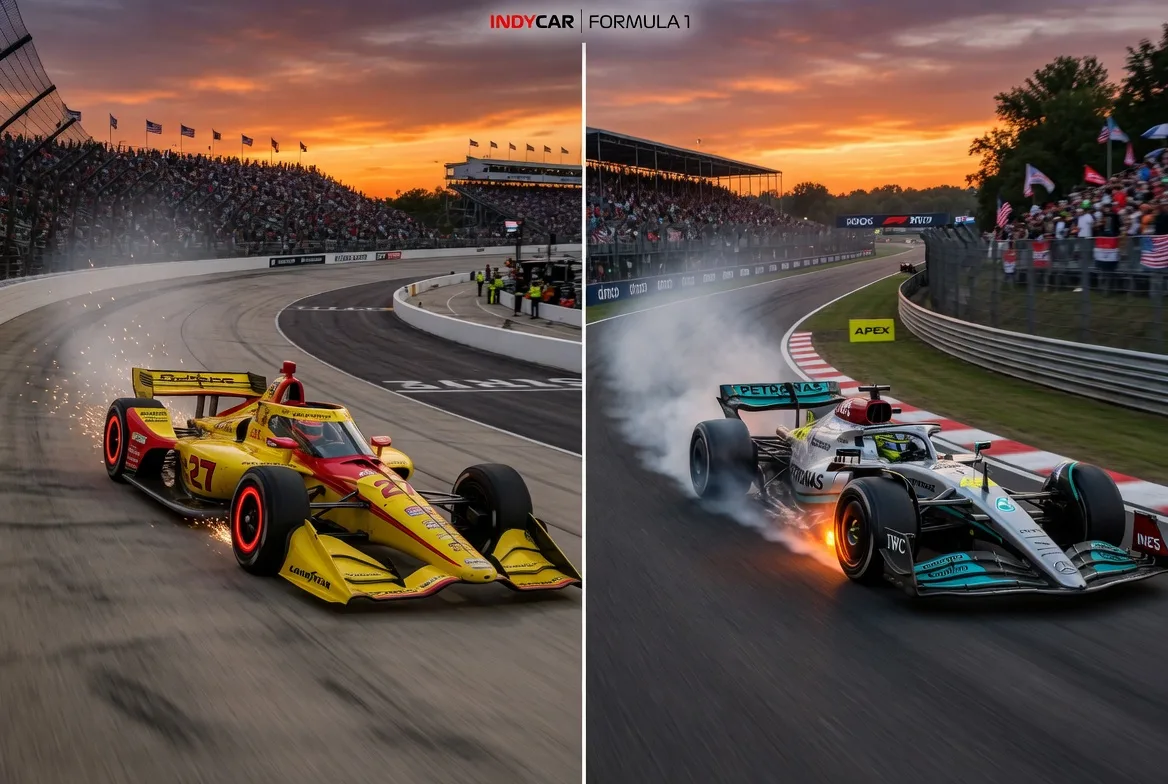
IndyCar vs F1:
Speed, Technology, Rules & Which Series Is Harder?
Two elite open-wheel championships, two completely different philosophies. Here’s every meaningful difference between Formula 1 and IndyCar — speed, engineering, budgets, tracks, driver demands, and where each series actually wins.
IndyCar vs F1:
Speed, Tech & Which Is Better?
The complete breakdown of every difference between Formula 1 and IndyCar — from lap times to budgets.
Ask any paddock regular which racing series is “better” and you’ll get a different answer depending on whether they’re holding a Borg-Warner Trophy or an FIA Super Licence. The IndyCar vs Formula 1 debate isn’t a question with a clean answer — it’s a question that only makes sense once you understand what each series is actually for.
Formula 1 is the technology arms race: a global championship built on bespoke engineering, hundred-million-dollar budgets, and the perpetual pursuit of the fastest road-course lap time on earth. IndyCar is the spec equaliser: a series where a well-funded midfield team can beat a factory operation on any given Sunday because every car starts from roughly the same mechanical baseline. Both produce elite racing. They just define “elite” in entirely different ways.
This comparison covers every meaningful difference — top speed, power output, aerodynamic philosophy, chassis design, race format, driver demands, safety systems, salary structure and global reach — so you can make your own call on which series deserves your attention.
What Is the Real Difference Between IndyCar and Formula 1?
Start with the most fundamental split: Formula 1 is a constructors’ championship, IndyCar is a spec series. That single distinction explains virtually every downstream difference between the two.
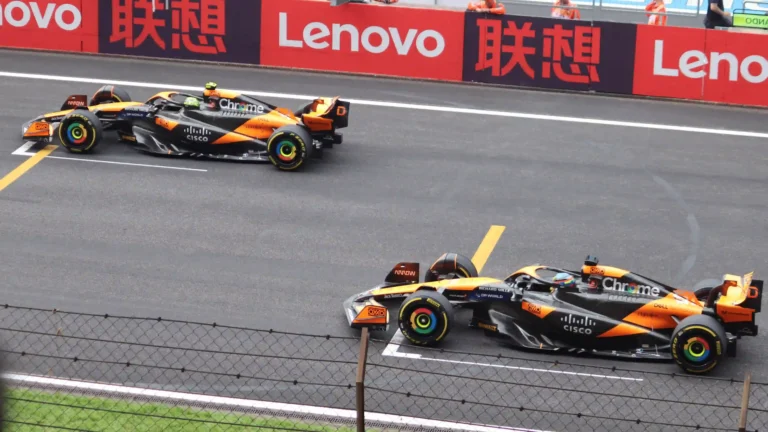
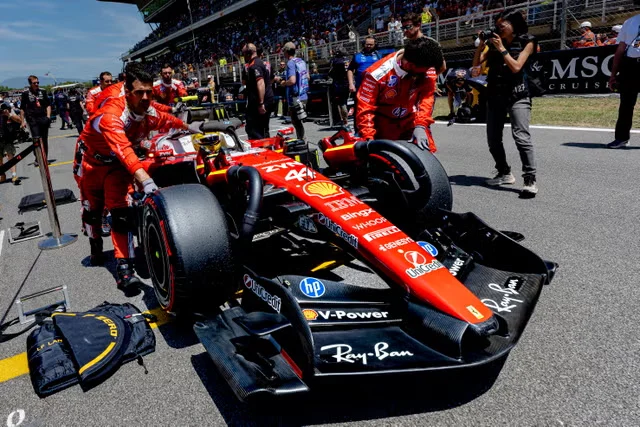
In F1, teams like Ferrari, Mercedes, Red Bull and McLaren design and build their own chassis from a blank sheet each season. The regulations govern what they can and cannot do, but within those guardrails there is enormous engineering freedom — a freedom that teams with the biggest budgets exploit most aggressively. Oracle Red Bull Racing spent years refining details in their diffuser geometry that the midfield couldn’t match. That’s the game in F1: out-engineer your rivals before the season starts, then out-drive them on Sundays.
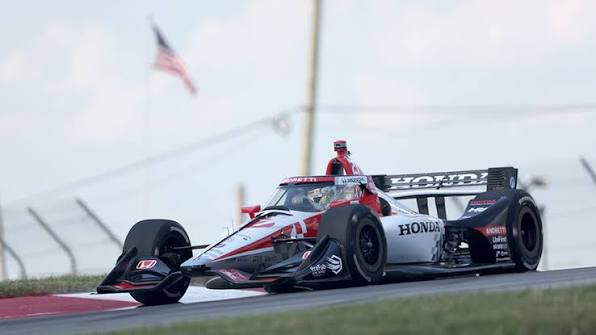
IndyCar runs on a universal Dallara DW12 (IR-18) chassis supplied to every team on the grid. Honda and Chevrolet provide the two available engine specifications, and within those packages, the performance window between a factory-backed operation and a small privateer team is narrow enough that a well-prepared two-car outfit can genuinely threaten for race wins. Meyer Shank Racing’s 2026 Indy 500 win proves the point exactly — a relatively small team beating Penske and Ganassi through racecraft and strategy, not chequebook size.
- Bespoke chassis — each team builds their own
- 1.6L V6 turbo-hybrid power unit (~1,000 hp)
- Road courses & street circuits globally
- 24-race international calendar
- Top team budgets: $300M+/season
- No power steering limit on regulations
- Halo cockpit protection (titanium)
- Pirelli control tyre — three compounds
- Universal Dallara IR-18 chassis for all teams
- Twin-turbo V6 — Honda or Chevrolet (~750 hp)
- Road courses, street circuits and oval tracks
- 17-race primarily North American calendar
- Top team budgets: $15–25M/entry/season
- No power steering — physical upper body demand
- Aeroscreen (halo + ballistic windscreen)
- Firestone control tyre — two compounds
The calendar tells the same story. Formula 1 in 2026 races across 24 rounds spanning Europe, Asia, the Americas, the Middle East and Oceania. IndyCar runs 17 rounds, almost all of them in North America. One series is designed for global brand exposure; the other is rooted in a distinctly American racing tradition that stretches back more than a century.
IndyCar vs F1 Speed: Who Is Actually Faster?
This question trips people up because it has two correct answers depending on context. Put both cars on a superspeedway oval and an IndyCar will hit higher top speeds. Put them both on a technical road course and an F1 car will lap the equivalent IndyCar by a distance that looks embarrassing on a timing sheet.
At the Circuit of the Americas in Austin — one of the few venues where both series have competed — the fastest F1 qualifying laps run approximately 14 seconds per lap quicker than IndyCar’s best times on the same layout. That’s not a margin; it’s a different sport. The explanation is downforce. An F1 car generates roughly three to four times the aerodynamic grip of an IndyCar in road-course configuration. When you can carry that much more speed through corners, lap time evaporates.
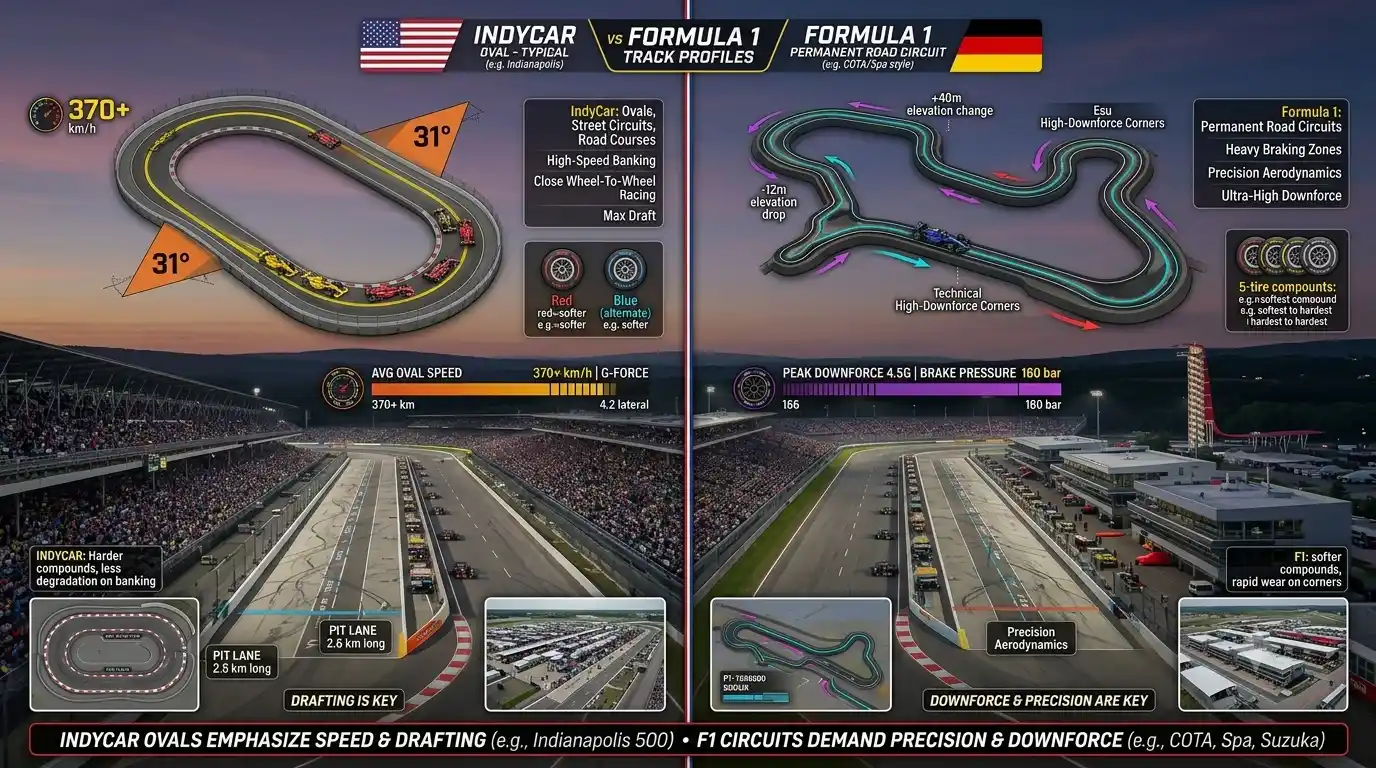
Flip to the oval. On the 2.5-mile Indianapolis Motor Speedway in qualifying trim, IndyCars routinely exceed 240 mph — Álex Palou’s 2026 Indy 500 pole run averaged 232.248 mph over four laps. An F1 car’s top speed in race trim sits around 230 mph on the longest straights; on an oval it would likely go faster still in theory, but the cornering forces and sustained flat-out nature of a banked superspeedway would present severe tyre and chassis challenges the current F1 package isn’t designed to manage. F1 simply does not race on ovals — by design and by choice.
| Metric | Formula 1 | IndyCar | Advantage |
|---|---|---|---|
| Top Speed (Road Course) | ~230 mph | ~195 mph | F1 ✓ |
| Top Speed (Oval) | N/A | 240+ mph | IndyCar ✓ |
| Cornering Speed | Extreme (5G+) | High (3–4G) | F1 ✓ |
| 0–60 mph | ~2.6 seconds | ~3.0 seconds | F1 ✓ |
| Horsepower | ~1,000 hp (hybrid) | ~750 hp (turbo) | F1 ✓ |
| COTA Lap Time Gap | Faster | –14 seconds | F1 ✓ |
The honest summary: F1 is faster everywhere it actually races. IndyCar goes faster in straight lines on ovals. Those two facts aren’t in conflict — they describe two machines optimised for fundamentally different environments.
F1 teams invest hundreds of millions of hours in wind tunnel time and computational fluid dynamics to develop intricate floor sections, front wing endplates, and rear diffuser geometries that generate enormous downforce without equivalent drag. The 2026 regulations introduced new aerodynamic philosophies around ground effect, but the fundamental advantage over a spec IndyCar package remains enormous. IndyCar’s standardised aero kit is deliberately simplified to prevent arms-race spending — it produces good racing, not peak downforce.
F1 vs IndyCar Technology: Engines, Aero & Driver Aids
The power unit is where the philosophical gap becomes starkest. Formula 1’s 2026 regulations require a 1.6-litre V6 turbocharged internal combustion engine combined with an electrified hybrid system. From 2026, that split is roughly 50/50 between combustion and electrical output — the ERS (Energy Recovery System) now delivers around 500 bhp on its own, making the F1 power unit an extraordinary piece of electrical engineering as much as a conventional engine. The combined output sits around 1,000 horsepower, and the whole package runs on 100% sustainable fuel.
IndyCar’s twin-turbocharged V6 — supplied as either a Honda or Chevrolet unit — produces around 550–600 hp in normal race trim, rising to approximately 750 hp when a driver deploys the Push-to-Pass system: a temporary boost button that adds around 60 additional horsepower for defined windows during a race. There is no hybrid recovery system. The engine is deliberately simpler to keep costs down and reliability high across a calendar that includes gruelling full-throttle oval races.
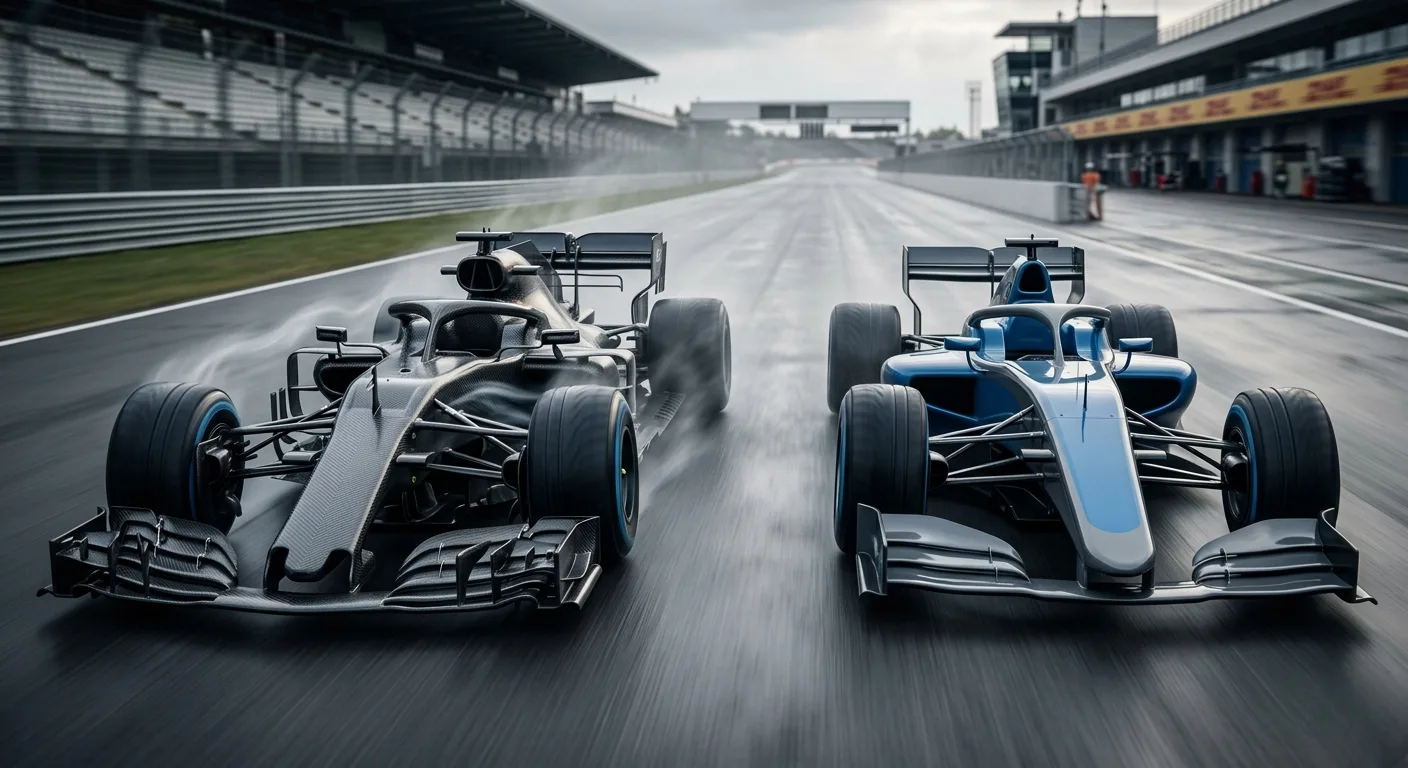
Aerodynamics: The Biggest Gap on Track
In Formula 1, teams have substantial freedom to develop their own aerodynamic surfaces within a framework of regulated dimensions. Every winglet, every bargeplate, every millimetre of floor geometry is scrutinised, optimised, and continuously revised. The rear diffuser alone on a competitive F1 car represents months of engineering work by departments that don’t exist at an IndyCar operation.
IndyCar runs one of two standardised bodywork kits: a high-downforce package for road and street circuits, and a low-drag, low-downforce oval configuration for superspeedways. Teams can make limited adjustments within these kits — wing angles, ride heights — but there is no fundamental aero development programme the way there is in F1. The result is closer racing on comparable tracks, because the aerodynamic differences between cars are small.
This is one of the most physically demanding distinctions in motorsport. IndyCar regulations prohibit power steering assistance entirely, meaning drivers must physically wrestle an 800 kg racing car through corners that generate 3G of lateral force using only upper body strength. Over a 500-mile race at Indianapolis that’s a sustained physical demand unlike anything in modern F1. Drivers like Scott Dixon and Josef Newgarden maintain specific gym programmes focused on neck, shoulder and forearm conditioning that F1 drivers, who have power steering assistance, do not require at the same intensity.
Steering Wheel Complexity
A Formula 1 steering wheel is a mobile command centre: dozens of rotary dials, toggle switches, a bright LCD display showing live tyre temperatures, fuel loads, ERS deployment levels, differential settings and competitor lap times. Drivers make real-time adjustments to suspension modes, brake balance and engine maps on the fly through high-speed corners. The cognitive and coordination demands are extreme.
An IndyCar steering wheel handles the essentials: radio communications, pit lane speed limiter, fuel mixture adjustment, push-to-pass activation, and rear weight jacker settings for ovals. The information hierarchy is simpler — not because IndyCar drivers are less skilled, but because the regulated systems don’t require the same depth of in-lap management that an F1 hybrid power unit demands.
F1 drivers manage a supercomputer strapped to the steering column. IndyCar drivers wrestle a machine that wants to fight them every lap. Neither is easy; they’re just hard in different ways.
Tracks, Race Formats and Championship Structure
The tracks each series uses reveal their sporting priorities more directly than any regulation document. Formula 1 goes to Monaco — a city street circuit with barriers inches from the car, where qualifying position is almost everything and overtaking is nearly impossible — because Monaco is a prestige event that sells the F1 brand globally. IndyCar goes to Indianapolis — 2.5 miles of banked oval where 33 cars run inches apart at 220 mph in pack traffic — because Indianapolis is the soul of American motorsport and has been since 1911.
These aren’t just different tracks. They demand completely different skill sets from a driver and a completely different engineering approach from a team. At Monaco, absolute pace in qualifying matters more than race strategy. At Indianapolis, pit stop timing, fuel conservation, drafting skill and pack-racing bravery matter more than single-lap speed.
Approximate 2026 calendar distribution by circuit type
Qualifying Formats
Formula 1 uses a three-segment knockout session — Q1, Q2, Q3 — where the slowest cars are eliminated in each segment until the top ten fight for pole in a 12-minute shootout. The format rewards pure pace and clean laps under pressure. Certain weekends include a Sprint race on Saturday, offering additional points and a chance for grid positions to change before the main event. For a detailed breakdown of how that works, see our F1 qualifying explainer.
IndyCar qualifying on road and street circuits uses a group-based system that culminates in a Fast Six shootout between the six quickest cars — a format that generates more viewer drama at the top of the grid. On ovals, each car makes a solo four-lap average run, with the field sorted entirely by that timed attempt. The Indianapolis 500 qualifying weekend is a multi-day event with Bump Day, where the last few positions on the 33-car grid are genuinely contested right to the final hour.
Points and Championship Scoring
F1 awards points to the top ten finishers: 25-18-15-12-10-8-6-4-2-1, plus a bonus point for the fastest lap if set by a top-ten finisher. IndyCar scores every driver on the starting grid, with bonus points available for leading the most laps, leading at least one lap, and pole position. Double points at Indianapolis mean a single race can reshape the entire title fight — a dramatic structural feature F1 has never adopted for its regular season. For a full breakdown of how racing championships are scored, see our explainer.
Drivers, Salaries, Budgets and Crossover Paths
The financial gap between F1 and IndyCar is enormous — and it shapes everything from driver salaries to tyre strategies to the size of the engineering department that works on each car overnight.
A top-tier Formula 1 driver earns between $40M and $60M annually in total compensation once endorsements and performance bonuses are included. Even midfield F1 drivers typically earn $5–10M per season. IndyCar’s leading earners — Josef Newgarden, Scott Dixon, Álex Palou — command salaries in the $2–5M range. That’s genuinely good money, but it reflects the scale of the commercial machine behind each series. F1’s global broadcast deals, race hosting fees and sponsorship structures generate revenue that dwarfs IndyCar’s North American footprint.
| Category | Formula 1 | IndyCar |
|---|---|---|
| Top Team Season Budget | $300M+ (before cost cap) | $15–25M per entry |
| Cost Cap (2026) | ~$135M (operational) | No formal cap |
| Top Driver Salary | $40–60M+ (total comp) | $2–5M |
| Chassis Cost | Bespoke — hundreds of millions | ~$600K (Dallara IR-18) |
| Engine Supply Model | Works / customer supply | Honda or Chevrolet — equal spec |
| Paddock Access | Restricted / premium ticketed | Fan-friendly / open access |
Can an IndyCar Driver Move to F1?
The FIA Super Licence point system governs eligibility for F1. An IndyCar champion earns 40 Super Licence points — the exact threshold required to hold an F1 race seat. That means a series winner can transition directly; but a driver finishing third, fifth, or seventh in IndyCar earns fewer points and may not clear the bar without supplementary results from other categories.
The crossover has produced some notable careers. Mario Andretti won the 1978 World Championship after years of oval racing. More recently, drivers like Juan Pablo Montoya moved from IndyCar to F1 and back again successfully. The physical and technical adjustment is real — an F1 car’s power steering and the cognitive demands of hybrid deployment require relearning habits that oval racers have deeply embedded — but elite-level racing talent transfers. Read our Mario Andretti profile to understand the kind of driver who makes that bridge work.
Both series prioritise cockpit protection above all else. Formula 1 uses the titanium Halo device, which deflects debris and protects the driver’s head in the event of an inverted slide or rollover. IndyCar uses the Aeroscreen — a hybrid solution combining a halo hoop with a polycarbonate ballistic screen that also shields drivers from the flying debris that small oval accidents generate at 220 mph. Both systems have demonstrably saved lives. The Aeroscreen’s additional screen element reflects the unique risk profile of oval racing; tyre fragments and debris at oval speeds travel at energies that a halo alone might not fully deflect.
Which Is Harder to Drive — IndyCar or F1?
This is the question that generates the most heat in paddock conversations, and the answer refuses to sit still. Formula 1 is cognitively harder in terms of in-car management — the hybrid deployment decisions, the tyre temperature windows, the real-time aerodynamic adjustments and the sheer processing demand of carrying 5G through a fast corner on a temporary street circuit while managing DRS zones and competitor gaps. The car does much of the physical work via power steering; the brain never stops.
IndyCar without power steering is physically harder on the body in a blunt, unambiguous way. Driving a 720 kg machine without steering assistance at 220 mph for 500 miles — as drivers do at Indianapolis — places muscular demands on the upper body that simply don’t exist in F1. The oval-specific skill set is also genuinely different: pack racing at close quarters requires spatial awareness, trust in adjacent drivers, and willingness to hold a racing line at full throttle when a car two feet away could spin and take you with it. It’s a different kind of bravery than braking 10 metres later than seems possible into a chicane.
Most drivers who’ve competed in both series describe the transition as significant in both directions. The consensus tends to be: F1 is harder to go fast in, because the performance ceiling is so much higher that the margins between “good” and “great” are measured in thousandths of a second. IndyCar is harder to survive in, because the consequences of mistakes at oval speeds are immediate and severe.

Global Reach and Fanbase: F1 vs IndyCar in 2026
Formula 1’s global audience exploded in the early 2020s. The Netflix Drive to Survive documentary series cracked open the sport for audiences who’d never watched a race, turning it into a cultural conversation piece across North America, Latin America and South Asia. The 2026 season features 24 rounds across five continents, generating live broadcast audiences that regularly exceed 100 million viewers for marquee events.
IndyCar’s fanbase is smaller but deeply loyal and geographically concentrated. The series commands strong attendance figures at traditional venues — Portland, Road America, Iowa Speedway — and the Indianapolis 500 remains one of the largest single-day sporting events on earth by attendance. The series offers something F1 genuinely cannot match: paddock access. For the price of a standard race ticket at most IndyCar events, fans can walk into the pit lane and stand next to a Penske mechanic changing tyres. That kind of proximity to the sport is permanently priced out of the F1 model.
F1’s audience in the United States grew by over 50% between 2018 and 2023, largely attributable to the Netflix documentary series and the addition of three US race venues to the calendar — Miami, Las Vegas and Austin. This created a demographic of younger, international fans who engaged with F1 primarily through digital content before they ever watched a full race. IndyCar has benefited indirectly from this motorsport boom, but the scale of F1’s media machine and global distribution contracts is in a different category entirely.
IndyCar vs F1: Which Series Should You Watch?
After covering every technical and sporting angle, the question still comes down to what kind of racing you want to watch. And here the two series genuinely serve different appetites.
Watch Formula 1 if you want to see the absolute outer edge of automotive technology competing at the highest performance level in motorsport. If you find it fascinating that Ferrari and Mercedes can spend hundreds of millions developing aerodynamic solutions that differ by millimetres — and that those millimetres produce championship outcomes — then F1 delivers something no other racing series can match. The global calendar, the grid of 20 drivers from across the world, and the political and technical soap opera that runs alongside the sport give it depth beyond pure racing entertainment.
Watch IndyCar if you want close racing, genuine unpredictability, and a series where a driver with a good car can beat a driver with the biggest budget on any given weekend. The oval events — particularly Indianapolis — offer a specific brand of motorsport spectacle that road-course racing simply cannot replicate: 33 cars at 220 mph in pack formation, running three and four wide through banked corners, separated by inches. That combination of speed, proximity and physical exposure does not exist anywhere else in motorsport. The Indianapolis 500’s history alone is worth your time.
- Absolute peak car performance
- Global circuits from Monaco to Singapore
- Deep technical narratives and team politics
- The world’s most-watched motorsport series
- Complex strategy involving hybrid deployment
- Genuinely unpredictable race outcomes
- Oval racing you won’t find anywhere else
- Fan paddock access and atmosphere
- The Indianapolis 500 — 110 years of history
- Racing decided by driver skill more than budget
The best answer, frankly, is to watch both. The IndyCar season peaks in May with Indianapolis, while F1 fills the calendar from March to December. There are weekends in summer when you can watch an IndyCar race on Saturday and an F1 qualifying session on Sunday. The comparison debate gets far more interesting when you’ve experienced both from inside the race rather than from a specification sheet.
Frequently Asked Questions — IndyCar vs Formula 1
The comparison that never really ends
IndyCar and Formula 1 will be compared as long as both series exist — and that’s a good thing, because the comparison forces you to think clearly about what you actually value in motorsport. Speed? F1 wins on any road course. Accessibility? IndyCar wins every time. Pure racing unpredictability? IndyCar’s spec format produces closer racing more consistently. Engineering spectacle? Nothing in global motorsport matches F1’s development war.
What the debate misses is that both series are asking fundamentally different questions. F1 asks: who built the best car and best team this year? IndyCar asks: who is the best racing driver right now? Both are valid questions. Both produce compelling, demanding, elite-level motorsport. The answer to “which is better” is entirely personal — and the best way to form an opinion is to watch both.
Follow the full IndyCar season and the F1 championship standings at World of Speed throughout 2026.