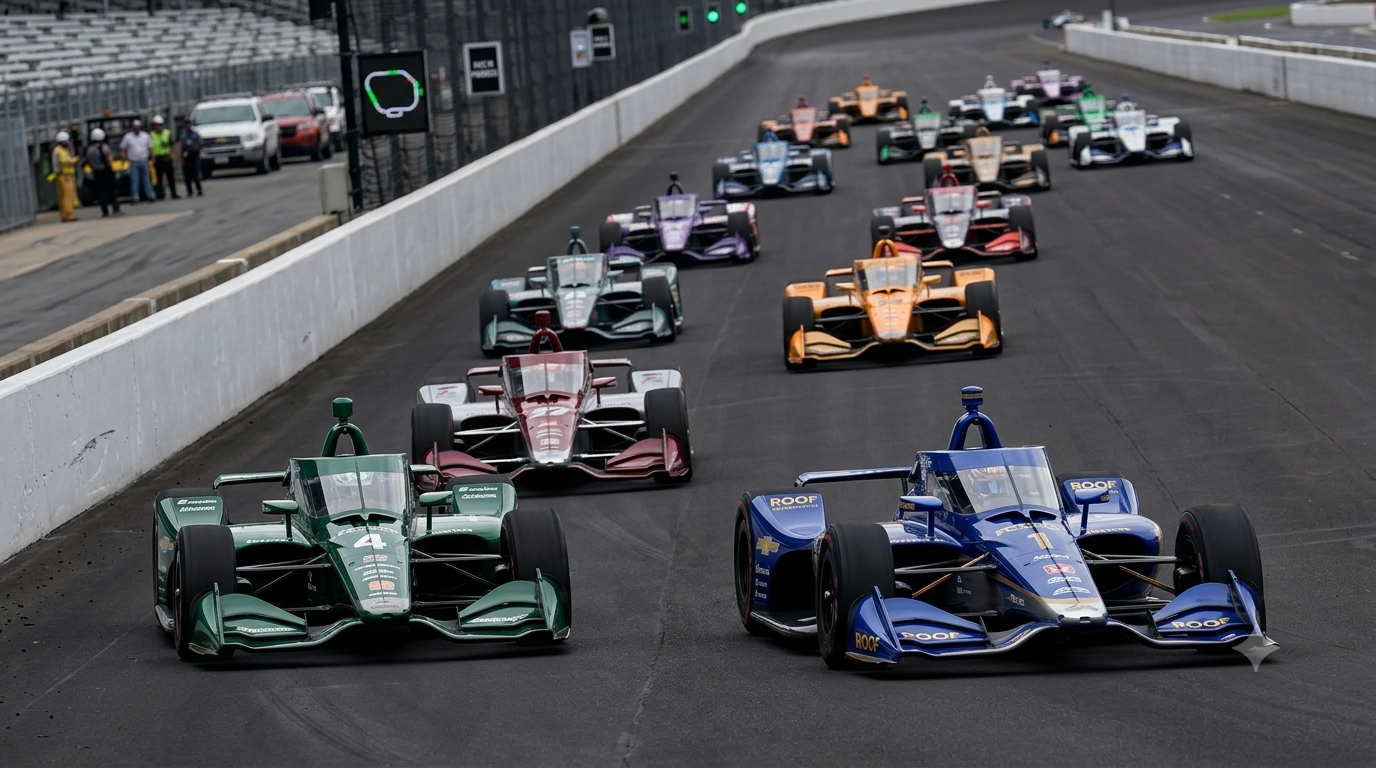
IndyCar Next Round Preview:
Form Guide, Track Analysis & Race Predictions
The championship is tightening. Post-Indy 500, the NTT IndyCar Series returns to road course action — and the title picture looks very different than it did in May. Here’s everything you need before the next round.
IndyCar Next Round:
Form Guide & Predictions
Championship standings, driver form and race strategy — everything before the next round.
The Indianapolis 500 was supposed to settle things. Felix Rosenqvist’s win for Meyer Shank Racing, a photo-finish that separated him from David Malukas by 0.0571 seconds, and a double-points haul that reshuffled the championship order in a single afternoon — the kind of result that resets conversations. But IndyCar doesn’t let anyone breathe for long. The series shifts to WeatherTech Raceway Laguna Seca, one of the most technically demanding road courses on the calendar, and the title fight resumes with a very different shape than it had going into May.
Álex Palou leads the standings but his advantage is narrower than his pre-Indianapolis form suggested it should be. Rosenqvist is now a genuine title threat, not just a race winner. Pato O’Ward needs a result, and Josef Newgarden — twice a champion, twice an Indy 500 winner — is approaching the kind of pressure point where great drivers either reassert themselves or fall away. Below: the complete preview, form guide, track breakdown, strategy outlook, and race prediction for the next round of the 2026 NTT IndyCar Series.
Race Weekend Schedule — WeatherTech Raceway Laguna Seca
AM
AM
PM
PM
Noon
Laguna Seca runs on a Saturday–Sunday format with practice sessions on Friday and Saturday morning before the afternoon qualifying shootout. The race runs Sunday at noon Pacific Time — 15:00 ET, 20:00 BST for UK viewers. The Fast Six qualifying format gives the championship contenders one of the most compelling single-lap sessions of the season. At a circuit where pole position carries significant weight given the limited overtaking opportunities, what happens in that Saturday afternoon shootout will shape the race entirely.
IndyCar Championship Standings — Post Indy 500
The Indianapolis 500 double-points event has done what it always does: completely reconfigured the mathematics of the championship fight. Palou’s third place at Indy, while good for points, wasn’t the dominant performance the pole-sitter might have hoped for. Rosenqvist’s win was the story, and it’s pushed him from a realistic contender into genuine title territory. The next six rounds — all road and street circuits — favour Honda-powered cars, and that fact isn’t lost on anyone in the Ganassi or Meyer Shank garages.
| Pos | Driver | Team | Engine | Pts | Gap | Trend |
|---|---|---|---|---|---|---|
| 1 | Álex Palou | Chip Ganassi Racing | Honda | 312 | Leader | Steady |
| 2 | Felix Rosenqvist | Meyer Shank Racing | Honda | 290 | –22 | ↑ Rising |
| 3 | Pato O’Ward | Arrow McLaren | Chevrolet | 265 | –47 | Steady |
| 4 | Scott McLaughlin | Team Penske | Chevrolet | 248 | –64 | Steady |
| 5 | Josef Newgarden | Team Penske | Chevrolet | 241 | –71 | ↓ Slipped |
| 6 | Scott Dixon | Chip Ganassi Racing | Honda | 228 | –84 | Steady |
| 7 | Kyle Kirkwood | Andretti Global | Honda | 214 | –98 | ↑ Rising |
| 8 | Will Power | Team Penske | Chevrolet | 198 | –114 | ↓ Slipped |
| 9 | Colton Herta | Andretti Global | Honda | 187 | –125 | Steady |
| 10 | Marcus Ericsson | Andretti Global | Honda | 176 | –136 | ↑ Rising |
With 550 championship points still available across the remaining 11 rounds, nobody is out of title contention through P8. A win at Laguna Seca is worth 50 points. A single race can reduce Palou’s lead to single figures if he finishes outside the top five while a rival wins. For how championship scoring works across the full season, see our IndyCar championship scoring guide.
WeatherTech Raceway Laguna Seca — Circuit Guide
There are road courses where strategy wins races. There are circuits where qualifying position is everything. Laguna Seca is both, wrapped around a hillside in Monterey County with a layout that has been producing dramatic racing since 1957. The circuit climbs and drops 180 feet in elevation across 2.238 miles, and every inch of it demands something different from a race car than a flat, smooth purpose-built facility does.
The defining feature is the Corkscrew — the blind left-right chicane at the top of the circuit’s highest point, Turn 8 and Turn 8A. You arrive over a crest, commit to a left turn before you can see the corner exit, then immediately pivot right and fall 59 feet in elevation in approximately three seconds. It is one of the most challenging corners in North American racing, and arguably the single corner that most completely separates IndyCar drivers by their willingness to commit under blind conditions at 170 mph. It rewards bravery married to mechanical sympathy — carrying maximum speed through the Corkscrew while keeping the car stable enough to hit the kerb on exit is a skill that only a handful of the current grid truly master consistently.
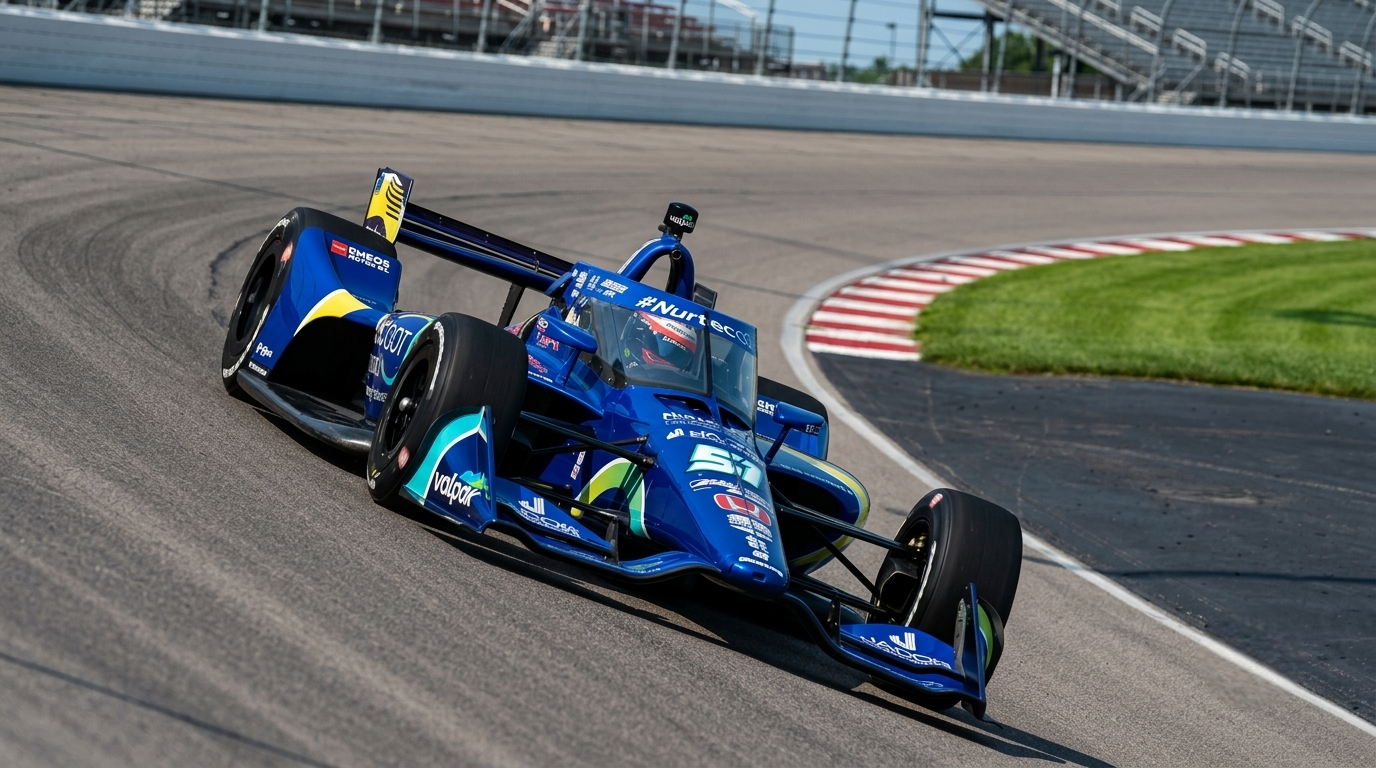
Circuit Fact File
| Stat | Figure | Context |
|---|---|---|
| Circuit length | 2.238 miles | One of the shorter road courses on the IndyCar calendar |
| Race distance | 95 laps | Acura Grand Prix of Monterey — standard event distance |
| Corners | 11 | Including the infamous Corkscrew at Turns 8/8A |
| Elevation change | 180 ft | More than any other IndyCar road course venue |
| Main overtaking zone | Turn 2 / Turn 11 | Hard braking zones — Turn 11 produces the most position changes |
| Circuit opened | 1957 | One of the oldest permanent road courses in North America |
| Firestone compounds | Alternate & Primary | Alternate (Red) wears fast on the left-front at Laguna |
The Sectors That Define the Lap
The opening sequence — the long sweep from the start-finish line through Turn 1 and into Turn 2’s heavy braking zone — is where the race is won and lost on lap one of every event. Turn 2 is late apex, blind over the entry crest, and the traction zone exiting onto the back section is where tyre degradation begins to accumulate. A car that locks a tyre here on lap one will be managing the consequences for the next 20 laps.
The Corkscrew sequence is the defining lap-time differentiator, but the sector that produces the most strategic interest is the final complex — Turns 9, 10 and the hairpin at Turn 11. Turn 11 is the last overtaking opportunity before the main straight and the lap time at this corner correlates more strongly with race pace across a full stint than anywhere else on the circuit. Teams that analyse long-run data from Saturday practice almost exclusively focus on the Turn 11 exit speed degradation curve — it tells them everything they need to know about their fuel load and tyre window calculations for Sunday’s strategy.
At Laguna Seca, the Corkscrew gets the headlines. The hairpin at Turn 11 wins championships. Get the exit wrong three laps in a row and your tyre window closes faster than your pit wall is prepared for.
Driver Form Guide — Who’s Hot, Who’s Struggling
Form at Laguna Seca doesn’t always follow the championship order. The circuit rewards drivers with strong mechanical sympathy, late-apex precision and the specific courage the Corkscrew demands. Some of IndyCar’s fastest oval racers find the elevation and blind corners here genuinely difficult. Below is an honest driver-by-driver assessment heading into the round.
The defending IndyCar champion sits 22 points clear and has been the most consistently fast driver across all circuit types in 2026. Palou’s Ganassi Honda is particularly well-sorted on road courses — his sector times through technical complexes have been measurably cleaner than any rival’s this season. At Laguna Seca, where his mechanical sensitivity through elevation changes is a specific advantage, he has to be considered the pre-event favourite. The only question is whether Meyer Shank can bring the same pace they found at Indianapolis to a circuit that rewards a different technical baseline.
Indianapolis 500 winner. That sentence alone changes everything about how Rosenqvist approaches this round. The Swedish driver has always been highly capable on road courses — his lap-to-lap racecraft and tyre management on smooth circuits have consistently produced stronger race results than his qualifying positions suggested. The question now is whether his engineer team at Meyer Shank can translate their Indianapolis fuel strategy expertise into a road-course setup that challenges Palou directly rather than just running close. The psychological confidence from winning the 500 is not a small thing, and Rosenqvist has historically responded well to pressure moments.
O’Ward is the most combustible talent in the 2026 field — capable of a dominant weekend or a frustrating retirement depending entirely on circumstances that often feel beyond his control. At Laguna Seca, he has genuine circuit knowledge and road-course pace that puts him in the Fast Six on merit. The issue is tyre management in the back half of stints: O’Ward has a tendency to push early when he has grip advantage, which creates a degradation cliff in the final 15 laps. If Arrow McLaren can convince him to manage Turn 11 exit speed more conservatively in the opening stint, his race pace in the final third is arguably the fastest on the grid.
Seventh at Indianapolis — a recovery drive from a difficult qualifying slot, yes, but still not the podium that Newgarden needed. His 2026 season has been characterised by Penske’s Chevrolet being marginally off the leading Honda-powered cars on road courses while being strong enough on ovals. Laguna Seca exposes that gap most directly. Newgarden is a two-time IndyCar champion and he knows how to win at this circuit — but he needs his team to find something in the data from Practice 1 that changes the car’s character through the Corkscrew, where his sector time has been consistently 0.08–0.12 seconds behind Palou and O’Ward all season.
Laguna Seca is effectively Herta’s home circuit — he grew up 90 minutes from the track and his first professional racing miles were set on that asphalt. His knowledge of the circuit’s grip evolution across a weekend, the exact lines through Turn 5 and Turn 8A, and the tyre load patterns that build through the back sector give him an edge that no amount of simulator preparation can fully replicate for rival engineers. Herta’s 2026 season has been inconsistent in results but his raw pace in qualifying has been among the three fastest on multiple occasions. A clean race weekend at Laguna Seca could put him squarely back into the championship conversation.
Dixon doesn’t set the fastest qualifying laps or produce the most spectacular overtakes. What he does, reliably, is score more points than any rival across a full season by finishing inside the top eight at circuits where others drop out, crash or misjudge strategy. At Laguna Seca — a circuit where he has five previous wins in IndyCar competition — Dixon’s experience with the circuit’s evolving rubber conditions over a race weekend is unmatched by anyone currently active in the series. His championship position is seventh and mathematically he needs wins, not podiums, to get back into genuine contention. But Dixon in a Ganassi Honda at Laguna Seca is never something to dismiss.
Team Performance Rankings — Road Course Pace
Road courses in 2026 have produced a clear hierarchy between the Honda and Chevrolet camps. The Honda package — shared between Ganassi, Meyer Shank, Andretti and Rahal Letterman Lanigan — has been measurably stronger through medium-speed and technical corners on smooth asphalt. Chevrolet’s advantage tends to appear in straight-line speed and through higher-speed flowing corners, which is why Penske’s cars are more competitive on oval tracks and less dominant on the technical twists of Laguna Seca.
Road course performance ratings based on 2026 qualifying delta and long-run race pace — analyst assessment
The Honda-Chevrolet performance split in 2026 is more pronounced on road courses than any recent season. Honda’s power delivery through mid-corner — the torque curve that loads the rear tyres progressively rather than sharply — translates into better rotation through technical sections. At Laguna Seca, where five of the 11 corners demand progressive throttle application from the apex rather than full-throttle commitment, that characteristic matters throughout every lap for 95 laps. Penske teams know this and will likely run a softer front suspension setup than Honda runners to compensate — it helps rotation but increases front tyre wear, adding complexity to their strategy window. For more on how IndyCar team setups work, see our series guide.
Tyre Strategy Outlook at Laguna Seca
Laguna Seca’s tyre strategy is more complex than it first appears. The Alternate (Red) compound — the softer of Firestone’s two options — generates strong lap times for approximately 20–24 laps before the degradation curve becomes steep, particularly on the left-front. The circuit’s extended left-hand corners through the back section load that corner unusually hard, and teams that push the Alternate past its window often find themselves managing vibration through the final five laps of a stint in a way that costs more time than an early pit stop would have.
The majority of teams will run two planned pit stops over 95 laps. The first stop typically falls between laps 28–35 depending on track position and caution timing. The second falls between laps 58–68. Teams with strong fuel efficiency — historically Ganassi has led this metric — can sometimes extend their window by two laps without meaningful pace loss, which creates the track position gap that makes the overcut viable in a caution-free race.
Strategy probability breakdown
Based on historical Laguna Seca IndyCar strategy patterns
Push-to-Pass at Laguna Seca
IndyCar’s Push-to-Pass system — which delivers around 60 additional horsepower for short deployment windows — is most valuable here in two specific situations: the Turn 2 braking zone when making or defending an overtake, and the exit of Turn 11 onto the main straight where an extra 60 hp in the first 200 metres of the straight can open or close a gap decisively. Teams typically allocate 20–25 activations for the race. The championship leaders tend to save their Push-to-Pass for the final 15 laps when track position becomes critical and natural tyre degradation has closed the pace gap between cars on different strategy windows. For a full breakdown of how IndyCar’s unique systems work, see our IndyCar vs F1 technical comparison.
Laguna Seca’s confined circuit layout and limited run-off areas mean caution periods — full-course yellows that close the pit window and bunch the field — arrive at a higher rate than at wide-open road courses. Historically, the Acura Grand Prix of Monterey averages 2.4 full-course yellows per event. A caution in the wrong place can wipe out a two-lap strategic advantage built over an entire stint, or conversely rescue a driver who was about to fall out of contention on fuel. The teams most likely to benefit from caution timing disruption are those who built their strategy around the second window — they can pit under yellow for near-free track position.
Race Prediction & Championship Implications
Before a wheel turns in practice, the most logical prediction based on the data points available is a Ganassi 1–2 with Palou first and Dixon second, with Rosenqvist and Herta in the mix for a podium position. But that’s the prediction a committee would write. Here’s the one that accounts for what actually makes Laguna Seca unpredictable:
Race winner: Álex Palou. The combination of Ganassi’s superior road-course setup, Palou’s clinical tyre management, and his clear edge through the technical mid-section of the circuit makes him the most likely winner. He has been the fastest car in the sector 2 complex at every road course in 2026 and there’s no reason to expect that changes at a circuit that rewards exactly those characteristics.
The threat: Colton Herta. Laguna Seca is his backyard and he has shown this season that his raw qualifying pace in the Fast Six is real. If he starts from the front row and manages his left-front tyre through the first stint more carefully than he sometimes does, he can produce a race pace that Palou will have to actively manage rather than simply extend. Herta winning at Laguna Seca is not a long shot — it’s arguably a probability once every three visits.
The championship implication: Rosenqvist needs a podium more than he needs a win. If he finishes third or second while Palou wins, the gap stays similar and the pressure remains on Palou to convert his car’s road-course advantage into results across the next phase of the calendar. If Rosenqvist wins and Palou finishes outside the top four — the scenario that would genuinely ignite this title fight — the mathematics become genuinely open heading into the second half of the season.
The championship is Palou’s to lose right now. That’s not a comfortable position. It comes with its own pressure, and pressure at Laguna Seca has a way of arriving through a kerbstone at Turn 8A you didn’t see clearly enough.
Dark Horse: Kyle Kirkwood
Kirkwood’s 2026 season has quietly been building toward something. His ninth-place finish at Indianapolis — working from mid-grid — showed a mature racecraft that wasn’t present in his rookie year. Andretti’s Honda package at Laguna Seca is strong, and Kirkwood’s qualifying pace on smooth, flowing circuits has been one of 2026’s understated stories. A top-five at Laguna Seca would push him back into a championship conversation that the double-Indy points briefly pushed him out of. He’s the driver the championship leaders are least worried about — which historically is exactly the wrong disposition to have toward an improving 24-year-old with nothing to lose.
Frequently Asked Questions — IndyCar Next Round
What this round means for the championship
Laguna Seca isn’t the decisive round of the 2026 IndyCar season. There are 10 races after this one. But it is the first genuine test of whether Rosenqvist’s Indianapolis 500 win represents a temporary surge in form or the beginning of something that can challenge Palou all the way to the final round. The circuit suits Honda-powered cars. The championship leader drives one. His most dangerous rival also drives one. What happens in the Fast Six shootout on Saturday afternoon — and in the first two laps through Turn 2 on Sunday — will tell us more about where this title is heading than any data we’ve seen all season.
Follow the full 2026 season with live results, standings and race previews at worldofspeed.org/indycar.