Rally Estonia 2026 Strategy Analysis: Road Order, Tyres & Stage Management
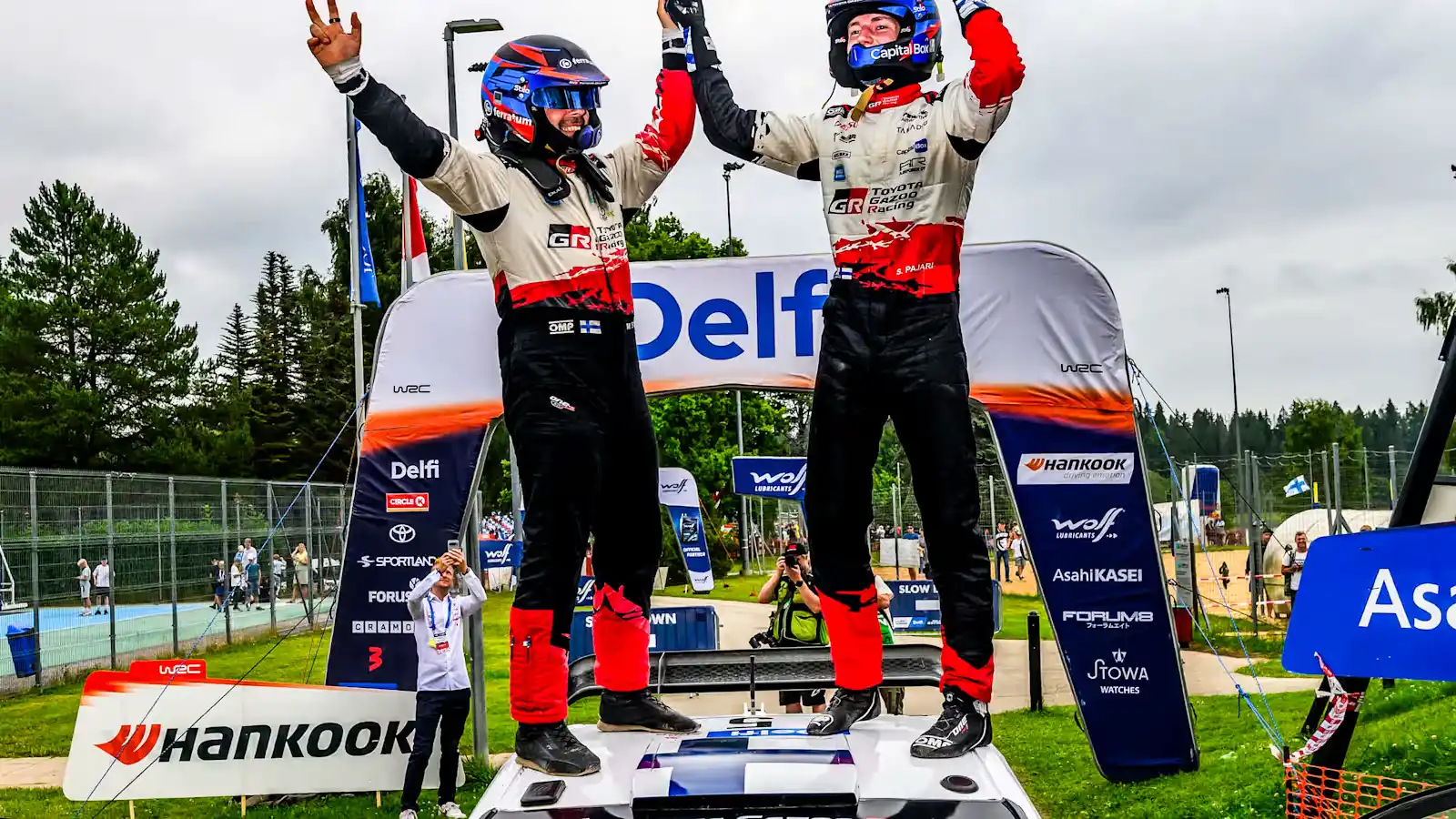
Sami Pajari’s first World Rally Championship victory was built before the final stopwatch. Road position, tyre discipline, repeated-stage learning and a measured Sunday converted raw speed into a 19.5-second win.
Rally Estonia 2026 strategy analysis begins with one important distinction: Sami Pajari did not win only because he was fast. He won because his speed arrived in the right places, under the right road conditions, with enough control to survive the moments that could have destroyed the rally.
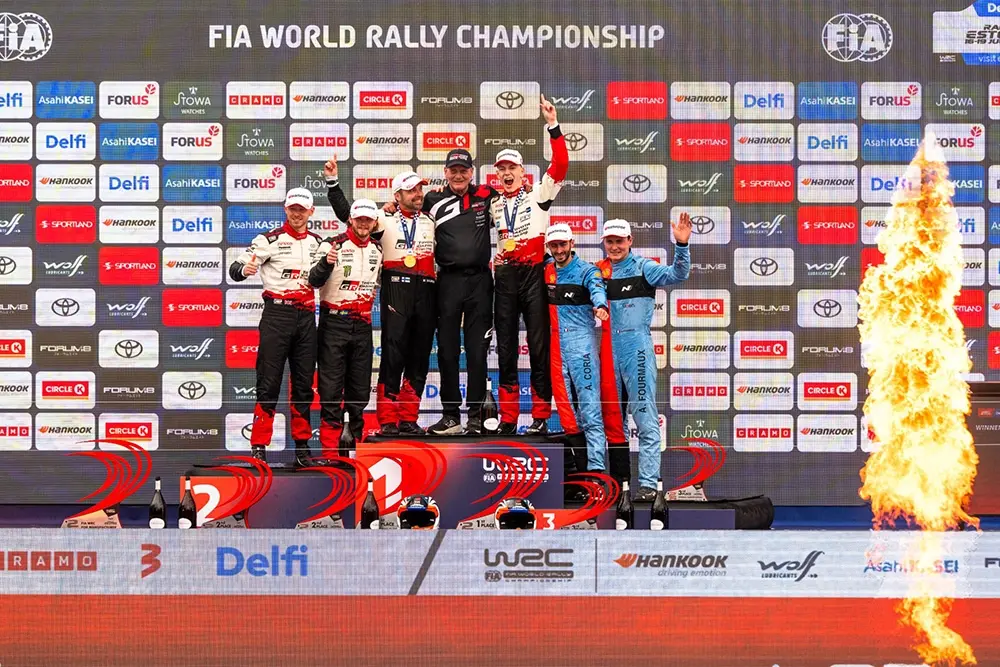
The Toyota driver led from the opening Raanitsa stage to the finish in Kääriku. He won 12 of the 18 competitive tests, including all seven Friday stages, and finished 19.5 seconds ahead of team-mate Oliver Solberg. Adrien Fourmaux secured third for Hyundai, 53.8 seconds behind the winner.
Those numbers tell the result. They do not fully explain it. Estonia’s loose first-pass gravel punished the opening cars. Its high-speed crests demanded exact pace notes. Its long Saturday rewarded tyre rotation and disciplined risk. Then Sunday’s points incentives encouraged Solberg to attack while Pajari protected the lead.
Pajari created the winning margin by maximizing a favorable Friday road position, winning every opening-leg stage, extending his lead during Saturday’s longest leg and avoiding a needless Sunday fight. Solberg’s late attack earned stage and bonus success, but Pajari’s earlier time bank gave him control of the final 48.78 kilometers.
Rally Estonia 2026 Result and Strategic Context
The outcome before the deeper explanationRally Estonia’s timed competition ran from Friday, July 17, through Sunday, July 19, after the ceremonial opening on Thursday. The route covered 301.8 competitive kilometers across 18 stages around Tartu and southern Estonia. Friday contained 103.42 kilometers, Saturday supplied the longest leg at 149.60 kilometers, and Sunday closed the rally with two runs through the 24.39-kilometer Kääriku test.
The event’s character was as important as its distance. Estonia combines wide, flowing forest roads with narrow technical sections, blind crests, compressions and large jumps. Average speeds can exceed 120 km/h. At those speeds, a small pace-note error is not a minor loss. It can change the car’s line several corners later or create tyre damage that affects an entire loop.
Pajari became the 83rd different winner in WRC history and delivered Finland’s 199th world rally victory. He also continued Estonia’s remarkable recent pattern: Kalle Rovanperä earned his maiden WRC victory there in 2021, Oliver Solberg did the same in 2025, and Pajari joined them in 2026.
The final margin can appear comfortable. However, it was not created by one dramatic gamble. Pajari accumulated it through repeated small gains, then defended it. Solberg was faster on both Sunday stages, including the Power Stage, yet he began the final day 25.0 seconds behind. The rally had already tilted toward Pajari before Sunday’s first split time.
| Pos. | Crew | Car | Total / Gap | Strategic note |
|---|---|---|---|---|
| 1 | Sami Pajari / Marko Salminen | Toyota GR Yaris Rally1 | 2:31:16.5 | Led from SS1; won 12 stages |
| 2 | Oliver Solberg / Elliott Edmondson | Toyota GR Yaris Rally1 | +19.5 | Won both Sunday stages and Power Stage |
| 3 | Adrien Fourmaux / Alexandre Coria | Hyundai i20 N Rally1 | +53.8 | Protected podium after Saturday incidents |
| 4 | Thierry Neuville / Martijn Wydaeghe | Hyundai i20 N Rally1 | +59.7 | Finished 5.9 seconds behind Fourmaux |
| 5 | Sébastien Ogier / Vincent Landais | Toyota GR Yaris Rally1 | +1:32.9 | Fourth on Power Stage |
| 6 | Elfyn Evans / Scott Martin | Toyota GR Yaris Rally1 | +2:01.0 | Recovered after sweeping loose gravel Friday |
| 7 | Mārtiņš Sesks / Renārs Francis | Ford Puma Rally1 | +2:35.3 | Included a 20-second penalty |
| 8 | Esapekka Lappi / Enni Mälkönen | Hyundai i20 N Rally1 | +3:02.3 | Steady points finish |
| 9 | Jon Armstrong / Shane Byrne | Ford Puma Rally1 | +3:28.0 | Managed early tyre damage |
| 10 | Robert Virves / Jakko Viilo | Škoda Fabia RS Rally2 | +8:33.1 | Home WRC2 victory by 7.6 seconds |
Pajari won the rally on Friday and Saturday, then made sure he did not lose it on Sunday.
How Road Order Shaped Rally Estonia 2026
Loose gravel, cleaner lines and changing opportunityThe first cars on Estonia’s dry gravel stages clear loose stones from the fastest line. That cleaning process reduces grip and increases wheelspin for the early runners, while later crews often find a firmer surface. The advantage can reverse when rain, dust, ruts or deep cuts begin to damage the road.
Road order is often described as if it were a simple advantage table. In reality, it is a moving calculation. The first driver may lose time by sweeping gravel, but later drivers can meet larger ruts, exposed rocks or hanging dust. Estonia’s speed magnifies every version of that problem because the driver must commit before seeing the complete corner.
Under the WRC start-order framework used for the event, priority crews ran according to championship order on the opening leg. Later legs used a reversed form of the provisional rally classification. Therefore, the championship leader carried an unavoidable Friday burden, while Saturday’s order rewarded and punished a different group.
Elfyn Evans supplied the clearest Friday example
Evans arrived as the championship leader and opened the road. He was already 10.0 seconds behind Pajari after the 21.45-kilometer first stage. By Friday evening, Evans was ninth overall and 49.8 seconds from the lead. That gap was not evidence of a driver suddenly forgetting how to attack fast gravel.
His Toyota had to cut through the loose upper layer and create part of the racing line for the cars behind. Wheelspin costs acceleration. A sliding front axle costs entry speed. More importantly, a driver who finds inconsistent grip cannot carry the same confidence over blind crests. A two-tenths hesitation at several high-speed entries quickly becomes a multi-second stage loss.
Evans eventually recovered to sixth and set the third-fastest Power Stage time. His Sunday pace showed that the underlying performance remained. The opening leg had simply placed him too far behind to fight Pajari without accepting excessive risk.
Pajari converted road position into a permanent advantage
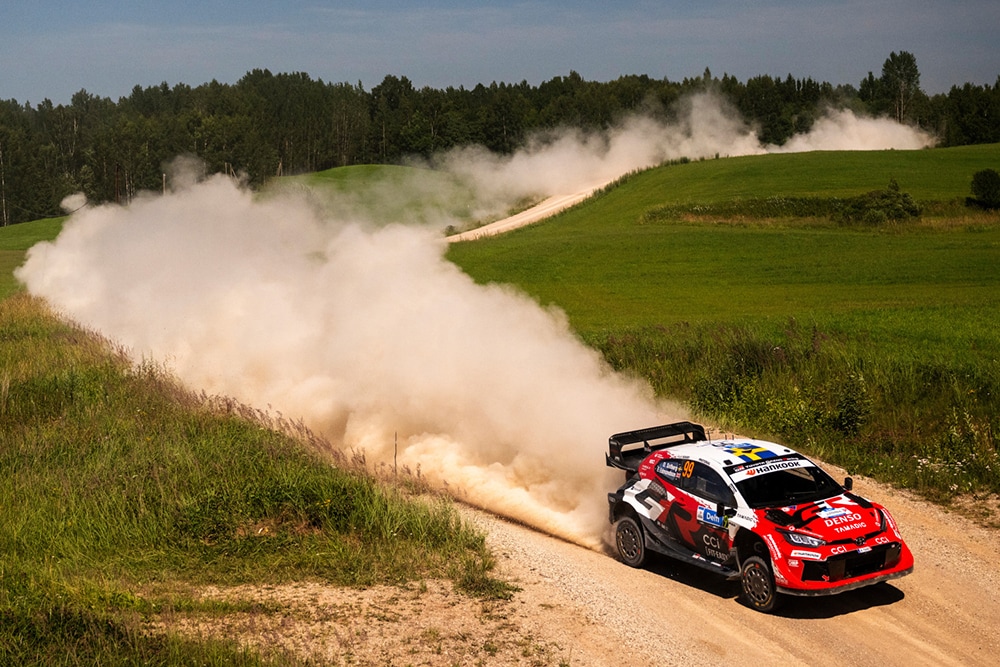
Pajari began behind the championship leaders and found a surface that had received more cleaning. However, calling his lead a road-order gift would misunderstand the performance. A better road is useful only when a crew has the notes, setup and confidence to use it. Pajari won all seven Friday stages. No rival with a comparable surface position matched that consistency.
He was 4.1 seconds ahead at the Tehvandi tyre-fitting zone, then expanded the advantage across the repeated afternoon stages. By the end of Friday, his margin over Solberg was 14.7 seconds. The repeated-stage gains mattered because crews had already seen the road once. Pajari did not merely benefit from conditions; he learned faster and executed the second pass better.
Saturday reversed the pressure
Road-order strategy changed after Friday. Takamoto Katsuta suffered tyre damage on Friday’s penultimate stage, dropped down the order and then faced the added cost of running first on Saturday. The sequence shows how one incident can create a second strategic penalty. The original tyre loss costs time, then the lower classification creates a worse starting position the next morning.
This compounding effect is central to stage-rally strategy. A crew does not manage only the current corner or stage. It manages tomorrow’s road position, available tyres, service workload and points opportunity. A late-Friday puncture can affect more than the stopwatch shown at that moment.
Clean the surface
More loose gravel, more wheelspin and less confidence on the first pass. The reward is usually a road with fewer ruts and less hanging dust.
Often the sweet spot
A cleaner line can deliver stronger braking and traction before the road becomes heavily cut or damaged by repeated cars.
Grip with new risks
The line may be polished, yet ruts, exposed rocks, dust and changing weather can remove the theoretical advantage.
Road order created the opportunity. Pajari’s seven Friday stage wins turned that opportunity into a lead nobody could erase.
Rally Estonia 2026 Tyre Strategy
Grip, durability, rotation and spare-wheel weightThe field used Hankook’s Dynapro R213 gravel tyre, offered in hard and soft specifications. The hard option favored durability and stability across long, fast loops. The soft option offered stronger initial grip in cooler or lower-grip conditions, but required closer attention to heat and wear.
Official event reporting confirmed the available hard and soft Dynapro R213 specifications. It did not publish a complete car-by-car tyre card for every stage. Therefore, responsible analysis should explain the strategic choices without inventing exact fitments for crews whose selections were not made public.
Estonia does not always produce the same severe abrasion as a rough, rocky rally. However, its speed creates a different tyre challenge. The carcass absorbs large compression loads. Landings transfer energy through the sidewall. A small cut can become critical before the stage ends because the car remains at high speed for long periods.
Hard versus soft was only the first decision
A hard tyre can provide greater consistency when the road is dry and the loop is long. Yet it may take longer to reach its strongest grip window. A soft tyre can help a driver attack immediately, especially on a cool first stage, but it may lose precision if temperature and wear rise across the loop.
Teams also had to decide how many spares to carry. One spare reduces mass and helps acceleration, braking and direction changes. Two spares give protection against multiple punctures and expand the option to rotate tyres between stages. The extra wheel, however, is dead weight every time the car climbs, accelerates or lands.
That weight tradeoff is easy to underestimate. Rally cars repeatedly accelerate from medium-speed corners rather than cruising at a fixed speed. An additional spare affects every launch. It can also alter the car’s balance because the wheel is mounted inside the car rather than at the center of gravity.
Consistency and protection
Useful when stages are dry, fast and long. The driver may accept less immediate bite in exchange for a stable tyre later in the loop.
Early grip and confidence
Attractive in cool or loose conditions. The crew must monitor heat, movement and wear as stage distance accumulates.
Lower mass, higher exposure
The car is lighter and more responsive, but a second tyre problem can end the competitive plan.
Insurance and rotation
More options between stages and better puncture protection, offset by a weight penalty throughout the loop.
Solberg’s Saturday afternoon showed the cost of a marginal call
Solberg cut Pajari’s advantage to 14.1 seconds before Saturday’s midday service. The contest looked open. During the afternoon, however, his tyre choice proved optimistic and tyre rotation became difficult. Pajari then set three consecutive fastest times and rebuilt the lead to 25.0 seconds.
The lesson is not that Solberg selected the “wrong” tyre in a simple sense. Rally strategy is probabilistic. A choice may be fastest if temperature stays low, the road remains clean and the driver can protect the tyre. The same choice becomes vulnerable when the surface or operating temperature moves outside that forecast.
Pajari’s approach created a more stable performance window. He did not need every stage to be perfect. He needed the package to remain predictable across an entire loop. That predictability allowed him to attack braking points and high-speed direction changes without waiting for the tyre to surprise him.
Tyre damage shaped several secondary battles
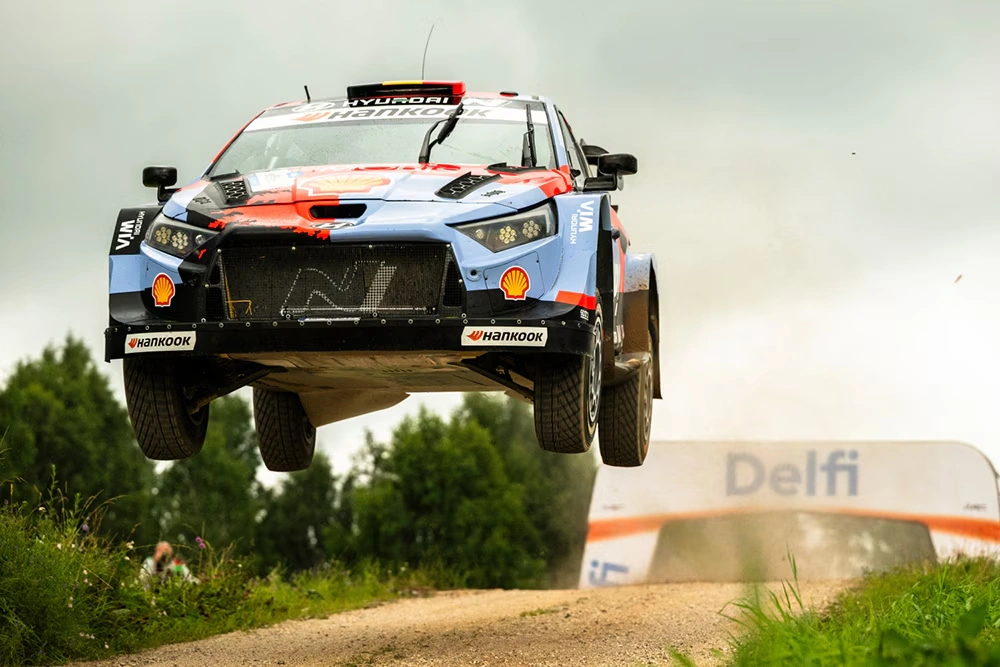
Katsuta’s Friday tyre damage cost immediate time and worsened his Saturday road position. Mārtiņš Sesks damaged the front-right tyre on SS9, adding pressure to a rally that already included a 20-second penalty. Jon Armstrong suffered front-left tyre damage after a heavy landing on the opening stage.
Fourmaux also managed a slow tyre deflation on SS11 after striking an anti-cut device on SS10 and losing bodywork. He remained in the podium fight because he limited the loss. That is stage management in its most practical form: recognize the damaged car, reduce the load in the most dangerous places and bring it to service before the problem multiplies.
The fastest tyre over one stage is not automatically the best tyre for the loop. Teams choose for total time, damage risk, changing temperature and the ability to rotate or replace tyres between stages.
Stage Management: How Pajari Controlled the Rally
Pace notes, repeated stages and controlled aggressionPajari combined immediate Friday speed with disciplined management. He won all seven opening-leg stages, responded when Solberg reduced the gap on Saturday morning, then protected a 25.0-second Sunday lead. His 12 stage wins provided the margin, while his restraint on the Power Stage secured the victory.
High-speed rallies reward commitment, but they punish emotion. A driver who sees a rival take three seconds cannot simply “try harder” everywhere. The correct response is to identify whether the loss came from grip, notes, setup, traffic, temperature or execution. Unfocused aggression creates larger steering inputs, overheated tyres and poor jump landings.
Pajari’s weekend showed controlled aggression. He attacked when conditions and information supported the risk. He reduced the target when the road deteriorated or the rally situation changed. That distinction explains why a near-spin on Saturday did not become a retirement and why a sixth-fastest Power Stage time was strategically correct.
Friday: build the time bank
Pajari won SS1 Raanitsa 1 and never surrendered the lead. He then won Karaski, Kanepi and all three repeated afternoon stages before completing the sweep on the short Elva super special. Winning every stage of an opening leg is rare because one test usually favors a different setup, tyre temperature or driver style.
The repeated stages revealed the strength of the Pajari–Salminen partnership. On the second pass, the crew could revise pace-note detail and compare grip against the morning. The road was faster in some places and more damaged in others. Their job was to separate those two trends corner by corner.
Accurate notes also reduce steering correction. On a fast crest, the driver commits before the exit appears. A precise note lets the car settle once. A vague note creates a lift, correction or late brake input. Each action costs only fractions, but Estonia strings many high-speed decisions together.
Saturday morning: absorb the counterattack
Saturday opened with Pajari 14.7 seconds ahead. He won the first two stages and briefly extended the margin to 17.6. Solberg then won SS10 and SS11, reducing the gap to 14.1 at midday service. The pressure had changed: Pajari was no longer building without interruption.
The worst response would have been to chase every tenth immediately. Instead, the Toyota crew reset at service, read the afternoon conditions and returned with a stronger total package. Pajari won the next three stages. By Saturday night, the lead had reached 25.0 seconds.
Saturday afternoon: survive the warning
Pajari struck a rock near the finish of SS14 and almost spun. The moment mattered because it exposed the edge of the operating window. A driver can treat such an incident as bad luck or as information. Pajari treated it as information and became more measured when SS15 deteriorated.
Thierry Neuville won SS15, becoming the first non-Toyota stage winner of the rally. Pajari did not need to answer with a reckless push. He had already restored the margin. Protecting the car was more valuable than preserving a perfect stage-winning sequence.
Sunday: separate the rally win from the points fight
Sunday presented two different competitions. Pajari needed to protect the overall lead. Solberg could attack the Super Sunday and Power Stage classifications. Solberg won SS17 by 0.4 seconds, then won the Power Stage in 11:11.9. Pajari was sixth on the final test, 5.101 seconds slower.
Viewed without context, sixth on the Power Stage appears weak. Viewed as rally management, it was efficient. Pajari gave up only a small portion of his lead while reducing exposure to punctures, overshoots and hard landings. He crossed the finish with 19.5 seconds in hand.
Solberg also executed his objective. He topped Sunday, won the final stage and left Estonia with 27 championship points. The two Toyota drivers therefore followed different rational strategies. One protected the rally. The other maximized the remaining rewards available to him.
Why stage rhythm mattered more than a single spectacular split
Estonia rewards a driver who carries speed through sequences. The exit of one corner determines the approach to the next crest. A small correction can reduce the car’s stability for several hundred meters. Therefore, a smooth stage can beat a more dramatic run even when both drivers reach similar peak speeds.
Pajari’s nine consecutive fastest times across Friday and Saturday morning showed that rhythm. He repeatedly placed the car where the next instruction expected it. That consistency reduced the number of emergency corrections, which protected tyres and maintained confidence.
This is also why the co-driver’s work deserves equal strategic credit. Marko Salminen had to deliver notes at a cadence that matched high-speed commitment without rushing the driver. The timing of a note is part of the setup. Too early and the detail is forgotten. Too late and the driver cannot prepare the car.
Team-by-Team Strategy Analysis
Toyota control, Hyundai recovery and M-Sport damage limitationToyota: multiple strategies, one dominant result
Toyota filled four of the first six positions. Pajari and Solberg delivered a one-two, Ogier finished fifth and Evans recovered to sixth. The result demonstrated both car speed and strategic flexibility. The crews were not all asked to run the same rally because their road positions and championship priorities differed.
Pajari attacked early because the surface and classification rewarded it. Solberg remained close enough to pressure the leader, then shifted toward Sunday points when the overall win became unlikely. Evans limited the damage after a difficult opening position. Ogier added a controlled fifth and finished fourth on the Power Stage.
The manufacturer also benefited from a predictable GR Yaris Rally1 at high speed. Aerodynamic stability does not create road grip, but it gives the driver a calmer platform over crests and during direction changes. Readers looking for the wider principle can review how downforce affects a racing car and why stability matters even on loose surfaces.
Hyundai: manage incidents, then settle the podium internally
Fourmaux and Neuville finished third and fourth. Only 1.9 seconds separated them entering Sunday, which created a delicate team situation. Both needed championship points, yet both were close enough that an error or tyre problem could remove a double finish.
Neuville took 7.9 seconds from Fourmaux on Sunday’s opening stage, but Fourmaux responded well enough on the Power Stage to retain third by 5.9 seconds. Their duel remained controlled. Neither Hyundai could realistically catch Solberg without a problem ahead, so the strategic priority was converting two competitive cars into two strong finishes.
Fourmaux’s Saturday was especially important. He struck an anti-cut device on SS10, lost bodywork, carried a slow tyre deflation on SS11 and survived a wild moment on SS13. Each incident could have triggered a larger attack to recover time. Instead, he preserved the car and remained positioned for the podium.
M-Sport Ford: the rally became an exercise in containment
Sesks finished seventh despite a 20-second penalty and front-right tyre damage on SS9. Armstrong finished ninth after a heavy opening-stage landing damaged his front-left tyre. Josh McErlean retired on Saturday with an exhaust issue and restarted Sunday.
For M-Sport, the strategic problem was not finding a path to victory after those setbacks. It was preventing separate incidents from becoming zero-point weekends. Sesks and Armstrong kept their cars in the classification, while McErlean’s restart provided mileage and information.
That kind of damage limitation is fundamental to championship scoring. A driver cannot recover points from a retired car. A slower finish often has more long-term value than a spectacular attempt that ends off the road.
WRC2: Virves won by managing a narrow margin
Robert Virves gave the home crowd a WRC2 victory in the Škoda Fabia RS Rally2. He beat Teemu Suninen by 7.6 seconds, while Roope Korhonen finished only 1.2 seconds behind Suninen. That compact gap required a different approach from Pajari’s Sunday management.
Virves could not cruise with multiple rivals close enough to capitalize on one slow corner. He needed clean pace without puncture exposure. Rally2 cars also approach jumps, compressions and traction zones differently from Rally1 machinery, so copying the leading line is not always the fastest or safest choice.
Route Structure and Where the Rally Was Won
Why the longest leg carried the largest strategic weightThe schedule distributed competitive distance unevenly. Friday created the road-order gap. Saturday contained almost half the rally’s stage kilometers and tested tyre consistency. Sunday was short enough for controlled management, yet its points incentives still rewarded a full attack from crews without an overall victory to protect.
| Day | Stages | Distance | Key strategic demand |
|---|---|---|---|
| Friday | SS1–SS7 | 103.42 km | Road sweeping, first-pass notes and repeated-stage learning |
| Saturday | SS8–SS16 | 149.60 km | Tyre life, rotation, setup response and damage control |
| Sunday | SS17–SS18 | 48.78 km | Overall protection versus Sunday and Power Stage rewards |
| Total | 18 stages | 301.80 km | High-speed precision across changing road conditions |
Friday’s repeated tests rewarded crews that learned quickly
Raanitsa, Karaski and Kanepi each ran twice. That structure makes the first pass partly competitive reconnaissance. The driver records grip, braking distances and surface changes while still racing at full speed. The engineering team then combines driver comments, tyre condition and data before the second pass.
A crew can improve without increasing risk everywhere. It may shorten one braking zone, change a differential map or revise a pace note from “flat” to a small lift. The gains are precise rather than emotional. Pajari’s afternoon wins showed that his crew converted morning information into time.
Saturday forced full-system management
Peipsiääre and Kambja each exceeded 23 kilometers. Long tests stress tyre consistency and concentration because the driver cannot reset between short bursts. Mustvee and Otepää added different rhythms, while the Tartu vald super special closed the leg.
The 149.60-kilometer day also limited the usefulness of a setup that worked only in one stage type. Teams needed a compromise: stable enough for high-speed crests, compliant enough for compression and rough sections, and responsive enough for narrower changes of direction.
Understanding the mechanical side helps explain why the crews discuss traction and rotation so often. A rally car’s active strategy depends on driveline behavior, and the principles behind a limited-slip differential, all-wheel-drive traction and engine torque all shape how efficiently the car leaves loose-gravel corners.
Sunday’s short distance did not mean simple strategy
Both Sunday stages used Kääriku. The first run supplied information for the Power Stage, but the road could evolve before the second pass. Solberg used the opening run to close slightly and then delivered the fastest final-stage time. Pajari used the same information to define a safe target.
This difference is a useful lesson for anyone learning how motorsport timing works. The fastest final stage does not identify the best weekend strategy. Overall rally time, separate Sunday objectives and risk exposure must be read together.
Championship Impact After Rally Estonia
Why different drivers accepted different levels of riskEvans left Estonia leading the drivers’ standings with 177 points, 25 ahead of Katsuta. Pajari’s victory moved him to 144 points and third place, 33 behind Evans. Ogier followed on 139, Solberg held 130, and Neuville and Fourmaux were tied on 111.
Those totals explain Sunday’s behavior. Pajari needed the first victory of his WRC career and a major championship gain. Solberg needed every available Sunday point after the overall contest moved out of reach. Evans needed to recover from a road-order loss without turning sixth place into a retirement.
| Pos. | Driver | Points | Estonia implication |
|---|---|---|---|
| 1 | Elfyn Evans | 177 | Retained a 25-point lead after recovering to sixth |
| 2 | Takamoto Katsuta | 152 | Tyre damage and road order limited the weekend |
| 3 | Sami Pajari | 144 | First victory moved him firmly into title contention |
| 4 | Sébastien Ogier | 139 | Controlled fifth kept his total close |
| 5 | Oliver Solberg | 130 | Sunday attack produced a 27-point event haul |
| 6 | Thierry Neuville | 111 | Fourth and Power Stage speed strengthened recovery |
| 7 | Adrien Fourmaux | 111 | Podium converted a difficult Saturday into major points |
Pajari’s win also changed how rivals must assess him. Before Estonia, he had shown podium speed and nearly won in Croatia before a tyre deflation. After Estonia, teams had evidence that he could lead, respond to pressure and close a rally.
The result did not prove he would win every fast gravel event. Rally surfaces, starting positions and weather change too much for that conclusion. It did prove that Toyota had another crew capable of turning favorable conditions into maximum points.
Strategy changes with the points table. The same corner can justify a full attack for one driver and a measured lift for another.
Five Strategic Lessons From Rally Estonia 2026
What teams and fans should carry forward1. A favorable road position is valuable, not sufficient
Pajari had better Friday conditions than the opening championship leaders. He still had to beat every other driver operating in similar conditions. Seven stage wins demonstrated execution, not only opportunity.
2. The second pass is a test of learning speed
Repeated stages reward crews that translate first-pass information into small, safe gains. Better notes and more accurate grip expectations can produce time without a larger risk budget.
3. Tyre strategy must be judged across the loop
A tyre that feels excellent on the first stage may lose its advantage later. Compound, spare count and rotation all interact with temperature, distance and road damage. The same principle applies in many forms of car racing strategy, although rallies make the decision without immediate pit access.
4. Incidents should change the target
Pajari’s near-spin, Fourmaux’s bodywork damage and several tyre problems forced revised objectives. The strongest crews did not pretend the car remained perfect. They adjusted speed and protected what was still available.
5. Sunday performance must be read in context
Solberg was the fastest Sunday driver. Pajari was the rally winner. Both statements are true. Modern WRC rewards separate objectives, so analysis must distinguish between stage pace, Sunday rewards and the overall classification.
Fans who want broader technical context can also explore how performance engines work, what horsepower measures, how racing flags communicate danger and why motorsport crashes happen. Rally Estonia showed how those technical systems become strategic decisions at more than 120 km/h on loose gravel.
Rally Estonia 2026 Strategy FAQ
Four direct answers for readersConclusion: Pajari Won With Speed, Then With Restraint
Rally Estonia 2026 strategy analysis shows why the final margin cannot be understood from the podium alone. Road order helped define Friday’s opportunity. Pajari and Salminen converted it into seven consecutive stage wins and a 14.7-second lead. When Solberg reduced that margin on Saturday, Pajari answered across the longest and most demanding leg.
Tyre strategy then separated stable performance from short-term speed. Solberg’s optimistic Saturday afternoon approach left less flexibility, while Pajari rebuilt the advantage. Damage management kept Fourmaux on the podium and allowed several Ford crews to salvage finishes.
Finally, Sunday demanded a different kind of intelligence. Solberg attacked and won both stages. Pajari accepted a slower Power Stage because the rally victory mattered more than one final split. That choice completed the strongest strategic performance of the weekend.
Pajari’s first WRC win will be remembered for 12 stage victories and a start-to-finish lead. The deeper lesson is more useful: on a high-speed gravel rally, the winning crew must know when the road allows attack, when the tyre asks for patience and when a lead is valuable enough to protect.
Sources & Reporting Notes
This article uses official classification data and post-event reporting. Exact tyre-compound selections are discussed only where official reporting provided enough context; no complete crew-by-crew tyre chart was publicly available in the cited material.