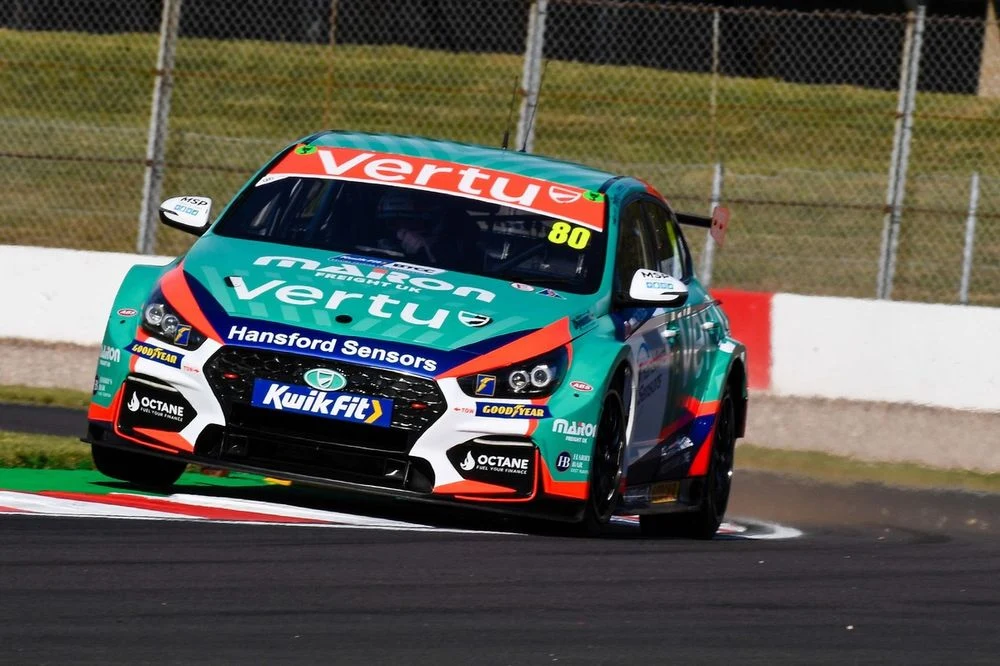
Donington Park GP BTCC 2026 Strategy Analysis:
Tyres, Turbo Boost & Track Position
Donington’s 2.49-mile GP layout turns the 2026 BTCC rulebook into a real tactical contest. Medium and hard tyres, position-based TOCA Turbo Boost, live overboost monitoring and the Race for Pole all change how the leading teams must approach the weekend.
The Donington Park GP BTCC 2026 strategy analysis is not built around pit windows. In dry conditions these are short touring-car races, so the big decisions are made before the lights go out: which Goodyear compound to use, when to spend TOCA Turbo Boost, how much track position to protect and how much risk to take in the new Saturday Race for Pole.
The official 2026 tyre allocation gives each driver 12 new medium tyres, four new hard tyres and eight carryovers for Donington GP. Drivers also have free compound choice in qualifying. Meanwhile, the position-based turbo system gives championship leader Ashley Sutton far less boost than the drivers behind him.
There is another technical layer. The 2026 Closed Loop Boost Scrutineering system monitors base engine boost in real time and is completely separate from the push-to-pass TTB system. That distinction matters because one is a tactical weapon and the other is a compliance limit.
Donington Park GP Strategy: The Three Systems That Matter
Donington GP gives teams 12 new mediums, four new hards and eight carryovers. Qualifying has free compound choice, but Sunday creates mandatory strategic trade-offs.
Championship and race position determine deployment speed, seconds per qualifying lap and how many race laps can use extra boost.
The GP loop adds heavy braking opportunities, yet passing still costs tyre temperature and time. Starting position can be worth more than a theoretical pace advantage.
These three systems interact. A driver with the faster tyre may still struggle if he has little TTB and starts behind a slower car. Likewise, a driver with a generous boost allocation can waste that advantage by spending it too early or getting trapped in a queue.
Donington adds another complication because Saturday is no longer simple qualifying. Free Practice decides the odd/even group split, qualifying builds the grid for the short race, and the nine-lap Race for Pole sets the starting order for Sunday Race 1.
Therefore, strategy starts at 11:00 a.m. BST on Saturday, not on Sunday morning. The Race for Pole begins at 3:05 p.m. BST, or 10:05 a.m. ET, and championship points are available before the main race day starts.
For the underlying mechanics of that format, our guide to how racing drivers qualify explains the basics. The separate pole position guide explains why clean air remains valuable even with the new Saturday race.
Goodyear Tyre Strategy: Medium, Hard & Carryovers
What is the best tyre strategy for Donington Park BTCC?
The best Donington strategy is the sequence that protects track position while avoiding being trapped on the hard tyre at the worst moment. Medium tyres offer the stronger performance baseline, while the hard compound can become a defensive obligation after a strong Race 1 result. The exact plan also depends on TTB allocation and reverse-grid position.
| Compound | New Tyres | Role | Qualifying | Strategic Meaning |
|---|---|---|---|---|
| Medium | 12 | Main dry allocation | Permitted | Most flexible race compound and likely baseline for outright pace. |
| Hard | 4 | Harder dry compound | Permitted | Lower peak grip, but strategically important for option use and Race 2 restrictions. |
| Carryovers | 8 | Previously used dry tyres | Available under event rules | Useful for practice mileage and preserving the freshest new sets. |
Why the medium tyre should be the default performance choice
The medium compound sits in the middle of Goodyear’s dry range, but at Donington GP it is the high-volume tyre. Each driver receives three complete new sets, compared with only one new set of hards.
That allocation tells teams where most of their weekend mileage will come from. The medium should provide the best blend of warm-up, traction and durability for the 14-lap Sunday races.
The GP layout also rewards a tyre that can tolerate different corner types. Hollywood and the Craner Curves load the car at speed, while the Melbourne Hairpin and Goddards demand low-speed traction.
A compound that produces strong front grip early but overheats later can become vulnerable in the final sector. That is why engineers will focus on the front axle during the single 50-minute practice session.
Why the hard tyre can change the whole race order
The hard tyre is not simply a slower tyre that drivers want to avoid. It is part of the sporting strategy because the leading Race 1 finishers must use the hardest compound available to them in Race 2.
That creates a success penalty with two separate effects. First, the driver loses tyre performance. Second, the Race 1 finishing order also reduces that driver’s TTB allocation for Race 2.
The combination can be severe. A Race 1 winner can start Race 2 at the front, yet have the least useful boost allocation and the hardest available tyre at the same time.
This is why fourth place can occasionally be strategically valuable. At the 2025 Donington GP meeting, Sutton was content to finish fourth in Race 1 because the top three were required to move onto the hard tyre for Race 2.
Finishing higher is always worth championship points, but a Race 1 podium can make Race 2 substantially harder. Teams must decide whether maximum immediate points outweigh the tyre and boost disadvantages that follow.
Free tyre choice in qualifying creates a Saturday puzzle
Donington GP is one of the events where drivers have free compound choice in qualifying. That makes the session more strategic than a standard one-compound shootout.
The harder tyre may require more preparation, while the medium should provide a stronger peak grip window. However, teams must consider how much useful life they want to preserve for later running.
Carryovers also matter because the regulations allow teams to bring eight tyres forward. That gives engineers freedom to complete setup work without consuming every fresh new set.
The short Qualifying Race adds a limitation because the option tyre is not permitted there. As a result, a clever qualifying decision must still lead into a legal and competitive Race for Pole package.
Tyre preservation is about temperature, not only tread life
BTCC sprint races are short, but thermal management can still decide the final laps. The front tyres do much of the steering, braking and drive work on the front-wheel-drive cars that make up much of the grid.
Craner is especially important because sliding through a fast corner can overheat the surface. The same driver then needs braking grip at the Esses and traction at Melbourne.
That relationship is why a car can look quick for three laps and then fade. The stopwatch may show a simple pace loss, but the real issue can be repeated front-tyre overload.
For broader fundamentals, see how car racing works and our guide to slipstreaming, because traffic and towing can change both tyre temperature and overtaking opportunities.
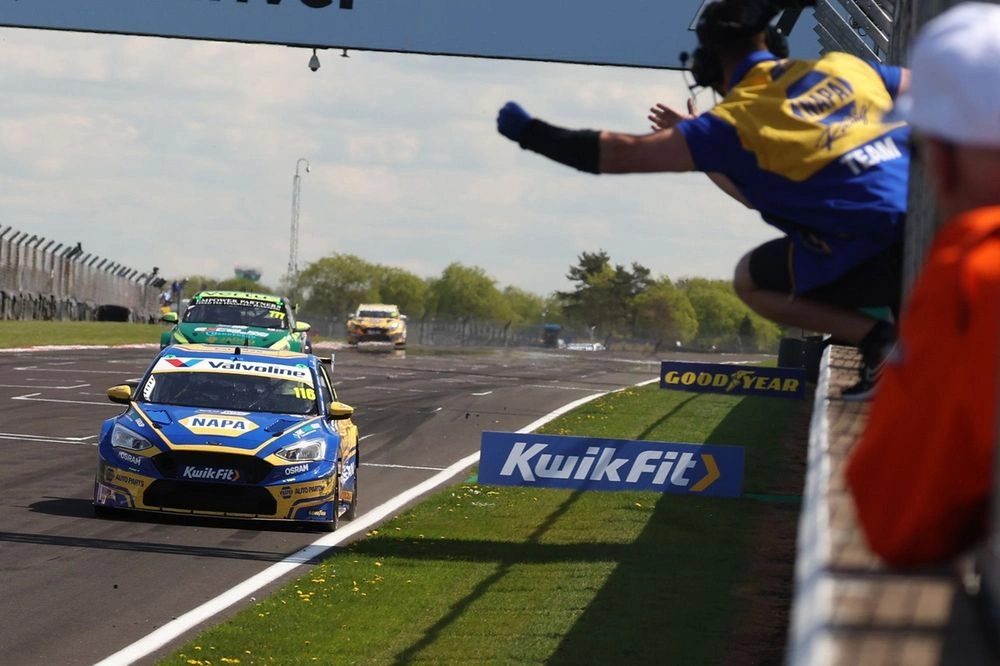
TOCA Turbo Boost: The 2026 Donington Handicap
How does TOCA Turbo Boost work at Donington Park GP?
TTB is the BTCC’s position-based push-to-pass system. At Donington GP, championship or race position controls three things: the minimum speed before deployment, the number of boost seconds available per qualifying lap and the number of race laps on which boost can be used. First place gets the smallest allocation.
TTB replaced the electric hybrid deployment after the hybrid programme ended. The extra power now comes through the turbo system, while Cosworth electronics continue to control the deployment logic.
The strategic goal remains familiar: reduce the advantage of the most successful cars and give lower-positioned drivers more tools to attack. However, the 2026 scale is more detailed than a simple on/off success handicap.
| Position | Min Speed | Qualifying / Race for Pole | Race TTB Laps · A Circuit | Pre-Donington Driver |
|---|---|---|---|---|
| 1 | 140 km/h | 1 sec/lap | 1 | Ashley Sutton |
| 2 | 135 km/h | 3 sec/lap | 2 | Tom Ingram |
| 3 | 130 km/h | 5 sec/lap | 3 | Dan Cammish |
| 4 | 125 km/h | 7 sec/lap | 4 | Ricky Collard |
| 5 | 120 km/h | 9 sec/lap | 5 | Charles Rainford |
| 6 | 115 km/h | 11 sec/lap | 6 | Mikey Doble |
| 7 | 110 km/h | 15 sec/lap | 8 | Josh Cook |
| 8+ | 105 km/h | 20 sec/lap | 10 | Morgan, Rowbottom & others |
Sutton’s strategy starts with accepting a power disadvantage
Sutton enters Donington with 327 points and the P1 TTB allocation. In qualifying and the Race for Pole, he has only one second of extra boost per lap and must wait until 140 km/h before deployment.
Race 1 is tougher still because Donington is an A-circuit. The championship leader receives one race lap with TTB under the published scale.
That means Sutton cannot build his weekend around repeated power-assisted overtakes. His best strategy is to qualify as high as possible, control exits and avoid becoming trapped behind cars with much more boost.
Ingram gets more TTB, but not enough to waste
Ingram enters second in the championship on 246 points. His qualifying allocation is three seconds per lap, and his Race 1 A-circuit allocation is two boost laps.
Two laps can still decide a race if they are used at the right time. Donington offers several locations where extra exit speed can turn into overlap under braking.
However, using both laps early leaves no tactical reserve for a late safety-car restart. The 2026 rules now allow boost on the first lap after a safety car, which makes saving one deployment especially valuable.
Cammish and the midfield have a larger tactical window
Cammish gets five seconds per qualifying lap and three Race 1 boost laps. Collard gets seven seconds and four race laps, while the gap continues to grow through the order.
From eighth onward, the minimum deployment speed falls to 105 km/h and qualifying availability rises to 20 seconds per lap. That is a major performance tool in the hands of a quick car starting out of position.
This is why Morgan and Rowbottom deserve attention. Both arrive on 161 championship points, outside the top seven, and Morgan comes directly from his strongest weekend of 2026 at Knockhill.
The Knockhill strategy analysis shows how position, conditions and race control can combine. The Knockhill results also show Morgan’s Race for Pole and Race 1 momentum before Donington.
TTB changes after every Sunday race
Race 1 uses championship order to set the number of TTB laps. After that, the system becomes even more dynamic.
Race 2 allocation is based on the Race 1 finishing order published by the official timekeepers before later sporting or technical decisions. Race 3 allocation is then based on the Race 2 finishing order.
Therefore, a Race 1 winner receives the P1 boost handicap for Race 2. A driver who finishes eighth or lower receives the larger allocation.
This effectively compresses the field. It also combines with the tyre rule, because the leading finishers can face both a harder compound and a smaller boost allowance in the next race.
Overboost Is Not TTB: The CLBS Compliance System
What is an overboost infringement in BTCC?
Overboost means the engine produces more base turbo pressure than the maximum permitted level for that engine. In 2026 the BTCC monitors this continuously through Closed Loop Boost Scrutineering. The system is separate from TTB, and unresolved excess boost can lead to five-second, ten-second or disqualification-level penalties.
This distinction is critical. TTB is legal additional boost triggered by the driver under the sporting rules. CLBS monitors the underlying engine boost limit for technical compliance.
Each engine type has a tailored maximum boost level designed to equalise power across the grid. Teams are responsible for operating within that limit even when kerbs, downshifts and transient pressure spikes make the control problem more difficult.
The 2026 system watches the cars continuously in every on-track session. If a car spends too long above its permitted threshold, the system can reduce available boost so the driver has a chance to correct the excess.
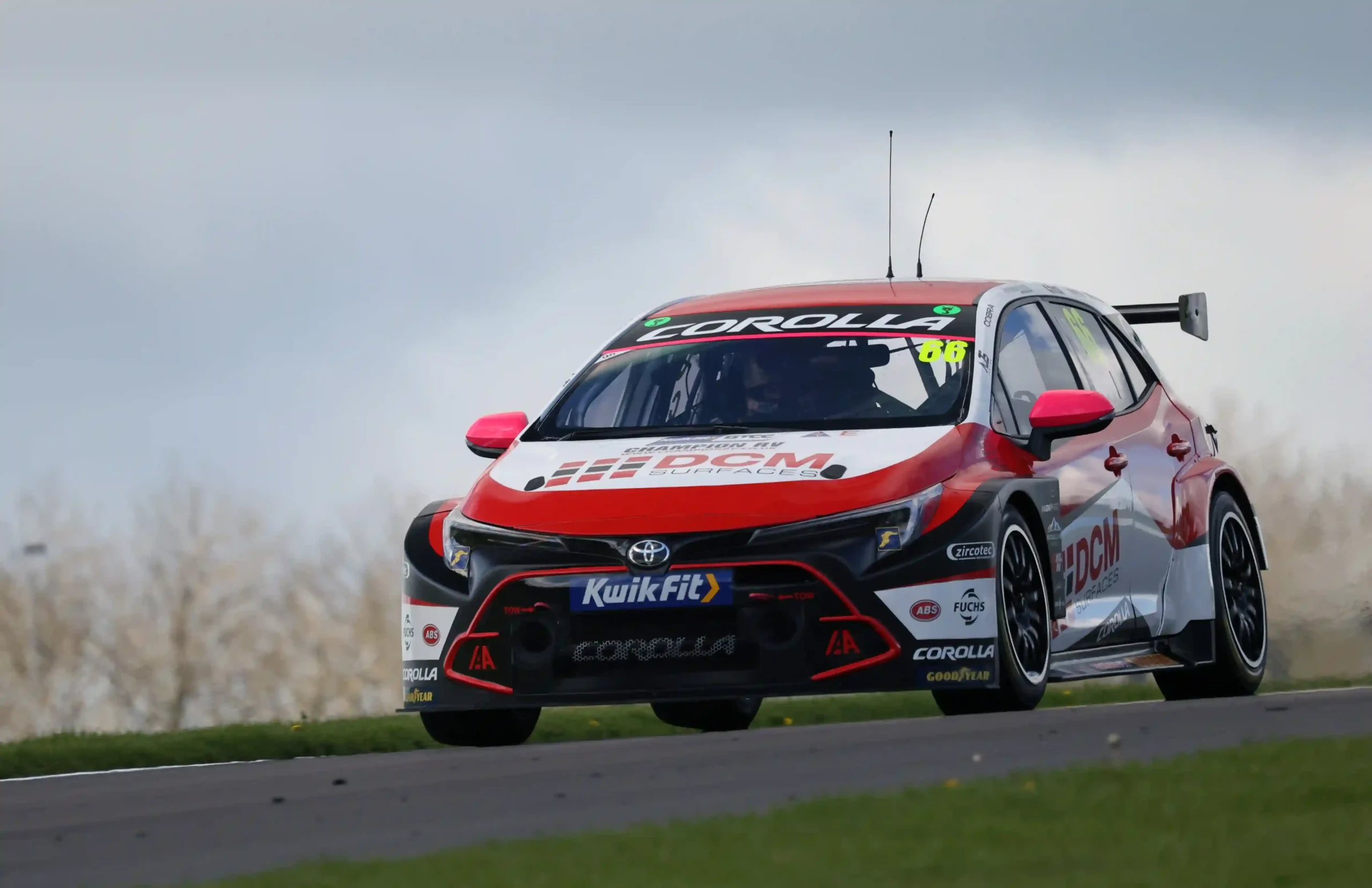
The driver can “repay” excess boost
Under the new system, a driver can change engine mapping or driving behaviour to reduce the accumulated overboost state. The dashboard tells the driver whether the car is inside a penalty state.
This is a major change from the older system. Previously, teams could discover the problem after the race and face automatic disqualification.
Now there is a sliding penalty structure. A minor unresolved infringement can cost five seconds, a medium one can cost 10 seconds, and the maximum state can still lead to disqualification.
Qualifying is especially unforgiving
A qualifying lap cannot be completed while the car remains in an overboost penalty state. If it is, the lap is deleted.
That creates another Donington trade-off. Drivers want maximum acceleration through the lap, but they cannot cross the timing line with an unresolved excess.
The season opener at Donington National produced several deleted qualifying laps under the new monitoring rules. The April Race 1 also produced a significant overboost penalty that removed Ingram from the result, while Morgan received a five-second penalty.
For a broader engine background, see turbo vs naturally aspirated engines and how car engines work. Those explain the hardware side, while the BTCC system adds sporting controls on top.
Track Position: Why Donington Rewards Control More Than Chaos
Donington GP gives drivers more overtaking possibilities than the shorter National circuit, but it still rewards clean air. A car that spends five laps behind a slower rival can lose tyre life and force the driver to use TTB simply to restore normal pace.
The circuit combines fast loaded corners with slow braking zones. That mix means following closely can hurt the front tyres in one section and then make it harder to attack in the next.
Redgate makes the start strategically expensive
A driver who loses two places at Redgate may need several laps and multiple boost deployments to recover them. That is a poor exchange for a title contender with a restricted TTB allocation.
Sutton’s low boost allowance makes the start particularly important. He cannot rely on repeated push-to-pass use to repair a bad first lap.
The Craner Curves punish desperate following
Craner is not only about bravery. It is also about keeping the platform stable while the car changes direction downhill at speed.
When a driver sits too close to another car, the line can become compromised. The result may be extra steering angle, more tyre scrub and a worse exit into the next sequence.
That is why patience can beat immediate attack. A driver may choose to drop back slightly through the fast section, protect the tyre and use TTB where the circuit actually offers a braking move.
Melbourne can turn saved boost into a position
The extended GP loop gives drivers a classic low-speed target. A stronger run into Melbourne can create overlap, while the corner’s low speed makes the pass easier to complete than a side-by-side attempt through Craner.
However, defending there is equally important. A driver who covers the inside too early can compromise the exit and become vulnerable again at Goddards.
For race-control context, see how racing flags work and what a safety car does. Safety-car timing can completely change the value of a saved boost lap.
Race-by-Race Strategy: Saturday to Sunday
Practice: one session means every lap must have a purpose
The official timetable gives the BTCC one 50-minute Free Practice session at Donington GP. That is longer than the generic 40-minute description on the championship rules page, so the event timetable is the correct weekend-specific reference.
Teams must use that period to understand long-run tyre behaviour and short-run balance. They also need enough pace to influence the odd/even qualifying group split.
A midfield team may accept more setup experimentation early, while Sutton and Ingram have stronger reasons to produce representative pace quickly.
Qualifying: free compound choice must still protect race inventory
Qualifying runs from 2:05 to 2:40 p.m. BST, or 9:05 to 9:40 a.m. ET. The field is split into two 15-minute groups after practice.
The faster group receives the odd-numbered grid positions for the Qualifying Race. Therefore, a driver’s own lap time is not the only variable; the relative speed of the whole group matters.
Drivers also need to manage CLBS. A deleted lap can be especially costly because the session is short and traffic can make the next attempt harder.
Race for Pole: nine laps with championship consequences
The Saturday race starts at 3:05 p.m. BST, or 10:05 a.m. ET. It runs for nine laps and sets the Race 1 grid.
The top 15 also score points, led by 10 for the winner. That gives title contenders a reason to race hard even though Sunday carries the larger points totals.
Yet damage is the bigger threat. A damaged steering arm or puncture can cost Saturday points and force a poor Race 1 start.
For the mechanics of grid construction and timing, see how race timing works and how racing laps are counted.
Race 1: maximum points now create a Race 2 bill
Sunday Race 1 starts at 11:45 a.m. BST, or 6:45 a.m. ET. It runs for 14 laps and uses the Race for Pole finishing order as its grid.
A driver who wins scores 20 championship points, plus possible fastest-lap and lap-leader bonuses. However, the leading Race 1 finishers also face the hardest available tyre in Race 2.
Meanwhile, the Race 1 finish determines TTB for the next race. That means success directly reduces the driver’s power-assist options.
Race 2: the hardest strategic race of the weekend
Race 2 begins at 2:45 p.m. BST, or 9:45 a.m. ET. It is where the strongest Race 1 drivers can become vulnerable.
A front-row driver on the hard tyre may need to defend immediately from medium-shod cars with larger TTB allocations. If the hard tyre is slow to warm, the first three laps can decide the entire race.
This is the classic “double handicap” scenario: the previous winner has less tyre grip and fewer power-assisted laps. A clever driver may use positioning and braking to make the car physically difficult to pass rather than chase lap time.
Race 3: reverse grid turns strategy into opportunity
The final race starts at 5:30 p.m. BST, or 12:30 p.m. ET. The reverse-grid draw uses Race 2 finishing positions from sixth to 12th to determine how much of the leading order is reversed.
Therefore, Race 2 finishing position can create a dramatic Race 3 grid advantage. However, deliberately sacrificing championship points is rarely a sensible guaranteed plan because the draw remains random.
The final race also uses Race 2 finishing order for TTB allocation. A driver drawn forward from the midfield may combine good track position with a generous boost allowance.
That combination is one reason Race 3 often produces surprise winners. The strategic system is designed to prevent the fastest car from simply repeating the same result three times.
Driver Strategy Profiles: Sutton, Ingram, Cammish & the Chasers
Ashley Sutton: win through positioning, not boost volume
Sutton’s 81-point championship lead allows a more conservative strategic approach than his rivals. He does not need to turn every half-chance into a pass.
His biggest handicap is TTB. One second per qualifying lap and one Race 1 boost lap on an A-circuit give him the smallest power-assist window in the field.
Therefore, Sutton needs front-row track position more than anyone. If he can start ahead, his racecraft and braking consistency can reduce the importance of boost.
He has shown this before. At the 2025 Donington National opener, Sutton won Race 2 without needing to use his single TTB lap after manipulating Ingram into spending his own boost earlier.
Tom Ingram: turn Donington pace into controlled attacks
Ingram owns the current GP race lap record at 1:33.621 and won the final Donington GP race in 2025. His Hyundai therefore has strong evidence on the exact circuit.
He also has a slightly better TTB allocation than Sutton. Three seconds per qualifying lap and two Race 1 boost laps are limited, but they offer more flexibility.
His best strategy is likely to use boost for completed overtakes rather than defensive bursts. The GP loop gives him enough braking zones to turn a good exit into a clean move.
Dan Cammish: enough TTB to be aggressive without becoming reckless
Cammish is only 13 points behind Ingram. Five seconds of qualifying TTB per lap and three Race 1 deployment laps give him more opportunity to attack than either title rival ahead.
He also won Race 2 at Donington GP in 2025. That result proves he can manage a changing tyre and weather picture on this layout.
For Cammish, the priority is Saturday. Beating Ingram in the Race for Pole can reduce the gap before Sunday and also improve Race 1 track position.
Josh Cook: the strongest top-seven boost opportunity
Cook sits seventh in the championship on 164 points. That gives him 15 seconds of boost per qualifying lap and eight A-circuit Race 1 boost laps under the scale.
That is a major difference compared with Sutton’s one second and one race lap. Speedworks also arrives confident that the Toyota Corolla can rediscover the performance it showed at the April Donington opener.
The team’s current preview notes that Cook qualified inside the top six in April and fought at the front in the Race for Pole before a Sunday puncture damaged his result.
If the Corolla qualifies near the top six again, Cook could have one of the most powerful combinations of track position and TTB in the leading group.
Adam Morgan: the P8+ boost allocation makes him dangerous
Morgan enters Donington eighth in the championship on 161 points, tied with Rowbottom. That places him in the maximum published TTB bracket for qualifying and Race 1.
He arrives with momentum as well. Morgan won the Knockhill Race for Pole and Race 1, then finished second to Chilton in Race 3.
A quick Mercedes with 20 seconds per qualifying lap and the P8+ A-circuit race allocation is a serious tactical threat. He does not need to be the fastest car in clean air to become difficult to defend against.
The Thruxton strategy analysis and Thruxton results provide another recent comparison for how tyre and track-position swings can move midfield cars into podium contention.
Latest Strategy News Before Donington GP
Speedworks believes April performance can return
Speedworks Corolla Racing returns to Donington four months after a promising National-circuit opener. Its August 20 team preview says Cook showed front-running potential before the opening Sunday race ended with a puncture.
The GP layout is longer and more technically demanding, so the April setup cannot simply be copied. Still, the same car showed enough qualifying pace to make Cook a strategic factor this weekend.
Knockhill changed the threat map
Three different drivers won the three Sunday races at Knockhill. Morgan took Race 1, Sutton won Race 2 and Chilton won Race 3.
Morgan’s weekend also included the Saturday Race for Pole victory. That matters because it proves Cataclean Plato Racing can execute the new Saturday format, not only Sunday race strategy.
Chilton’s finale win was his first of 2026 and his 19th career BTCC victory. He also won the opening Donington GP race in 2025, so the Hyundai veteran has both current momentum and circuit history.
Our Knockhill preview gives the pre-event context, while the latest result shows why the Donington strategy fight extends beyond Sutton, Ingram and Cammish.
Championship Strategy: Why Sutton Can Play Defence
Sutton leads with 327 points, Ingram has 246 and Cammish 233. That gives Sutton an 81-point advantage before a weekend that offers a normal maximum of 76 points.
As a result, the championship leader does not need to win every Donington race. A consistent scoring weekend can be more valuable than risking a retirement while defending against cars with more TTB.
Ingram’s strategy is different. He needs to reduce the gap, so he has more reason to use his limited boost aggressively when a win is available.
Cammish is fighting two battles at once. He is 94 points behind Sutton, but only 13 behind Ingram. A strong Donington weekend could move him into second even if Sutton remains out of reach.
That championship context changes the definition of a “good” strategy. Sutton can accept second place to protect a points lead, while Ingram may need to take the same corner as a win-or-lose opportunity.
For a fuller points framework, see how racing championships are scored. Track incidents can also transform points decisions, which is why what causes racing crashes is relevant to the risk side of race strategy.
Donington Park GP BTCC 2026 Strategy FAQ
Conclusion: Donington Is a Strategy Race Before It Is a Speed Race
The fastest BTCC car at Donington GP may not be the car that scores the most points. The 2026 rules make tyre sequence, TTB allocation and track position inseparable.
The tyre numbers are clear: 12 new mediums, four new hards and eight carryovers, with free qualifying choice. The power numbers are equally clear: Sutton enters with the smallest TTB allocation, Ingram receives a little more, and the midfield has a much larger tactical window.
Then CLBS adds the technical discipline. Teams can chase the permitted boost limit, but they must stay out of a penalty state before the lap or race ends.
Race 2 is likely to be the sharpest strategic test because Race 1 success can bring both the harder tyre and reduced TTB. Race 3 then adds the reverse-grid draw, making the final event the place where a midfield driver can combine track position with extra boost.
Sutton’s best strategy is control. Ingram needs to convert Donington pace into decisive overtakes. Cammish has enough boost to attack, Cook has one of the strongest top-seven allocations, and Morgan arrives with maximum-bracket TTB plus recent momentum.
That is why Donington Park GP should be read through more than lap time. Watch which tyre goes on the car, count who still has boost available, and pay attention to where each driver sits on the road. Those three details will explain most of the weekend before the timing screen does.