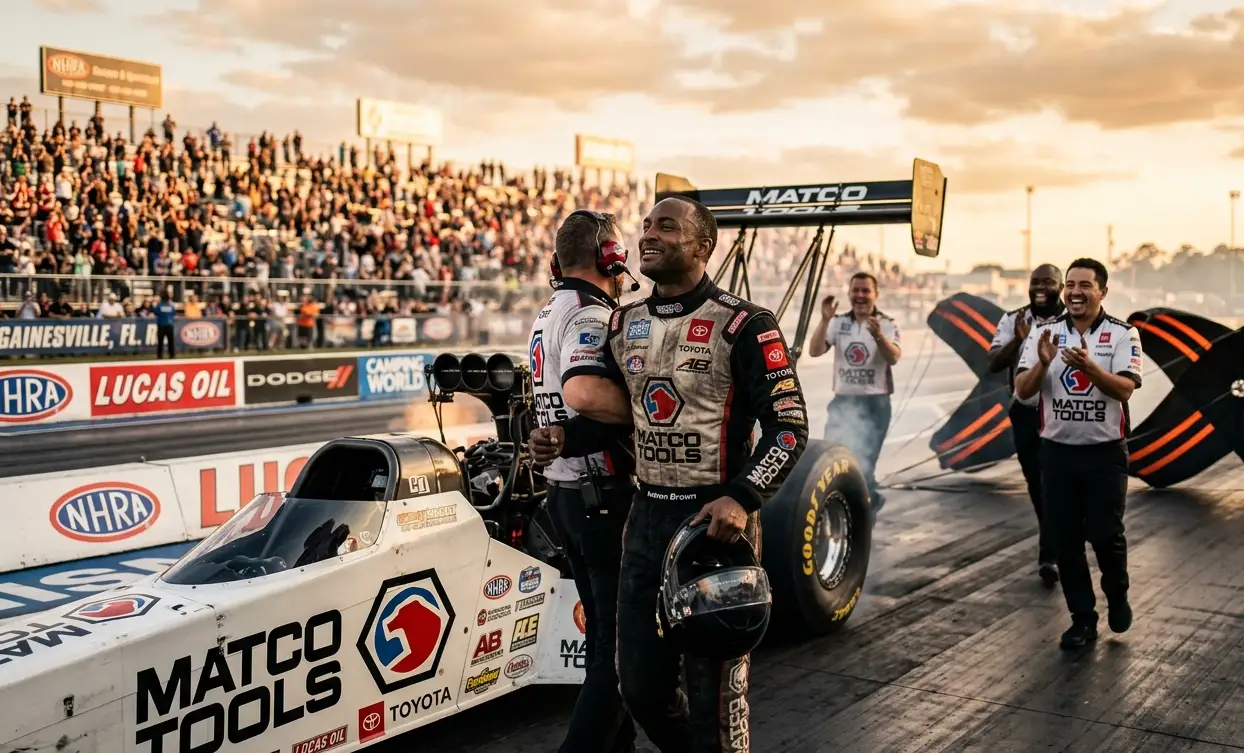
How Far Do NHRA Top Fuel Cars Race?
Distance, Speed & 1,000-Foot Rules Explained
Top Fuel dragsters cover exactly 1,000 feet in modern NHRA competition — producing 11,000 horsepower, exceeding 330 mph, and doing it all in under 3.8 seconds. Here is everything you need to understand why, and how.
How Far Do NHRA Top Fuel Cars Race? Distance, Speed & Power Explained
1,000 feet. 11,000 HP. 330 mph. Under 3.8 seconds. Here’s the complete breakdown.
There is nothing quite like standing at the starting line of an NHRA national event when a Top Fuel dragster launches. The explosion of sound arrives before you can process what your eyes are telling you. The ground shakes. The nitromethane fumes hit the back of your throat. And by the time your brain registers that the lights went green, the car is already past the 330-foot mark and pulling 5 Gs. It is over almost before it begins — and that is entirely the point.
NHRA Top Fuel dragsters race exactly 1,000 feet (304.8 meters) in modern competition. This was not always the standard. For decades, the benchmark was a full quarter mile at 1,320 feet — until a series of catastrophic high-speed events forced the NHRA to fundamentally rethink what a safe drag strip actually looks like. The shift to 1,000 feet changed the sport forever, and understanding why it happened tells you everything about how these 11,000-horsepower machines have simply outgrown the physics that the original quarter-mile format was built around.
This guide covers the exact race distance, why it changed, the physics of the launch sequence, horsepower figures, fuel systems, safety innovations, and how the sport is structured at the professional level. Whether you are a first-time fan or a seasoned paddock regular, the numbers here never get less staggering.
How Far Do NHRA Top Fuel Cars Race? The Direct Answer
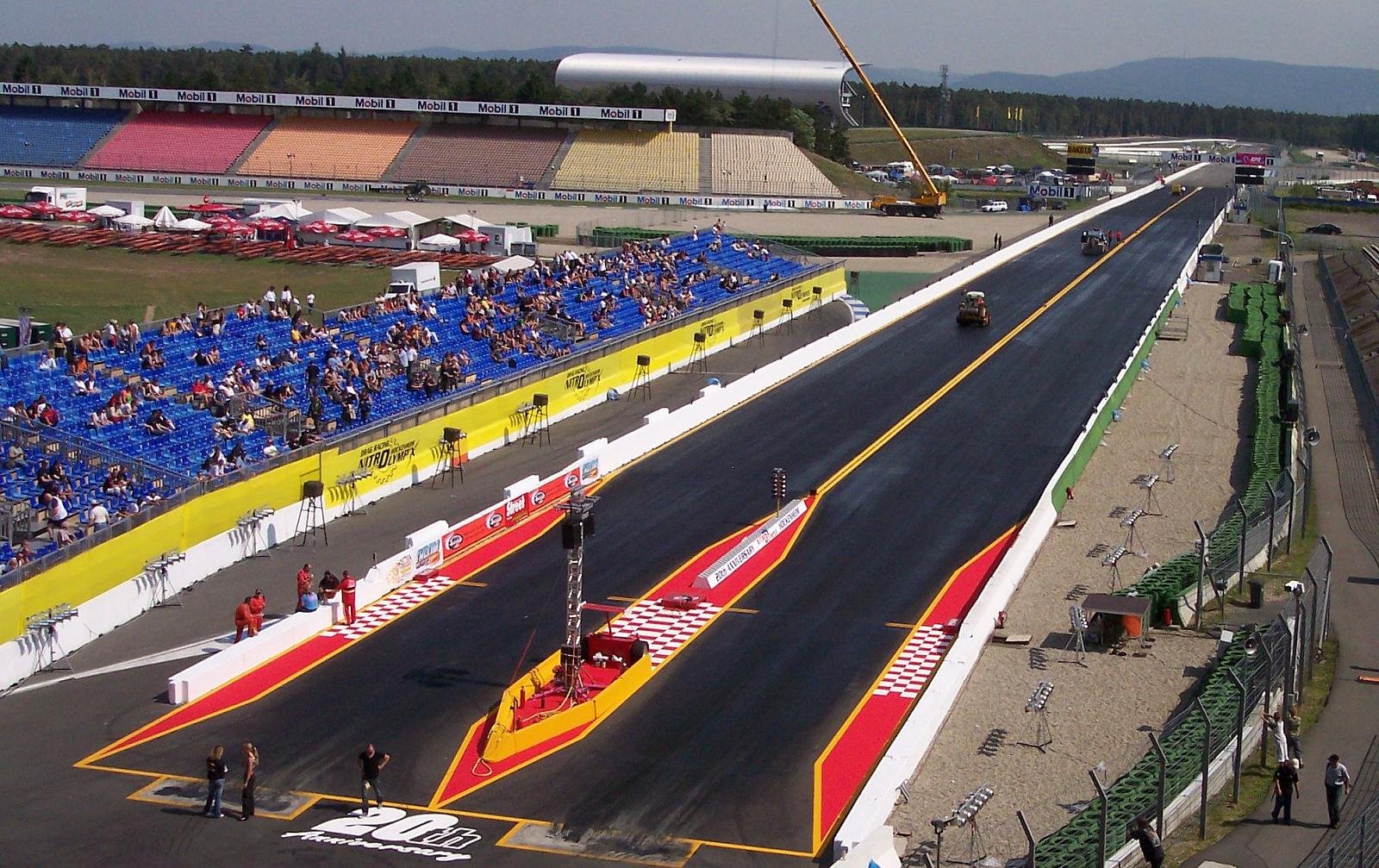
Top Fuel dragsters race exactly 1,000 feet — 304.8 meters — in every NHRA national event. That distance is measured from the starting line to the finish line timing lights on the drag strip. Nothing about this number is arbitrary. It is the precise measurement the NHRA determined would allow a 330 mph vehicle to deploy parachutes, slow progressively, and stop safely within the available paved runout area that most established facilities can provide.
Furthermore, this distance applies specifically and exclusively to the two premier nitro-burning classes: Top Fuel dragsters and Funny Cars. Lower professional classes — Pro Stock and Pro Stock Motorcycle — continue to race the traditional quarter-mile at 1,320 feet. So when fans ask how far NHRA Top Fuel cars race today, the answer is definitively 1,000 feet, and has been since 2008.
Before 2008, NHRA Top Fuel and Funny Car classes raced a full quarter mile — 1,320 feet. The final 320 feet were removed after it became clear that modern nitromethane-powered cars had evolved faster than the safety infrastructure of existing drag strips. Terminal speeds were approaching 340 mph through the finish line, leaving dangerously short runout areas. The NHRA’s move to 1,000 feet was not a concession — it was an engineering decision that saved lives. Learn more about how NHRA drag racing works across all professional classes.
How Does 1,000 Feet Compare to Other Racing Distances?
One thousand feet is approximately 0.19 miles — barely a fifth of a mile. To put that in motorsport context, a single lap at the Indianapolis Motor Speedway covers 2.5 miles. A Formula 1 Grand Prix runs around 190 miles over 60-plus laps. Even a NASCAR superspeedway lap dwarfs the entirety of a Top Fuel run. Yet the elapsed time and peak G-forces produced in those 1,000 feet exceed almost anything those other disciplines generate in a full race distance.
For more on how racing distances and formats compare across different disciplines, see our breakdown of how car racing works across motorsport categories. The physics are genuinely incomparable.
Why NHRA Shortened Top Fuel Races to 1,000 Feet
To understand the 1,000-foot rule, you have to understand what was happening at the end of a quarter-mile run in 2007 and 2008. Top Fuel cars were regularly crossing the 1,320-foot finish line at speeds approaching 340 mph. The parachutes — two primary chutes deployed simultaneously — needed a certain amount of distance to slow the car from those terminal velocities to a manageable speed before the runout area ended and the retaining walls began. That distance was shrinking every season as teams found more and more power.
Modern Top Fuel cars had simply outgrown the quarter mile. The physics of stopping from 340 mph don’t care about tradition — they only care about distance.
The Scott Kalitta Tragedy — June 2008
The event that accelerated the NHRA’s decision beyond debate happened on June 21, 2008, at Old Bridge Township Raceway Park in Englishtown, New Jersey. Veteran Top Fuel driver Scott Kalitta suffered a catastrophic engine failure near the end of a qualifying run. The explosion destroyed his primary parachutes, leaving the car without its primary braking system at more than 300 mph. Without the chutes to scrub speed, Kalitta’s dragster overshot the shutdown area and impacted barriers beyond the track boundary. He did not survive.
The NHRA acted immediately. Within weeks of Kalitta’s death, the association announced the reduction of nitro class races from 1,320 feet to 1,000 feet, effective from the next event. The change was implemented with a speed that is rare in any governing body — a reflection of both the urgency of the safety issue and the weight of the loss felt across the paddock. Scott Kalitta was the son of legendary driver Connie Kalitta, himself a Top Fuel pioneer. The family’s history in the sport runs deep, and the decision to change the rules carried the emotional weight of that history alongside the cold engineering rationale.
Scott Kalitta’s death was the immediate catalyst, but the NHRA had already been examining terminal velocities after the 2007 death of Funny Car driver Eric Medlen. Medlen died following a testing session crash caused by severe tire shake — a violent oscillation at high speed that rendered him unconscious before impact. His death led to significant improvements in roll cage padding and head-and-neck restraint requirements. Both tragedies together formed the safety reckoning that produced the 1,000-foot rule. For a broader look at what causes crashes in motor racing, the dynamics of high-speed tire failure are among the most complex and dangerous phenomena in the sport.
Top Fuel Speed, Acceleration & Horsepower
The performance numbers produced by a Top Fuel dragster over 1,000 feet sit in a category completely separate from every other form of motorsport. Formula 1 cars generate around 1,000 horsepower. High-end supercars produce 700 to 800. A Top Fuel dragster makes roughly 11,000 horsepower — more than the entire first four rows at the Daytona 500 combined. Understanding where that power comes from, and what it does to a car and driver over the course of 3.7 seconds, is the real story of the sport.
The 0–100 mph Launch: Under One Second
A Top Fuel dragster reaches 100 mph in less than one second from a standing start. Specifically, the 0–60 mph time is estimated at approximately 0.8 seconds — though this figure is genuinely difficult to measure precisely because the massive rear slicks undergo enormous elastic deformation during launch, absorbing energy before full traction is established. The result is a tire that physically grows in diameter under the load and wrinkles at the contact patch before gripping the VHT-treated track surface.
The driver experiences up to 5 Gs of acceleration force during this phase. For context, fighter pilots wearing G-suits are trained to handle 9 Gs for brief periods. A Top Fuel driver in a fire suit, with no G-suit, absorbs 4 to 5 Gs across the entire run. The force that presses them into their custom-molded seat during launch is equivalent to the weight of five of themselves stacked on their chest simultaneously. Understanding what G-force does to the human body makes the physical demands of drag racing substantially more legible.
Horsepower Breakdown: Where 11,000 HP Comes From
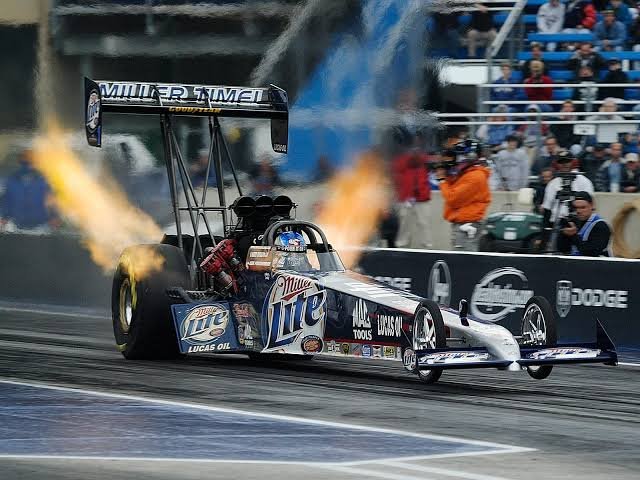
The engine at the heart of every Top Fuel dragster is a 500-cubic-inch (8.2-litre) naturally aspirated V8 — forced to breathe through a massive Roots-type supercharger that forces air into the combustion chambers at several times atmospheric pressure. However, the real secret is the fuel. These engines do not run on any form of conventional gasoline. They burn a specially blended mixture of 90% nitromethane and 10% methanol.
Nitromethane is a remarkable chemical compound. Unlike conventional hydrocarbon fuels, nitromethane carries its own oxygen molecule — meaning it does not rely as heavily on atmospheric oxygen for combustion. This allows the engine to burn far more fuel per cycle than any gasoline engine could manage. The fuel pump on a running Top Fuel car flows at roughly 100 gallons per minute — burning through approximately 15 gallons of nitromethane in a single warmup burnout and race pass combined. At that consumption rate, the fuel lines look more like garden irrigation hoses than anything you’d find under the bonnet of a road car.
A litre of nitromethane produces roughly 2.3 times more power than a litre of gasoline when burned in identical conditions. Furthermore, because nitromethane carries its own oxygen, the engine can run a dramatically richer fuel mixture than any gasoline-powered engine. The explosive result is why a Top Fuel engine produces more power in 3.7 seconds than most car engines will produce cumulatively over their entire service life. For a deeper look at how engine chemistry affects performance, see our guide on turbo vs naturally aspirated engines and how engine displacement affects power output.
Speed Comparison: Top Fuel vs Other Motorsports
Top Fuel Distance History: Quarter Mile to 1,000 Feet
Drag racing’s quarter-mile tradition runs as deep as American car culture itself. The distance was not chosen through scientific analysis — it emerged organically from the illegal street racing culture of post-war America, where the nearest intersection a quarter mile from the start line served as a natural finish point. When the NHRA was founded in 1951 by Wally Parks, the quarter mile was simply the established convention, and it stayed that way for almost sixty years.
Through the 1960s and 1970s, the quarter-mile format worked because the cars were genuinely limited by the mechanical technology of the era. Don “The Snake” Prudhomme and Tom “The Mongoose” McEwen — the rivalries that put Top Fuel drag racing in front of mainstream American audiences for the first time — were racing cars that topped out somewhere around 240 to 250 mph. Stopping from 250 mph requires significantly less runout than stopping from 340 mph, and the safety infrastructure of the time was sufficient.
The Quarter-Mile Record That Made Everyone Nervous
By the mid-2000s, teams like DSR (Don Schumacher Racing) and John Force Racing were running the quarter mile in the low 4.4-second range at terminal speeds above 330 mph. Engineers at the NHRA began running calculations on shutdown distances at every facility on the national tour. Several tracks could not provide the theoretical stopping distance needed if a car’s parachutes failed at full race speed. The margin between “adequate” and “catastrophic” was shrinking with every horsepower breakthrough.
The last significant quarter-mile Top Fuel records — runs in the 4.41 to 4.43 second range at 336 to 338 mph — were set in the final months before the 2008 rule change. If modern cars were allowed to run the full quarter mile today, most credible engineering estimates suggest the ET would drop to the 4.2-second range with terminal velocities approaching or exceeding 350 mph — numbers that existing raceway infrastructure simply cannot accommodate safely. The NHRA U.S. Nationals at Indianapolis remains the sport’s most prestigious event, and even that facility’s extended runout area is sized around the 1,000-foot standard.
Elapsed Time: 3.628 seconds — set at a national event. Top Speed: 338.17 mph — the fastest officially recorded trap speed in NHRA Top Fuel history at the 1,000-foot mark. Both records represent the absolute limit of what current NHRA technical regulations and available track conditions allow. To see where the next records might fall, check the 2026 NHRA schedule for upcoming national events.
How Long Is a Top Fuel Dragster? Physical Dimensions
Beyond the performance numbers, the physical scale of a Top Fuel dragster surprises almost every first-time paddock visitor. A standard car measures approximately 25 feet from front wing to rear wing — roughly the length of a transit bus. The chassis rides on an extraordinarily long wheelbase of exactly 300 inches (762 cm), which provides the straight-line stability needed at triple-digit speeds. Despite that dramatic length, the car weighs only around 2,300 pounds including the driver — lighter than most compact family cars. The chassis is constructed entirely from lightweight aerospace-grade chromoly steel tubing, with carbon fibre bodywork panels that contribute almost nothing to crash protection but everything to aerodynamic efficiency.
The massive rear tyres — 17 inches wide and 36 inches in diameter — are purpose-built drag slicks that operate at very low air pressure (around 7–10 psi) to maximise the contact patch with the VHT-treated surface. They wrinkle visibly under the launch load, which is one of the signature visual characteristics of a perfect Top Fuel run that even casual fans immediately recognise. The aerodynamic forces pressing those rear tyres into the track surface at 300 mph are the only thing preventing the car from becoming airborne.
Top Fuel Technology, Fuel System & NHRA Classes
The technology inside a Top Fuel dragster represents one of the most extreme applications of internal combustion engineering on the planet. These are not modified production engines — they are purpose-designed racing engines where virtually every component is either hand-machined or custom-cast to tolerances that exceed aerospace manufacturing in some areas. And because those tolerances are pushed so aggressively, engines routinely destroy themselves in the process of making a run. The consumable parts list after a single 1,000-foot pass would fill several pages.
The Supercharger and Injection System
The 14-71 Roots-type supercharger sitting atop the engine is one of the most recognisable pieces of equipment in all of motorsport. Running at roughly twice the speed of the engine’s crankshaft, it forces a massive volume of air into the intake manifold at pressures that no conventional gasoline engine could survive. Combined with the nitromethane fuel delivery system — which injects fuel through multiple nozzles directly into the intake manifold and individual cylinders simultaneously — the result is a combustion event that is barely controlled detonation rather than conventional burning.
For a technical comparison of how forced induction differs across different performance contexts, our guide on superchargers vs turbochargers covers the fundamental mechanical differences. In a Top Fuel application, the Roots blower is chosen specifically for its instant boost delivery without the lag associated with turbocharging — at 1,000 feet, there is simply no time for any power delivery delay whatsoever.
The Fuel: 90% Nitromethane
NHRA Top Fuel cars run a regulated mixture of 90% nitromethane and 10% methanol. At wide-open throttle, the fuel pump delivers approximately 100 gallons per minute — consuming over 15 gallons in a single race pass and burnout combined. The exhaust produces the characteristic acrid smell that NHRA fans describe as simultaneously nauseating and addictive.
Engine Displacement: 500 Cubic Inches
The NHRA-spec engine is a pushrod V8 displacing exactly 500 cubic inches (8.19 litres). It produces roughly 11,000 HP in race trim — approximately 22 HP per cubic inch. For context, a high-performance road car engine produces around 1 to 1.5 HP per cubic inch. The sheer force generated inside the block routinely bends solid steel components during a pass.
Dual Parachutes
Two primary parachutes deploy simultaneously at the finish line — one from each side of the rear body panel. A third backup chute is also on board. The parachutes are the primary braking mechanism from 330 mph, reducing speed enough that conventional disc brakes can bring the car to a complete stop within the available runout area.
Top Fuel vs Funny Car
Both classes use identical 11,000 HP engines, but Funny Cars feature a carbon-fibre body that tilts forward for driver access — resembling a production car silhouette. Funny Cars ride a shorter wheelbase, making them notoriously difficult to control. Top Fuel’s open-wheel long rail is marginally faster on average, while Funny Cars produce more theatrical fire and smoke at launch due to the enclosed body trapping exhaust.
NHRA Professional Classes Explained
The NHRA’s four professional categories each represent a distinct engineering philosophy and racing experience. Moreover, understanding the differences between them makes watching any national event significantly richer. Here is how the professional classes stack up:
| Class | Race Distance | Engine Type | Peak Speed | ET |
|---|---|---|---|---|
| Top Fuel | 1,000 ft | 500ci Supercharged Nitromethane V8 | ~338 mph | ~3.62 sec |
| Funny Car | 1,000 ft | Same engine — enclosed carbon body | ~335 mph | ~3.85 sec |
| Pro Stock | 1,320 ft | Gasoline NA V8 — no supercharger | ~210 mph | ~6.5 sec |
| Pro Stock Motorcycle | 1,320 ft | Twin-cylinder motorcycle engines | ~200 mph | ~6.7 sec |
NHRA Qualification and Elimination Rounds
A professional NHRA race weekend follows a structured format that spans four days. Friday and Saturday consist of qualifying sessions where drivers make up to four individual runs to clock their fastest elapsed time. The 16 fastest cars in qualifying advance to Sunday’s elimination rounds. Consequently, consistency across multiple passes matters almost as much as outright speed — a car that runs 3.70 every time is worth more than a car that occasionally runs 3.68 but also 3.75.
On Sunday, racing proceeds through a strict single-elimination bracket. To win the event, a driver must win four consecutive rounds — quarterfinals, semifinals, the final — defeating a different opponent each time. The entire championship season is decided by accumulated round wins and bonus points, with the dramatic Countdown to the Championship playoff structure shaping the final six events of the year. For a broader understanding of how racing championships are scored across different series, the NHRA’s approach is notably different from both F1’s constructor format and NASCAR’s points structure.
Safety Innovations in Modern NHRA Top Fuel Racing
The modern NHRA Top Fuel safety package is arguably the most sophisticated protective system in all of motorsport when you consider the energy involved. A driver surviving a 300 mph wall impact in a car with a failed parachute system is not luck — it is the result of decades of incremental safety engineering, much of it driven by the tragic losses that forced each improvement.
Dual primary parachutes plus a backup third chute — the primary braking system from race speed. Padded roll cage with specific crumple zones designed around wall impact scenarios at 200+ mph. HANS device (Head and Neck Support) — mandatory for all drivers, designed to prevent fatal head motion during sudden deceleration. Multi-layer fire suit rated to protect against the intense thermal event of a nitromethane fuel fire. Fire suppression system that can flood the cockpit with specialised foam within seconds of activation. Carbon fibre helmet with integrated communications. Between these systems, drivers routinely walk away from crashes that visually appear catastrophic to spectators.
The Burnout: Why It Matters for Safety
Before every run, a Top Fuel driver performs a controlled burnout — spinning the rear tyres through water boxes positioned just behind the starting line to heat the rubber and lay a fresh layer of clean rubber on the track surface. This is not showmanship (though it produces impressive plumes of smoke and the crowd loves it). It is a critical preparation step that establishes the maximum traction possible for the launch, reducing the violent tire shake risk that contributed to Eric Medlen’s fatal crash in 2007.
The track surface itself undergoes significant preparation before a professional nitro session. VHT (Very High Traction) compound — a highly adhesive resin — is applied to the racing surface and worked into the concrete or asphalt through the burnout tyres of earlier runs in the day’s session. By the time Top Fuel cars make their passes, the track is significantly stickier than any road surface. This additional grip is what allows the rear tyres to hook up rather than spin, translating the 11,000 HP into forward motion rather than smoke. For a detailed look at how race preparation and tyre management varies across motorsport disciplines, the VHT preparation process is one of the most unique rituals in any professional racing category.
The Fuel Economy Reality
While consumers celebrate 60+ mpg hybrid vehicles, a Top Fuel dragster achieves approximately 0.1 miles per gallon. The car burns more than 15 gallons of nitromethane in a single warmup cycle and race pass combined. Moreover, because the engine essentially operates at the boundary of controlled detonation, major engine components — pistons, connecting rods, cylinder heads — are frequently damaged or destroyed in the process of making a competitive pass. Teams rebuild engines between every single run, replacing components that might last 50,000 miles in a road car within a single 3.7-second race pass. The cost of a NHRA Top Fuel engine reflects this extraordinary consumption rate.
Furthermore, the annual operational budget for a competitive Top Fuel team runs into the millions. Driver salaries, crew costs, engine rebuilds, fuel bills, and the logistics of a national touring series that visits venues from New England to California make Top Fuel driver compensation and sponsorship structures genuinely complex. The economic model of NHRA Top Fuel racing is built entirely on major corporate sponsorship — which is why the liveries on these cars tend toward the bold and maximalist.
Frequently Asked Questions — NHRA Top Fuel Distance
The Checkered Flag: 1,000 Feet of Pure Physics
How far do NHRA Top Fuel cars race? One thousand feet — 304.8 meters — in 3.7 seconds at 330-plus mph. That is the answer. But the number alone does not capture what makes Top Fuel drag racing so completely singular in the world of motorsport. The distance was chosen not to limit the spectacle, but to preserve it. By shortening the race and extending the shutdown area, the NHRA found a way to let teams keep developing faster and faster cars without outrunning the safety margins of the facilities where fans gather.
The result is a sport that has continued to push records lower and speeds higher across the fifteen-plus years since the 1,000-foot rule came into effect. The current elapsed time record of 3.628 seconds and top speed of 338.17 mph are both faster than anything recorded on the quarter mile before the change. Furthermore, the 11,000-horsepower monsters that produce those numbers have become more sophisticated, more reliable, and — critically — safer for the drivers inside them with every passing season.
If you have never seen a Top Fuel car in person, the 2026 NHRA national event calendar gives you multiple opportunities across North America. The ground shaking is real. The chest-thudding concussion of the exhaust is real. And the 3.7 seconds between green light and parachute deployment is the fastest, most violent, most viscerally exciting thing you will ever watch in motorsport. Check the NHRA TV schedule this weekend to catch the next event from home, or visit the World of Speed museum exhibits to see drag racing history up close.