What Is the F1 Cost Cap? Budget Rules Explained
The 2026 limit is $215 million, but that number does not cover every salary, flight, sponsor event or power unit. Here is how the rule really works.
The F1 cost cap is an FIA limit on defined team spending that directly affects race-car performance. For 2026, the base team cap is $215 million before applicable adjustments.
Formula 1 used to reward the team with the deepest pockets almost as much as the team with the sharpest ideas.
Large manufacturers could hire more engineers. They could build larger facilities and produce more upgrades.
Smaller teams often faced a different fight. They had to survive while rivals spent several times more.
That changed in 2021. Formula 1 introduced financial regulations and a formal spending limit.
The aim was straightforward. Teams could still choose how to spend, but unlimited performance budgets would end.
However, the phrase “budget cap” can be misleading. It is not a cap on the entire cost of running a team.
Driver salaries sit outside the limit. So do many marketing, legal, travel and corporate costs.
Power-unit manufacturers also follow a separate financial rulebook. Their 2026 cap is $190 million before indexation.
Meanwhile, the team cap increased sharply for 2026. It rose from a $135 million base plus inflation to $215 million.
That increase did not simply hand teams another $80 million for upgrades. Several costs moved inside the new scope.
Therefore, understanding what is the F1 cost cap requires more than memorizing one number.
This guide explains the limit, exclusions, audits, breaches and penalties. It also shows how the cap changes racing decisions.
The F1 Cost Cap in Plain English
Each team reports its defined “Relevant Costs” to the FIA. Those costs must remain below the applicable cap after exclusions and permitted adjustments are applied.
The Formula 1 cost cap controls performance spending. It focuses on the work that makes the race car faster.
Research, design and manufacturing sit at the heart of the rule. Technical payroll also forms a major share.
Every team remains free to choose its priorities. One constructor may invest heavily in aerodynamics.
Another may favor simulation, manufacturing speed or reliability. The cap limits the total, not the strategy.
It Is a Cost Cap, Not a Revenue Cap
A team can earn more than $215 million. Sponsorship, prize-fund payments and owner investment are not limited by the rule.
Instead, the cap controls eligible expenditure. A commercially strong team can still become profitable.
That distinction is important. The rule does not punish teams for attracting sponsors or selling merchandise.
It Is Not a Salary Cap
American leagues often cap player payroll. Formula 1 targets the car as the main performance differentiator.
Driver retainers remain excluded. The three highest-paid staff members are also outside the team cap.
Therefore, a team can still pay heavily for a champion driver or elite technical leader.
It Does Not Make Every Team Equal
The cap controls current spending. It does not erase factories, wind tunnels or knowledge built before 2021.
Large teams still own valuable infrastructure. Experienced departments also execute projects more efficiently.
Nevertheless, the financial ceiling prevents an unlimited response. Wealth alone cannot fund endless parallel development programs.
For a wider introduction, read what Formula 1 is and review the 2026 F1 teams list.
What Is the F1 Cost Cap in 2026?
The 2026 Formula 1 team cost cap is $215 million before applicable adjustments. Formula 1 says the higher number is roughly neutral because the new rules place more costs inside the cap.
The headline increase is $80 million over the previous $135 million base. At first glance, that appears dramatic.
However, the scope changed. The 2026 regulations absorb spending that previously sat elsewhere.
Capital Expenditure Changed
The previous system included a separate capital-expenditure allowance. Formula 1 described it as $36 million over a rolling four-year period.
That separate framework was removed for 2026. Annual depreciation from facilities and equipment now enters the main calculation.
Therefore, a modern wind tunnel or machine tool can affect the yearly cap through depreciation. The original purchase price does not simply appear as one annual upgrade bill.
Shared Staff Became Harder to Split
Teams often operate Formula 1 and non-F1 engineering businesses. Previously, they could allocate employee time across those activities.
The revised approach is stricter. Formula 1’s official explainer says an employee cost can become fully F1 once that person spends time on F1 work.
This change reduces the opportunity to move portions of technical payroll outside the cap. It also raises the amount counted inside.
New Exclusions Balance the Wider Scope
Health and safety costs now sit outside the limit. Factory and race-event catering also became excluded.
These changes reduce arguments over unavoidable staff-support costs. Meanwhile, performance activity remains controlled.
Teams Can Carry Forward a Small Amount
A team may roll forward up to $2 million of unused cap into the next year. That feature rewards prudent planning.
However, it does not create an unlimited savings account. The carry-forward is tightly limited.
High-Cost Jurisdictions Receive a Mechanism
Salary costs vary by country. A team based in a very expensive labor market can face a structural disadvantage.
The 2026 rules include a mechanism for high-cost jurisdictions. Audi’s Swiss base is a commonly cited example.
The $215 million figure cannot be compared directly with the old $135 million base. A wider accounting perimeter now sits beneath the larger headline number.
How the F1 Budget Cap Has Changed Since 2021
The Formula 1 cost cap began in 2021 at a $145 million base. It fell to $140 million in 2022 and $135 million from 2023 through 2025 before the redesigned $215 million framework began in 2026.
Formula 1 introduced the cap after years of widening financial gaps. The original plan reduced the limit in stages.
Inflation and calendar adjustments could change the final applicable figure. Therefore, the table shows headline base levels.
| Season | Headline Base | Main Context |
|---|---|---|
| 2021 | $145 million | First season of the team Financial Regulations |
| 2022 | $140 million | Planned reduction during the early cap era |
| 2023 | $135 million | Third step in the original reduction schedule |
| 2024 | $135 million | Base retained, with applicable adjustments |
| 2025 | $135 million plus inflation | Final season before the expanded 2026 scope |
| 2026 | $215 million | Wider scope, depreciation inside and limited carry-forward |
Why the Original Limit Fell
The scheduled reduction pushed teams toward efficiency. However, Formula 1 avoided an immediate cut to the lowest figure.
Large organizations needed time to restructure. Staff reductions and project changes could not happen overnight.
Why Inflation Matters
Teams buy energy, materials and labor in real markets. A fixed dollar limit loses purchasing power when prices rise.
Therefore, the rules use indexation. The applicable cap can differ from the headline base.
Why Calendar Size Matters
More events increase operating demands. The regulations contain adjustments linked to championship structure.
However, the main cap still controls development. Teams cannot treat each extra race as permission for an unlimited upgrade program.
How the FIA Calculates a Team’s Relevant Costs
The FIA starts with the reporting group’s total costs, removes permitted exclusions, applies required adjustments and compares the resulting Relevant Costs with the team’s adjusted cap.
The calculation begins with ordinary accounting records. Yet the final number is not the same as a company’s total expenses.
Teams identify the legal entities that perform Formula 1 activity. Those entities form the reporting group.
The finance department then classifies each cost. It must separate capped performance work from excluded activity.
Related Companies Cannot Offer Artificial Discounts
A team may buy services from a parent company or related business. The rules require proper valuation.
That prevents a manufacturer from charging one dollar for work worth millions. Fair-value principles protect the cap.
Shared Facilities Require Allocation
A wind tunnel can serve Formula 1 and outside clients. A simulator department may also support another racing program.
Teams must document those allocations. The FIA can challenge a split that does not reflect reality.
Inventory Has a Financial Effect
A front wing becomes a cost even if it never reaches a Grand Prix. Manufacturing failed or unused parts still consumes resources.
Therefore, stock control matters. Teams cannot build every possible specification and decide later.
Accounting Judgment Is Part of Competition
Engineers decide what to design. Finance teams decide how the related cost fits the regulations.
Both groups must work together. A technically brilliant project can create compliance risk if accounting begins too late.
What Costs Are Included in the F1 Cost Cap?
The cap generally includes research, design, aerodynamic work, technical payroll, manufacturing, new parts, repairs, spares and other costs tied directly to car performance.
The simplest test asks whether the spending helps design, build or operate a faster Formula 1 car. If it does, it will usually count.
However, the regulations use detailed definitions. Teams cannot rely on a casual description.
Design and Research
Aerodynamics, vehicle dynamics, simulation, design software and technical consultancy generally enter the cap.
People and Production
Most engineering salaries, manufacturing labor, materials, tooling and quality control count.
Parts and Operation
Upgrades, spares, crash repairs and many race-car operating costs consume capped resources.
Aerodynamic Development
Wind-tunnel models and CFD work sit inside the financial ceiling. The sporting rules also limit aerodynamic testing time.
Therefore, teams manage two restrictions. They need money under the cap and testing allocation under the aerodynamic rules.
Read what downforce is and how wing angle creates performance.
Technical Salaries
Most engineers, designers and manufacturing staff count toward Relevant Costs. Payroll is one of the largest items.
This creates a difficult trade-off. Hiring more specialists leaves less room for parts and facilities.
Manufacturing and Materials
Carbon fiber, metals, tooling and machine time enter the calculation. So do many outsourced production services.
A failed part still costs money. Teams cannot erase it because the design never raced.
Upgrades and Spare Parts
New floors, wings and bodywork consume cap space. Producing multiple sets multiplies the cost.
Therefore, teams decide how many spares they truly need. A shelf full of unused parts offers no lap time.
Crash Repairs
Replacement chassis parts, wings and suspension can hit the development budget. Major accidents create real opportunity costs.
A team may repair the car and delay an upgrade. It cannot simply ask the owner for more capped spending.
What Costs Are Excluded From the F1 Cost Cap?
Major exclusions include driver retainers, the three highest-paid staff salaries, marketing, legal, finance, human resources, race travel, heritage programs and several health, safety, catering and sustainability costs.
The exclusions explain why an F1 team’s total budget can exceed $215 million. The cost cap is not a complete corporate spending ceiling.
Each exclusion serves a purpose. Some protect staff welfare, while others separate sporting performance from commercial activity.
Usually Inside
- Car research and design
- Aerodynamic development
- Most technical payroll
- Manufacturing and upgrades
- Spare and replacement parts
Major Exclusions
- Driver retainers
- Three highest-paid staff
- Marketing and sponsorship activation
- Legal, finance and HR
- Race travel and heritage programs
Driver Salaries
Driver pay remains outside the cap. Therefore, teams can compete for elite talent without sacrificing the car budget directly.
However, the salary still requires real cash. A team needs sponsorship or owner support to cover it.
See how much Formula 1 drivers make.
The Three Highest-Paid Staff
The three largest staff salaries are excluded. Team principals and senior technical leaders often occupy those positions.
This lets teams recruit top management. Yet the rest of the technical organization remains financially constrained.
Learn what an F1 team principal does and how a technical director shapes the car.
Marketing and Commercial Work
Sponsor activation, advertising and many hospitality costs are excluded. They sell the team rather than develop the car.
Nevertheless, these departments can be expensive. A team must fund them outside the performance cap.
Legal, Finance and Human Resources
Corporate support functions remain outside. Ironically, cost-cap compliance has increased the workload for finance and legal teams.
They may be excluded from Relevant Costs, but they remain essential to the process.
Race Travel
Flights, hotels and selected travel costs remain excluded. A global calendar would otherwise consume a large share of the performance limit.
This exclusion also reduces the impact of geography. Teams based far from events do not lose car-development budget simply through travel.
Heritage Programs
Historic-car operations can sit outside the cap. Those cars support museums, demonstrations and sponsor events.
The exclusion protects the sport’s history without taking money from current development.
Health, Safety and Catering
For 2026, health and safety costs are excluded. Catering at factories and races also moved outside.
These changes reduce incentives to cut essential employee support. They also simplify several recurring disputes.
The Separate Formula 1 Power-Unit Cost Cap
The 2026 power-unit manufacturer cap is $190 million before indexation. A future manufacturer’s three pre-entry reporting years use a $148.5 million limit before indexation.
The team cost cap does not cover the full cost of developing Formula 1 engines. Power-unit manufacturers follow Section E of the FIA regulations.
Those rules came into force for the new 2026 generation. They target engine research, manufacturing and track support.
Why the Engine Cap Increased
The earlier plan used a $130 million base plus inflation from 2026. That figure focused more heavily on research and development.
The final $190 million framework covers broader activity. Manufacturing, supply and track support now sit inside.
Pre-Entry Manufacturers Receive a Different Limit
A future supplier must spend before its first season. The N-3, N-2 and N-1 periods use a $148.5 million base before indexation.
This recognizes the cost of building a new program. However, it still prevents an unrestricted spending race.
Customer-Team Activity Has Special Treatment
Power-unit suppliers support customer teams. That involves engineers, transport and replacement units.
The regulations contain specific exclusions and adjustments for customer activity. Therefore, the manufacturer cap cannot be compared directly with a team cap.
Performance Relief Exists
The 2026 rules include Additional Development and Upgrade Opportunities, known as ADUO. A manufacturer with a defined performance deficit can receive extra technical and financial allowances.
Reliability work can also receive relief under thresholds. The aim is to stop a weak homologated engine from remaining permanently trapped.
The power-unit framework also covers the complex hybrid systems used by the new generation of Formula 1 engines.
How the FIA Audits F1 Team Spending
The FIA Cost Cap Administration receives team reporting documents, reviews accounting and technical evidence, investigates concerns and issues compliance certificates or breach findings.
Every constructor must submit detailed reporting documentation. The submission covers the full financial reporting period.
The Cost Cap Administration then performs a review. It can request records, explanations and supporting calculations.
The Review Is Both Financial and Technical
An auditor must understand what the team purchased. A carbon component may be an upgrade, spare or non-F1 project.
Therefore, the FIA also assesses technical activity. Account names alone cannot prove the correct treatment.
Reviews Take Months
The FIA’s review of the 2024 reporting period lasted seven months. The governing body called it thorough and intensive.
That timeline explains why certificates arrive well after the season. Teams race the next championship while the previous accounts remain under review.
Good-Faith Cooperation Matters
Teams must provide requested information and cooperate. A failure to submit accurate records can create a procedural breach.
That can happen even when the team stays below the spending limit. Compliance includes process as well as total cost.
The FIA Can Investigate Further
A compliance certificate does not make dishonest conduct acceptable. The CCA has investigative powers under the regulations.
Related-party pricing, shared staff and outside projects can receive close scrutiny. The system depends on reliable evidence.
Read what the FIA does and how an F1 race engineer works.
Procedural, Minor and Material Breaches Explained
The FIA recognizes procedural breaches, minor overspend breaches below five percent and material overspend breaches above five percent.
Not every breach means a team spent too much. Some involve documents, deadlines or incorrect accounting treatment.
Procedural Breach
A procedural breach concerns compliance duties. Examples include late, inaccurate or incomplete reporting.
The team may still sit below the cap. Nevertheless, poor reporting weakens the system and can receive punishment.
Minor Overspend Breach
An overspend below five percent is classed as minor. The word “minor” describes the regulatory category.
It does not mean the sporting benefit is automatically small. Five percent of a modern cap represents millions of dollars.
Material Overspend Breach
An overspend above five percent is material. The Cost Cap Administration must refer such a case to the adjudication panel.
If confirmed, a Constructors’ Championship points deduction becomes mandatory. Further financial or sporting sanctions can follow.
Aggravating and Mitigating Factors
Intent, cooperation and previous conduct affect the outcome. Honest errors do not receive the same treatment as concealment.
However, good faith does not erase a breach. It influences the sanction and settlement route.
| Breach Category | Basic Meaning | Possible Route |
|---|---|---|
| Procedural breach | Reporting or compliance failure | Accepted Breach Agreement or adjudication |
| Minor overspend | Relevant Costs exceed the cap by less than 5% | ABA or Cost Cap Adjudication Panel |
| Material overspend | Relevant Costs exceed the cap by more than 5% | Mandatory referral to the adjudication panel |
What Penalties Can the FIA Apply?
The FIA can impose fines and sporting sanctions. Penalties may include reduced wind-tunnel or CFD work, points deductions, testing limits, a lower future cost cap, race suspension or championship exclusion.
The penalty depends on the breach. A late document and a large deliberate overspend are not equivalent.
Financial Penalties
The FIA can impose a fine. However, a fine alone does not return lost sporting opportunity to rivals.
Therefore, financial sanctions can accompany performance restrictions. The deterrent must affect competition.
Aerodynamic Testing Restrictions
Wind-tunnel and CFD reductions directly target development. They can slow future upgrades for months.
This penalty also interacts with the sliding aerodynamic-testing scale. Leading teams already receive less testing than lower-ranked rivals.
Points Deductions
The FIA can remove Constructors’ Championship points. Driver points can also appear among available sporting sanctions under the framework.
A material overspend requires a Constructors’ deduction if confirmed. That creates a clear line above five percent.
Future Spending Restrictions
A team can face a lower future cap or restricted testing. This makes the penalty affect later development.
However, delayed punishment can complicate championship narratives. Rivals may race against a car developed during the breach year.
Severe Sanctions
The rules allow stronger action, including suspension or exclusion. Such penalties would carry enormous commercial and sporting consequences.
The FIA can also consider aggravating factors. Repetition or concealment would make the case more serious.
The Red Bull 2021 Cost-Cap Case
The FIA found Red Bull in procedural and minor overspend breach for 2021. Its adjusted Relevant Costs exceeded the cap by £1.864 million, or 1.6%, leading to a $7 million fine and an aerodynamic-testing restriction.
The first full compliance review produced the cost cap’s defining early case. Red Bull accepted an agreement with the FIA in October 2022.
The FIA found inaccurate treatment across several cost categories. These included catering, employee costs, inventory and power-unit use.
The Official Overspend Figure
Red Bull’s adjusted Relevant Costs exceeded the 2021 cap by £1.864 million. That represented 1.6 percent.
The FIA also noted a tax-credit issue. With correct treatment, the excess would have been £432,652, or 0.37 percent.
Nevertheless, the accepted breach used the official £1.864 million figure. Both the procedural and overspend findings remained.
The Penalty
Red Bull paid a $7 million fine. It also received a 10 percent reduction to the coefficient used for restricted wind-tunnel and CFD allocation.
The aerodynamic sanction lasted 12 months. It reduced development opportunity during the following period.
Why the Case Still Matters
The decision established a practical precedent. Overspending could produce a performance-related penalty, not only a fine.
It also showed the complexity of the rules. Several accounting treatments combined to create the final result.
Read the history of Red Bull Racing for the competitive background.
The Latest Completed FIA Compliance Review
No team exceeded the 2024 cost cap. Nine teams received compliance findings, while Aston Martin had a minor procedural breach caused by circumstances outside its control.
The FIA completed its 2024 review on October 28, 2025. It examined all ten teams and five registered power-unit manufacturers.
Nine teams were compliant. Aston Martin’s operating company received a procedural finding.
Aston Martin Did Not Overspend
The FIA stated that Aston Martin remained below the cap. The procedural issue was very minor.
Exceptional and unpredictable circumstances outside the team’s control caused the breach. Therefore, no financial penalty was imposed.
All Five Power-Unit Manufacturers Complied
The FIA also reviewed five manufacturers under the power-unit financial rules. All five complied for the 2024 reporting period.
This was important because manufacturers were developing the new 2026 engines. Their pre-entry spending already fell under financial control.
Why 2025 Results Are Not Included Yet
The 2025 reporting period ended on December 31, 2025. The review process takes months.
As of July 27, 2026, the 2024 review remains the latest completed public team certification cycle. Therefore, claims that every team has passed 2025 would be premature.
Current-status note: Cost-cap compliance is confirmed only when the FIA publishes its review. A team’s own statement is not a substitute for an FIA certificate.
How the Cost Cap Changes Car Development
The cap forces teams to choose which parts to research, manufacture and carry. A failed upgrade or excessive spare inventory can reduce the budget available for later development.
Before the cap, a wealthy team could run several concepts at once. It could abandon the losers and fund replacements.
That approach is harder now. Each design path consumes salaries, wind-tunnel time and manufacturing money.
Teams Prioritize Expected Lap Time
An upgrade must justify its cost. Engineers estimate performance gain, production risk and circuit usefulness.
A small change that works across many tracks may beat an expensive one-race package. Efficiency becomes a competitive skill.
Manufacturing Speed Has Greater Value
A fast factory can wait longer before freezing a design. More development time can produce a better part.
However, rushing increases scrap risk. A failed mold or damaged component still consumes capped resources.
Simulation Reduces Expensive Mistakes
Teams rely on CFD, simulators and correlation. Strong tools improve the chance that a new part works immediately.
Read about the birth of racing simulators.
Staff Allocation Becomes Strategic
A team cannot maximize every department. It must balance aerodynamics, mechanical design, software and production.
Therefore, leadership matters. The best budget may not belong to the team with the highest revenue.
Learn what an F1 sporting director does inside the wider operation.
Why Crash Damage Matters Under the Budget Cap
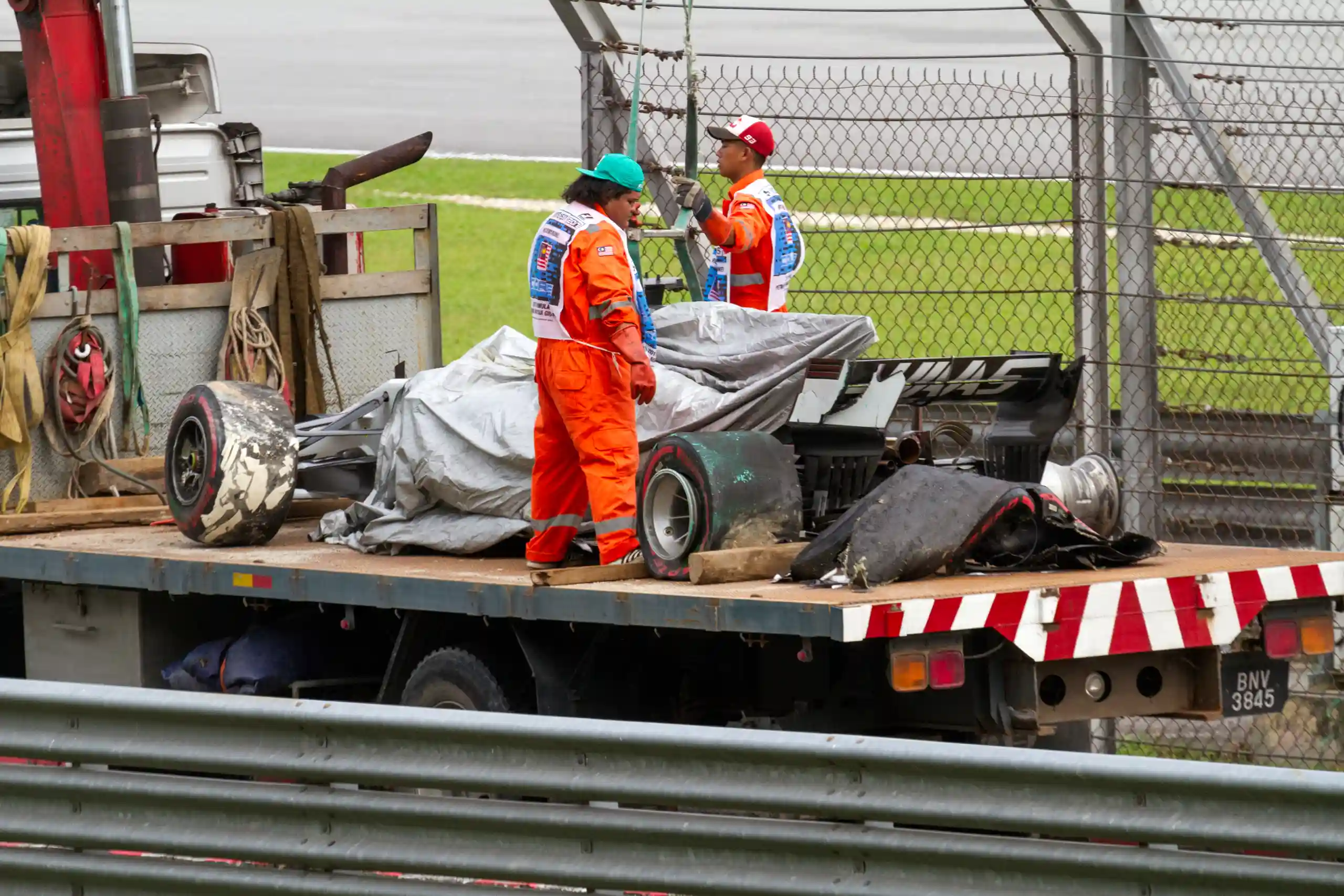
Yes, replacement parts and repairs generally consume capped resources. A serious crash can therefore delay upgrades or reduce the number of spare parts available later.
Crashes have always been expensive. Under the budget cap, they also carry a direct development consequence.
A front wing, floor and suspension assembly may need immediate replacement. The factory must divert materials and labor.
Opportunity Cost Is the Real Damage
The team does not merely pay for broken parts. It loses the chance to spend that money elsewhere.
A replacement floor may displace a planned upgrade. Extra production can also overload the factory.
Street Circuits Change Spare Planning
Monaco, Baku and Singapore create a higher wall-contact risk. Teams often bring more critical spares.
However, extra inventory costs money. The team must balance preparedness against unused stock.
Driver Error Can Affect Both Cars
A major crash can consume parts intended for the teammate. It may also force both cars to use an older specification.
Therefore, clean driving helps the development program. Reliability and discipline have financial value.
Read what causes crashes in motor racing.
Has the F1 Cost Cap Made Racing More Competitive?
The cap has improved financial sustainability and limited unlimited spending. However, it cannot erase existing infrastructure, technical knowledge or regulatory advantages immediately.
The cost cap was designed to encourage convergence. It was never expected to make all cars equal overnight.
Large teams entered 2021 with better facilities and deeper experience. Those advantages remained after annual spending was controlled.
The Cap Limits Recovery Spending
A struggling wealthy team cannot simply double its development budget. It must solve problems within the same ceiling.
That makes poor decisions more costly. It also gives efficient smaller teams a chance to outperform their revenue level.
Aerodynamic Testing Rules Work Beside the Cap
The championship also uses a sliding scale for wind-tunnel and CFD allocation. Lower-ranked teams receive more testing.
Therefore, financial and sporting regulations work together. The cost cap controls money, while the testing scale controls development opportunity.
New Regulations Can Reset the Order
A major rules change creates uncertainty. A team that interprets the regulations well can jump forward.
However, the cap limits how many wrong paths it can explore. The 2026 car and engine rules make efficiency especially important.
Future regulation changes will create another development cycle in which spending efficiency matters.
Financial Stability Is the Clearest Success
Teams can forecast performance spending more accurately. Owners face less risk from an unrestricted arms race.
That stability supports investment and franchise value. It also reduces the chance that a team disappears mid-cycle.
How the Cost Cap Affects Profitability and Team Value
The cost cap can improve profitability by controlling performance spending, but it does not guarantee profit. Driver salaries, travel, marketing and other excluded costs remain substantial.
A team can earn revenue above the cap. That changes the economics of success.
Before 2021, extra sponsorship often funded more development. Rivals then responded with more spending.
Now, revenue growth can improve operating results. It can also fund excluded activity or long-term infrastructure.
Predictability Attracts Investors
Investors prefer a business with visible cost boundaries. The cap creates a more stable planning environment.
Meanwhile, Formula 1 revenue and central team payments have grown. Strong income and controlled spending support valuations.
Capital Investment Still Matters
Teams continue building factories, simulators and wind tunnels. The 2026 depreciation treatment connects those assets to the annual cap.
Therefore, the timing and useful life of equipment become strategic. A new facility can improve efficiency while also creating future capped depreciation.
Profit Is Not Guaranteed
A team still pays drivers and senior leaders. Global travel, marketing and sponsor service remain expensive.
Moreover, a manufacturer may accept a low team profit for wider marketing value. Private-team and works-team accounts are not directly comparable.
Read how much a Formula 1 car costs for the hardware side.
Common Myths About the Formula 1 Budget Cap
“Every Team Can Spend Only $215 Million in Total”
False. The $215 million figure covers defined Relevant Costs.
Drivers, top salaries, marketing, travel and other exclusions can push total spending much higher.
“A Team Cannot Earn More Than the Cap”
False. Revenue is not capped.
A team can increase sponsorship, merchandise and central payments without raising its permitted performance spending.
“Engine Development Is Inside the Team Cap”
Not as a complete program. Power-unit manufacturers follow a separate $190 million 2026 framework.
Customer supply and team payments receive detailed treatment under both rulebooks.
“Minor Overspend Means the FIA Does Not Care”
False. A breach below five percent can still bring a fine and sporting penalty.
Red Bull’s 2021 case produced both financial and aerodynamic sanctions.
“The Cost Cap Makes Every Car Equal”
False. Teams retain different people, facilities and ideas.
The cap limits spending, but engineering quality still decides performance.
“Crash Damage Is Free Because It Was Accidental”
False. Replacement parts usually consume capped resources.
Accidents can delay upgrades even when the driver did not cause the incident.
F1 Cost Cap FAQs
What is the F1 cost cap?
The F1 cost cap limits defined spending that directly affects car performance. The 2026 base team cap is $215 million before applicable adjustments.
What is included in the F1 cost cap?
Research, design, aerodynamic development, most technical payroll, manufacturing, upgrades, spares and crash repairs generally count.
Are F1 driver salaries included in the cost cap?
No. Driver retainers are excluded. The three highest-paid staff salaries and several commercial, legal and travel costs are also outside.
What happens if an F1 team breaks the cost cap?
The FIA can impose fines and sporting sanctions, including reduced aerodynamic testing, points deductions, spending restrictions, suspension or exclusion.
Conclusion: The F1 Cost Cap Controls Performance Spending, Not the Whole Team
So, what is the F1 cost cap?
It is the FIA’s limit on defined spending connected to the performance of a Formula 1 car.
The 2026 team cap is $215 million before applicable adjustments. However, that number uses a wider scope than the old framework.
Depreciation moved into the main cap. The separate capital-expenditure allowance disappeared.
Shared staff allocations also became stricter. Meanwhile, health, safety and catering costs received exclusions.
Teams can carry up to $2 million of unused cap into the following year. High-cost jurisdictions also have an adjustment mechanism.
The cap usually includes research, design and aerodynamic work. It also captures most technical salaries, manufacturing and replacement parts.
However, driver retainers remain outside. So do the three highest-paid staff members.
Marketing, legal, finance, HR, heritage activity and race travel are also major exclusions.
Therefore, an F1 team’s total spending can exceed $215 million. The rule focuses on competitive performance rather than every corporate expense.
Power-unit manufacturers follow another financial framework. Their 2026 cap is $190 million before indexation.
A future supplier receives a $148.5 million pre-entry cap for each of its final three development years.
The FIA Cost Cap Administration audits team submissions. It reviews financial records, technical activity and related-party values.
A procedural breach can occur without overspending. A minor overspend remains below five percent.
A material overspend exceeds five percent. If confirmed, it requires a Constructors’ Championship points deduction.
Other penalties can include fines, wind-tunnel restrictions and future spending reductions. Severe cases can bring suspension or exclusion.
Red Bull’s 2021 breach proved the rule has sporting consequences. The team paid $7 million and lost aerodynamic-testing capacity.
The latest completed review covered 2024. No team exceeded the cap.
Nine teams complied fully. Aston Martin received a minor procedural finding without an overspend or fine.
On track, the cap changes every development decision. A failed floor, spare wing or crash repair consumes limited resources.
Consequently, efficiency has become a performance tool. The best team must spend intelligently as well as design quickly.
The cap has not made every constructor equal. Existing facilities and knowledge still matter.
Nevertheless, it has ended the era of unlimited performance spending. That has improved financial stability across the grid.
Ultimately, Formula 1 still rewards innovation. It now asks every team to innovate inside a controlled financial boundary.
Sources and Fact-Checking
This article was checked against official FIA and Formula 1 material available on July 27, 2026. Headline cap values are base figures before applicable indexation and regulatory adjustments.
- FIA 2026 Formula 1 Regulations, Section D: Financial Regulations for F1 Teams, Issue 07
- Formula 1: What the 2026 cost cap is, why it increased and which major costs are excluded
- FIA: 2024 reporting-period compliance review for teams and power-unit manufacturers
- FIA: Red Bull Racing 2021 Accepted Breach Agreement public summary