Formula E Teams Explained:
Full List, Drivers & 2026 Grid Breakdown
Every manufacturer, every driver pairing, and every grid change across the ABB FIA Formula E World Championship’s most reshuffled season yet.
Formula E Teams: Full List, Drivers & Grid
Every manufacturer and driver pairing across the most reshuffled Formula E season yet.
Formula E’s current championship season fields 10 teams and 20 drivers, racing the final year of the Gen3 Evo car before the sport’s next major technical leap. However, the grid looks meaningfully different from a year ago. McLaren walked away to focus on its sports car programme, Maserati’s slot transformed into a brand-new Citroën factory entry, and several of the sport’s most recognisable names swapped garages entirely.
This guide breaks down every team competing right now, who drives for them, what powertrain sits behind each car, and where the championship picture stands heading into the closing rounds of the season. Therefore, whether you are new to electric racing or have followed every E-Prix since season one, this is the complete reference for understanding who is actually racing.
What Are Formula E Teams, Exactly?
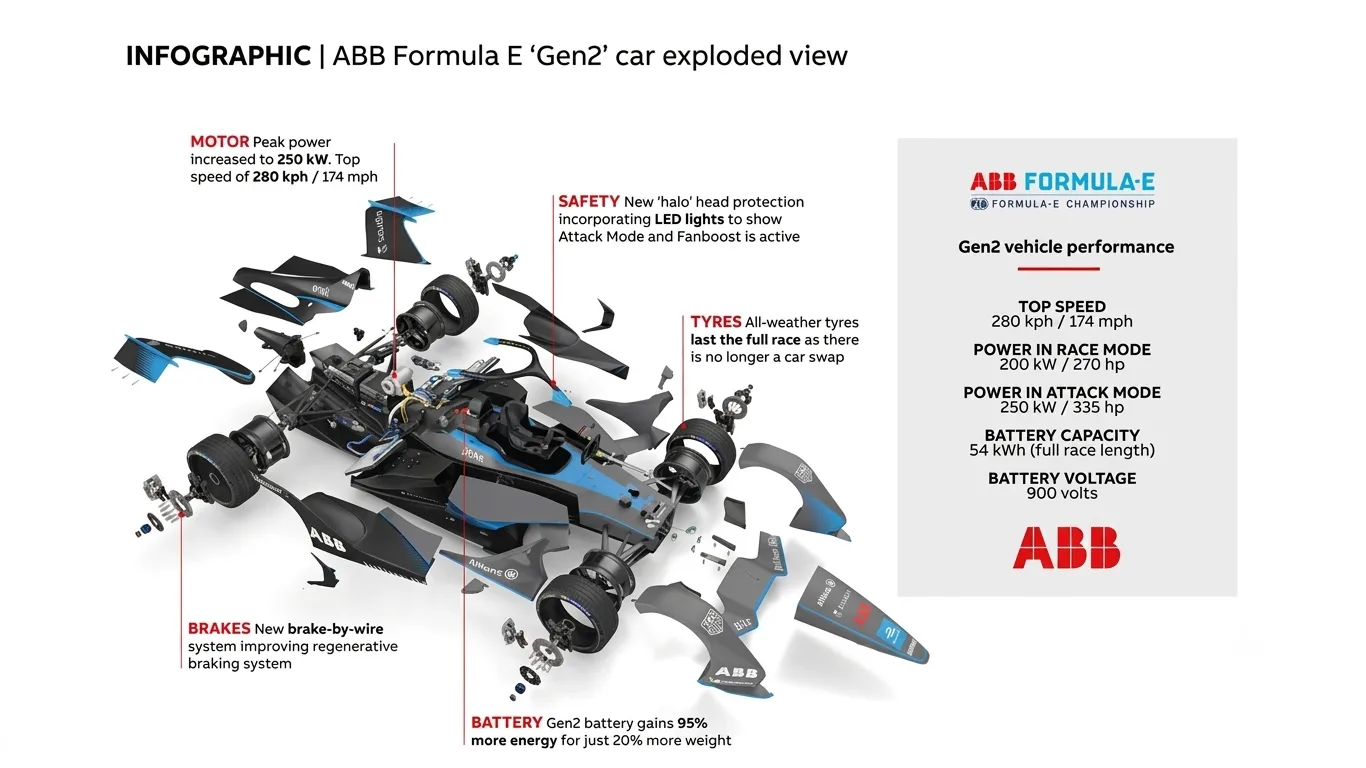
Formula E teams are the official entrants competing in the ABB FIA Formula E World Championship, the FIA-sanctioned series for fully electric open-wheel race cars. Unlike Formula 1, every team races an identical Gen3 Evo chassis built to a single spec. Consequently, the competitive differences between teams come almost entirely from the powertrain, software, and driver execution rather than aerodynamic development.
The grid splits into two structural categories. Manufacturer teams, such as Porsche, Jaguar, and Nissan, design and build their own electric powertrains in-house. Meanwhile, customer teams purchase a finished powertrain from one of those manufacturers and race it under their own banner. Envision Racing, for example, runs Jaguar powertrains as a customer operation, while Cupra Kiro currently uses Porsche-supplied units.
Every Gen3 Evo car shares the same chassis and battery capacity. Therefore, the real competitive battle happens in energy management software — how efficiently a team’s regenerative braking and Attack Mode deployment strategy extracts lap time from a fixed energy budget. This is fundamentally different from traditional combustion racing, where raw horsepower and fuel load dominate strategy conversations.
The Complete Formula E Teams List for 2026
The current Formula E season fields 10 teams across the full calendar. Below is the complete, accurate breakdown of who races for whom right now.
| Team | Driver 1 | Driver 2 | Powertrain |
|---|---|---|---|
| Porsche Formula E Team | Pascal Wehrlein | Nico Müller | Porsche (Factory) |
| Jaguar TCS Racing | Mitch Evans | António Félix da Costa | Jaguar (Factory) |
| Nissan Formula E Team | Oliver Rowland | Norman Nato | Nissan (Factory) |
| Mahindra Racing | Nyck de Vries | Edoardo Mortara | Mahindra (Factory) |
| DS Penske | Maximilian Günther | Taylor Barnard | DS Automobiles (Factory) |
| Andretti Formula E | Jake Dennis | Felipe Drugovich | Porsche (Customer) |
| Envision Racing | Sébastien Buemi | Joel Eriksson | Jaguar (Customer) |
| Citroën Racing | Nick Cassidy | Jean-Éric Vergne | DS Automobiles (Factory Debut) |
| Lola Yamaha ABT | Lucas di Grassi | Zane Maloney | Mahindra (Customer) |
| Cupra Kiro | Dan Ticktum | Josep María Martí | Porsche (Customer) |
McLaren’s Formula E programme ended after the previous season, with the British team shifting its motorsport focus toward its World Endurance Championship LMDh project. The Maserati MSG entry transformed into a brand-new Citroën factory effort for this season, immediately rewarded with a maiden win in just the team’s second race.
Team-by-Team Profiles: Who’s Who on the Grid
Porsche Formula E Team
Porsche’s tactical superiority has defined this season’s narrative. Wehrlein leads the championship through relentless, race-after-race consistency rather than outright dominance — scoring points in every single round so far. Moreover, his Jeddah victory marked Porsche’s 100th E-Prix win, a milestone that underlines exactly how thoroughly the German manufacturer has mastered Formula E’s energy management challenge.
Müller joined the works team after a single season at Andretti, replacing António Félix da Costa, who departed for Jaguar. Therefore, Porsche enters this stretch of the season with arguably the strongest combination of proven race-winning pace and tactical software sophistication on the entire grid.
Jaguar TCS Racing
Evans extended his all-time win record this season and currently sits second in the championship, just a handful of points behind Wehrlein. Furthermore, Jaguar’s switch of partners — bringing in da Costa, a former champion, to replace the departed Nick Cassidy — gave the team a genuine second title threat alongside Evans rather than a clear number-two driver.
The pairing delivered a dominant result at the brand-new Madrid E-Prix, with da Costa taking victory as Jaguar locked out the podium’s top positions. Consequently, Jaguar currently leads the Teams’ Championship standings, reflecting how strong this lineup has performed across the season’s first half.
Nissan Formula E Team
Rowland enters this season carrying the number one car as reigning World Champion, and he has remained committed to Nissan through the defence of his title. His Monaco E-Prix win — engineered through a sharp Attack Mode split — reignited his championship campaign after a quieter opening stretch.
Nato continues alongside him, adding versatility and consistent points-scoring depth to Nissan’s title challenge. However, the team has shown flashes of pure speed without yet matching Porsche or Jaguar’s race-by-race reliability across the full season.
Mahindra Racing
Mahindra retains one of the grid’s most settled and experienced pairings. De Vries returned to the team after a brief Formula 1 stint and immediately found form again, breaking a near five-year winless drought for himself with victory in the Monaco E-Prix opener. Meanwhile, Mortara has quietly built one of the season’s most potent campaigns, sitting second in the drivers’ standings through consistent podium finishes in Mexico and Jeddah.
The Indian manufacturer continues testing ambitious software concepts each season, and this year’s results suggest that long-term investment in energy strategy is finally paying genuine championship dividends.
DS Penske
DS Penske brings deep French electric vehicle engineering experience together with Penske’s renowned racing operational excellence. Barnard joins after finishing as the most successful rookie in the previous campaign, having scored five podiums and two pole positions during his time with the now-departed McLaren squad.
Replacing Jean-Éric Vergne, who departed for the new Citroën entry after eight seasons with the DS brand, Barnard’s arrival gives the team fresh momentum. Therefore, DS Penske heads into the remainder of the season looking to convert Günther’s experience and Barnard’s emerging pace into a stronger points haul.
Andretti Formula E
Andretti leverages Porsche customer powertrains and opened the season with a statement win courtesy of Jake Dennis in São Paulo. Felipe Drugovich joins as a fresh full-season signing after several rookie test appearances and a one-round substitute outing the previous year, bringing genuine single-seater pedigree as a former FIA Formula 2 Champion.
Envision Racing
Envision continues proving that a well-run customer operation can outperform factory-backed rivals using identical Jaguar powertrains. Sébastien Buemi remains the team’s senior driver after years of consistent performance, while Joel Eriksson steps up from Jaguar’s reserve role to his first full-time seat, replacing the departed Robin Frijns.
Citroën Racing
Citroën’s arrival represents the single biggest structural story of the season. The historic French manufacturer makes its single-seater racing debut, taking over the technical entry previously occupied by Maserati MSG Racing. Nick Cassidy, last season’s runner-up, departed Jaguar to lead the new effort, and Jean-Éric Vergne — a two-time Formula E champion — joined him from DS Penske.
The pairing delivered an immediate payoff: Cassidy secured Citroën’s first-ever Formula E win in just the team’s second race weekend, in Mexico City. Consequently, what could have been a difficult debut season instead became one of the grid’s most talked-about success stories early on.
Lola Yamaha ABT
The historic Lola brand returned to global motorsport with this Mahindra-powered customer entry, and Lucas di Grassi remains the most experienced driver on the entire grid behind the wheel. Zane Maloney partners him, giving the squad a blend of veteran race craft and emerging young talent as it continues building toward sustained competitiveness.
Cupra Kiro
Formerly known simply as Kiro Race Co, the team now races under the Cupra banner using Porsche customer powertrains. Dan Ticktum claimed an eye-catching pole position at Monaco, while Josep María Martí — a promising young Spaniard who graduated through Formula 3 and Formula 2 — earned a surprise maiden podium after a late penalty for Ticktum opened the door during a chaotic Monaco race.
What Changed: New Teams, Departures & Driver Moves
This season produced one of the most significant grid reshuffles in the championship’s history. Understanding what changed — and why — explains a lot about the current competitive picture.
McLaren’s Departure
After three seasons on the grid, McLaren announced it would not return to Formula E, choosing instead to concentrate its motorsport resources on its World Endurance Championship LMDh sports car programme. Therefore, the spot McLaren vacated effectively became available for new entrants, and Taylor Barnard — McLaren’s standout young driver — moved to DS Penske rather than losing his seat entirely.
Citroën Replaces Maserati
Maserati MSG Racing’s grid slot transformed into a brand-new Citroën factory entry, marking the historic French brand’s first appearance in single-seater motorsport. The Stellantis-backed effort wasted no time making an impression, immediately fighting for podiums and securing a maiden victory within its first two race weekends.
The Biggest Driver Swaps
- Nick Cassidy: Moved from Jaguar TCS Racing to lead the new Citroën Racing effort.
- Jean-Éric Vergne: Departed DS Penske after eight seasons with the brand to join Cassidy at Citroën.
- António Félix da Costa: Left Porsche after three seasons, moving to Jaguar to fill the seat Cassidy vacated.
- Nico Müller: Departed Andretti after a single season to join the Porsche works team.
- Felipe Drugovich: Signed with Andretti as a full-season rookie after prior test and substitute appearances.
- Taylor Barnard: Moved from the departing McLaren squad to DS Penske.
- Joel Eriksson: Promoted from Jaguar’s reserve role to a full-time Envision Racing seat.
Five different winners across the first five races of the season tells you everything about how tight this grid has become. No single team or powertrain supplier has been able to establish the kind of dominance that defined Formula E’s earlier Gen2 era.
Which Formula E Team Is Strongest Right Now?
Ranking Formula E teams requires looking past qualifying speed alone. Energy management consistency across a full race distance ultimately separates genuine title contenders from teams capable of the occasional flash of pace.
What’s Next: The Gen4 Era Arrives
This is the fourth and final season for the Gen3 Evo car, with the next-generation Gen4 regulations taking effect the following year. Therefore, every team on the current grid is simultaneously racing for points today while quietly developing the powertrain and software concepts that will define the next technical era.
Historically, regulation changes in Formula E have reshuffled the competitive order significantly — teams that nail the new battery and powertrain architecture early can leapfrog established frontrunners, while teams that misjudge it can fall backward just as quickly. Consequently, how Citroën’s promising debut season translates into Gen4 development, and whether Porsche and Jaguar’s current software advantage carries over to genuinely new hardware, will shape the next several years of the championship.
Formula E has always positioned itself as a real-world testbed for consumer electric vehicle technology, not purely a racing spectacle. Battery management techniques and regenerative braking strategies refined under Gen4 regulations will likely influence how manufacturers approach production EV development. For more context on electric racing’s broader place in motorsport, see our is Formula E faster than Formula 1 comparison and is Formula E a respected race category explainer.
Frequently Asked Questions
Verify This Information — High-Authority Sources
Why this Formula E grid is worth following closely
Five different race winners across the season’s first five rounds tells a clear story: no single team or powertrain has solved Formula E’s energy management puzzle decisively enough to dominate. Therefore, the championship battle genuinely remains open between Wehrlein’s Porsche consistency, Evans and da Costa’s Jaguar speed, and Mortara’s quietly building Mahindra campaign.
Citroën’s immediate competitiveness adds a layer that pure grid analysis often misses — a brand-new manufacturer entry winning within two race weekends is a rare achievement in any racing series, let alone one as technically demanding as Formula E’s energy-limited format. As the season heads toward its Gen4 future, this year’s results will matter for far longer than just this year’s trophy.