McLaren Formula E Withdrawal Explained:
Why the Team Is Leaving & What Happens Next
After three seasons under the papaya banner, McLaren Racing is ending its NEOM McLaren Formula E program. Here is everything — the real reasons, the full timeline, what it means for the drivers, and where McLaren goes from here.
McLaren Formula E Withdrawal: Why, When & What’s Next
McLaren is leaving Formula E after Season 11. Here’s the full picture — reasons, timeline, drivers, and future plans.
Few announcements in recent electric motorsport history landed quite as heavily as the McLaren Formula E withdrawal. For three seasons, the iconic papaya orange had lit up city street circuits from Monaco to Tokyo — a vivid symbol of one of motorsport’s most recognisable brands committing to the electric future. Then, in the spring of 2025, McLaren Racing confirmed what paddock insiders had been quietly discussing for months: the NEOM McLaren Formula E Team would leave the grid at the end of Season 11.
This was not a crisis decision. Furthermore, it was not a knee-jerk reaction to a difficult season. Instead, it was a ruthlessly calculated strategic pivot — the kind that Zak Brown has become known for since taking the McLaren Racing CEO chair. To understand why, you have to look beyond the Formula E paddock itself and examine what McLaren is building toward in endurance racing, how their Formula 1 programme now consumes the bulk of their engineering ambition, and what that means for the championship they are leaving behind.
This guide covers every angle of the McLaren Formula E exit — the real financial and strategic reasons, the complete timeline from entry to departure, what happens to the drivers and staff, who might take over the franchise, and exactly where McLaren’s motorsport story goes next.
What Happened to McLaren’s Formula E Team?
The McLaren Formula E withdrawal refers to the confirmed decision by McLaren Racing to end its participation in the FIA Formula E World Championship. The exit concludes their operation of the NEOM McLaren Formula E Team — a joint venture between McLaren Racing and NEOM, the Saudi Arabian giga-project development that served as title sponsor. McLaren announced the formal withdrawal in spring 2025, committing to complete Season 11 before handing back or selling their grid slot.
To understand what they are walking away from, it helps to understand how they got in. McLaren did not build a Formula E team from scratch. Instead, they made a highly strategic acquisition. When Mercedes-EQ decided to exit the championship after winning back-to-back drivers’ and teams’ titles in Seasons 7 and 8, McLaren moved quickly. They purchased the Mercedes-EQ operation outright — staff, infrastructure, the championship-winning Brackley facility, and all the institutional knowledge built across eight seasons of Formula E competition.
McLaren’s Formula E story began with the 2022/23 season (Season 9). By acquiring the outgoing Mercedes-EQ team — including Team Principal Ian James, who stayed on in the same role — McLaren inherited arguably the strongest operational infrastructure on the grid. They secured a powertrain deal with Nissan and rebranded everything in distinctive papaya orange. The NEOM title sponsorship gave them serious commercial firepower from day one. For a full overview of the current Formula E grid, see our Formula E teams guide.
What Is the NEOM McLaren Formula E Team?
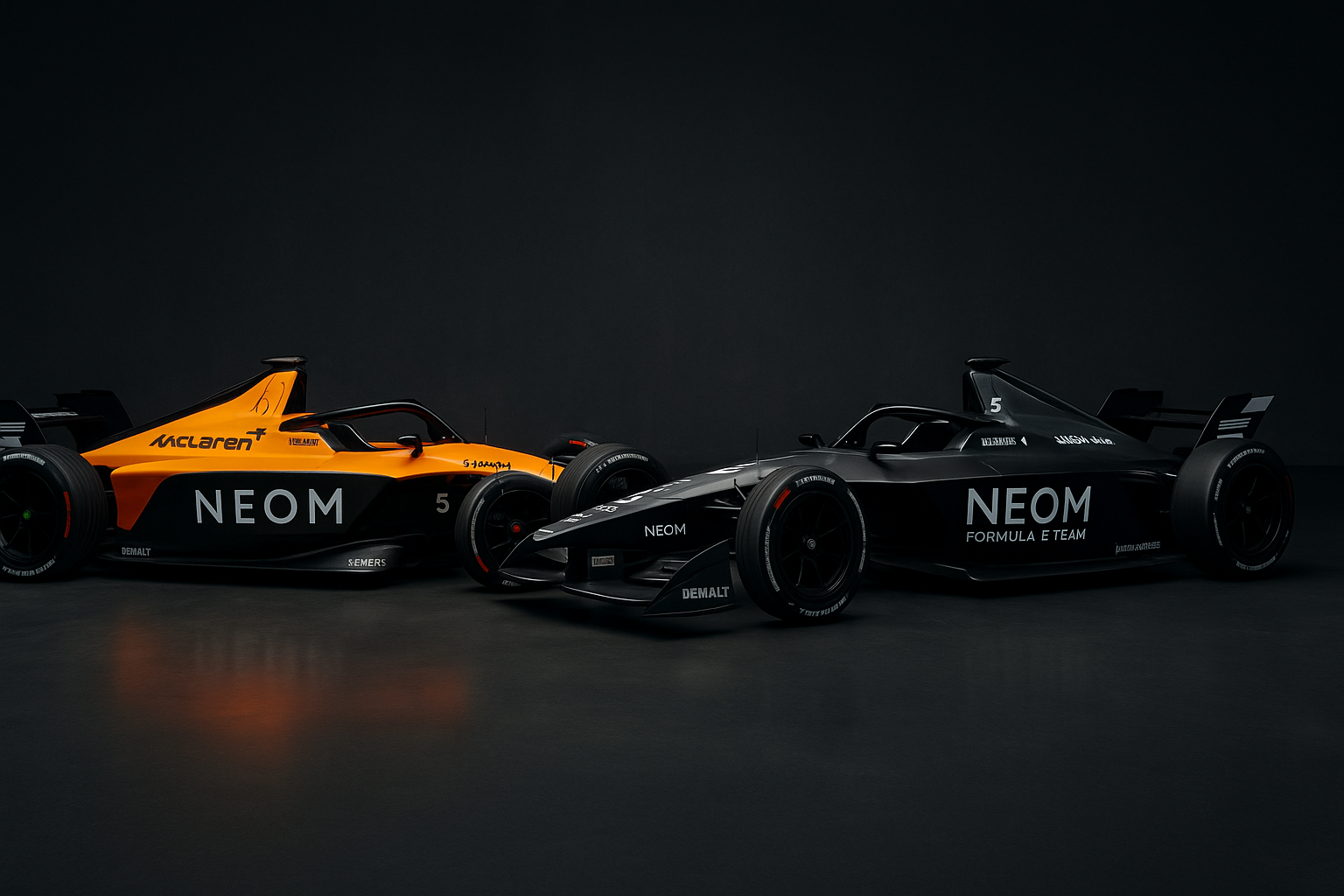
The NEOM McLaren Formula E Team was the official name under which McLaren raced in the series from Season 9 onward. NEOM — a Saudi Arabian smart city and giga-project development — brought substantial financial backing and global marketing ambitions to the partnership. The McLaren side contributed the iconic papaya branding, the championship-winning Mercedes-EQ infrastructure, and Zak Brown’s commercial network for sponsor activation.
For NEOM, Formula E was a natural fit. Moreover, the series’ sustainability credentials aligned directly with NEOM’s stated vision of a renewable-energy-powered city of the future. For McLaren, the partnership provided a cost-sharing arrangement that made Formula E financially viable alongside their Formula 1 commitments. When the withdrawal was announced, both parties confirmed the separation was mutually agreed and professionally managed. The papaya cars completed their obligations — no acrimony, no courtroom drama.
Why Is McLaren Leaving Formula E?
The McLaren Formula E withdrawal was driven by three overlapping forces: a long-term strategic shift toward endurance racing, a hard-headed ROI calculation that no longer favoured Formula E over other programmes, and a top-down leadership decision by Zak Brown to tighten McLaren’s motorsport portfolio rather than spread it further. None of these reasons is embarrassing. However, together they represent a judgement that Formula E — for all its genuine merit — no longer earned its seat at the McLaren Racing resource table.
Motorsport is the most unforgiving ROI exercise in global sport. When the numbers stop working, no amount of paddock goodwill will keep a factory team on the grid.
1. The WEC Hypercar Programme Changes Everything
The single biggest driver of the McLaren Formula E exit is the blockbuster commitment to the FIA World Endurance Championship (WEC) Hypercar class, targeting 2027. This is McLaren returning to Le Mans for the first time since the legendary 1995 victory that remains one of the most celebrated results in the sport’s history. Building a Hypercar from scratch — developing the hybrid powertrain, the aerodynamic package, the endurance-optimised chassis — requires enormous engineering bandwidth.
Furthermore, McLaren’s road car division is fundamentally oriented around high-performance hybrid and eventually electric supercars. A Hypercar programme provides genuine technical crossover: the development of energy recovery systems, high-performance electrification, and extreme thermal management has direct relevance to McLaren Automotive. Formula E, by contrast, operates on a spec powertrain format that limits the technical learning McLaren can extract and apply to road car development. The Hypercar programme simply offered a more compelling engineering return on the same investment.
Le Mans Legacy & The Triple Crown
McLaren won the 24 Hours of Le Mans in 1995 with the F1 GTR. That remains one of motorsport’s greatest achievements. The 2027 Hypercar entry represents a direct attempt to recapture that legacy and pursue the Triple Crown — a feat deeply embedded in McLaren’s identity. Formula E cannot offer that narrative.
Financial ROI — The Hard Numbers
Formula E’s global viewership, while growing, still trails traditional series. McLaren’s sponsors pay for mass-market exposure. A series that draws smaller TV audiences — even on premium city circuits — delivers a smaller return per marketing dollar than F1 or WEC. The budget freed by exiting Formula E strengthens McLaren’s F1 war chest directly.
Zak Brown’s Strategic Focus
Brown built McLaren into a multi-series racing operation covering F1, IndyCar, Extreme E, and Formula E. However, his philosophy has always been pragmatic expansion paired with brutal pruning. When a programme no longer serves the brand’s core direction, it gets cut — regardless of the sentimental attachment.
F1 Is Booming — Nothing Distracts From It
McLaren’s Formula 1 team is fighting at the front of the championship grid. The budget cap era makes F1 the most profitable it has ever been for successful teams. Every resource decision — engineering talent, capital, leadership bandwidth — must now serve the F1 programme first. Formula E was a distraction McLaren could no longer justify.
The BMW Parallel: When Corporate Math Beats Motorsport Loyalty
To understand how corporate racing decisions work, it helps to look at historical precedent. BMW left Formula 1 at the end of 2009 — not because the championship lacked prestige, but because the global financial crisis demanded budget cuts and F1’s V8 regulations offered zero relevance to their road car development strategy. The cost could not be justified. Consequently, BMW redirected those resources into programmes with clearer commercial alignment.
McLaren’s Formula E exit follows the same logic. When a racing series no longer delivers the technical learning, the broadcast exposure, or the commercial return that justifies the operational cost — even a brand as deeply invested in motorsport as McLaren will walk away cleanly. This is not failure. Moreover, it is rational capital allocation in an industry where the margins between competitive funding and operational survival are always narrower than outsiders assume. For more context on Formula E’s standing in the motorsport hierarchy, the series remains genuinely competitive — just not the right fit for McLaren’s current strategic direction.
McLaren F1 vs Formula E: No Competition
McLaren Formula E Timeline: Entry to Exit
Understanding the exact McLaren Formula E timeline clears up significant confusion. The popular “McLaren Formula E withdrawal 2022” search term is actually incorrect — 2022 marked their entry into the sport, not their departure. Their exit was confirmed in spring 2025, with the final racing season completed by the end of Season 11 (2024/25). Here is the complete chronology:
McLaren Formula E Drivers, Team Structure & Staff
The human story of the McLaren Formula E withdrawal is one that tends to get overlooked in the strategic analysis. Behind the papaya livery and the sponsor graphics sat a team of mechanics, engineers, data analysts, and strategists — most of whom transitioned from the championship-winning Mercedes-EQ programme — who built something genuinely competitive in a very short time. Their futures now depend on whether the franchise sale succeeds and whether the new owners retain the existing workforce.
The Drivers Who Flew the Papaya Flag
| Season | Driver | Nationality | Notable Achievement | Status |
|---|---|---|---|---|
| S9 (2022/23) | René Rast | 🇩🇪 German | 3× DTM champion — brought raw qualifying pace | Departed |
| S9 (2022/23) | Jake Hughes | 🇬🇧 British | First poles for McLaren in Formula E | Departed |
| S10 (2023/24) | Sam Bird | 🇬🇧 British | Veteran FE race winner — brought championship experience | Departed |
| S10–S11 | Taylor Barnard | 🇬🇧 British | Youngest polesitter in Formula E history | S11 Final Year |
Taylor Barnard’s achievement as the youngest polesitter in Formula E history is the headline result of McLaren’s time in the series. Furthermore, it demonstrates that the programme was producing genuine developmental value — finding and fast-tracking young talent into competitive positions. The question now is where Barnard lands when the McLaren door closes. If the franchise is sold and continuity is maintained, the most logical outcome is that he stays with the relaunched team under new branding.
Team Principal Ian James — The Quiet Constant
No single figure in this story deserves more recognition than Ian James. He transitioned from Mercedes-EQ to McLaren without missing a beat, providing the operational continuity that allowed a new team to immediately contend rather than spend a season finding its feet. Moreover, James is now instrumental in managing the franchise sale process — working to find a buyer who will keep the staff employed and the team’s competitive infrastructure intact.
His experience across multiple generations of Formula E car, combined with the relationships he has built across the FIA, the FE commercial structure, and the driver management community, makes him one of the most valuable team principals in the championship. Whoever buys the McLaren slot should consider retaining him a non-negotiable requirement. Read more about how to follow Formula E through the transition period as the new owner announcement approaches.
What Does McLaren’s Exit Mean for Formula E?
The question everyone asks first is: does the McLaren Formula E withdrawal hurt the championship? The honest answer is — yes, in the short term it stings. Losing a brand of McLaren’s global stature from the grid is never neutral. However, Formula E has demonstrated a remarkably resilient ability to absorb manufacturer exits. Audi left after Season 7. BMW left after Season 7. Mercedes left after Season 8. In every case, the championship replaced the departing manufacturer within one to two seasons and continued growing its audience and commercial base.
The Manufacturers Who Remain
The Formula E grid entering Season 12 still carries genuine automotive credibility. Porsche, Jaguar, Nissan, and Stellantis (operating the Maserati and DS Automobiles programmes) remain committed, factory-backed operations. These are not token presences — they are fully supported manufacturer entries with serious engineering investment and long-term strategic rationale built around EV technology development for their road car divisions.
Who Will Take Over McLaren’s Grid Slot?
The Formula E franchise model is specifically designed to handle exits without grid disruption. McLaren’s franchise licence — the commercial right to operate a team on the Formula E grid — is a valuable, transferable asset. Ian James is actively facilitating its sale to a new owner. Several scenarios are plausible.
A new manufacturer could acquire the slot as a ready-made entry point. Alternatively, a wealthy privateer investor group could rebrand the team similarly to how many Formula E teams operated in the championship’s early seasons. The infrastructure — staff, equipment, operational processes — can theoretically be maintained under any new identity. The precedent from previous manufacturer exits strongly suggests the grid slot will be filled before Season 12 begins. Moreover, the current Formula E schedule continues to expand into new markets, making the commercial case for owning a franchise stronger than it has ever been.
The wider picture is more nuanced than the McLaren headline suggests. In Season 12, Formula E is set to introduce the Gen3 Evo regulations — delivering improved performance and efficiency in its cars. Meanwhile, the championship’s push into new markets in Asia, the Middle East, and North America continues. Several automotive brands that do not currently participate in Formula E are publicly exploring future entries. McLaren leaving does not signal a collapse. However, it does reinforce that Formula E must keep improving its broadcast numbers and commercial model to retain the world’s top automotive brands long-term. For a deeper look at the series, see our guide on how Formula E compares to Formula 1.
McLaren’s Future Motorsport Plans After Formula E
The McLaren Formula E withdrawal is best understood not as an exit but as a redirection. Resources do not disappear — they are reallocated. And the picture of where those resources are heading tells a very coherent story about what McLaren Racing is trying to become over the next five to ten years.
The 2027 WEC Hypercar Entry — The Big Prize
McLaren officially confirmed plans for a WEC Hypercar programme targeting 2027. This is the single most consequential element of the strategic picture. The 24 Hours of Le Mans in 1995 — where the McLaren F1 GTR finished first, third, fourth, fifth and thirteenth — remains one of the defining moments of the brand’s motorsport identity. McLaren CEO Zak Brown has spoken repeatedly about returning to Le Mans as unfinished business that the organisation intends to resolve.
A Hypercar entry requires a minimum two-year development cycle from engineering commitment to race-ready car. By freeing up the technical staff and capital previously allocated to Formula E, McLaren can accelerate that development timeline. Furthermore, the hybrid powertrain technology at the heart of a modern WEC Hypercar has far more direct relevance to McLaren’s road car division than anything the Formula E spec platform could offer. The P1, the Artura, and every future electrified McLaren road car benefits from the thermal management, energy recovery, and high-voltage system engineering that a Hypercar programme demands.
The motorsport Triple Crown — the Indianapolis 500, the 24 Hours of Le Mans, and the Monaco Grand Prix — represents the pinnacle of three distinct disciplines. McLaren won Monaco multiple times through their F1 programme. They came close at Indianapolis through their Arrow McLaren IndyCar partnership. The 1995 Le Mans victory is already in the record books. However, a new factory Hypercar effort would allow McLaren to pursue a modern Le Mans win — a distinction that matters enormously to both the brand and the motorsport community. Follow the IndyCar side of McLaren’s efforts at our IndyCar racing guide.
Formula 1 — The Crown Jewel That Demands Everything
McLaren’s Formula 1 team is at the most competitive point it has been in over a decade. The budget cap era has levelled the playing field enough that a well-funded, well-organised team like McLaren can genuinely fight for race wins and championship positions. Lando Norris’s development into a front-running driver capable of championship contention, combined with the ongoing upgrade programme at the Woking technical centre, means the F1 team is entering its most important phase in years.
No Formula E withdrawal, no Hypercar announcement, and no IndyCar partnership can be allowed to divert engineering talent or leadership attention from that F1 fight. Brown understands this completely. By cutting Formula E, he removes one more competing demand on the organisation’s most valuable resource: the time and focus of McLaren’s best engineers and strategists. For context on McLaren’s F1 situation, check our 2026 F1 teams overview.
Arrow McLaren in IndyCar — Staying Put
The Arrow McLaren IndyCar programme is not affected by the Formula E exit. The IndyCar operation functions as a largely separate entity with its own commercial infrastructure, sponsor base, and engineering staff. Moreover, IndyCar provides McLaren with significant North American brand presence — a market where Formula 1’s boom has created enormous appetite for premium motorsport brands. The Indy 500 specifically offers the kind of iconic global moment that justifies the sponsorship investment on its own.
Therefore, fans of McLaren’s IndyCar programme should rest easy. The Formula E withdrawal does not signal a broader retreat from multi-series racing. Instead, it represents a pruning of the portfolio — keeping the programmes that work commercially and strategically while eliminating the one that has run its course.
McLaren Lego & Brand Legacy From Formula E
Even as the racing operation winds down, the brand impact of McLaren’s time in Formula E lives on in unexpected places. The highly popular McLaren Formula E LEGO Technic set — released to celebrate the team’s entry — became one of the best-selling McLaren merchandise items of the period. It introduced the brand to a younger demographic through the Formula E story, teaching children about electric drivetrains and pull-back mechanisms in McLaren’s iconic colours. That brand reach does not evaporate when the car leaves the grid. Furthermore, it represents exactly the kind of long-tail commercial benefit that justifies Formula E participation even for brands that ultimately exit — the awareness generated continues long after the last race.
Frequently Asked Questions — McLaren Formula E Exit
The Bottom Line: McLaren’s Exit Is a Pivot, Not a Retreat
The McLaren Formula E withdrawal marks the end of a three-season chapter that was genuinely exciting while it lasted. The papaya orange on city street circuits, Taylor Barnard’s record-breaking pole, Ian James’s quiet operational excellence — all of it will be remembered as a competitive, well-run programme that simply ran into a larger strategic reality.
McLaren is not retreating from motorsport. If anything, the ambition has grown larger. A factory Le Mans Hypercar entry by 2027, a Formula 1 team fighting for championships, and an IndyCar operation chasing the Indy 500 — that is a more coherent, more commercially powerful motorsport portfolio than one that also includes a formula series where the audience is still finding its scale. Zak Brown made a hard call. However, the logic is sound.
For Formula E, the immediate task is finding the right new owner for the McLaren franchise slot and ensuring the Series 12 grid is complete and credible. The championship is bigger than any single manufacturer. That has been proven multiple times. It will be proven again. Meanwhile, McLaren heads to Le Mans — and the motorsport world will be watching.