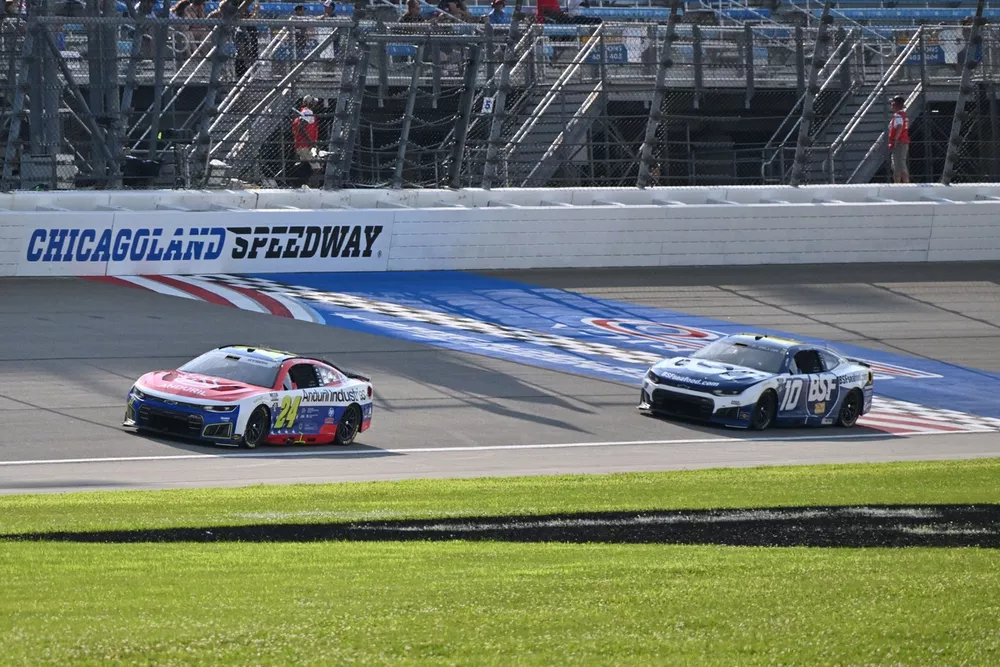
Chicagoland NASCAR 2026 Strategy Analysis:
Tyres, Fuel Windows & Pit Stop Tactics
267 laps. A worn, bumpy 1.5-mile oval back on the Cup schedule for the first time in seven years. No prior Next Gen data. Eight sets of Goodyears. And crew chiefs flying partially blind into the most strategically unpredictable intermediate race of the season.
Chicagoland Speedway is back. After a seven-year absence from the NASCAR Cup Series schedule, the 1.5-mile tri-oval in Joliet, Illinois, hosts the 2026 eero 400 on Sunday July 5. The return of this track is not just an emotional moment for Midwest fans — it is a genuine strategic puzzle that no current Cup team has fully solved. The Next Gen car has never turned a competitive lap at this facility. The surface has sat largely unused for seven years, developing bumps, ruts, and surface irregularities that crew chiefs described as more extreme than any other intermediate oval on the current schedule.
This is a race where strategy will matter as much as raw speed. The team that correctly reads tyre wear, manages eight sets of Goodyears through 267 laps, times its green-flag pit cycles, and makes smart calls during cautions will emerge with a trophy. The team that gets it wrong — whether by running short on tyres late or making a fuel miscalculation in the long 102-lap final stage — will watch the win disappear. This analysis breaks down every strategic dimension of the 2026 eero 400 at Chicagoland Speedway.
Chicagoland Speedway — The Track That Changed in Seven Years
Chicagoland Speedway opened in 2001. For nearly two decades it was a regular fixture on the Cup schedule — a 1.5-mile tri-oval in Joliet, Illinois, about 35 miles southwest of Chicago, capable of producing close racing and genuine strategy battles. The track went silent for Cup racing in 2019, removed from the schedule as NASCAR restructured its calendar during and after the COVID-19 period. It never officially closed. It simply waited.
Seven years of waiting have had consequences. The asphalt has aged, cracked, and developed the kind of character you cannot manufacture. Crew chiefs arriving at Chicagoland in 2026 described a surface with pronounced bumps, ruts worn into the racing groove, and sections where the Next Gen car’s underbody literally contacts the asphalt. That kind of surface fundamentally changes the strategic equation. Ride quality, not just raw pace, becomes a primary setup consideration.
What Makes Chicagoland Different From Other Intermediates
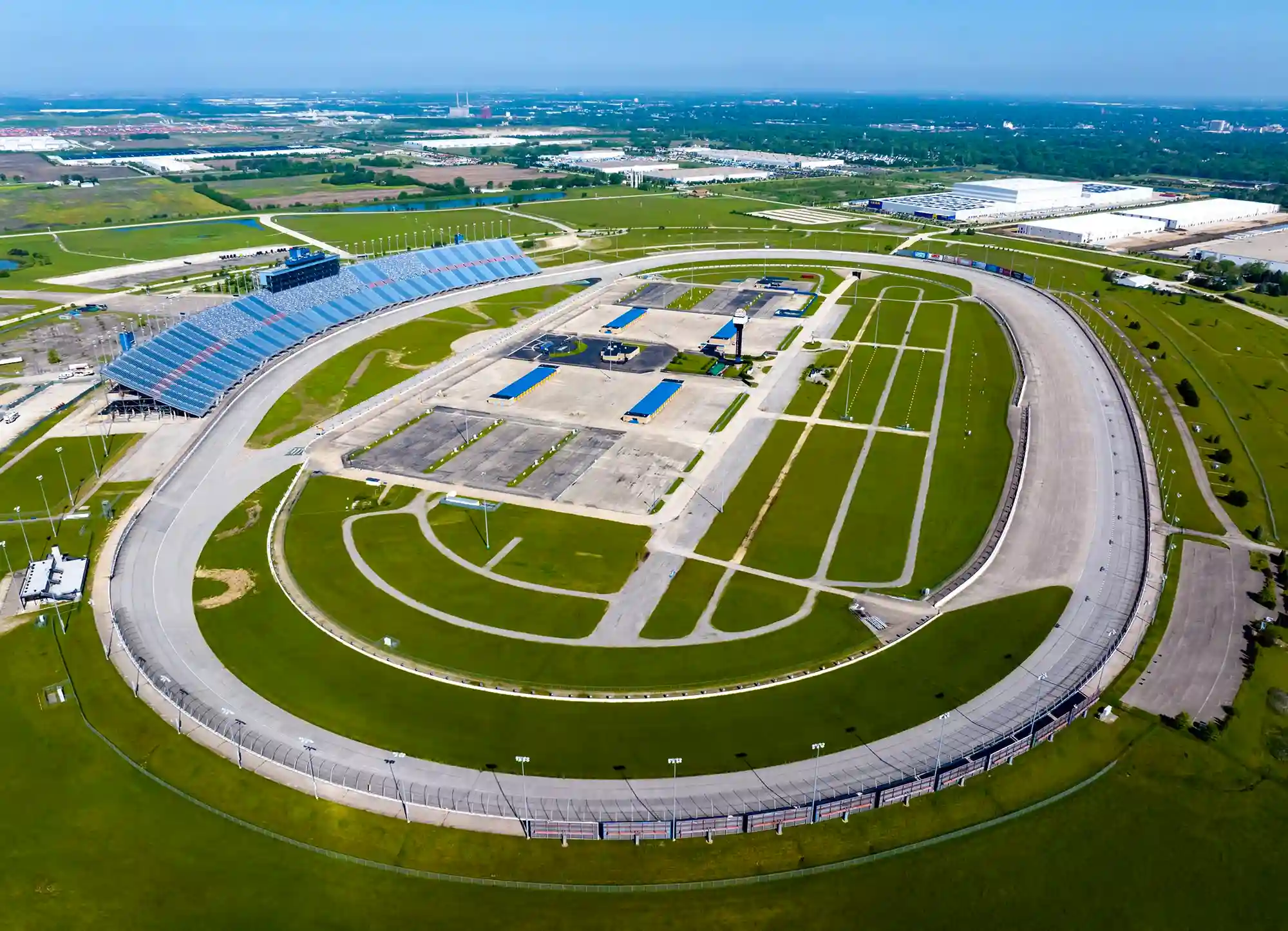
The four turns at Chicagoland carry 18-degree banking — less than Charlotte (24°) or Atlanta (28°). That lower banking angle translates into higher lateral load on the tyres, more mechanical grip dependence, and a narrower groove. The frontstretch has only 11-degree banking, and the backstretch sits at a nearly flat 5 degrees. Consequently, the car’s handling characteristics shift dramatically between the two ends of the track — placing unique demands on the front suspension and making setup balance across a full run genuinely difficult.
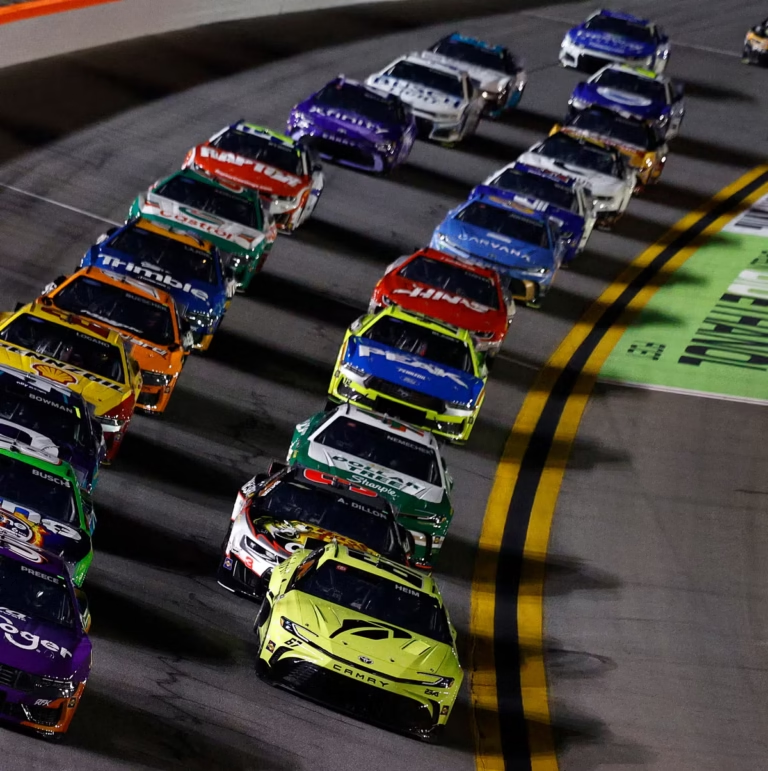
Furthermore, passing at Chicagoland is considerably harder than at wider, more steeply banked intermediates. The limited groove width means track position is enormously valuable. A driver running third behind two slower cars can lose 15–20 seconds across a 30-lap green-flag run without a realistic chance to pass. That reality shapes every pit call a crew chief makes. As pole position and pit stop execution matter more than usual here, teams invested heavily in track position strategies heading into race day.
The Next Gen car has competed at every intermediate oval on the current Cup schedule — but never at Chicagoland. That means engineering models built from Charlotte, Texas, Kansas, and Michigan cannot be directly applied. Three teams — No. 11 Joe Gibbs Racing (Denny Hamlin), No. 5 Hendrick Motorsports (Kyle Larson), and No. 12 Team Penske (Ryan Blaney) — received special dispensation to conduct a two-day tyre test at Chicagoland in April 2026. That data advantage is real, according to crew chief Chris Gayle. As he put it: “You get a leg up on where the place is.”
The sole 50-minute practice session on Friday July 3 provided the first Next Gen competitive data at Chicagoland. Riley Herbst led the session at 178.065 mph, with Bubba Wallace second (177.930) and both Kyle Larson and Denny Hamlin at 177.877. Tyler Reddick ran the most laps (61) and posted the best 10-consecutive-lap average at 176.130 mph — a critical indicator of long-run competitiveness. Multiple drivers locked up their brakes on pit road entries during the session, confirming the surface is more aggressive than any recent intermediate. For pit stop execution detail, see how NASCAR pit stops work.
eero 400 Stage Structure — How the Race Is Divided
The 2026 eero 400 runs 267 laps on Chicagoland’s 1.5-mile oval. The race is divided into three stages with mandatory stage breaks that serve as forced pit windows for most of the field. Understanding exactly how each stage breaks down is essential to predicting strategic windows across the 400.5-mile distance.
How Many Pit Stops Will Teams Make at Chicagoland 2026?
Under green conditions, teams will complete 4–5 total pit stops across 267 laps. A standard fuel window of roughly 55–60 laps means green-flag cycles at approximately Laps 55–60, 115–120, 175–180, and 230–235, with a potential splash-and-go window in the final 20 laps. Every stage break forces an additional stop for most teams. The exact number depends heavily on caution timing — more yellows early compress fuel windows and reduce the number of stops needed.
| Stage | Laps | Ends Lap | Pit Windows | Key Decision |
|---|---|---|---|---|
| Stage 1 | 80 laps | Lap 80 | ~Lap 55–65 (green flag) | Pit for 4 tyres + stage points |
| Stage 2 | 85 laps | Lap 165 | ~Lap 120–130 (green flag) | Fuel strategy diverges here |
| Final Stage | 102 laps | Lap 267 | ~Lap 200–215 & 240–250 | Tyre count & fuel mileage critical |
| Full Race | 267 laps | 400.5 mi | 4–5 stops total (green flag) | Track position rules at Chicagoland |
Tyre Strategy — Four Tyres, Every Time, or Pay the Price
Every team at the 2026 eero 400 receives eight sets of Goodyear tyres for the race weekend. That sounds like a generous allocation, but across 267 laps of a bumpy, abrasive surface that has not seen Cup racing in seven years, tyre management is not merely a strategy lever — it is a survival constraint.
Crew chief Chris Gayle of the No. 11 Joe Gibbs Racing Toyota was direct about his approach after practice: “I think you’re going to want tires and you’re probably going to want four at that point.” That statement captures the dominant philosophy heading into race day. The surface at Chicagoland in 2026 is more aggressive than Kansas, Texas, or Charlotte. Drivers who run old tyres through the bumpy sections reported significant vibration and handling degradation that makes two-tyre calls a meaningful gamble rather than a straightforward track-position play.
“Whenever the cautions come out every 10 laps, you’re scared to death. The five-lap cautions are, they’re kind of fun because you have the opportunity to trade and get ahead of something.”
Two Tyres vs Four Tyres — When Each Makes Sense
| Scenario | Two-Tyre Call | Four-Tyre Call | Verdict at Chicagoland 2026 |
|---|---|---|---|
| Stage end (green) | Gain 6–9 track positions at restart | Lose 6–9 spots but have fresher rubber | 4 tyres — harder to pass back |
| Late race caution, ≥20 laps left | Gain track position for restart | Better speed over remaining distance | Situational — depends on tyre age |
| Short caution (2–3 laps on new tyres) | Risk losing the position gain | Still building heat — no advantage | 4 tyres — stay out or wait |
| Leader controlling the pace | Gives back gap advantage | Maintains long-run edge | 4 tyres every time |
| Final 15 laps, track position secured | Could hold on if car is stable | Not needed if gap is large enough | Fuel only or 2R possible |
With eight sets allocated, a team running four tyres every stop has approximately 2 sets remaining after four cycles. If cautions cluster — producing six or seven pit cycles in the first 200 laps — teams who take four tyres every time could literally run out of fresh tyres for the decisive final stage. That is why crew chief Matt Swiderski’s concern resonated in the paddock: “I just am curious about running out of tires, maybe.” The ideal scenario is 3–4 cautions spaced evenly — not so frequent that tyre inventory runs dry, not so infrequent that green-flag mileage grinds old rubber into the racetrack.
Tyre Degradation at Chicagoland — What Practice Revealed
Crew chiefs after Friday’s practice session compared Chicagoland’s tyre wear to Charlotte Motor Speedway — what one described as “Charlotte-ish.” That is a moderate-to-high degradation rating for a 1.5-mile track. The difference from Charlotte is the surface texture. At Charlotte, the tyre wears predictably through rubber buildup. At Chicagoland in 2026, the irregularities in the asphalt create uneven contact patches that accelerate inside-shoulder wear on the right-front tyre and produce vibration after 40–50 laps that makes a car difficult to manage at the limit.
Tyler Reddick’s 10-consecutive-lap average in practice (176.130 mph) serves as the best available benchmark for long-run speed. The fact that he was 1.8 mph slower on his average compared to his single-lap best illustrates the rate of falloff. At that rate, a car on 60-lap-old tyres is giving up roughly 0.5–0.8 seconds per lap to a freshly shod competitor — which translates to roughly 3–5 car lengths per lap, or a 15–25 car length gap over a 30-lap green-flag run. That gap is very difficult to defend at Chicagoland where passing lanes are limited. See more on grip management in racing and how it relates to tyre behaviour at intermediate ovals.
Fuel Windows at Chicagoland — The Numbers Every Crew Chief Is Running
Fuel mileage at Chicagoland Speedway follows the standard intermediate oval model: approximately 55–60 laps at racing pace on a full tank. At 1.5 miles per lap, that equates to 82.5–90 miles of fuel capacity at flat-out race speed. Under caution, conservation can extend that window meaningfully — experienced drivers can stretch a tank to 65–70 laps in light traffic with fuel-saving throttle management.
The three-stage structure of the eero 400 creates both opportunities and complications for fuel strategy. Stage 1 ends at Lap 80 — just outside a standard fuel window. That means a team that pits early in Stage 1 around Lap 55 for a green-flag stop will arrive at the Stage 1 break with roughly 25 laps of fuel remaining. They can either pit at the stage break and take four tyres, or try to extend their fuel window and save the set of tyres. Most front-runners will pit at the stage break regardless, accepting the fuel cost as the price of fresh rubber and clean restarts.
Fuel Window Modelling — 2026 eero 400
| Stint | Approx Laps | Pit Window Opens | Pit Window Closes | Risk If Late |
|---|---|---|---|---|
| Green-flag Stint 1 | 55–60 laps | Lap 50 | Lap 63 | Run dry before Lap 80 |
| Stage 1 break (Lap 80) | Forced stop | Lap 80 | Lap 80 | Most teams pit here |
| Stage 2 green-flag | 55–60 laps | Lap 130 | Lap 145 | Risk running out by Lap 165 |
| Stage 2 break (Lap 165) | Forced stop | Lap 165 | Lap 165 | Field resets; final stage begins |
| Final Stage Stop 1 | 55–60 laps | Lap 210 | Lap 225 | Critical: must have tyres left |
| Final Stage Stop 2 / Splash | 40–55 laps | Lap 240 | Lap 255 | Fuel-only saves 2 sec; 4 tyres wins |
What Is the Fuel Window at Chicagoland Speedway 2026?
NASCAR Cup Series cars at Chicagoland Speedway can run approximately 55–60 laps on a full tank at racing pace. Under caution with throttle conservation, that extends to 65–70 laps. The 102-lap final stage of the eero 400 requires a minimum of two green-flag pit stops within it. Any team attempting a one-stop final stage must manufacture a caution or take a significant fuel-saving gamble that will cost substantial track position to other competitors.
The Final Stage Fuel Problem
The 102-lap final stage is the strategic minefield of this race. It is significantly longer than either the 80-lap Stage 1 or 85-lap Stage 2. Teams entering the final stage at Lap 165 will need two additional pit stops. The first typically falls around Lap 210–215. The second — whether a full four-tyre stop or a fuel-only splash — falls around Lap 240–255, leaving 12–25 laps to the flag.
That final stop is where races are won and lost. A crew chief who can correctly judge whether to take two tyres (gaining track position) or four tyres (gaining speed) in the last 25 laps will either send their driver to victory or watch him fall back. Moreover, a team that miscalculates fuel consumption and takes a splash-and-go instead of a full stop concedes valuable time — but avoids the catastrophic alternative of running dry under green on the final lap. For context on how fuel strategy decisions play out across different oval types, see our Pocono race strategy breakdown from earlier in the 2026 season.
Caution Strategy — How Yellow Flags Reshape Everything at Chicagoland
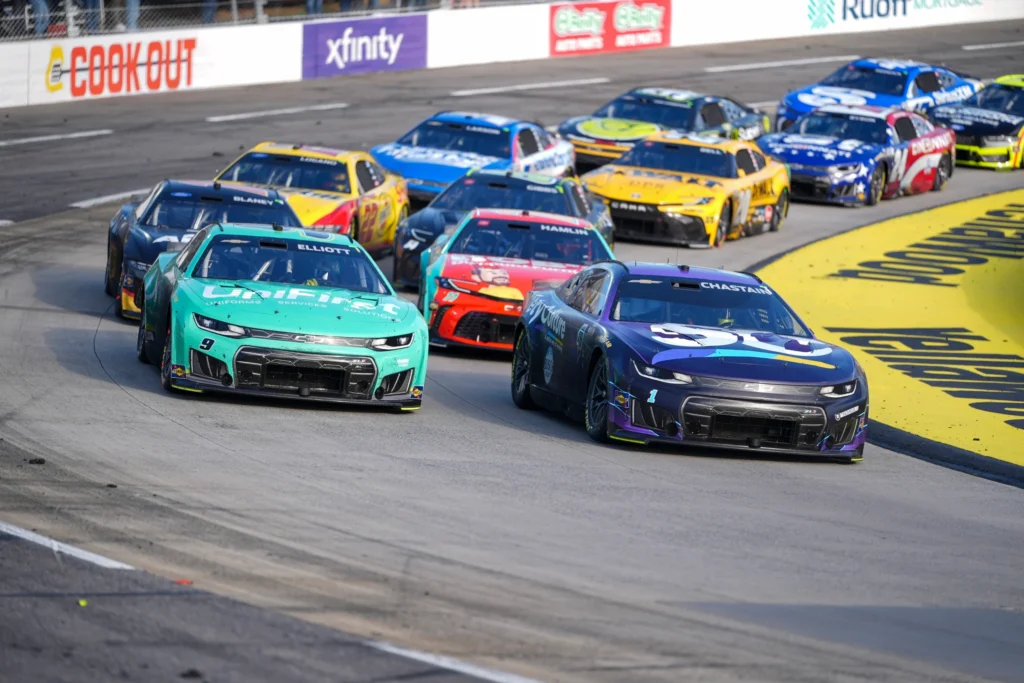
Caution flags at Chicagoland in 2026 will carry unusual strategic weight. Because the track has been dormant for seven years and the Next Gen car has no race experience here, the risk of incidents — from brake lock-ups to debris to cars sliding out of the groove on the bumpy surface — is higher than at any well-worn intermediate on the schedule. Multiple drivers locked their brakes during Friday’s practice session. That pattern tends to repeat under race pressure.
For crew chiefs, every caution is a decision tree. The first branch: do you pit? If you have run fewer than five laps on fresh tyres, pitting makes almost no sense — the tyres have not yet reached operating temperature and the position loss is not compensated by meaningful grip gain. If you have run 20 laps or more on used rubber, pitting almost always makes sense at a track where long-run speed differential is this large.
The “Stay Out” Gamble — When It Makes Sense and When It Destroys the Race
Staying out under caution to gain track position is a legitimate strategy at most intermediate ovals. At Chicagoland 2026, it is a higher-risk play than usual. Because the groove is narrow and passing is genuinely difficult, a car on 50-lap-old tyres that stays out and leads the restart can theoretically control the pace for three to four laps before fresher rubber begins to run him down. However, as crew chief observations from practice made clear, the performance cliff on aged tyres at this track is steeper than expected. A car that was managing the gap on old rubber can suddenly fall half a second per lap off the pace when the grip drops out — and at that point, it is not just one car passing, it is the entire top-10 filing by in three laps.
The five-lap cautions are kind of fun — but the every-15-lap yellows, those are the ones that make every crew chief sweat. You want four tyres every time, but your tyre inventory has a hard ceiling, and that ceiling arrives whether you’re ready for it or not.
Wave-Around Strategy and Lucky Dog
With a 38-car field and a narrow racing groove, lapped traffic will be an ongoing complication in the eero 400. Teams running in the 25th–38th positions will be monitoring wave-around opportunities carefully. A well-timed wave-around under a caution — where a lapped car elects to go around the field rather than pit — can recover a lap and put a marginal team back in strategic contention. The “lucky dog” (free pass to the first car one lap down) will also influence how teams on the fringe of the lead lap position themselves across mid-race stints. For a broader look at how NASCAR’s championship scoring system incentivises these decisions, see our explainer.
Pre-race forecasts showed a 65% chance of rain at race time on Sunday July 5, with conditions described as moderate rain and wind at 8 mph. At Chicagoland, a rain interruption would trigger a completely different strategic reset. Teams would be forced to adapt their tyre inventories to changing surface conditions, and the restart sequence after a red-flag period could dramatically shuffle the running order. Rain is not just an inconvenience at a night race on a bumpy intermediate — it is a genuine race-changer that could elevate a mid-field team to contention or eliminate a race leader through a simple pit road mistiming. The weather forecast heading into Sunday is arguably the most important variable that no crew chief can control.
The Crew Chief Edge — Who Has the Strategic Advantage at Chicagoland 2026
Three teams went to Chicagoland in April 2026 for a tyre test under special dispensation: Joe Gibbs Racing (No. 11, Denny Hamlin), Hendrick Motorsports (No. 5, Kyle Larson), and Team Penske (No. 12, Ryan Blaney). That test gave those three organisations something no other team has at this race: actual Next Gen tyre wear data from this specific surface. Crew chief Chris Gayle of the No. 11 was candid about its value.
However, that advantage has limits. Track rubber evolves throughout a race weekend. As 38 cars lay down rubber across practice, qualifying, and the race itself, the surface grip level changes dramatically. The April test lap counts cannot fully replicate the racing groove that develops with 38 cars on track — particularly on an asphalt surface that has been aging for seven years. Nevertheless, knowing the baseline gives those three teams a meaningful head start on setup convergence, particularly through the first 30 laps of Stage 1 when everyone else is learning on the fly.
Pit Stall Selection — Why It Matters More Than Usual
At a track where passing is this difficult, pit road efficiency is amplified. A team with a pit stall near the beginning of pit road exits faster after a stop and re-enters the racing groove ahead of rivals who have stalls further along pit road. Kyle Larson’s team lost preferred pit stall selection after failing pre-race inspection twice on Saturday — a significant disadvantage heading into a race where pit road position determines track position. Similarly, Michael McDowell’s No. 71 car failed inspection three times and will serve a pass-through penalty after the green flag, forfeiting any stall preference entirely.
The qualifying result — with Denny Hamlin taking pole by an incredibly tight 0.001 seconds over Kyle Larson — also shaped pit stall selection. Front-qualifiers selected stalls near the beginning of pit road, giving the top teams both a grid advantage and a pit road advantage simultaneously. For an explanation of how grid position affects race strategy across different oval formats, our dedicated explainer covers the mechanics in detail.
Driver-Specific Strategic Profiles — Who Wins What Type of Race
| Driver | Car / Team | Strategy Strength | Best Race Type |
|---|---|---|---|
| Denny Hamlin | #11 JGR Toyota | Long-run management, veteran reads | Green-flag cycles, late restarts |
| Kyle Larson | #5 HMS Chevy | April test data, Chicagoland history | Fuel conservation, alternate strategy |
| Ryan Blaney | #12 Penske Ford | April test, consistent laps led | Clean-air races, top-5 battles |
| Tyler Reddick | #45 23XI Toyota | Best 10-lap avg in practice (176.130) | Long-run speed races, track position |
| Chase Elliott | #9 HMS Chevy | Consistent lap averages | Caution-heavy, alternate pit cycles |
| Christopher Bell | #20 JGR Toyota | Toyota long-run benchmark | Green-flag dominance, lead-lap runs |
Historic Chicagoland Strategy Patterns — What the Pre-2019 Races Tell Us
The eero 400 on July 5 is technically the 20th Cup Series race ever held at Chicagoland Speedway. The previous 19 races, run between 2001 and 2019, provide the only historical blueprint for strategic patterns at this track — albeit with different car generations and completely different surface conditions than what the Next Gen car will encounter in 2026.
Tony Stewart holds the all-time record at Chicagoland with three Cup wins (2004, 2007, 2011). Kevin Harvick won the inaugural race in 2001 and repeated in 2002. The most recent winner before the hiatus — Alex Bowman in 2019 — executed one of the cleanest fuel-and-tyre strategies of that weekend, holding on through a tight final stage against Kyle Larson to take his first career Cup win by less than half a second. That 2019 race is the most directly applicable reference point for 2026, given that the surface at the time was the most aged it had ever been before the seven-year dormancy further deteriorated the asphalt.
What the 2019 Race Tells Us About 2026
In 2019, the Camping World 400 (as it was then called) ran under a combination of green-flag racing and strategic cautions. Alex Bowman won from a position where track position carried him through the final stage, while Larson — who arguably had more raw speed — was caught in traffic at a critical moment. The race featured multiple two-tyre calls mid-field that temporarily reshuffled the running order but ultimately failed to overcome the long-run disadvantage of old rubber against the leaders. That lesson is directly applicable to 2026: at Chicagoland, track position and tyre freshness combine as a more powerful strategic weapon than they do at wider, more freely passing intermediates like Charlotte or Las Vegas.
Furthermore, the 2019 race produced a caution-period strategic error from at least one lead team that dropped a likely top-5 car to a 15th-place finish through a mistimed pit call. Those errors are more consequential at this track than at circuits where passing is straightforward. As the history of this venue shows, Chicagoland rewards patience and punishes aggression at the wrong moment. For more on how intermediate oval racing has evolved from its roots in American motorsport, see our archive piece on oval car handling and strategy.
The 2026 eero 400 is Round 2 of the NASCAR In-Season Challenge — a 32-driver, single-elimination bracket where the higher finisher in each head-to-head matchup advances. Following Round 1 at Sonoma, where No. 1 seed Tyler Reddick was upset by No. 32 seed Alex Bowman (who finished 10th), the bracket enters Chicagoland with multiple favourites already in vulnerable positions. The In-Season Challenge creates a secondary race within the race: drivers with favourable bracket matchups will sometimes prioritise beating their specific rival over pure race win strategy, which can produce unexpected pit calls and aggressive restarts. Bowman, interestingly, won the last Cup race at Chicagoland in 2019 — his return to Joliet as a potential bracket adversary adds a narrative layer that makes this race genuinely multi-dimensional. For coverage of how NASCAR’s championship points system incorporates the In-Season Challenge, see our 2026 points standings tracker.
Frequently Asked Questions — Chicagoland NASCAR 2026 Strategy
The Bottom Line — What Will Actually Decide the eero 400
The 2026 eero 400 at Chicagoland Speedway will be decided by three things in roughly equal measure: tyre management, fuel timing, and caution luck. The track’s bumpy, aged surface punishes anyone who runs old rubber too long. The 55–60 lap fuel window is tight enough that a mistimed green-flag stop or a poorly-read caution can cascade into a top-10 finish instead of a win.
Denny Hamlin enters as the favourite on recent oval form, with April test data giving his team the best baseline setup of any competitor. Tyler Reddick showed the best long-run speed in Friday’s practice. Kyle Larson and Ryan Blaney — with their own test data — are dangerous across any scenario. But the race belongs to whichever crew chief makes the fewest strategic errors across 267 laps of the most unpredictable surface the 2026 Cup Series has faced all year.
Watch Stage 1’s final 20 laps closely. How teams position themselves relative to the break — whether they pit early, push to the stage end, or try a fuel-only gamble — will telegraph their strategic posture for everything that follows. At Chicagoland in 2026, the crew chief wins the race before the driver does.