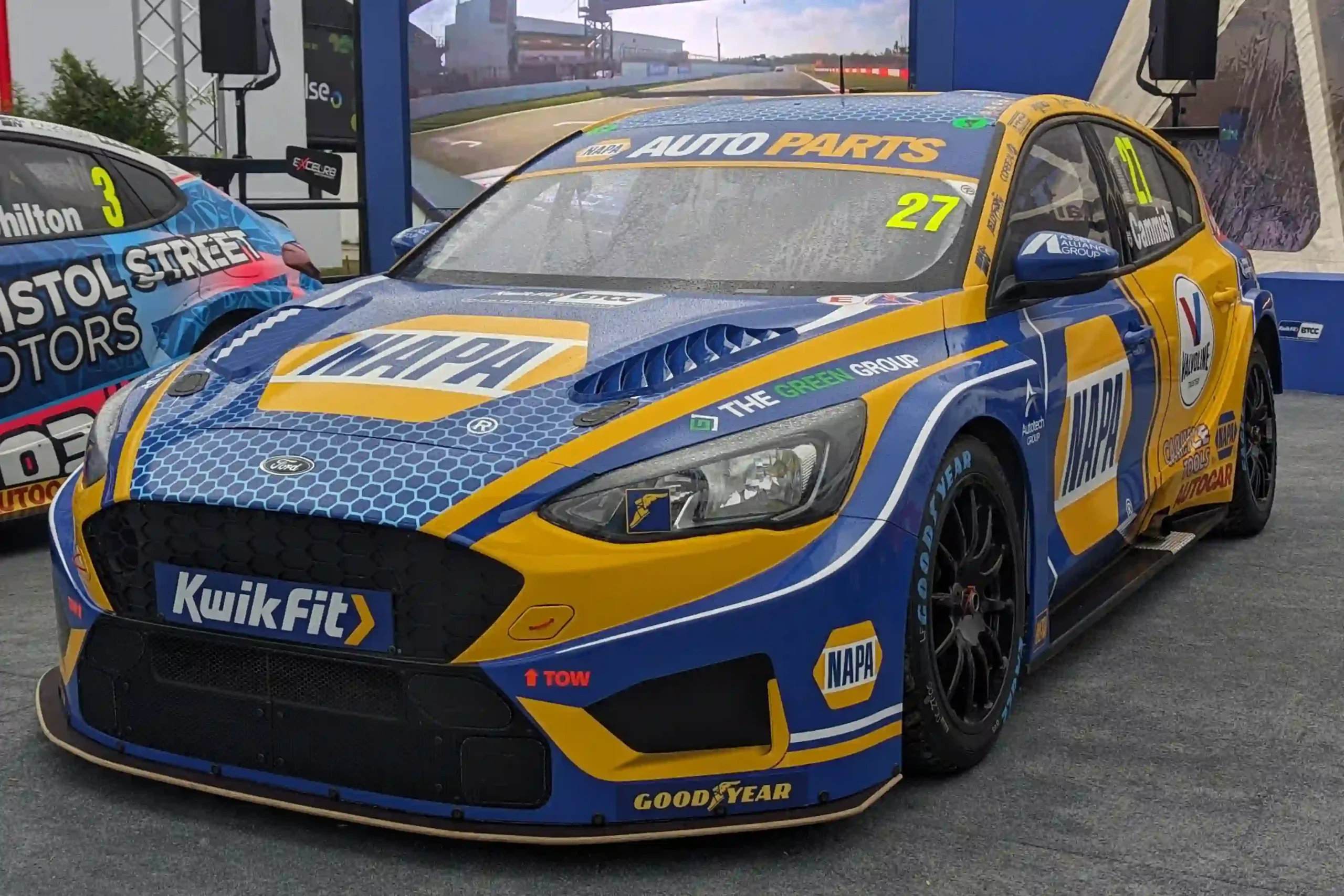
Thruxton BTCC 2026 Practice Results: Fastest Driver, Full Times & Key Takeaways
Chris Smiley led a Restart Racing one-two with a 1:15.365 lap, while championship leader Ash Sutton set the fastest time on the hard Goodyear tyre at the fastest circuit on the BTCC calendar.
Chris Smiley topped the Thruxton BTCC 2026 practice results with a 1:15.365 lap for Restart Racing.
Smiley beat teammate James Dorlin by only 0.093 seconds as the Hyundai pair used Goodyear’s medium compound. Ash Sutton finished third for NAPA Racing UK and provided the most significant hard-tyre reference, 0.359 seconds behind the leader.
The raw order needs context. Goodyear brought the medium tyre to Thruxton for the first time, even though the circuit’s speed and abrasive surface normally demand the hard compound. The official BTCC report estimated that the medium tyre was worth about three-tenths of a second during practice.
Data basis: The classification, lap totals, gaps and “on lap” numbers below come from the official BTCC session report. Calculated figures—such as the 468 combined laps and Smiley’s approximate 112.5 mph average—are derived from that official table and Thruxton’s published 2.356-mile length.
Who Was Fastest in Thruxton BTCC Practice?
Chris Smiley leads Restart Racing’s Hyundai one-twoChris Smiley was fastest in the 2026 BTCC Free Practice session at Thruxton. The Restart Racing driver set a 1:15.365 lap, beating teammate James Dorlin by 0.093 seconds. Ash Sutton finished third, 0.359 seconds behind, and was the quickest driver using the hard Goodyear tyre.
Smiley’s lap arrived on his 21st tour of a 22-lap programme. That timing suggests Restart Racing used the early part of the session to establish balance and gather information before committing to a late medium-tyre run.
Dorlin followed a similar pattern. His best lap came on lap 18 of 20. Therefore, both cars had already completed substantial mileage before their fastest attempts.
The narrow 0.093-second margin matters. It indicates that Restart Racing did not find one exceptional lap from one side of the garage. Both Hyundai i30 N Fastbacks reached almost the same performance level.
practice lap
Restart teammates
hard-tyre benchmark
one second
the 22 drivers
Chris Smiley
The session leader used the medium tyre and completed a representative high-mileage programme.
James Dorlin
Dorlin confirmed team-wide pace and kept the two Hyundais separated by less than a tenth.
Ash Sutton
Sutton’s hard-tyre pace was arguably the strongest race-relevant signal in the session.
Smiley’s lap in speed terms
Thruxton’s official timing length is 2.356 miles. A 1:15.365 lap over that distance equals an average speed of approximately 112.5 mph.
Average speed understates the fastest moments because the lap includes the Club chicane and slower corner phases. On the long sweep through Goodwood, Church and Brooklands, BTCC cars operate at much higher speeds.
This is why small setup errors become expensive. A minor lift or correction can continue costing time for several seconds. At a tighter circuit, the same mistake may be contained within one short corner.
Restart Racing’s strongest evidence was the second car
A single fast lap can come from a perfect tyre window or a well-timed clear track. A one-two is harder to dismiss. Dorlin’s second position showed that Restart Racing understood the medium compound across both cars.
The two drivers also completed 42 laps between them. That gave the team enough data to compare pressures, temperatures, damper behaviour and aerodynamic balance.
However, the practice result did not prove that Restart held a three-tenths advantage on equal tyres. The medium compound shaped the headline. Sutton’s third-place hard-tyre time remained essential for a fair comparison.
Smiley owned the fastest time, but Sutton supplied the most important hard-tyre benchmark for the sessions and races that followed.
Full Thruxton BTCC 2026 Practice Classification
Every driver, lap time, gap, lap count and best-lap positionSmiley led Dorlin and Sutton, followed by Mikey Doble, Josh Cook, Árón Taylor-Smith, Dan Cammish and Tom Ingram. Fourteen drivers finished within one second of the fastest time. Nicolas Hamilton completed the 22-driver order, 2.591 seconds behind.
| Pos. | No. | Driver | Team | Laps | Best time | Gap | Best on lap |
|---|---|---|---|---|---|---|---|
| 1 | 22 | Chris Smiley | Restart Racing | 22 | 1:15.365 | — | 21 |
| 2 | 132 | James Dorlin | Restart Racing | 20 | 1:15.458 | 0.093 | 18 |
| 3 | 116 | Ashley Sutton | NAPA Racing UK | 22 | 1:15.724 | 0.359 | 11 |
| 4 | 88 | Mikey Doble | LKQ Euro Car Parts with Power Maxed Racing | 21 | 1:15.877 | 0.512 | 19 |
| 5 | 66 | Josh Cook | Speedworks Corolla Racing | 22 | 1:15.890 | 0.525 | 18 |
| 6 | 50 | Árón Taylor-Smith | Laser Tools Racing with MB Motorsport | 20 | 1:15.898 | 0.533 | 18 |
| 7 | 27 | Dan Cammish | NAPA Racing UK | 21 | 1:15.900 | 0.535 | 12 |
| 8 | 80 | Tom Ingram | Team VERTU | 16 | 1:15.912 | 0.547 | 16 |
| 9 | 33 | Adam Morgan | Cataclean Plato Racing | 20 | 1:16.071 | 0.706 | 15 |
| 10 | 52 | Gordon Shedden | Laser Tools Racing with MB Motorsport | 19 | 1:16.120 | 0.755 | 18 |
| 11 | 32 | Daniel Rowbottom | Cataclean Plato Racing | 21 | 1:16.148 | 0.783 | 19 |
| 12 | 11 | Ricky Collard | Team VERTU | 22 | 1:16.173 | 0.808 | 21 |
| 13 | 99 | Charles Rainford | WSR | 24 | 1:16.293 | 0.928 | 23 |
| 14 | 18 | Senna Proctor | NAPA Racing UK | 23 | 1:16.357 | 0.992 | 10 |
| 15 | 3 | Tom Chilton | Team VERTU | 20 | 1:16.447 | 1.082 | 19 |
| 16 | 2 | Daryl De Leon | WSR | 20 | 1:16.511 | 1.146 | 14 |
| 17 | 7 | Ryan Bensley | Speedworks Corolla Racing | 25 | 1:16.619 | 1.254 | 23 |
| 18 | 16 | Aiden Moffat | LKQ Euro Car Parts with Power Maxed Racing | 18 | 1:16.826 | 1.461 | 12 |
| 19 | 15 | Lewis Selby | NAPA Racing UK | 25 | 1:17.028 | 1.663 | 21 |
| 20 | 17 | Dexter Patterson | Steel Seal with Power Maxed Racing | 21 | 1:17.291 | 1.926 | 21 |
| 21 | 29 | Lewis Gilbert | WSR | 21 | 1:17.619 | 2.254 | 17 |
| 22 | 28 | Nicolas Hamilton | Team VERTU | 25 | 1:17.956 | 2.591 | 21 |
The top eight were separated by only 0.547 seconds
Ingram’s eighth-place time was just over half a second from Smiley. That group included Hyundai, Ford, Audi and Toyota-based cars, plus leading championship contenders and independent runners.
The spread became even tighter from fourth to eighth. Doble, Cook, Taylor-Smith, Cammish and Ingram were separated by 0.035 seconds. One small improvement could have changed five positions.
Therefore, the middle of the top ten cannot be read as a firm performance ranking. Traffic, tyre age and track evolution may explain more than the position numbers.
Fourteen drivers finished within one second
Proctor’s 1:16.357 placed him fourteenth and 0.992 seconds behind. That means almost two-thirds of the field sat inside one second at a 2.356-mile circuit.
Thruxton is less forgiving than the gap suggests. Its long, fast corners magnify balance problems. A compressed field indicates that many teams had workable foundations despite different tyre programmes.
Lap counts reveal different priorities
Bensley, Selby and Hamilton completed 25 laps, the highest totals. Rainford ran 24, while Proctor completed 23. These drivers placed mileage above headline position.
Ingram completed only 16 laps, the fewest of the classified field. However, he still finished eighth. That suggests Team VERTU extracted useful pace without needing a large number of tours.
A high lap count can help with long-run tyre data. Conversely, fewer laps may indicate planned setup changes, a shorter programme or time spent in the garage. The timing sheet alone cannot identify the reason.
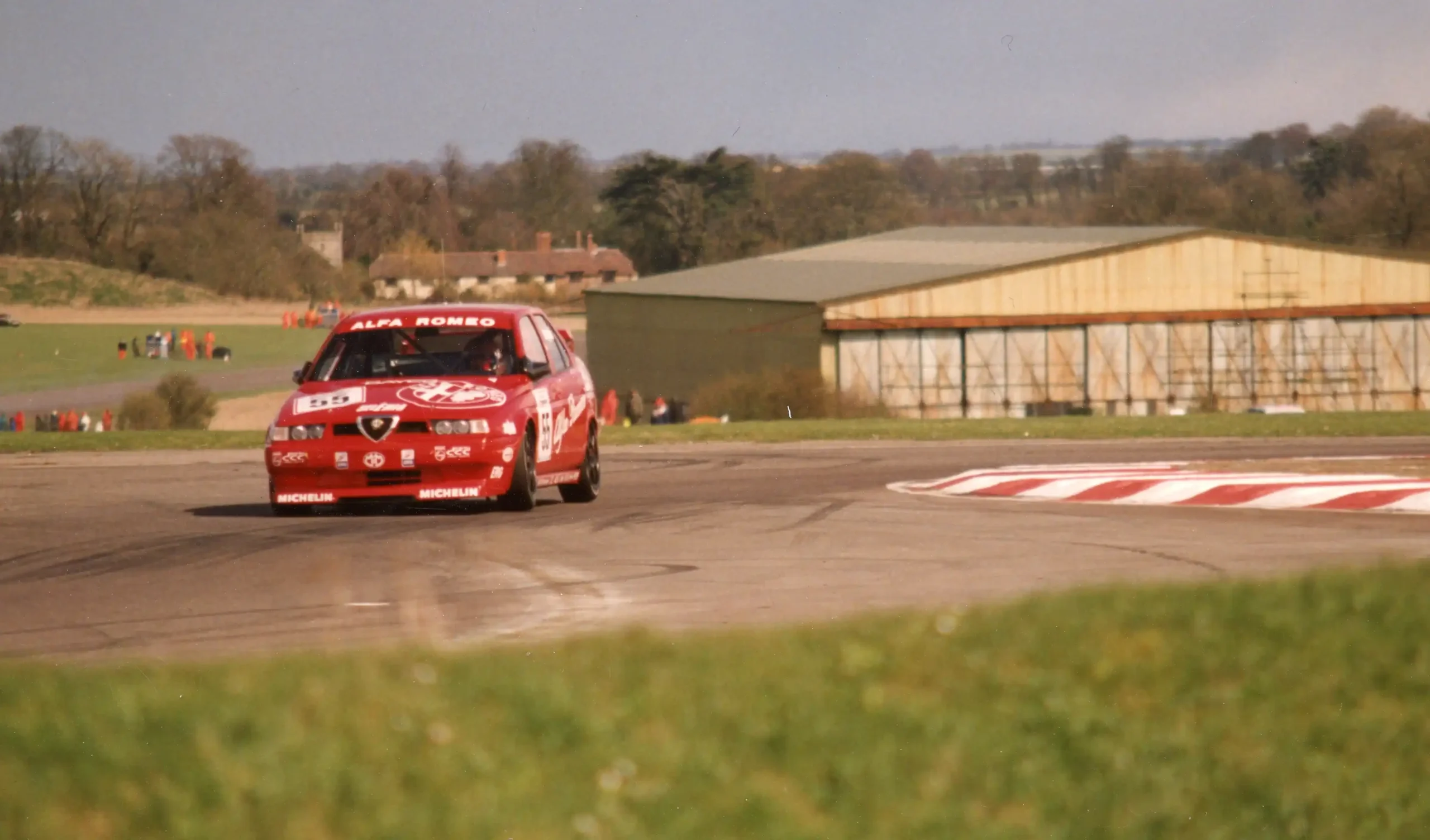
How Goodyear Tyres Changed the Practice Order
Medium-compound headline pace versus hard-tyre relevanceSmiley and Dorlin used Goodyear’s medium compound to finish first and second. Sutton was the fastest hard-tyre runner in third. BTCC estimated the medium’s advantage at approximately three-tenths, while the Qualifying Race and all three Sunday races were scheduled to use the traditional hard tyre.
The medium tyre offered more immediate grip and helped Restart Racing occupy the first two positions. However, it was not the primary race compound for the weekend.
The hard tyre is better suited to Thruxton’s sustained loads and abrasive surface. Sutton’s third-place lap showed strong pace on the compound used in competition.
Why Thruxton normally requires the hard tyre
Thruxton asks the loaded outside tyres to work for long periods. The car does not simply brake, turn and accelerate through a short corner. It remains under lateral force through extended high-speed arcs.
That load builds temperature. It also increases wear across the tread surface. A softer compound may produce a faster single lap but lose stability or life over a longer run.
The hard tyre gives teams a wider operating window. It can tolerate repeated high-energy laps with less risk of overheating. The trade-off is lower initial grip.
Why the medium produced a faster lap
A medium compound can generate grip sooner. The driver may carry more speed into a corner and use less steering correction. That improves both minimum speed and exit speed.
At Thruxton, an earlier throttle application continues paying through the next section. The benefit can extend beyond the corner where the extra grip was created.
However, tyre advantage is not perfectly fixed. Fuel load, temperature, pressure and preparation affect the result. BTCC’s “around three-tenths” estimate should be treated as a useful guide rather than a universal conversion.
Sutton’s adjusted position
Sutton was 0.359 seconds behind Smiley. If the medium was worth about three-tenths, the three cars were broadly close on an adjusted basis.
That does not prove Sutton would have topped the session on equal tyres. It does show why third place was more impressive than a simple reading of the order suggests.
Sutton’s fastest lap came on lap 11 of 22. He produced the benchmark earlier than the two Restart cars, which set their best times late. Track conditions may have improved between those runs.
The correct tyre conclusion
Restart Racing was genuinely fast and executed the medium tyre well. At the same time, Sutton’s hard-tyre lap was the strongest direct indicator for the mandatory competition compound. Both statements can be true.
What teams learn from mixed-compound practice
Mixed compounds complicate the leaderboard but improve engineering knowledge. Teams can compare how the chassis responds to different grip levels.
A car that works only on the softer tyre may lack support on the hard compound. Engineers may need to adjust spring stiffness, roll control, ride height or differential behaviour.
Tyre pressure is equally important. A low starting pressure can improve the initial contact patch but may create excessive flex and heat. A higher pressure can sharpen response while reducing compliance.
Our explainers on tyre pressure and downforce cover the road-car and aerodynamic principles behind these trade-offs.
Team and Driver Performance Analysis
What the 22-car order revealed beyond first placeRestart Racing: the clear practice winner
Restart Racing achieved the only team one-two. Smiley and Dorlin were also the only drivers below 1:15.5. Their combined result made the team the main Saturday morning story.
The tyre choice contributed, but execution remained necessary. A faster compound does not automatically produce two clean laps within 0.093 seconds.
Restart entered Thruxton after encouraging progress before the summer break. Smiley had already taken a season-best fourth at Snetterton and produced his strongest points weekend at Oulton Park. The practice result continued that rise.
NAPA Racing UK: Sutton led the hard-tyre evidence
Sutton placed third, while Cammish finished seventh. Proctor was fourteenth in his return to the grid as a stand-in at Thruxton.
Sutton and Cammish were separated by 0.176 seconds. Both Ford drivers completed more than 20 laps, giving NAPA a substantial data set.
The new-for-2026 Ford Focus Titanium had already established Sutton as the championship leader. Its Thruxton practice performance suggested that the car retained strong high-speed balance.
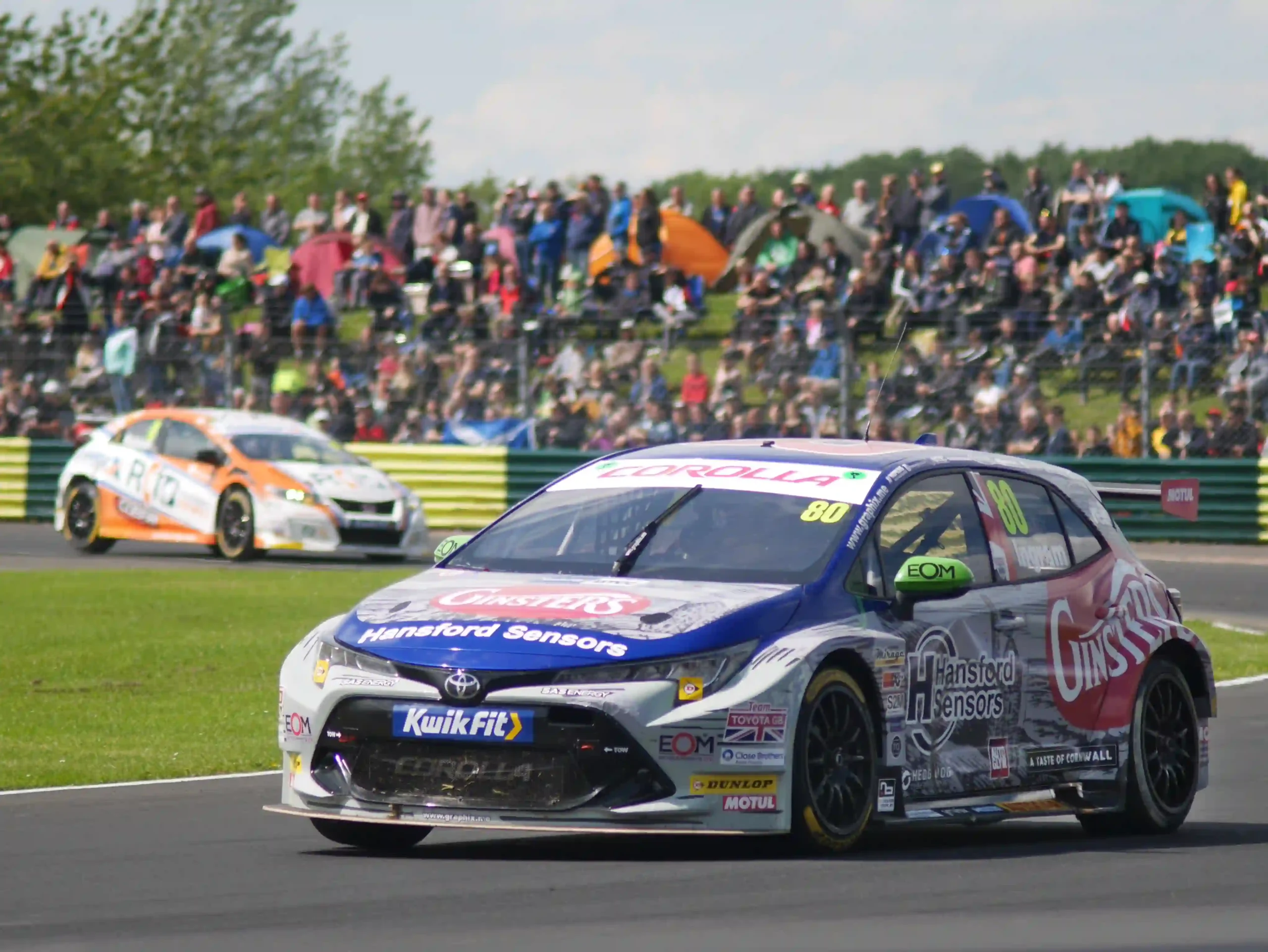
Power Maxed Racing: Doble made the Audi a top-four car
Doble placed fourth with a 1:15.877. He was only 0.153 seconds behind Sutton and 0.512 from the outright lead.
The new Audi A3 Saloon package therefore showed immediate high-speed potential. Doble’s performance also strengthened his independent championship case.
Moffat finished eighteenth, while Patterson placed twentieth in the other Audi entry. The spread showed that Doble’s lap was not simply an automatic property of the car.
Speedworks Corolla Racing: Cook carried proven Thruxton form
Cook finished fifth with a 1:15.890. His reputation at Thruxton made that result significant. He entered the event with ten previous BTCC victories at the circuit.
Bensley placed seventeenth and completed 25 laps. The mileage was valuable for a driver building experience in the championship.
Cook later won the opening Sunday race, while Sutton and Ingram won the remaining contests. That later result confirmed an important lesson: practice pace can identify strong packages, but the outright practice winner does not automatically control race day.
Laser Tools Racing: two Toyotas in the top ten
Taylor-Smith finished sixth, only 0.008 seconds behind Cook. Shedden was tenth. Both cars therefore sat within 0.755 seconds of the lead.
The team had shown strong one-lap pace at Oulton Park before the summer break. Its Thruxton times suggested that the Corolla remained competitive at a very different circuit.
Team VERTU: Ingram’s low-lap efficiency
Ingram placed eighth after only 16 laps. Collard was twelfth, Chilton fifteenth and Hamilton twenty-second.
The spread across four cars was substantial. However, teams often divide practice tasks. One driver may chase a qualifying setup while another studies long-run behaviour.
Ingram’s fastest lap was his final tour. That suggests his programme built toward one late attempt rather than repeated short runs.
Cataclean Plato Racing: two Mercedes cars inside the top 11
Morgan finished ninth and Rowbottom eleventh. Only 0.077 seconds separated their best laps.
That consistency suggested a shared level of performance. It also gave the team a stable foundation after reporting straight-line concerns earlier in the season.
WSR: mileage before headline pace
Rainford completed 24 laps and finished thirteenth. De Leon ran 20 laps and placed sixteenth. Gilbert was twenty-first.
The BMWs did not lead the timing sheet, but Rainford’s best lap came on lap 23. That late improvement indicated continued setup progress.
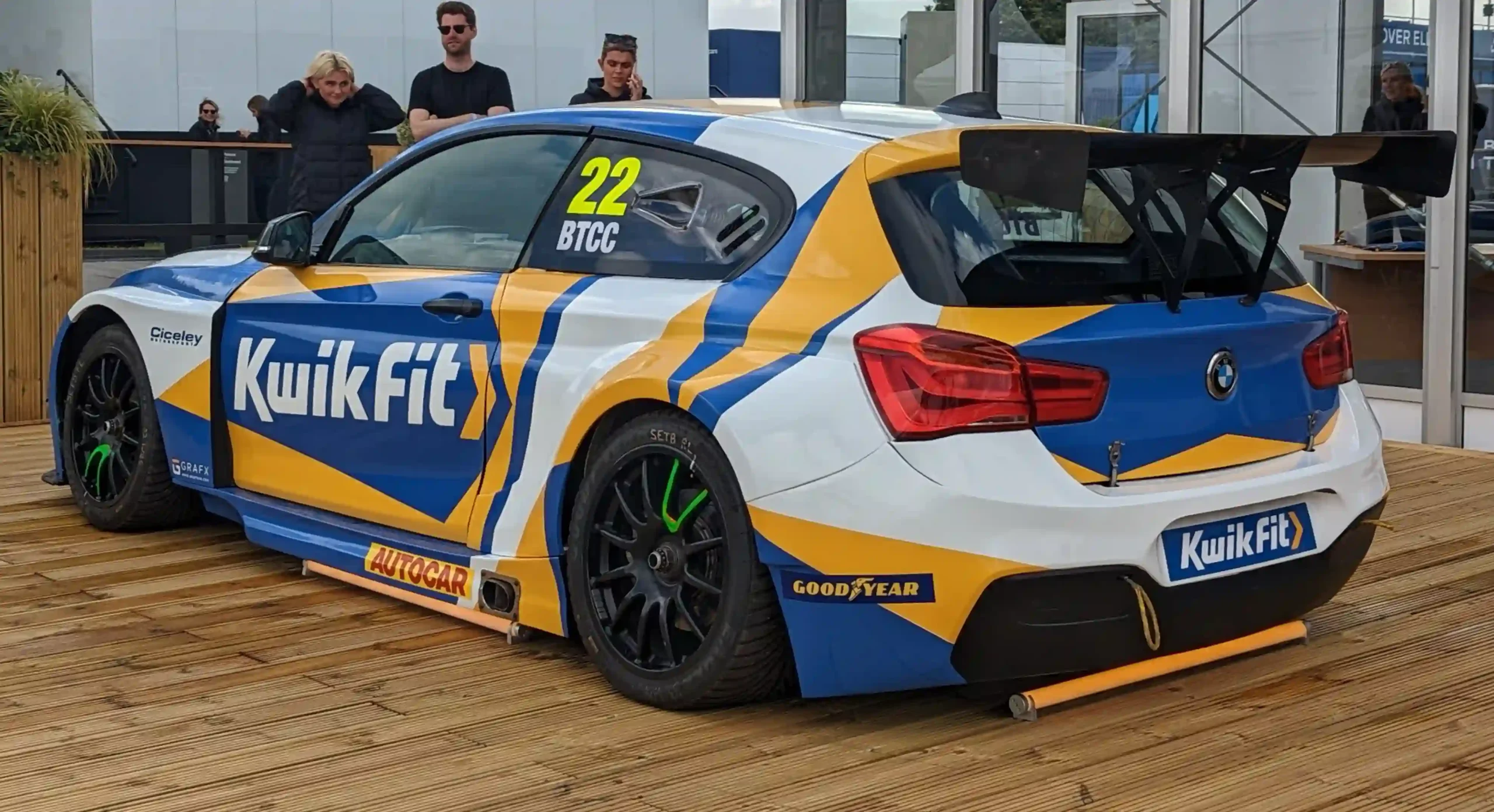
Why Thruxton Produces a Unique Practice Session
High average speed, sustained load and limited marginThruxton is the fastest circuit on the BTCC schedule. The official event used the 2.36-mile layout for Rounds 13, 14 and 15.
The track’s identity comes from long, sweeping corners rather than repeated heavy braking. Goodwood, Church and Brooklands require confidence, balance and stable tyre temperatures.
The Club chicane creates the main low-speed interruption. Drivers must slow the car, attack the kerbs and accelerate cleanly onto the following lap.
High-speed balance matters more than peak corner grip
A car can produce strong grip for one instant and still be difficult across a long corner. The driver needs predictable balance as speed, steering angle and aerodynamic load change.
Understeer forces the driver to lift or add steering. Oversteer increases rear-tyre temperature and may require a correction. Both cost time over a long arc.
Our guide to how car racing works covers the basic relationship between braking, cornering and acceleration. The Thruxton lap puts unusual emphasis on the middle phase.
Straight-line speed still matters
Touring cars create significant aerodynamic drag. A small loss of power or poor exit speed can remain visible through the next high-speed section.
TOCA Turbo Boost allocation adds another variable. Drivers do not always have equal deployment across competitive sessions, so teams must understand the car’s mechanical speed as well as its boosted performance.
For engine context, see how car engines work, turbo versus naturally aspirated engines and what torque means.
Traffic affects every fast lap
A 22-car field creates traffic even on a long circuit. A driver catching a slower car through the fast section may need to abandon the lap.
The following driver also loses aerodynamic stability in disturbed air. Touring cars do not create Formula 1 levels of downforce, but the front end still responds to airflow changes.
Therefore, the best lap depends on track position as well as setup. A clear run can be worth several tenths.
Practice was one 50-minute session
The Saturday timetable listed BTCC Free Practice from 10:25 to 11:15 a.m. BST. For U.S. readers, that was 5:25 to 6:15 a.m. ET.
The compact format increased pressure. Teams needed to complete setup work, tyre comparison and driver preparation in one session before qualifying.
That structure differs from older BTCC weekends with multiple free-practice sessions. It rewards teams that arrive with accurate simulator and engineering preparation.
What the Practice Result Meant for the Weekend
Useful evidence, but not a complete qualifying forecastPractice identified several strong packages, but it did not directly predict the three race winners. Smiley topped Free Practice, while Josh Cook, Ash Sutton and Tom Ingram won the Sunday races. The mixed tyre programmes made the practice order especially difficult to translate.
Practice times were not an equal-compound ranking
The two leading drivers used the medium tyre, while Sutton’s third-place lap came on the hard. Consequently, the order mixed outright speed with different technical programmes.
A team preparing only for qualifying may run less fuel and focus on tyre temperature. Another team may use a heavier car to study race balance.
Without fuel and tyre-age data, the table cannot reveal every car’s true maximum. It can still identify broad strengths and problems.
The top-eight compression signaled an open contest
Only 0.547 seconds covered the top eight. The group included drivers from six team structures and four vehicle brands.
Such compression reduces the value of a small theoretical advantage. Track position, boost use and one mistake can outweigh two tenths of underlying pace.
Cook’s fifth place supported his circuit reputation
Cook did not lead practice, but he remained close enough to matter. His fifth-place lap was only 0.525 seconds behind Smiley and almost identical to Doble, Taylor-Smith, Cammish and Ingram.
He later won Race 1. That outcome showed why a driver with proven circuit understanding remains dangerous even without the fastest Saturday morning time.
Sutton’s third place was a championship statement
Sutton entered Thruxton leading the drivers’ standings. His hard-tyre benchmark suggested that the championship position had not forced NAPA Racing UK into a conservative setup.
He later won Round 14 and added two second places across Sunday. Therefore, the hard-tyre practice pace translated into sustained race performance.
Ingram’s eighth place understated his eventual weekend
Ingram completed the fewest practice laps and placed eighth. However, he later won the final race.
This contrast shows why session position alone can be misleading. His 16-lap programme may have achieved its engineering goals without chasing the practice headline.
Practice interpretation rule
Compare drivers on the same tyre, examine when the best lap occurred and consider lap count. A raw position becomes meaningful only after those three questions are answered.
Seven Key Takeaways From Thruxton Practice
The most useful conclusions from the official timing sheet1. Chris Smiley earned the headline
Smiley set the fastest lap and completed 22 tours. The result was not a one-lap programme with no supporting mileage.
He also beat his teammate, which remains the first comparison for any driver. The margin was small, but first place was clear.
2. Restart Racing’s one-two was more important than the tyre alone
The medium compound helped, yet both Hyundais maximized it. Team-wide pace usually provides stronger evidence than one isolated lap.
Dorlin’s result also demonstrated development since his earlier 2026 setbacks. He matched Smiley closely at a demanding track.
3. Sutton was the hard-tyre reference
The championship leader placed third without the leading pair’s softer compound. His 0.359-second deficit closely matched the estimated tyre difference.
That made Sutton’s lap highly relevant for the competition sessions. His later race results supported that interpretation.
4. Five drivers were almost inseparable from fourth to eighth
Doble, Cook, Taylor-Smith, Cammish and Ingram were covered by 0.035 seconds. Timing resolution, traffic and tyre condition could easily reorder them.
Therefore, describing one as clearly faster than the others would overstate the evidence.
5. Fourteen drivers were within one second
The field remained compressed despite Thruxton’s length and speed. That created the conditions for close qualifying groups and difficult race traffic.
At this level, a one-second gap can still reflect several small issues rather than one major weakness.
6. Mileage leaders were not timing leaders
Bensley, Selby and Hamilton each completed 25 laps. They finished seventeenth, nineteenth and twenty-second.
Their programmes likely emphasized learning and data collection. Practice value cannot be measured only by position.
7. The session proved that practice and race outcomes are different
Smiley topped practice, while Cook, Sutton and Ingram won the three races. The result was not a failure of practice analysis.
Instead, it showed the limits of a mixed-compound, single-lap classification. Racecraft, tyre durability, grid position and incidents all enter the picture later.
- Fastest driver: Chris Smiley, 1:15.365.
- Closest challenger: James Dorlin, 0.093 seconds behind.
- Fastest hard-tyre driver: Ash Sutton in third.
- Closest performance cluster: positions four through eight, covered by 0.035 seconds.
- Highest lap total: Ryan Bensley, Lewis Selby and Nicolas Hamilton with 25 each.
- Field compression: 14 of 22 drivers within one second.
- Approximate leader average: 112.5 mph around the 2.356-mile circuit.
Readers building a deeper technical foundation can also explore horsepower, engine displacement, engine-oil protection and automatic versus manual performance.
Thruxton BTCC Practice FAQ
Four direct answers about the sessionConclusion: Smiley Was Fastest, but the Tyre Context Defined the Session
The Thruxton BTCC 2026 practice results gave Chris Smiley and Restart Racing a deserved one-two. Smiley’s 1:15.365 beat Dorlin by 0.093 seconds, and both drivers completed meaningful mileage before setting their fastest laps.
However, the medium compound influenced the order. Ash Sutton’s third-place hard-tyre lap was only 0.359 seconds from the lead and provided the clearest race-relevant benchmark. His later victory and two second places showed that the underlying pace was genuine.
The classification also revealed a tightly matched field. Eight drivers were covered by 0.547 seconds, and fourteen finished within one second. Doble, Cook, Taylor-Smith, Cammish and Ingram were separated by only 0.035 seconds.
Practice therefore supplied two strong conclusions. Restart Racing used the faster tyre better than anyone, while NAPA Racing UK looked highly competitive on the hard compound. The three Sunday winners—Cook, Sutton and Ingram—then showed why one free-practice table can inform a weekend without deciding it.
Sources
- BTCC: Restart Racing hit the top with Goodyear medium tyre run — official session report, full 22-driver classification and tyre-compound context.
- BTCC Thruxton circuit and event page — official event dates, Rounds 13–15 and Saturday session schedule.
- BTCC 2026 Thruxton results page — official event timing and race-result archive.
- 2026 BTCC Sporting Regulations — approved Goodyear tyre compounds and championship framework.
Historical photographs are identified as archive illustrations and do not claim to depict the July 25, 2026 Free Practice session. Timing calculations use the official lap table and the published 2.356-mile circuit length.