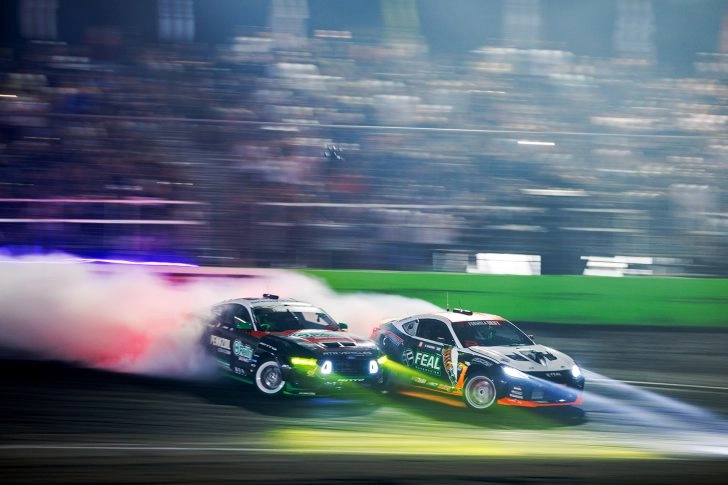
Formula DRIFT Indianapolis 2026 Preview: Championship Contenders, Track Guide & Predictions
Verified standings, the Deane–Bakchis title fight, the redesigned Indianapolis course, UDSM qualifying, tandem tactics, dark horses and a complete prediction board for Formula DRIFT’s first visit to the Racing Capital of the World.
The Formula DRIFT Indianapolis 2026 preview starts with a rare combination: a new event, a new competition course and a championship leader carrying real momentum.
James Deane arrives with 149 points after finishing second at Atlanta and Orlando, then winning Stafford. Aurimas “Odi” Bakchis is 22 points behind after taking the Orlando victory. Meanwhile, only two points separate Branden Sorensen, Jack Shanahan and Conor Shanahan in third, fourth and fifth.
Indianapolis Raceway Park has never hosted a Formula DRIFT championship round. Officials added new asphalt and developed the layout through track visits, driver input, judging input and simulator work. Therefore, historical setup books offer little protection.
This preview uses official event information, standings, results and 2026 regulations available on July 22, 2026. Every prediction is editorial analysis. Practice, qualifying, weather and the final Top 32 bracket can still change the outlook.
Formula DRIFT Indianapolis 2026 Preview: The Quick Answer
Who are the favorites for Formula DRIFT Indianapolis 2026?
James Deane is the overall favorite after three consecutive finals and a Stafford victory. Aurimas Bakchis is the closest challenger. Dylan Hughes is the qualifying pick, Jack Shanahan is the leading podium dark horse and Branden Sorensen is the strongest consistent outsider.
Deane owns the championship lead and the best recent elimination record. However, Indianapolis removes the comfort of prior track knowledge. His advantage lies in adapting quickly and delivering complete lead and chase runs.
Bakchis has already beaten Deane in a 2026 final. His new Subaru BRZ won at Orlando and has produced strong results from the season’s opening rounds. Therefore, he is more than a points-table rival. He is the most credible Round 5 winner outside the leader.
The Shanahan brothers arrive after completing an all-Irish Stafford podium with Deane. Jack finished second, while Conor took third. Both have shown the aggression needed to challenge on an unfamiliar course.
Hughes enters sixth in points but topped Stafford qualifying. UDSM rewards measurable line and angle, making his data-led execution especially relevant at a course with seven new judged zones.
Sorensen sits third and has quietly accumulated 107 points. He has not matched Deane’s finals streak, yet he has remained close enough to punish any early championship exit.
James Deane
149 points
Three consecutive finals, one victory and the strongest all-role execution in the field.
Aurimas Bakchis
Orlando winner
A proven Deane-beater with a new Subaru that has delivered immediate championship pace.
Dylan Hughes
Stafford P1
His latest UDSM performance makes him the strongest forecast for the top Indianapolis seed.
Jack Shanahan
Stafford P2
High proximity and recent momentum create the clearest upset route among the chasers.
Deane has the form. Bakchis has the head-to-head proof. Hughes has the qualifying signal. Indianapolis supplies the uncertainty.
World of Speed preview verdictMidwest Mayhem Event Guide and Eastern Time Schedule
When is Formula DRIFT Indianapolis 2026?
Midwest Mayhem runs from July 30 through August 1 at Indianapolis Raceway Park. PRO practice and qualifying take place Thursday. PROSPEC competes Friday. The PRO Top 32 starts Saturday at 2:30 p.m. ET, followed by the Top 16 through the final at 7:00 p.m. ET.
The event is Round 5 of the eight-round PRO Championship. It also includes PROSPEC competition, a PASMAG car show, autograph sessions and a Saturday track-walk experience.
Unlike many international events, the local Indianapolis timetable already uses Eastern Time. Therefore, U.S. East Coast readers can follow the published schedule without conversion.
| Day | Headline session | Eastern Time | Preview significance |
|---|---|---|---|
| Thursday, July 30 | PRO Practice | 11:15 a.m.–12:45 p.m. | First real grip map of the new layout |
| Thursday, July 30 | PRO Warm-Up | 6:00–7:00 p.m. | Final preparation for cooler evening conditions |
| Thursday, July 30 | PRO Qualifying | 7:00–10:00 p.m. | Sets the Top 32 bracket and awards bonus points |
| Friday, July 31 | PROSPEC Top 32 | 2:00–5:00 p.m. | Shows how the surface changes in daytime heat |
| Friday, July 31 | PROSPEC Top 16 to Final | 7:00–10:00 p.m. | Provides the best pre-PRO night-condition sample |
| Saturday, August 1 | PRO Warm-Up | 12:30–2:00 p.m. | Confirms tandem setup before elimination |
| Saturday, August 1 | PRO Top 32 | 2:30–5:30 p.m. | First knockout phase and likely upset window |
| Saturday, August 1 | PRO Top 16 to Final | 7:00–10:00 p.m. | Night battles decide Round 5 |
The Thursday-to-Saturday gap is unusual but useful. Teams can study qualifying data for more than a day. They can also repair damage before the main event.
However, the final Saturday warm-up lasts only 90 minutes. Teams cannot afford to discover a fundamental setup problem after qualifying. The main philosophy must already be correct.
Track temperature may shift sharply between the afternoon Top 32 and evening Top 16. Consequently, tire pressure and throttle response must work across two different grip windows.
Watch PROSPEC on Friday. It will provide the clearest public evidence of how the fresh Indianapolis surface develops before the PRO elimination bracket.
2026 Formula DRIFT Standings Before Indianapolis
Who leads Formula DRIFT before Indianapolis?
James Deane leads with 149 points. Aurimas Bakchis is second on 127. Branden Sorensen has 107, Jack Shanahan 106 and Conor Shanahan 105. Only two points cover third through fifth, while Deane holds a 22-point lead over Bakchis.
| Pos. | Driver | Points | Gap | Round 5 objective |
|---|---|---|---|---|
| 1 | James Deane | 149 | — | Extend the lead without giving away qualifying position |
| 2 | Aurimas Bakchis | 127 | -22 | Reach the final and prevent a major Deane breakaway |
| 3 | Branden Sorensen | 107 | -42 | Convert consistent speed into a first 2026 final |
| 4 | Jack Shanahan | 106 | -43 | Carry Stafford momentum into another deep bracket run |
| 5 | Conor Shanahan | 105 | -44 | Pair maximum attack with mechanical completion |
| 6 | Dylan Hughes | 87 | -62 | Repeat Stafford pole and improve tandem conversion |
| 7 | Fredric Aasbo | 85 | -64 | Stop the mechanical losses and restore podium form |
| 8 | Ryan Tuerck | 64 | -85 | Use experience to exploit a first-year venue |
| 9 | Chris Forsberg | 58 | -91 | Recover from a scoreless Stafford main event |
| 10 | Cole Richards | 55 | -94 | Continue leading the rookie class |
The standings create two separate fights. Deane and Bakchis form the leading title pair. Meanwhile, Sorensen and the Shanahans are separated by almost nothing.
A maximum PRO round can deliver 54 points: four for qualifying first and ten for each of five main-event battle wins. Therefore, the top five remain mathematically connected through one Indianapolis weekend.
Qualifying points matter because the margins are small. One point separates Sorensen and Jack Shanahan. Another point separates Jack and Conor.
The bracket also affects ranking among drivers eliminated in the same phase. A higher qualifying seed can therefore protect championship position even when two rivals both exit in the Great 8.
Four Rounds, Four Winners: Why Indianapolis Is Open
Who has won Formula DRIFT rounds in 2026?
Conor Shanahan won Long Beach, Vaughn Gittin Jr won Atlanta, Aurimas Bakchis won Orlando and James Deane won Stafford. Four different winners from four rounds show that no driver or chassis has controlled the season.
Long Beach rewarded Conor Shanahan’s commitment and immediate speed. Atlanta then produced a Vaughn Gittin Jr victory after several leading contenders suffered bracket problems.
Orlando placed Bakchis and Deane in the final. Bakchis won in the new Subaru BRZ, while Deane recorded his second straight runner-up result.
Stafford produced another new-venue challenge. Deane recovered from a 12th-place qualifying position and defeated five opponents. Jack and Conor Shanahan completed the podium.
Those results make Indianapolis difficult to reduce to one favorite. A new venue can reward the quickest learner, not the driver with the longest setup archive.
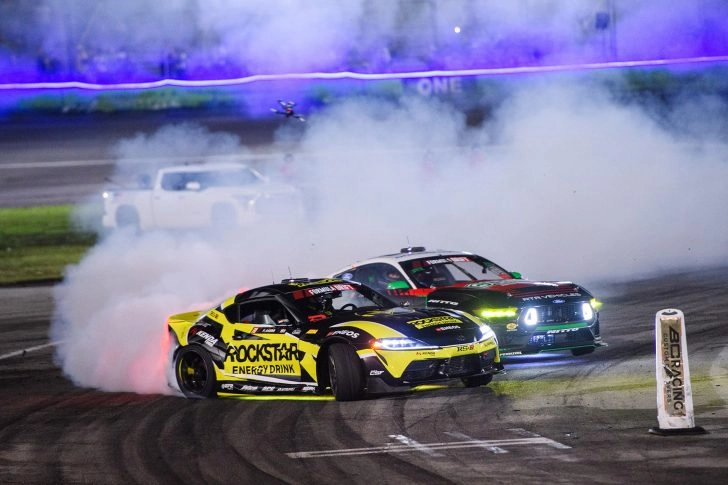
Deane’s Form Is Better Than One Win Suggests
Deane’s opening round ended early. Since then, he has finished second, second and first. That is the strongest three-event sequence in the field.
Moreover, he reached the Stafford final from outside the top ten in qualifying. That recovery shows bracket resilience. It also warns that even a weak Thursday score may not remove him from contention.
Bakchis Has Immediate New-Car Success
Bakchis changed from his long-serving Nissan S15 to a Subaru BRZ. The new car produced a fifth-place finish at Long Beach, third at Atlanta and victory at Orlando.
Stafford was less productive, yet he still reached the Great 8. His championship challenge is based on repeated points rather than one isolated result.
The Shanahans Have Proven Event-Winning Pace
Conor won Round 1 and reached the Stafford podium. Jack reached the Stafford final after strong tandem battles throughout the night.
Both drivers can create huge proximity. However, Indianapolis requires complete mechanical reliability. Technical issues affected both Shanahans during the late Stafford rounds.
Sorensen Is Building a Quiet Title Case
Sorensen has remained near the leaders through four rounds. He qualified second at Stafford and finished sixth overall.
His season lacks a headline victory, but the points table rewards repeated battle wins. Indianapolis could become the event where consistency turns into a final appearance.
Championship Contenders and Indianapolis Dark Horses
James Deane: The Favorite With the Complete Package
Deane’s Ford Mustang RTR has delivered three consecutive finals. More importantly, his recent results cover different course types and changing conditions.
He leads with 149 points and can afford a measured qualifying approach. Yet excessive caution would create a harder bracket. Indianapolis therefore tests his ability to balance championship control with aggression.
Deane’s lead runs are predictable without being slow. His chase runs often remain close through transitions. Those qualities matter on a course where every opponent is still learning the rhythm.
The main risk is a second qualifying error. He spun on his second Stafford run and started 12th. Another weak seed could place him against a major contender before the Great 8.
Aurimas Bakchis: The Most Credible Direct Challenger
Bakchis has 127 points and a 2026 victory over Deane. His Subaru has shown strong forward drive, repeatable angle and immediate competitiveness.
Indianapolis may reward that stability. Fresh asphalt can magnify power-to-grip differences, and the BRZ package has already worked across several surfaces.
Bakchis needs a stronger result than Stafford. A Great 8 exit was respectable, but Deane’s win created a 22-point gap.
His best route is a top-four qualifying score followed by a direct final appearance. That combination can reduce the deficit even if Deane reaches the semifinal.
Branden Sorensen: The Championship Sleeper
Sorensen sits third with 107 points. He has remained in the lead group without receiving the same attention as the champions.
He qualified second at Stafford, only half a point behind Hughes. That performance makes him a genuine Indianapolis qualifying threat.
The key question is tandem conversion. Sorensen needs to turn top-five pace into a final. A clean bracket could move him past both Shanahans and closer to Bakchis.
Jack Shanahan: The Momentum Challenger
Jack’s Stafford runner-up result moved him to 106 points. He defeated several strong opponents before a steering problem ended the final challenge.
His chase style produces the proximity that wins close decisions. However, new-course competition punishes a chase driver who predicts the lead incorrectly.
Indianapolis should suit his willingness to commit. The car’s steering system and front-end consistency must survive high-angle transitions and possible OMTs.
Conor Shanahan: The High-Ceiling Aggressor
Conor won Long Beach and remains fifth with 105 points. His season proves both the reward and risk of maximum attack.
He can qualify well, lead at high pace and chase with exceptional aggression. Nevertheless, Orlando’s poor seed showed how quickly one qualifying session can complicate a weekend.
A podium at Stafford restored momentum. If the Toyota GT86 completes every run, Conor can win Indianapolis. If it suffers another technical interruption, the title gap may grow sharply.
Dylan Hughes: The Top-Seed Specialist
Hughes qualified first at Stafford with 84.1 points. UDSM measured the strongest combined line and angle package, while the judges rewarded his style.
Indianapolis gives him another course without historical expectations. That environment can favor a driver and team willing to trust data quickly.
The challenge comes after qualifying. Hughes needs to convert a high seed into a semifinal or final. The pole prediction is stronger than the event-win prediction.
Fredric Aasbo: The Experienced Recovery Pick
Aasbo sits seventh after an inconsistent opening half. He reached the Orlando podium but lost other points through mechanical problems and early exits.
Experience remains valuable at a new venue. Aasbo understands how to build a line from limited practice and adapt his Toyota to changing grip.
His Indianapolis ceiling is a final. The floor remains a mechanical loss. Reliability, rather than raw speed, determines whether he becomes a serious dark horse.
Ryan Tuerck, Chris Forsberg and Cole Richards
Tuerck is eighth with 64 points. He reached the Stafford Great 8 and remains one of the field’s strongest improvisers. That skill matters when a new track changes between runs.
Forsberg sits ninth after scoring no Stafford main-event points. However, he qualified fifth there and has enough experience to create an Indianapolis rebound.
Richards is tenth and the leading rookie. His season has combined strong early results with limited Stafford scoring. A Top 16 appearance would strengthen his Rookie of the Year position.
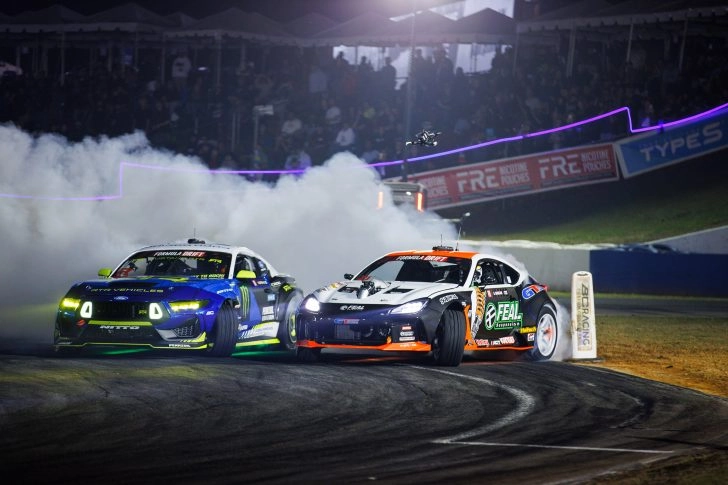
Indianapolis Raceway Park Track Guide
Why is the Formula DRIFT Indianapolis course new?
Indianapolis Raceway Park is making its Formula DRIFT debut. Series officials, judges, driver liaisons and track staff added pavement and refined a purpose-built course through site visits and simulator testing. The published competition route contains seven judged zones.
Indianapolis Raceway Park opened in 1960 and is known for drag racing and short-oval competition. Formula DRIFT will use the venue in a different way, combining existing pavement with newly added sections.
Driver liaisons Ryan Litteral, Ken Gushi and Matt Field worked with judges Brian Eggert, Reese Marin, Robbie Nishida and Vernon Zwaneveld. The Formula DRIFT competition department and track officials completed the group.
The goal was not simply to place cones on an oval. The series wanted a course with sustained angle, readable zones, high-speed commitment and enough transition quality for tandem comparison.

The First Strategic Problem: Entry Commitment
A new course offers no reliable previous entry-speed reference. Drivers must determine speed, initiation point and gear within limited practice.
Too little speed creates shallow angle and incomplete zone fill. Too much speed can force a correction or push the car beyond the defined course.
The fastest learner will separate simulator expectations from real grip. Fresh asphalt, actual barriers and real tire rubber can change the line immediately.
The Second Problem: Transition Rhythm
The middle of a Formula DRIFT course often reveals the best chassis. Drivers must move from one side to the other while maintaining pace and stable front-wheel control.
Slow, stepped transitions reduce style. Violent transitions can overshoot the next zone and create a chase collision.
Indianapolis should reward a broad power band and a predictable steering system. Drivers need enough response to rotate without turning every transition into a rescue.
The Third Problem: A Chaseable Lead
The lead driver cannot simply escape. The run must follow the judged line, pace and momentum map.
A car with exceptional grip may create legal separation through better acceleration. However, an unchaseable mistake or unexpected slowdown can create a deduction.
That distinction matters on a new surface. Every driver will still be learning how quickly the field can follow each section.
Fresh Asphalt and Track Evolution
New pavement often begins green and dusty. It then gains rubber in the preferred line. The result can be a large difference between Thursday practice and Saturday night.
More grip improves forward speed and chase proximity. Yet it also increases drivetrain load and can make transitions more abrupt.
Offline grip may remain low. Therefore, a driver forced away from the ideal zone during tandem can lose speed faster than expected.
World of Speed’s guides to grip, car handling and oversteer and understeer explain the basic vehicle behavior.
Day-to-Night Conditions
The Top 32 runs in the afternoon. The Top 16 starts at 7:00 p.m. ET. Surface temperature and ambient conditions can change between those phases.
A pressure target that works in afternoon heat may create too much or too little grip at night. Teams need a direction of adjustment before competition begins.
PROSPEC offers the best reference. Its Friday afternoon and evening sessions cover the same broad time windows as Saturday PRO competition.
Indianapolis is likely to favor adaptable drivers with stable cars. The decisive advantage should come from repeatable transitions and accurate zone placement, not the largest horsepower figure.
UDSM Qualifying: Why the Top Seed Matters
How does Formula DRIFT qualifying work in 2026?
PRO drivers receive two non-consecutive solo runs in reverse championship order. UDSM telemetry awards up to 40 points for line and 40 for average angle. The judges award up to 20 points for style, creating a 100-point total.
Qualifying has returned to two runs for PRO in 2026. The change reduces the damage from one mistake while preserving the pressure to complete both attempts.
Line and angle now account for 80 percent of the total through Race Data Labs telemetry. Judges still evaluate style, including initiation, transition speed, front-wheel control, pace and throttle commitment.
First Run: Build a Usable Bracket
The first run should establish a complete score. A driver needs enough line, angle and style to enter the Top 32 without depending on the second attempt.
However, a deliberately cautious run can create a weak seed. That may place the driver against a championship rival in the first elimination round.
The best first run is secure but representative. It should fill the zones, carry real angle and avoid an incomplete.
Second Run: Attack the Missing Category
The second attempt allows a targeted improvement. A driver with a weak line score can focus on zone fill. A driver with low average angle can add rotation.
Yet an incomplete remains costly. Spins, opposite drift, major off-course errors or loss of control across the finish produce no score for that run.
Deane’s Stafford qualifying offers a clear example. He scored 77.1 on his first run, then spun on the second. The result was 12th place rather than a front-row seed.
Why Indianapolis Can Produce a Surprise Pole
The championship leaders run later because qualifying uses reverse standings order. They can watch earlier drivers and surface development.
However, later running does not guarantee better grip. Rubber pickup, debris or a changing temperature can make the surface less predictable.
Hughes and Sorensen were first and second at Stafford. Both should challenge again. Aasbo, Bakchis, Jack Shanahan and Deane remain realistic top-five seeds.
For general context, see World of Speed’s explanations of how racing drivers qualify, pole position and grid position.
Dylan Hughes is the pole pick, with Branden Sorensen and Aurimas Bakchis as the closest alternatives. Deane is expected to qualify inside the top eight rather than repeat Stafford’s 12th place.
Lead, Chase and Bracket Strategy
What makes a winning Formula DRIFT tandem battle?
The lead driver must deliver the judged line, angle, initiation and pace without becoming unchaseable. The chase driver must initiate no later, remain close, match transitions and show equal or greater angle. Judges compare both lead-and-chase runs before deciding the winner.
The higher bracket seed leads first. The drivers then switch roles. That order matters, but it does not create a guaranteed scoring advantage.
A strong first lead can apply pressure immediately. Conversely, the lower seed can study the opponent’s pace while chasing, then set a lead reference on the second run.
Lead Strategy
The best lead resembles a top qualifying run. It follows the line, fills zones, maintains pace and transitions cleanly.
Separation should come from execution. Faster rotation, stronger acceleration and a cleaner exit are legitimate. Unexpected slowing or a compromised path can make the run unchaseable.
Indianapolis adds uncertainty because the normal pace is not established. Drivers and judges will define that standard during briefing, practice and qualifying.
Chase Strategy
The chase car needs proximity before the first major transition. A late initiation can create a gap that never closes.
Once committed, the chase driver must match timing and angle. Position alone is not enough. A car may appear close while carrying less angle and missing the lead line.
Smoke can hide mistakes from cameras, but UDSM data remains available as a judging tool. It measures proximity, comparative speed, angle and off-course tires.
Contact and Cause-and-Effect
Light contact does not always decide a battle. If both cars continue without an incomplete, the judges evaluate the runs rather than assigning an automatic loss.
When contact causes an incomplete, officials study which action created the outcome. Lead mistakes, chase mistakes and unavoidable reactions are treated differently.
At a new venue, cause-and-effect can be difficult to read. The course may produce speed differences that drivers have not yet experienced in close tandem.
One More Time
An OMT repeats both roles when the judges cannot reach a majority decision. It is not intended to rescue two poor runs.
Extra runs create a competitive cost. They use tires, build heat and reduce repair time before the next battle.
A driver who survives multiple OMTs can still win. However, that route places more stress on steering, axles, transmission and cooling systems.
Championship Points
Qualifying first earns four points. Second earns three, third earns two and fourth through 32nd earn one.
Every main-event battle win earns ten points. A driver who qualifies first and wins the Top 32, Top 16, Great 8, Final Four and final scores 54 points.
That structure explains the Indianapolis stakes. Bakchis can erase a 22-point deficit in one night. Deane can also convert the same margin into a commanding lead.
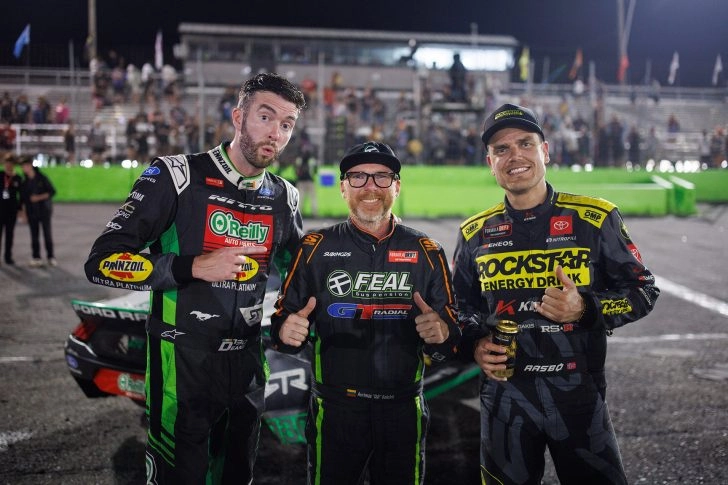
Car Setup and Tire-Grip Priorities
What setup should work at Formula DRIFT Indianapolis?
A stable front end, predictable rear grip, broad torque delivery and strong cooling should matter more than maximum peak power. Teams need a car that fills the zones during qualifying, remains chaseable in the lead role and can repeat its behavior through consecutive tandem runs.
Tire Rules and Grip
PRO cars must use approved DOT tires rated at least 200 UTQG. The rear tire must fit an 18-inch DOT-standard wheel.
Maximum measured rear width depends on vehicle weight. The classes range from 260 millimeters at 2,700 pounds to 330 millimeters at 3,400 pounds.
Formula DRIFT measures the tire’s contact patch rather than trusting the sidewall number. Tire warmers, shaving, grooving and chemical treatments are prohibited.
Therefore, teams tune grip with legal tire choice, pressure, burnout procedure, alignment and suspension. The ideal setup must remain consistent across two consecutive battle runs.
Front-End Response
The front tires determine whether the driver can place the rear accurately. Caster, camber, toe and Ackermann affect steering behavior at large angle.
Too little response creates missed zones. Too much sensitivity can make transitions nervous and increase the chance of correction.
Indianapolis should reward a calm steering platform. The driver needs to make precise changes while surrounded by smoke and another car.
Torque Delivery
Peak horsepower is not the main target. Drivers need predictable torque after initiation and during each transition.
A sudden boost spike can widen the line or force the car beyond the desired angle. Slow response can create a visible pause and reduce chase proximity.
A broad power band allows the driver to use throttle position rather than repeated clutch kicks. World of Speed’s guides to turbo response, torque and horsepower provide further background.
Gearing and Differential
The selected gear should cover initiation, transitions and the finish without repeated shifts. Hitting the limiter can interrupt pace and reduce style.
Differential behavior must remain predictable as grip rises. Inconsistent locking can create a step or unexpected change in wheel speed.
Higher surface grip increases mechanical load. Teams must monitor fluid temperature and component condition between battles.
Cooling and Reliability
Summer heat, burnouts and possible OMTs can raise coolant, oil, steering, transmission and differential temperatures.
The Top 16 through final occurs in one evening window. Repair time becomes limited as a driver advances.
Stafford demonstrated the risk. Steering and other technical issues affected leading contenders late in the event. Indianapolis may produce similar failures if the new surface creates greater load.
The winning car should feel slightly less dramatic than the most spectacular qualifying build. Repeatability, steering health and usable torque matter across five battles.
Formula DRIFT Indianapolis 2026 Predictions
Who will win Formula DRIFT Indianapolis 2026?
James Deane is predicted to beat Aurimas Bakchis in the final. Dylan Hughes is selected as the top qualifier. Jack Shanahan is the podium pick, while Branden Sorensen is the strongest Great 8 dark horse. Deane is also expected to retain the championship lead.
Top Qualifier: Dylan Hughes
Hughes topped Stafford qualifying and should benefit from another data-heavy new-course challenge. His strongest route is a complete first run followed by a more aggressive second attempt.
Sorensen is the nearest alternative. Bakchis and Aasbo are also likely top-five qualifiers. Deane should improve from Stafford but may not chase maximum angle at championship risk.
Predicted Great 8
- James Deane — recent bracket form makes an early exit difficult to predict.
- Aurimas Bakchis — strong new-car consistency and the main title challenge.
- Jack Shanahan — Stafford momentum and excellent chase proximity.
- Branden Sorensen — qualifying speed and championship consistency.
- Dylan Hughes — expected high seed and accurate solo-line execution.
- Conor Shanahan — event-winning ceiling with mechanical risk.
- Fredric Aasbo — experience and new-venue adaptability.
- Ryan Tuerck — strongest lower-standings improvisation pick.
Predicted Final: Deane Versus Bakchis
The pair contested the Orlando final, where Bakchis won. Deane then won Stafford and moved ahead in the standings.
A rematch fits the Indianapolis story. Both cars have proven line speed, angle and repeated bracket durability.
Deane receives the final prediction because of his three-event sequence. His lead-and-chase balance has remained strong even when qualifying position was imperfect.
Predicted Winner: James Deane
The forecast is Deane over Bakchis in a close decision. An OMT is possible because both drivers can produce highly complete runs.
Deane’s advantage is recent elimination form. Bakchis’ advantage is direct proof that the Subaru can beat the Mustang in a final.
The prediction depends on reliability. A steering, axle or cooling issue would immediately change the outcome.
Predicted Podium
James Deane
Best recent bracket record and the strongest complete-role forecast.
Aurimas Bakchis
New-car consistency and a proven 2026 final victory over Deane.
Jack Shanahan
Stafford momentum and aggressive chase proximity create podium value.
Dark Horse: Branden Sorensen
Sorensen is only called a dark horse because the leading pair and Shanahan story receive more attention. His points total and Stafford qualifying prove genuine pace.
A top-three seed could create a favorable first half of the bracket. From there, one strong Great 8 decision can place him in the semifinal.
Upset Pick: Ryan Tuerck
Tuerck’s points position may create a difficult first-round matchup. However, his adaptability makes him dangerous at a venue without prior data.
If the course rewards throttle precision and fast learning, Tuerck can eliminate a top-eight seed and reach the Great 8.
Championship Forecast After Indianapolis
Deane is expected to retain the lead. A final appearance should keep the margin above 20 points even if Bakchis wins.
Jack Shanahan is predicted to move into third. Sorensen should remain close, while Conor Shanahan’s position depends heavily on mechanical completion.
Hughes can close on the top five through qualifying and Great 8 points. A top seed alone will not create a major championship jump.
| Category | Prediction | Closest alternative | Main reason |
|---|---|---|---|
| Top qualifier | Dylan Hughes | Branden Sorensen | Latest UDSM pole and accurate line execution |
| Event winner | James Deane | Aurimas Bakchis | Three consecutive finals and Stafford victory |
| Runner-up | Aurimas Bakchis | Jack Shanahan | Championship consistency and Orlando win |
| Third place | Jack Shanahan | Branden Sorensen | Stafford momentum and chase strength |
| Dark horse | Branden Sorensen | Fredric Aasbo | Third in points and second in Stafford qualifying |
| Upset pick | Ryan Tuerck | Chris Forsberg | Adaptability at a first-year venue |
What Could Change the Forecast?
Rain would reduce smoke, lower grip and change the preferred setup. Formula DRIFT can adjust judging criteria for changing weather.
The final course may also drive differently from simulations. New asphalt, real barriers and rubber buildup can alter the ideal pace.
Qualifying decides the bracket. A Deane–Bakchis or Shanahan–Sorensen matchup in the Top 16 would remove one favorite much earlier than predicted.
Finally, mechanical problems remain the largest wildcard. A five-minute timeout cannot repair every steering, axle or drivetrain failure.
Formula DRIFT Indianapolis 2026 Preview FAQ
Conclusion: Indianapolis Rewards the Team That Learns Fastest
The Formula DRIFT Indianapolis 2026 preview begins with Deane as the clear favorite. Three consecutive finals and a Stafford victory give him the strongest form.
However, Bakchis remains a genuine direct threat. He won Orlando, has adapted quickly to the Subaru BRZ and trails by only 22 points.
The fight behind them is even tighter. Sorensen, Jack Shanahan and Conor Shanahan are separated by two points.
Indianapolis adds uncertainty through a purpose-built course and fresh pavement. No driver arrives with a previous championship setup.
Practice must establish entry speed, transition rhythm, pressure direction and night-condition behavior. Friday PROSPEC competition should provide valuable surface evidence.
Qualifying will shape the weekend. UDSM awards 80 points through line and angle telemetry, while the judges control the 20-point style score.
Hughes is the pole prediction after topping Stafford. Sorensen and Bakchis are expected to challenge closely.
Tandem competition requires two complete roles. The lead must be fast and chaseable. The chase must remain close while matching angle and transitions.
Deane is predicted to defeat Bakchis in the final. Jack Shanahan is the third-place pick, while Sorensen is the leading dark horse.
That forecast can change as soon as the bracket appears. A poor seed may place two favorites together before the Great 8.
Mechanical reliability remains essential. Steering, axles, transmission and cooling must survive possible OMTs and five elimination rounds.
For now, Deane should leave Indianapolis still leading. Yet the first Midwest Mayhem round has every ingredient needed to tighten the title fight rather than settle it.
Sources & Verification
Event dates, Eastern Time sessions, course-development details, championship standings, Stafford results and qualifying rules were checked against official Formula DRIFT material available on July 22, 2026. Predictions remain editorial analysis.