The Evolution of F1 Steering Wheels Explained
The steering wheel began as a simple rim. It is now the driver’s gearbox control, dashboard, radio panel and energy-management console.
They changed from large round rims into compact removable control centers. Paddle shifting, displays, radio controls, brake settings and hybrid-energy tools moved onto the wheel as F1 cars became faster and more complex.
A 1950 Formula 1 driver held a steering wheel. A 2026 driver operates an entire car through one.
The visual difference is obvious. Early wheels were round, thin and almost empty.
Modern versions resemble aircraft controls. They carry switches, paddles, LEDs, menus and a color display.
However, the deeper change is not cosmetic. The wheel became the driver’s main interface with the car.
The evolution of F1 steering wheels followed every major technical shift in the championship. Smaller cockpits demanded tighter packaging.
Semi-automatic gearboxes moved shifting from a lever to paddles. Electronics then moved setup controls from the dashboard to the driver’s thumbs.
Furthermore, hybrid power units added energy deployment, recharge and fault-management tasks. The wheel had to grow smarter without becoming harder to use.
That challenge explains why two teammates may use different layouts. Their controls perform similar jobs, but the grip shape and paddle feel can be personal.
Meanwhile, regulations still protect the basic act of steering. The wheel must turn one axis, and power assistance can only reduce physical effort.
The 2026 rules added another chapter. Boost, Overtake Mode and active aero now shape how drivers manage speed and electrical energy.
This guide traces the full story. It covers wooden rims, Ferrari’s 1989 paddle-shift breakthrough, digital dashboards, hybrid controls and Mercedes DAS.
It also explains the buttons, paddles, construction, cost myths and current FIA safety rules.
The Direct Answer: The Wheel Evolved Because the Driver’s Job Expanded
Cars gained semi-automatic gearboxes, electronic controls, radio communication, digital timing and hybrid power units. Moving those functions onto the wheel let drivers use them without removing a hand.
The first steering wheel had one essential job. It turned the front wheels.
Every later addition solved a cockpit problem. Paddles removed the need to reach for a gear lever.
Buttons replaced switches mounted deeper inside the car. Therefore, the driver could make changes while staying fully committed through a corner.
Displays replaced separate gauges. They also organized far more information through selectable pages.
Moreover, the wheel became removable. This improved access to extremely narrow cockpits and helped drivers exit quickly.
The evolution of F1 steering wheels also reflects regulation. Automatic gear changes are forbidden, so the driver still requests every shift.
Current clutch paddles follow strict geometry rules. The quick-release system and steering column must also survive FIA tests.
Complexity did not remove driver skill. Instead, it changed the skill from simple mechanical operation to rapid control management.
A modern F1 wheel is complicated by design but simple in use. The best layouts place critical controls where the driver can find them through muscle memory.
F1 Steering Wheel Evolution Timeline
| Period | Typical Steering Wheel | Major Change |
|---|---|---|
| 1950s | Large circular rim with metal spokes | Separate dashboard gauges and manual gear lever |
| 1960s–1970s | Smaller leather or suede round wheel | Tighter cockpits and faster steering responses |
| 1980s | Compact wheel with a few electrical buttons | Radio and electronic functions begin moving closer |
| 1989 | Ferrari 640 paddle-shift wheel | Driver changes gear without leaving the steering rim |
| 1990s | Flat-sided wheels with buttons and paddles | Electronic gearboxes and quick-release systems spread |
| 2000s | Carbon-composite multifunction wheel | Digital displays, rotary dials and detailed setup controls |
| 2014–2025 | Hybrid-era wheel with energy pages | ERS, brake migration and power-unit management expand |
| 2020 | Mercedes W11 with DAS | Push-pull wheel movement altered front-wheel toe |
| 2026 | Boost and Overtake controls | New energy deployment and active-aero information |
The table makes the evolution of F1 steering wheels look smooth. In reality, teams developed several ideas at different speeds.
Some designs stayed round for years. Others quickly became flat-sided because cockpit packaging demanded it.
1950s F1 Steering Wheels: Large, Round and Mechanically Direct
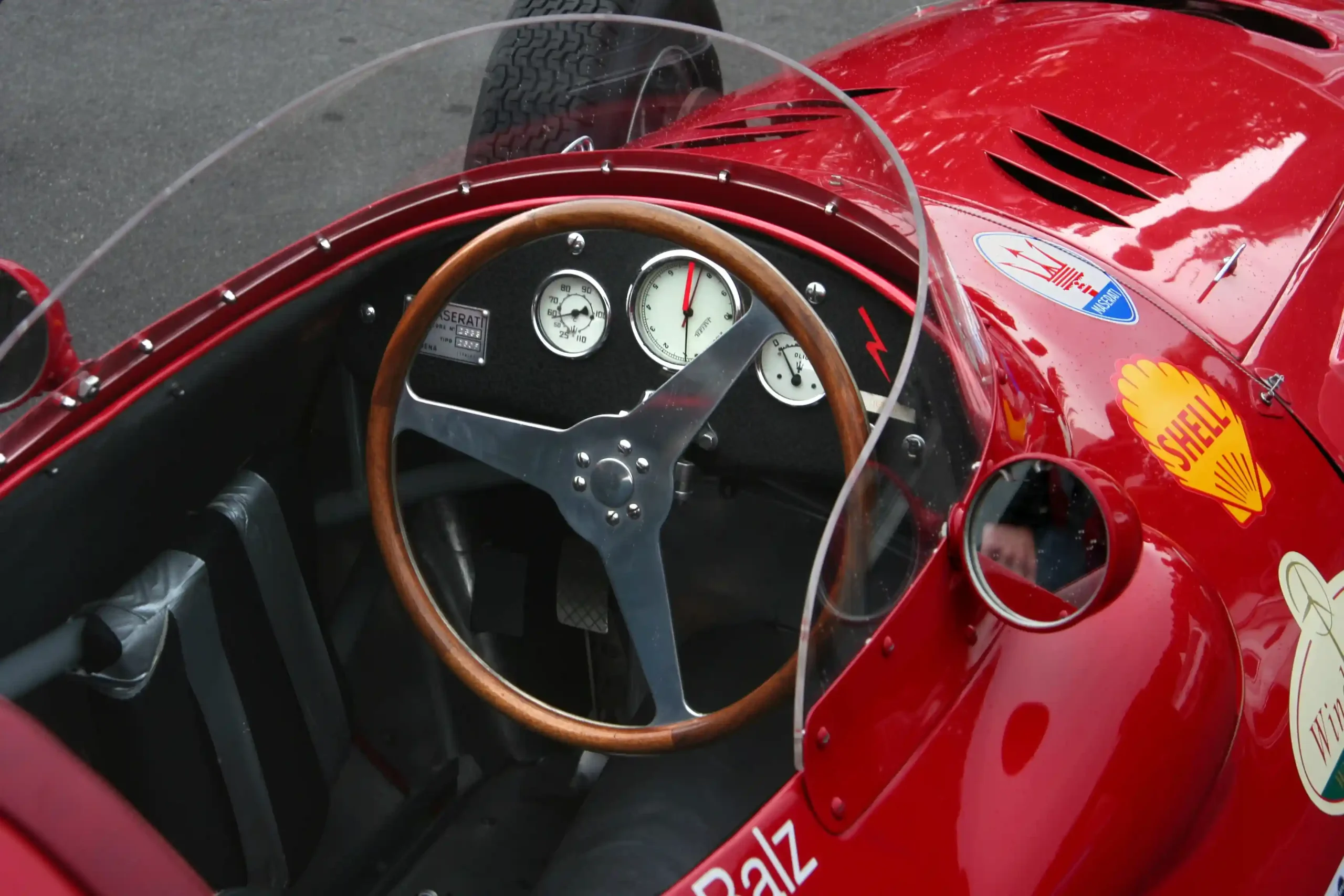
They were large circular rims with three or four metal spokes. Most controls and gauges sat on the dashboard, while the driver changed gear with a separate lever.
The first World Championship cars inherited design ideas from pre-war Grand Prix racing. Drivers sat upright in narrow aluminum bodies.
The steering wheel was often wood-rimmed or wrapped in leather. Its diameter gave leverage because steering assistance did not exist.
The Dashboard Carried the Information
A large tachometer usually dominated the instrument panel. Oil pressure and water temperature appeared on separate analog gauges.
Therefore, the driver looked past the wheel to check the engine. Nothing needed a display page or menu.
Drivers Removed a Hand to Change Gear
The gear lever sat beside the cockpit. Each shift required one hand to leave the rim.
That action was manageable on slower corners. However, it demanded precision during braking and high-speed direction changes.
Steering Feedback Was Raw
The wheel connected mechanically to the steering box or rack. Tire forces traveled through the column and into the driver’s hands.
Consequently, bumps, understeer and wheel movement felt immediate. There was little filtering.
A Large Rim Created Mechanical Leverage
A bigger diameter reduces the effort needed for the same steering torque. That mattered with narrow tires and heavy front-engine cars.
Yet the wheel also occupied valuable cockpit space. As cars became lower, the diameter had to shrink.
This early stage of the evolution of F1 steering wheels looks simple. However, drivers managed a difficult car with few aids.
The 1960s and 1970s: Smaller Wheels for Lower, Faster Cars
Formula 1 moved toward rear engines, lower seating positions and stronger aerodynamic loads. The steering wheel followed.
Rims became smaller and thicker. Suede improved grip when the driver wore racing gloves.
Rear-Engine Cars Changed the Cockpit
The driver’s legs extended into a narrower nose. Therefore, teams reduced wheel diameter to clear the knees.
A smaller wheel also suited quicker steering ratios. Drivers could make rapid corrections without crossing their arms.
Downforce Increased Steering Loads
Wings pushed the front tires harder into the track. Steering became heavier at speed.
However, teams could not simply return to huge rims. Cockpit size and aerodynamic packaging limited space.
Buttons Were Still Rare
Most electrical controls remained on the dashboard. A driver might have an ignition switch, starter or simple communication control nearby.
The wheel itself remained focused on direction. Therefore, the driver still separated steering from car management.
Round Shapes Still Made Sense
Drivers sometimes used larger steering angles than modern F1 requires. A complete rim gave a continuous gripping surface.
That advantage mattered on slow circuits and during slides. Later cars reduced the need for hand-over-hand movement.
For the forces behind those reactions, see what car handling means and how racing grip works.
The 1980s: Electronics Reached the Driver’s Hands
Turbo engines, fuel limits and electronic management made the cockpit busier. Teams needed faster access to controls.
Small buttons began appearing on or near the steering wheel. However, the manual gear lever still dominated the driver’s workload.
Turbo Cars Needed More Management
Drivers monitored boost, fuel and engine temperatures. Some settings changed according to race strategy.
Therefore, the dashboard grew more crowded. Engineers started searching for controls that could sit within thumb reach.
Radio Communication Became More Important
Team radio developed into a regular race tool. A wheel-mounted push-to-talk button let the driver communicate without reaching down.
That small button marked a major philosophical change. The wheel was becoming an interface, not only a steering rim.
Cockpits Became Extremely Tight
Ground-effect tunnels and narrow monocoques reduced available space. The steering wheel had to fit around the driver’s legs and the cockpit opening.
Consequently, quick-release ideas became more valuable. Removing the wheel made entry and exit easier.
Manual Shifting Reached Its Limit
A traditional lever required linkages through the chassis. It also forced the driver to remove one hand.
John Barnard saw an opportunity. Electronics and hydraulics could select the gear after a simple paddle request.
Ferrari 640: The 1989 Paddle-Shift Breakthrough
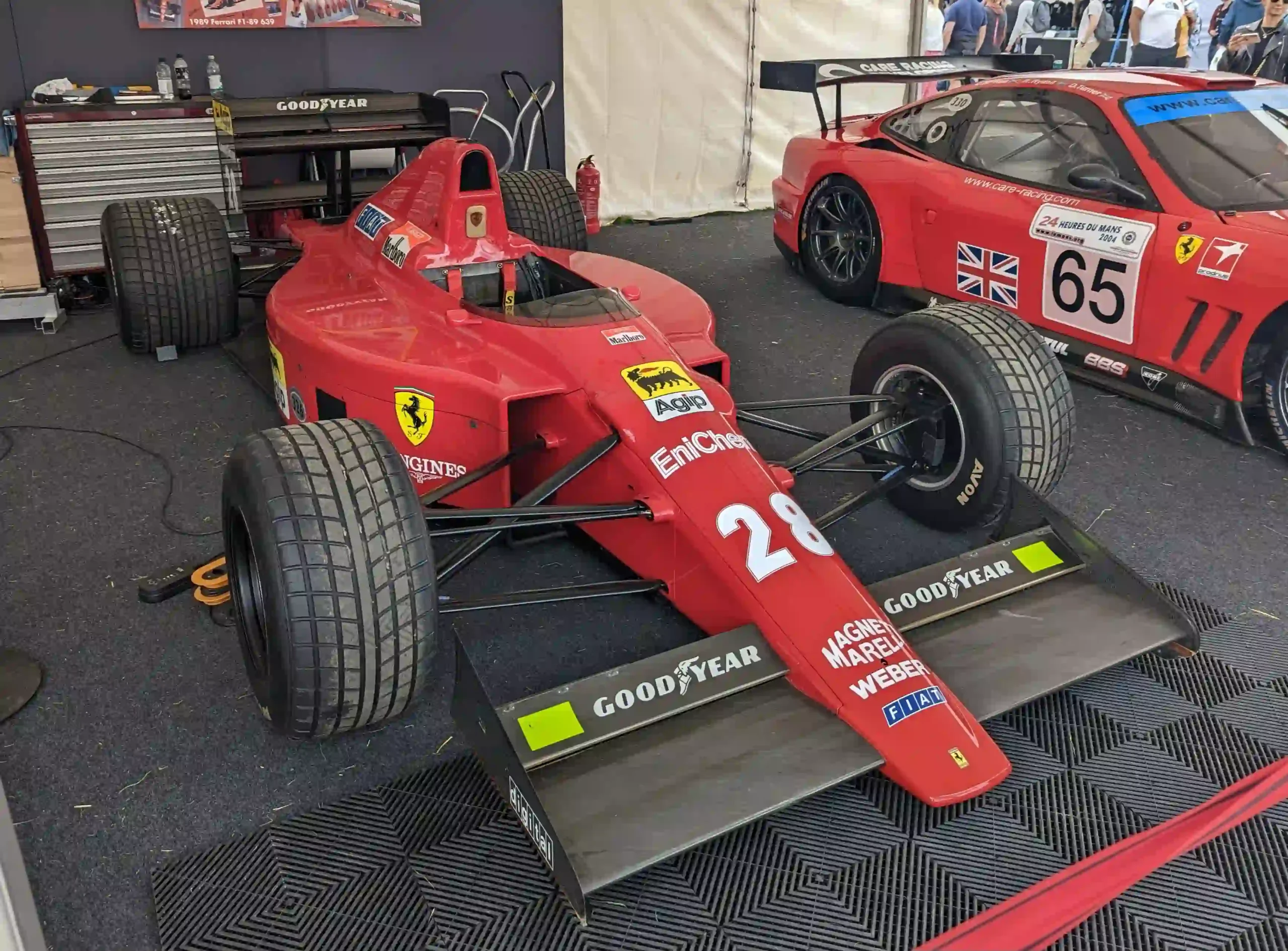
Ferrari introduced the first successful semi-automatic paddle-shift system with the 640 in 1989. Nigel Mansell won the car’s debut race in Brazil.
The Ferrari 640 changed the evolution of F1 steering wheels more than any single car. Its paddles brought gear selection to the driver’s fingertips.
John Barnard designed the electro-hydraulic semi-automatic gearbox. The driver requested upshifts and downshifts from behind the wheel.
The Driver Kept Both Hands on the Wheel
Traditional shifting required a reach into the cockpit. The paddle system removed that movement.
Therefore, the driver could shift while cornering. Steering control remained more stable during acceleration and braking.
The Gearbox Reduced Missed Shifts
The hydraulic system completed the mechanical change. It could manage the clutch and engine torque during the shift.
However, the driver still chose the gear. Automatic gear changes remain classified as a driver aid and are forbidden today.
The Debut Win Proved the Concept
Nigel Mansell won the 1989 Brazilian Grand Prix. The victory gave the new system instant credibility.
Reliability remained a challenge during the season. Nevertheless, rivals understood that paddle shifting represented the future.
The Road-Car Connection Followed
Ferrari later used paddle shifting on production cars. Other manufacturers adopted similar ideas.
Consequently, one of F1’s most recognizable cockpit technologies moved into everyday performance cars.
The mechanics behind the idea are covered in how paddle shifters work, the sequential gearbox guide and how a clutch works.
Why F1 Steering Wheels Became Removable
The cockpit opening is too narrow for easy entry and exit with the wheel installed. A quick-release hub lets the driver remove it in seconds.
Modern F1 drivers sit deep inside the survival cell. Their thighs and knees pass close to the steering column.
Therefore, the wheel must move out of the way. Removal is essential during normal entry and emergency escape.
The Release Uses a Concentric Flange
The 2026 FIA rules require a quick-release mechanism. The driver operates it by pulling a concentric flange behind the wheel.
That motion unlocks the wheel from the column. Electrical connections also separate through the integrated hub.
The Driver Must Exit in Seven Seconds
With belts fastened and normal equipment worn, the driver must remove the wheel and leave within seven seconds.
Moreover, the wheel must be replaced within 12 seconds total. Steering control must remain after refitting.
The Wheel Must Stay With an Abandoned Car
Sporting rules require the driver to leave the steering wheel in place. This lets marshals move or steer the car.
Consequently, throwing the wheel aside after a retirement is not acceptable.
The Column Must Survive an Impact Test
The steering wheel, column and rack assembly face a dedicated FIA impact test. The quick release must still work afterward.
This makes the wheel part of the safety structure. It is not merely an electronic accessory.
Read more about the surrounding structure in the F1 monocoque guide and the F1 cockpit explainer.
The 1990s: Buttons, Paddles and Flat-Sided Shapes
Once paddle shifting proved effective, the old gear lever quickly disappeared from leading cars. The steering wheel gained more responsibility.
Teams added neutral controls, radio buttons and engine settings. Meanwhile, shapes became less circular.
Flat Sides Created Space
The wheel no longer needed a complete rim for hand-over-hand steering. F1 cars used limited steering rotation on most circuits.
Therefore, designers removed unused upper and lower sections. The open areas improved knee clearance and instrument visibility.
Neutral Became a Dedicated Control
A paddle-shift gearbox needed a safe way to select neutral. A guarded button prevented accidental activation.
That principle still shapes modern controls. Critical buttons often use different sizes, colors or guards.
Launch Procedures Increased Paddle Complexity
Clutch control moved behind the wheel. Some designs used multiple paddles for bite-point management.
Regulators later limited automation. Consequently, the driver now judges clutch release more directly.
Electronic Driver Aids Changed the Interface
Traction control and other systems appeared during parts of the decade. When rules changed, teams revised wheel controls again.
The evolution of F1 steering wheels was never one-way. Bans could remove a switch as quickly as technology added it.
The 2000s: The Steering Wheel Became the Dashboard
Digital readouts appeared gradually during the 1990s. By the 2000s, top teams had integrated gear, rev, warning and setup information into the wheel itself.
The early 2000s produced the recognizable multifunction F1 wheel. Carbon-composite housings carried buttons and rotary dials.
Shift lights stretched across the top. Central displays showed gear position, lap information and warnings.
Rotary Dials Added Many Settings Without Many Buttons
A rotary selector can offer several positions. Therefore, one control can manage engine modes, differential maps or strategy presets.
Teams arrange the dials by function. Color coding helps drivers recognize them at a glance.
Thumbwheels Improved Mid-Corner Adjustment
A thumbwheel can be moved without releasing the grip. Drivers use similar controls for brake balance and other fine changes.
However, exact layouts differ. Each team uses its own logic and naming system.
The Display Reduced Dashboard Clutter
Information could now move between pages. The wheel might show gear and speed on one page, then temperatures or warnings on another.
Consequently, engineers gained flexibility without adding more gauges.
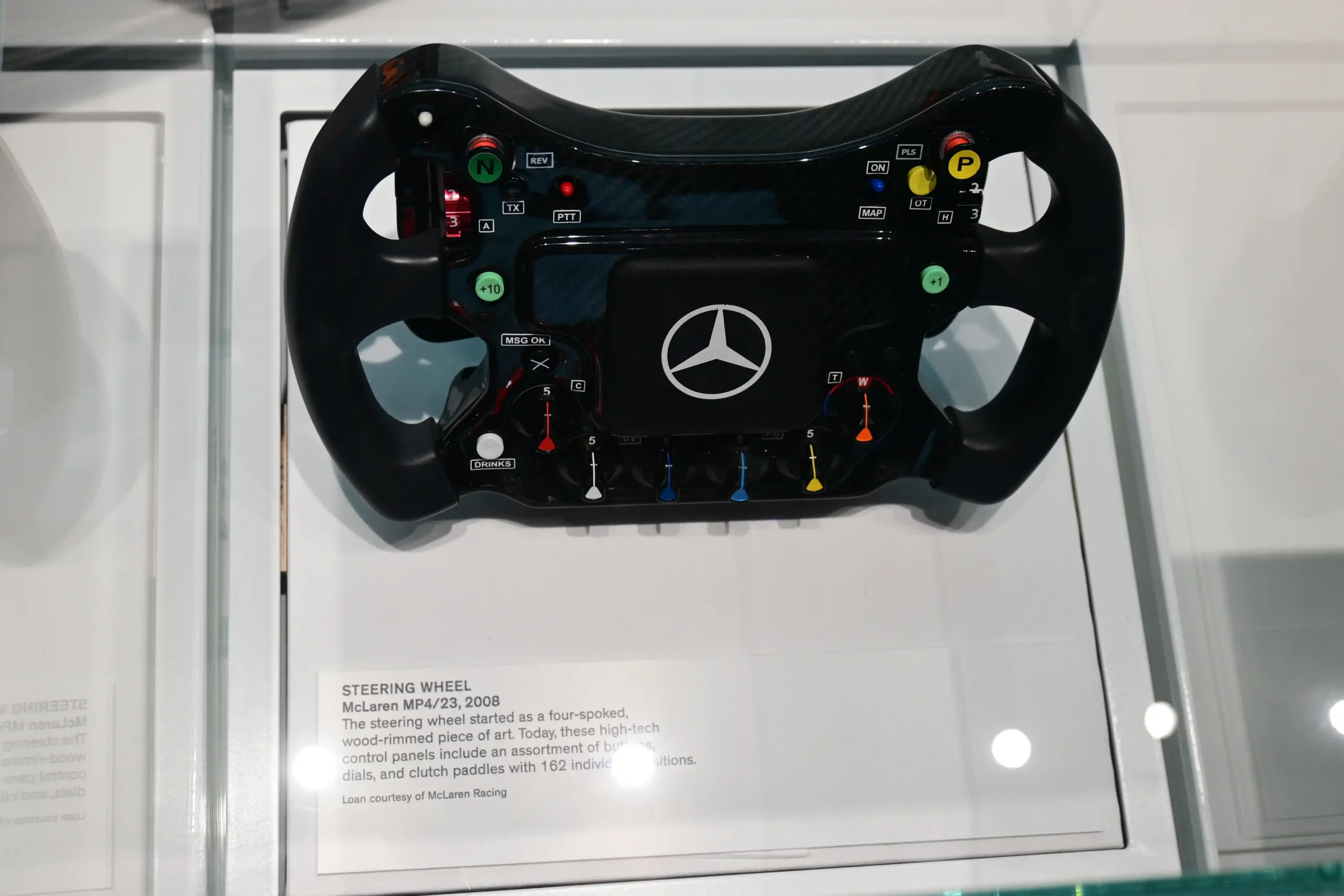
Lewis Hamilton’s 2008 McLaren Shows the Transition
The McLaren MP4-23 wheel used a compact carbon shape, multiple rotaries and a narrow display.
It still looks simpler than a modern hybrid-era wheel. Yet the core architecture is familiar.
The Hybrid Era Added Energy and Brake Management
The 2014 turbo-hybrid rules expanded the driver’s technical workload. Power came from an engine and energy-recovery systems.
Therefore, the wheel needed controls for deployment, harvesting, brake balance and failure management.
ERS Turned Energy Into a Tactical Resource
The driver could adjust deployment according to attack, defense and battery state. Engineers supplied maps for different situations.
The display then showed charge and target information. Read the full system guide at what ERS does in F1.
Brake-by-Wire Added More Rear-Brake Control
Energy recovery changes rear-axle braking. The control system balances hydraulic braking with MGU-K harvesting.
Drivers still adjust brake balance and migration. Therefore, the wheel became essential during every braking phase.
The terms are explained in the F1 brake-balance guide.
Fault Management Became More Visible
A power-unit problem may require a reset sequence. The driver follows instructions and selects a specific rotary position.
Moreover, the display can identify alarms. This saves time compared with describing every warning over radio.
DRS Added a Dedicated Race Control
From 2011 through 2025, drivers opened the rear-wing flap with a steering-wheel control when allowed.
The wheel also indicated availability. The DRS era is covered in the complete DRS explainer.
The Wheel Became a Workload Filter
Drivers do not adjust every function constantly. Teams create default modes and procedures.
Consequently, the best wheel reduces complexity by grouping related actions.
What the Buttons on a Modern F1 Steering Wheel Do
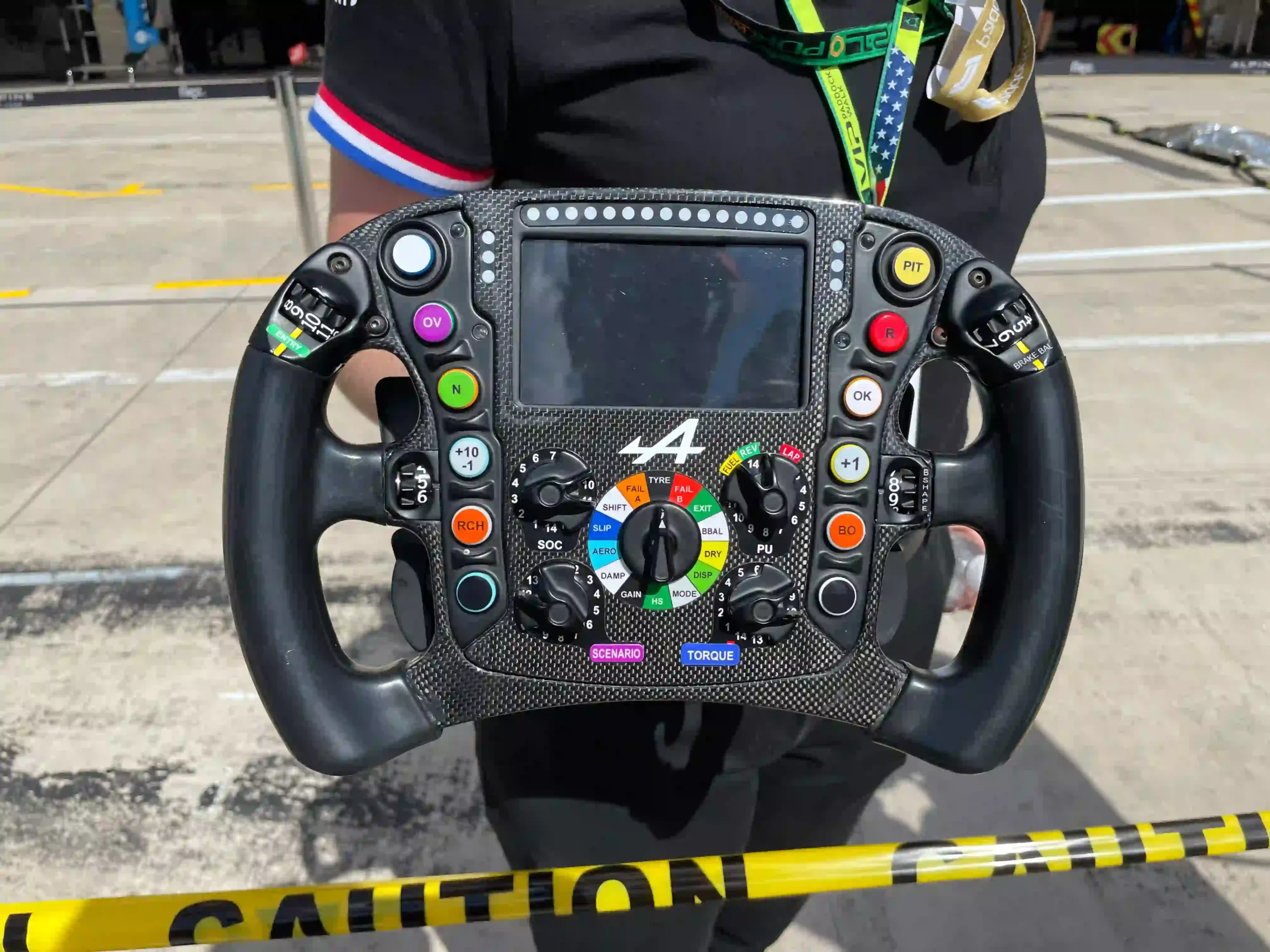
Typical controls include radio, pit-lane speed limiter, neutral, drink pump, brake balance, differential settings, power-unit modes, display pages and energy deployment.
No two team layouts are identical. However, the main functions are similar across the grid.
| Control | Typical Purpose | Why It Matters |
|---|---|---|
| Radio | Opens communication with the pit wall | Lets the driver report balance, tires and problems |
| Pit limiter | Restricts speed in the pit lane | Prevents a costly speeding penalty |
| Neutral | Selects gearbox neutral | Used after a spin, during recovery or in the pits |
| Brake balance | Moves braking force forward or rearward | Adapts to fuel load, tires and corner type |
| Differential | Changes rear-wheel locking behavior | Tunes entry, mid-corner and exit balance |
| Strategy rotary | Selects power-unit or race modes | Groups complex software settings |
| Display page | Changes information shown on screen | Gives timing, warnings and energy data |
| Drink | Runs the driver’s fluid pump | Supports hydration in hot races |
| Boost | Requests manual energy deployment in 2026 | Can help attack, defend or improve lap time |
| Overtake Mode | Uses extra electrical energy when eligible | Replaces DRS as the proximity-based passing aid |
Brake Balance Changes Throughout a Stint
Fuel burns off and tire grip changes. Therefore, the ideal brake setting does not stay fixed.
Drivers may adjust it corner by corner. They usually use a thumbwheel or dedicated switch.
Differential Settings Shape Rotation
The differential controls how the rear wheels share torque. Entry, middle and exit phases can need different locking behavior.
A driver may trade stability for rotation. However, an aggressive setting can increase tire slip.
The Pit Limiter Must Be Instant
Drivers activate the limiter as they cross the pit-entry line. A late press can trigger a penalty.
Therefore, the button sits where the driver can reach it without searching.
Teams Cannot Operate the Wheel Remotely
Engineers send advice by radio. The driver must make the permitted control input.
The FIA monitors electronic systems through the standard ECU. Read more in the F1 ECU guide.
Why Modern F1 Steering Wheels Are Not Round
Drivers rarely need a full rotation, while narrow cockpits demand knee clearance. Flat sides also create space for a display, buttons and rear paddles.
A road car may use more than one full turn from lock to lock. An F1 car usually needs far less movement.
Therefore, a complete circular rim offers little value. Designers can remove unused sections.
The Driver Keeps Hands Near Nine and Three
F1 drivers hold fixed grip positions through most corners. Their thumbs rest on controls.
A molded handle gives better support than a thin continuous rim. Consequently, the wheel looks more like two grips joined by a control panel.
Flat Bottoms Clear the Driver’s Legs
The cockpit narrows around the knees. A flat lower edge makes entry easier.
The upper edge may also be open. This improves display visibility and reduces mass.
Monaco Is the Steering-Lock Exception
The Fairmont hairpin requires unusually large steering angle. Teams prepare extra steering lock for Monaco.
However, the driver still does not need road-car-style hand-over-hand motion. The wheel remains compact.
The Shape Must Still Protect the Driver
FIA rules limit protruding parts behind the rim plane. Components must reduce injury risk during head contact.
Therefore, ergonomic paddles and switches cannot create sharp dangerous features.
What the F1 Steering Wheel Display Shows
The display can show gear, speed, lap delta, engine revs, flags, tire or brake information, energy status, pit-lane speed and system warnings.
The display is not one fixed dashboard. Drivers select pages according to the session and problem.
Shift Lights Give Immediate Engine Information
LEDs illuminate as revs rise. The sequence tells the driver when to pull the upshift paddle.
The lights sit high on the wheel. Therefore, they remain visible while the driver looks toward the corner exit.
Race-Control Signals Can Appear on the Wheel
Yellow, blue and red flag information may be shown through the FIA marshalling system.
Consequently, the driver receives a visual warning even before reaching a trackside panel.
Delta Time Is Critical Under VSC
The driver must stay above the required time delta. The display shows whether the car is too fast or too slow.
That information is explained in the F1 delta-time guide.
Energy Pages Became More Important in 2026
Drivers now manage a larger electrical contribution. Therefore, battery state and deployment targets carry greater tactical value.
The evolution of F1 steering wheels increasingly concerns information design. Showing the right data is as important as adding another button.
What the Paddles Behind an F1 Steering Wheel Do
The rear of a modern wheel can look as complex as the front. However, the main paddles have clear jobs.
Shift Paddles Request Gears
One paddle requests an upshift, while the other requests a downshift. The gearbox completes the change electro-hydraulically.
Automatic gear changes are banned. Therefore, every normal shift begins with the driver.
Clutch Paddles Control Starts and Pit Movement
Drivers do not use the clutch for each racing shift. They use it mainly when launching or moving slowly.
The current rules allow a maximum of two clutch paddles mounted on the wheel. If two are fitted, they must work identically.
Clutch Travel Is Strictly Controlled
The FIA limits paddle movement to 80 millimeters between end stops. The paddle must also have one degree of freedom.
Moreover, the driver cannot use shaped reference points to hold a programmed bite position.
Extra Paddles Depend on Team Design
Some historic wheels carried several paddles for clutch, gear or secondary functions. Regulation changes reduced certain arrangements.
Consequently, a photo from one season may not represent another.
Feel Matters at the Race Start
Drivers want precise feedback as the clutch reaches its bite point. Teams alter paddle shape and finger recesses for that purpose.
The evolution of F1 steering wheels therefore includes small ergonomic changes that television cameras rarely show.
How F1 Steering Wheels Are Customized for Each Driver
They may share the same electronics and core functions, but grip shape, paddle position, finger recesses and button preferences can differ.
Drivers have different hand sizes and techniques. One may prefer a long clutch paddle, while another wants a shorter travel feel.
Teams Measure Hands and Gloves
Engineers study thumb reach, finger length and grip pressure. They also account for racing-glove thickness.
Therefore, a button that feels natural to one driver may be awkward for another.
Critical Controls Use Muscle Memory
Drivers cannot look down before every input. They learn the position and feel of each control.
Color coding helps during practice. However, tactile differences matter more at racing speed.
Buttons Can Be Raised, Guarded or Recessed
A radio button must be easy to press. Neutral must be harder to activate accidentally.
Consequently, teams use different shapes and protective rings.
Simulator Work Refines the Layout
Drivers test controls before new hardware reaches the track. They rehearse start procedures and fault sequences.
This lowers cognitive load. The wheel should feel familiar before the first real lap.
Layouts Continue to Evolve During a Season
A driver may request a grip change or paddle revision. Teams can produce updated components quickly.
Formula 1 has documented these driver-specific changes for Lewis Hamilton, Sebastian Vettel and others.
What an F1 Steering Wheel Is Made Of—and What It Costs
Modern wheels use carbon-composite housings, lightweight metal parts, circuit boards, sealed switches, a display, wiring, paddles and molded grips.
The wheel must resist vibration, heat, sweat and repeated high-force use. It must also remain light.
Carbon Composite Forms the Main Structure
Carbon fiber offers high stiffness for low mass. Therefore, teams can create thin housings around electronics.
Metal inserts reinforce fasteners and paddle pivots. The quick-release hub also needs durable precision parts.
The Grips Are Built for Gloves
Teams mold rubber or silicone-like materials around the handles. Texture prevents slipping when the driver sweats.
The shape can be copied from a hand scan or physical mold. Consequently, each driver receives consistent spares.
Electronics Must Survive a Hostile Environment
Printed circuit boards and connectors face vibration and temperature changes. Sealing also protects them from fluid and rain.
Every button must produce a reliable signal. A missed radio or neutral input can damage a race.
There Is No Official Universal Price
Teams do not publish one standard retail cost. Online estimates vary because they include different levels of development, electronics and labor.
Therefore, a precise universal price would be misleading. The real value lies in engineering time and team-specific integration.
Teams Build Several Units
Each driver needs race wheels, spares and simulator hardware. Updated versions may appear during the season.
The evolution of F1 steering wheels made the part expensive because it became a complete electronic system.
How F1 Power Steering and Steering Feel Work
Yes. Current F1 cars use hydraulic power assistance, but FIA rules forbid electronically controlled or electrically powered assistance.
Modern front tires and aerodynamic loads create heavy steering forces. Assistance prevents excessive fatigue.
However, the system cannot steer for the driver. It may only reduce the physical effort.
The Driver Still Feels Tire Load
Engineers tune assistance to preserve feedback. Too much help would make the front axle difficult to read.
Therefore, drivers still feel understeer, curb strikes and grip changes through the wheel.
Steering Ratio Changes the Response
A quick ratio turns the wheels more for a small steering input. That helps rapid direction changes.
However, it can make the car nervous. Teams balance precision and stability.
Geometry Also Changes Steering Weight
Caster, tire load and suspension design affect the forces at the rim. Downforce increases those forces at speed.
The connection between steering and aero is explained in the downforce guide.
The Current Rule Protects a Simple Principle
The front-wheel position must follow wheel rotation about one axis. This prevents a steering control from performing unrelated adaptive functions.
That wording is important when considering Mercedes DAS.
Mercedes DAS: When the Wheel Moved Forward and Back
Dual Axis Steering let Lewis Hamilton and Valtteri Bottas push and pull the steering wheel to change front-wheel toe during the 2020 season.
DAS created one of the strangest moments in the evolution of F1 steering wheels. The wheel still rotated left and right, but it also moved along the column.
Pulling the Wheel Changed Toe
On a straight, the driver pulled the wheel toward the body. The front wheels moved toward a straighter alignment.
Before a corner, the driver pushed the wheel forward. The wheels returned to their normal toe-out setting.
The System Targeted Tire Behavior
A straighter wheel position could change tire temperature and drag on long straights. Toe-out then helped the car’s corner-entry response.
Therefore, DAS gave the driver another mechanical setup tool during the lap.
It Was Legal for 2020
Mercedes worked with the FIA during development. Rivals studied the system and debated whether they could copy it.
However, new regulations prohibited the concept for 2021. It remained a one-season innovation.
Current Rules Close the Same Route
The 2026 steering rule requires front-wheel alignment to follow rotation of one wheel about one axis.
Consequently, a push-pull toe control would not fit the current definition.
The complete mechanism appears in the Mercedes DAS explainer.
What the 2026 FIA Rules Say About Steering Wheels
The wheel must operate steering through rotation about one axis, use a quick-release flange, meet cockpit-clearance rules and work with the steering column during an FIA impact test.
The current regulations define much more than wheel shape. They control steering behavior, clutch paddles and emergency exit.
Only the Front Wheels May Be Steered
The steering system converts column demand into alignment of the two front wheels. Rear-wheel steering is not permitted.
The Relationship Must Be Monotonic
Turning farther in one direction must produce a consistent steering response. The system cannot switch between unrelated steering maps.
Moreover, the wheel must rotate around one axis. This protects a direct driver-to-wheel relationship.
Power Assistance Has a Narrow Purpose
It cannot be electronically controlled or electrically powered. It may only reduce the effort needed to steer.
The Quick Release Is Mandatory
The driver pulls a flange behind the wheel. The wheel must then come free for cockpit exit.
Clutch Paddles Are Tightly Defined
There can be no more than two. They must pull toward the driver and cannot provide a programmed physical reference.
Automatic Gear Changes Are Banned
The system can coordinate clutch and engine torque during a shift. However, the driver must request the gear change.
These rules preserve the central idea behind the evolution of F1 steering wheels: technology can assist operation, but the driver must command it.
How 2026 Changed the F1 Steering Wheel Again
Drivers gained new energy-management tools. Boost provides manual deployment, while Overtake Mode offers additional electrical performance when a driver meets the eligibility rule.
Formula 1 replaced the old DRS concept with a broader system. The front and rear wings now use active aero.
Meanwhile, the power unit has a much larger electrical contribution. Therefore, drivers manage energy more actively.
Boost Is Available for Attack or Defense
The driver can request maximum power or a team-configured deployment profile. Battery charge limits how much is available.
Boost can be used to attack, defend or improve lap time. It is not limited to a one-second following gap.
Overtake Mode Is the Proximity-Based Tool
Eligibility depends on being within one second at the detection point. The driver then gains access to an extra electrical profile.
The energy can be used strategically. Therefore, the driver may release it in one burst or spread it through the lap.
Active Aero Uses Straight and Corner Modes
Wing elements move between low-drag and high-downforce configurations in defined track areas.
The cockpit interface must clearly show system status. However, the FIA-defined zone logic governs when the mode operates.
Recharge Becomes Part of the Conversation
Drivers and engineers select energy-recovery approaches. Braking and throttle lift can return energy to the battery.
Consequently, the display needs clear battery and deployment information.
The Wheel Must Simplify New Complexity
Adding another labeled switch is easy. Designing a control that works at 200 mph is harder.
The 2026 chapter of the evolution of F1 steering wheels is therefore about information hierarchy as much as new functions.
See the wider technical package in the F1 2026 regulations guide.
Old vs Modern F1 Steering Wheels
| Feature | 1950s Wheel | Modern 2026 Wheel |
|---|---|---|
| Shape | Large and circular | Compact, flat-sided and grip-focused |
| Material | Wood, metal and leather | Carbon composite, metals and molded grips |
| Gear change | Separate manual lever | Rear shift paddles |
| Clutch | Foot pedal for normal operation | Hand paddles for starts and slow movement |
| Dashboard | Separate analog gauges | Integrated color display and LEDs |
| Communication | Little or no live radio | Wheel-mounted radio control |
| Setup changes | Very limited while driving | Brake, differential and energy adjustments |
| Removal | Not always required | Mandatory quick-release system |
| Driver fit | General-purpose rim | Personalized grips and paddles |
| Main challenge | Mechanical force and manual shifting | High-speed control and information management |
The old wheel demanded physical coordination. The modern wheel demands coordination plus rapid decision-making.
Neither era was easy. Each asked the driver to master the technology available at the time.
What Future F1 Steering Wheels Could Look Like
The steering wheel will continue changing because car systems keep changing. However, certain ideas are unlikely to disappear.
Touchscreens Remain Unlikely
A touchscreen lacks reliable tactile feedback. Gloves, vibration and lateral force make precise tapping difficult.
Therefore, physical buttons and rotary detents remain safer. Drivers can feel them without looking.
Displays May Become Clearer Rather Than Larger
The screen already carries more data than a driver can use at once. Better page design may offer more value than extra size.
Consequently, teams will focus on alerts and priority information.
Haptic Feedback Could Add Another Channel
In theory, grips or paddles could provide controlled vibration. That might warn drivers without filling the display.
However, any system would need regulatory approval and strong reliability.
Standardization Could Reduce Cost
F1 already standardizes key electronics. A common display or switch module could reduce development work.
Yet teams value ergonomic freedom. Therefore, full wheel standardization would face resistance.
The Driver Will Still Need Physical Controls
Voice control sounds attractive, but radio noise and delay create risk. Critical actions need immediate confirmation.
The future evolution of F1 steering wheels will probably refine buttons and paddles rather than remove them.
Common Myths About F1 Steering Wheels
“Every Button Makes the Car Faster”
False. Many controls manage safety, communication, warnings or recovery procedures.
“The Steering Wheel Changes Gear Automatically”
False. The driver requests each normal shift. The gearbox then completes the mechanical action.
“Every Driver Uses the Same Wheel”
False. Teams share core systems, but grips and paddles can be personalized.
“F1 Cars Do Not Have a Clutch”
False. They have a clutch, but the driver mainly operates it with hand paddles during starts and slow movement.
“The Wheel Is Rectangular Only for Style”
False. The shape saves space, improves knee clearance and supports fixed hand positions.
“Engineers Can Press the Buttons Remotely”
False. The driver makes the permitted input after radio instructions.
“DAS Was Normal Power Steering”
False. DAS changed front-wheel toe through axial wheel movement. Standard power assistance only reduces steering effort.
“A Precise F1 Steering Wheel Price Is Public”
False. Teams do not publish a universal price, and online figures use different assumptions.
The overall car is covered in the Formula 1 race-car guide.
F1 Steering Wheel FAQs
How have F1 steering wheels evolved?
They changed from simple round rims into removable carbon-composite control centers with paddles, displays, buttons, dials and hybrid-energy tools.
When did F1 introduce paddle shifters?
Ferrari introduced the first successful semi-automatic paddle-shift system with the 640 in 1989. Nigel Mansell won its debut race in Brazil.
Why are modern F1 steering wheels not round?
Drivers use limited steering movement, while the narrow cockpit needs knee clearance. Flat sides also make room for controls and a display.
What changed on F1 steering wheels in 2026?
Drivers gained Boost and Overtake Mode controls, while the wheel now supports the information needed for active aero and expanded electrical-energy management.
Conclusion: The F1 Steering Wheel Became the Driver’s Complete Interface
The evolution of F1 steering wheels began with a simple mechanical rim. It now reaches almost every system the driver can legally control.
In the 1950s, the wheel was large and round. Analog gauges sat behind it, while the gear lever stood beside the cockpit.
Drivers removed one hand for every shift. They also fought steering loads without assistance.
As cars became lower, wheels became smaller. Suede grips and faster ratios suited the new rear-engine machines.
However, the basic design remained simple through much of the 1970s. Most controls stayed on the dashboard.
The 1980s changed that balance. Turbo engines and electronic systems increased the driver’s management workload.
Therefore, buttons started moving closer to the thumbs. Radio communication also became a normal race tool.
The defining breakthrough arrived in 1989. John Barnard’s Ferrari 640 used an electro-hydraulic semi-automatic gearbox.
Paddles let Nigel Mansell change gear without removing his hands. He won the car’s first race.
That result pushed every rival toward the same direction. The manual cockpit lever quickly became outdated.
During the 1990s, the steering wheel gained neutral controls, clutch paddles and more electronics. Its shape also became flatter.
Quick-release systems improved cockpit access. They later became part of strict FIA safety requirements.
By the 2000s, the wheel had become the dashboard. Displays, shift lights and rotary selectors carried more information.
The hybrid era then added energy deployment and brake management. Drivers handled complex procedures through muscle memory.
Yet regulation preserved the human role. Automatic gear changes remain banned, and the driver still requests each shift.
Current clutch paddles follow strict movement rules. Power assistance may only reduce steering effort.
Mercedes tested the boundary with DAS in 2020. Drivers pushed and pulled the wheel to alter front-wheel toe.
The system was legal for one season. Current rules now require steering to follow rotation about one axis.
In 2026, the wheel gained another energy chapter. Boost lets drivers deploy power for attack or defense.
Overtake Mode provides extra performance when the eligibility condition is met. Active aero also changes the information shown to the driver.
Despite the extra functions, the best wheels do not feel chaotic. Buttons have different shapes, positions and guards.
Drivers learn them through repetition. Therefore, a complex wheel becomes instinctive at racing speed.
Materials also evolved. Wood and metal gave way to carbon composite, sealed electronics and molded grips.
However, teams do not publish one universal cost. The wheel’s value comes from design, software, testing and customization.
The future may bring clearer displays or new feedback systems. Touchscreens are less likely because physical controls offer better feel.
Ultimately, the evolution of F1 steering wheels mirrors Formula 1 itself. The cars became faster, smarter and more specialized.
The steering wheel followed every change. It remains the one component the driver holds through every corner, shift and decision.
Sources and Fact-Checking
This article was checked against official Formula 1 and FIA material available on July 29, 2026. Current-rule references use the FIA 2026 Formula 1 Technical Regulations, Section C, Issue 19, published June 25, 2026.