Rally Finland 2026 Shakedown Incidents:
Crashes, Damage & Mechanical Problems
A source-checked incident audit from Ruuhimäki: what was actually reported, what was not, which Rally1 cars completed clean runs, and why Finland’s jumps still make shakedown a serious reliability test.
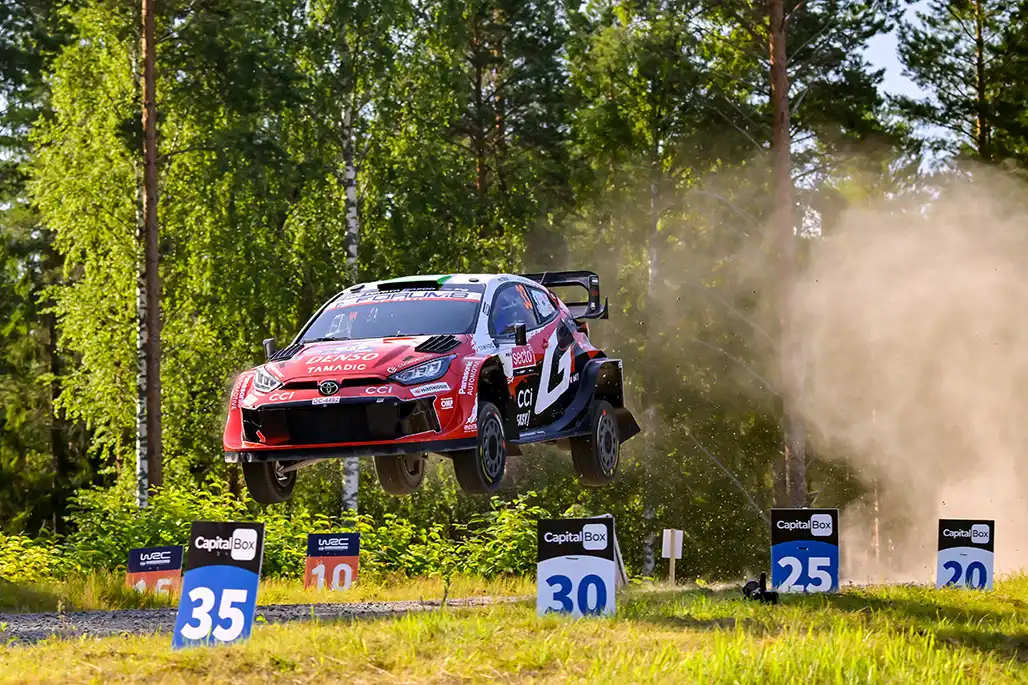
Rally Finland 2026 shakedown incidents need one important correction before the details begin. The major contemporary reports and manufacturer summaries reviewed for this article did not document a major Rally1 crash, damage-related stoppage, or mechanical failure during the Ruuhimäki shakedown itself. Takamoto Katsuta completed three runs and set the benchmark at 2m11.7s, while all 11 Rally1 crews appeared in the published shakedown order.
That does not mean nothing happened mechanically. Shakedown exists precisely so teams can load the suspension, check temperatures, inspect tyres, confirm steering feel, confirm drivetrain behavior and identify small faults before the rally starts. However, a routine setup change or inspection is not the same thing as a confirmed mechanical problem, and a dramatic jump is not automatically an incident.
This article therefore treats the headline as an incident audit. It separates confirmed news from assumptions, explains which damage modes Ruuhimäki was capable of exposing, and shows why an apparently clean shakedown was valuable before the first competitive stage at Harju.
Verified Incident Summary: Ruuhimäki Was Clean at Rally1 Level
The biggest finding from the source review is straightforward. There is no credible evidence in the main published reports that a Rally1 car suffered a major crash during the 2026 Rally Finland shakedown. Toyota’s official Thursday report says the morning action started over Ruuhimäki’s famous jumps and records Katsuta as fastest after three runs. It does not report accident damage or a technical stoppage for any of Toyota’s five Rally1 entries.
Contemporary shakedown reports tell the same story from the broader field. Katsuta led Adrien Fourmaux and Oliver Solberg, with the remaining Rally1 cars spread through a tight order. The reports discuss pace, confidence and the unusual return of Julien Ingrassia beside Sébastien Ogier. They do not identify a crash, suspension failure, engine problem or damaged car requiring an emergency pre-start rebuild.
That distinction matters for an incident-focused article. Search terms such as “Rally Finland shakedown crash” can attract readers even when the session itself was clean. Publishing an unverified crash simply because the stage contains big jumps would turn a technical possibility into false news. Instead, the accurate story is that a high-risk shakedown produced a competitive benchmark without a documented Rally1 disaster.
Across the official Toyota Thursday report and the contemporary shakedown recaps reviewed here, no major Rally1 crash, major damage stoppage or mechanical failure was reported at Ruuhimäki. This statement is limited to the published Rally1 coverage; it does not claim that every one of the 61 entered crews completed every pass without a minor issue.
For broader event context, the Rally Finland 2026 schedule shows how little time separated shakedown from the actual start. Ruuhimäki began at 09:01 local time on Thursday, while the Harju super special followed at 19:05. A serious morning accident could therefore have turned into a race against the clock for mechanics.
Rally Finland 2026 Shakedown Results: What the Times Confirmed
Ruuhimäki measured 4.12 km in 2026 and started at 09:01 local time. WRC’s stage guide describes a wide opening road with a sequence of crests, followed by a sandier and more technical section. The test ends with a large artificial jump. It is short, but it contains enough speed and vertical load to tell teams whether their gravel setup is behaving as expected.
Katsuta improved across the session and stopped the clock at 2m11.7s. Fourmaux and Solberg both finished 0.9s behind that reference, while championship leader Elfyn Evans was 1.7s away. Contemporary reports placed Esapekka Lappi and Sami Pajari on the same 1.9-second gap, with tie ordering varying between secondary summaries.
Behind them, Thierry Neuville, Jon Armstrong, Josh McErlean and Mārtiņš Sesks were packed together around the lower half of the Rally1 top ten. Ogier was 11th among the Rally1 runners, three seconds from Katsuta’s benchmark. Crucially, his position was not reported as the result of a mechanical problem or accident.
| Driver | Car | Best / Gap | Incident status in reviewed reports |
|---|---|---|---|
| Takamoto Katsuta | Toyota GR Yaris Rally1 | 2:11.7 | No major incident reported; fastest after three runs. |
| Adrien Fourmaux | Hyundai i20 N Rally1 | +0.9s | No major crash or mechanical failure reported. |
| Oliver Solberg | Toyota GR Yaris Rally1 | +0.9s | No major shakedown incident reported. |
| Elfyn Evans | Toyota GR Yaris Rally1 | +1.7s | No major shakedown incident reported. |
| Esapekka Lappi / Sami Pajari | Hyundai / Toyota | +1.9s | Both recorded on the same reported gap; no major incident noted. |
| Sébastien Ogier | Toyota GR Yaris Rally1 | +3.0s | 11th among Rally1; no published crash or technical explanation for the gap. |
Shakedown rankings need careful interpretation. Teams use the test for different objectives, and a driver can complete extra runs to try a setup change rather than chase the fastest time. The FIA also changed the 2026 rules so P2, P3, P4 and non-priority drivers are limited to two shakedown passes. That makes the session format different across priority groups.
If you want a direct comparison with the previous fast-gravel round, see our Rally Estonia 2026 shakedown results. The Estonia weekend also shows why incident labels must stay event-specific: Mārtiņš Sesks had an off during Estonia shakedown that triggered repairs and a later penalty, but that was not a Rally Finland shakedown crash.
A slow shakedown time is not evidence of damage, and a spectacular jump is not evidence of a crash. Incident reporting starts with what was actually documented.
Were There Any Rally Finland 2026 Shakedown Crashes?
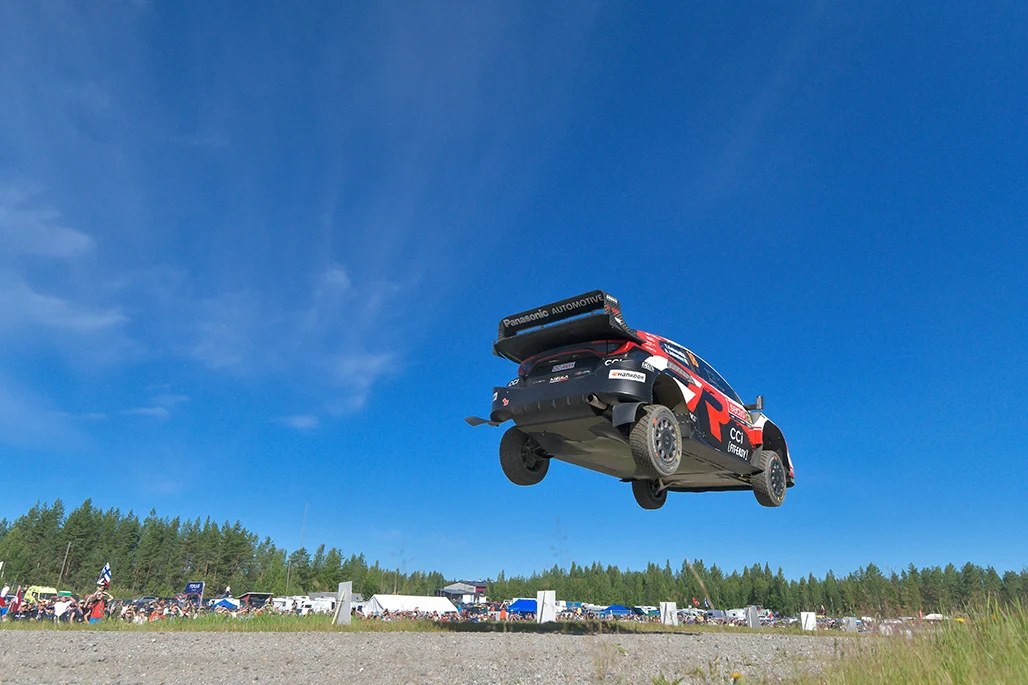
No major Rally1 crash was reported during the 2026 Rally Finland shakedown in the sources reviewed for this article. That is the direct answer to the most important featured-snippet question. Ruuhimäki looked dramatic because cars were attacking crests and a major finish jump, but dramatic motion alone is not an accident.
Rally Finland naturally creates confusion because crashes are common in its wider history. The event’s roads are among the fastest in the championship, and WRC describes average speeds as routinely exceeding 120 km/h. Blind crests compress the time available to react, while a landing can immediately feed into another high-speed direction change. Those ingredients make crash risk real even when a particular session ends cleanly.
Another source of confusion is the proximity of Rally Estonia. Sesks suffered a genuine shakedown off there two weeks earlier. That incident required repairs and affected his rally through a time penalty linked to leaving post-shakedown service late. Because Estonia and Finland are consecutive high-speed gravel events with many of the same Rally1 crews, social posts and short clips can easily be mislabelled when shared without dates.
Our Rally Estonia 2026 results, Rally Estonia preview and Rally Estonia strategy analysis give that previous round its own context. Keeping those events separate protects the accuracy of a Rally Finland incident report.
What would count as a confirmed shakedown crash?
A credible report should identify the crew, location or run, and a consequence. That could be a car leaving the road, striking a bank or tree, rolling, damaging suspension, stopping on the stage, or requiring significant repair before the rally. Ideally, the account should come from WRC, the FIA, a manufacturer, the organizer, or a reputable motorsport publication with direct event coverage.
By that standard, no major Rally1 crash emerges from the 2026 Ruuhimäki reporting examined here. Readers looking for the mechanics of why high-speed rally crashes become severe can use our explainer on what causes crashes in motor racing. The physics are relevant; attributing a crash to a specific driver without evidence is not.
After shakedown, Toyota reported that Oliver Solberg made a few mistakes on the opening Harju super special and did not have his best feeling on the mixed surface. Those were comments about SS1, not a Ruuhimäki crash. The car completed the stage and Solberg finished Thursday seventh overall.
Shakedown Damage Report: What Ruuhimäki Was Testing
The reviewed Rally1 reports do not identify a car that stopped because of accident damage during shakedown. Still, Ruuhimäki is exactly the kind of test where teams look for evidence of small damage before it becomes a rally-ending failure. The wide, fast opening road generates high lateral load, while the crests repeatedly unload and reload the suspension.
The finish jump adds a different stress. A Rally1 car can land with large vertical forces passing through the tyres, wheels, hubs, dampers, suspension links and body structure. A clean landing spreads those forces predictably. A nose-heavy, sideways or edge-of-road landing can concentrate the load and expose a weakness that was invisible in the service park.
Mechanics therefore inspect more than obvious broken bodywork. They look for wheel damage, tyre cuts, fluid seepage, loosened fixings, steering changes and underbody contact. They also compare driver feedback with data. If the steering wheel is no longer centered or the car reacts differently under braking, the root cause may be alignment rather than a dramatic visible failure.
Readers interested in how a rally car turns engine torque into usable grip can also see our AWD vs RWD vs FWD guide. Rally1’s four-wheel-drive system, suspension and tyres work as one package. Damage to a wheel corner can therefore affect traction, braking confidence and high-speed stability at the same time.
Tyre damage can exist without an accident
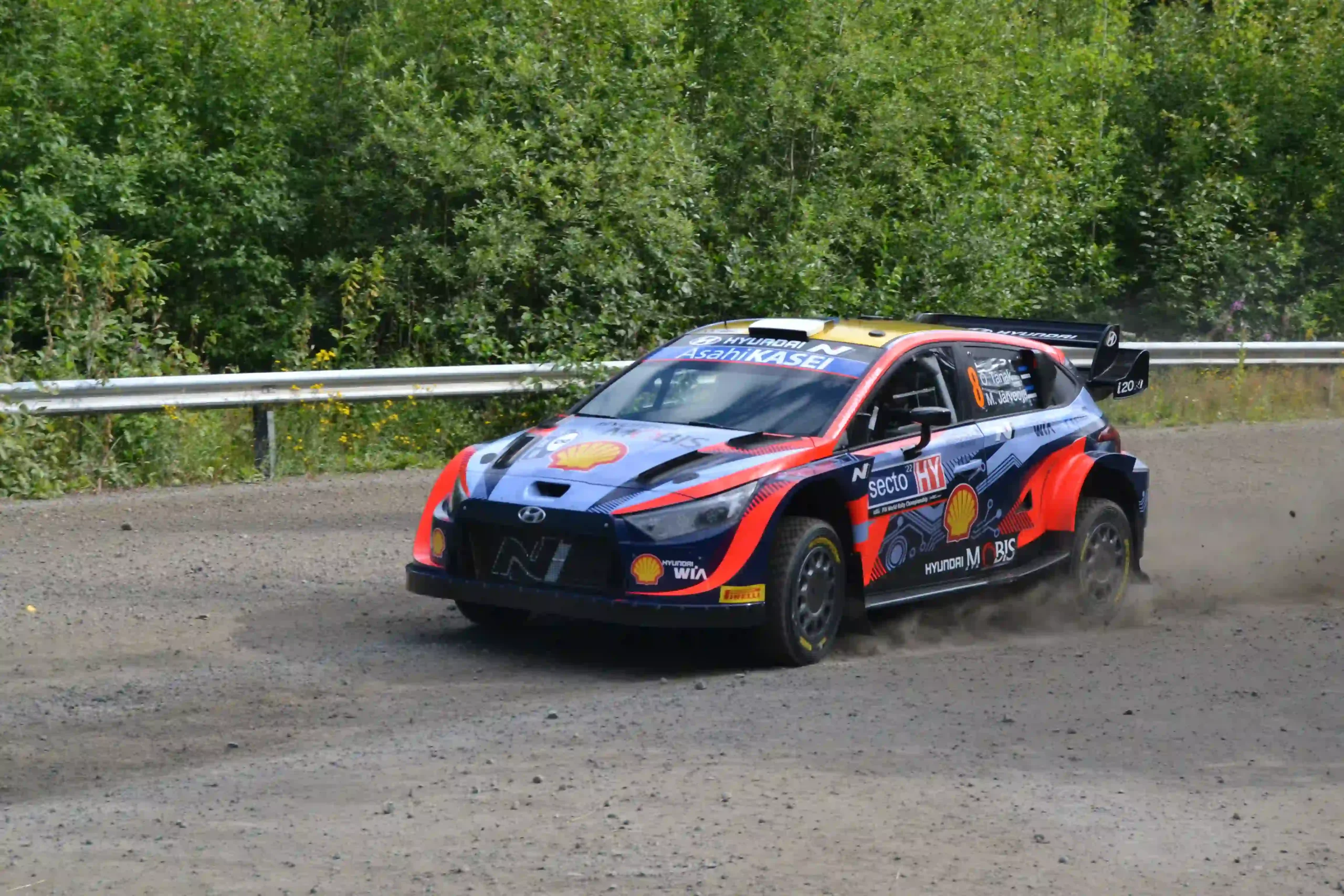
A puncture or damaged carcass is not necessarily the result of a crash. Sharp stones can be exposed as gravel moves, while an aggressive cut can load a sidewall. At Finland speeds, a tyre problem can quickly become secondary wheel or body damage if the driver cannot reduce speed before the carcass fails completely.
Nothing in the reviewed Rally1 shakedown coverage indicates that such a problem produced a major stoppage at Ruuhimäki. That clean bill is important because the rally’s Friday loop was much longer than the 4.12 km test. Teams wanted to leave shakedown with confidence that wheels, tyres and suspension could handle repeated high-speed compressions.
Bodywork also matters more than it looks. Rally1 aerodynamic surfaces help stabilize the car at speed. A damaged rear wing, front aero element or underbody panel can change balance even when the car remains driveable. For the basic aerodynamic principle, our downforce explainer covers why airflow becomes more influential as speed rises.
Mechanical Problems: What Was Reported and What Was Not
No major Rally1 engine, gearbox, drivetrain, steering or electrical failure was identified in the published shakedown reports reviewed here. That point deserves emphasis because the title includes mechanical problems. A driver being slower than expected does not prove a technical fault. Teams frequently use different maps, setup directions or run plans during shakedown.
Ogier is the clearest example. He ended the session 11th among the Rally1 runners, around three seconds from Katsuta. Contemporary reporting focused on his reunion with Julien Ingrassia, who returned as co-driver after Vincent Landais was unable to attend for personal reasons. There was no sourced claim that Ogier’s shakedown position resulted from engine trouble, transmission damage or an accident.
That co-driver change was unusual, but it was not a mechanical incident. Ingrassia had stepped away from full-time WRC competition after the 2021 season and returned for this one event. The change mattered for pace-note rhythm and communication, especially on Finland’s blind crests. However, it should not be filed under car reliability.
What teams actually use shakedown to check
Shakedown gives engineers a controlled opportunity to put the competition car under stage load before SS1. The process includes confirming engine response, cooling behavior, gear selection, brake feel, steering assistance, differential behavior and suspension response. Drivers also test whether the setup matches the grip level they found during reconnaissance.
A modern rally car can feel healthy in the service park and reveal a problem only when it lands from a jump or spends several seconds at high engine load. Vibration may appear at speed. Temperatures may rise differently once the car is moving through deep gravel. A component can also be safe mechanically but produce a driver-confidence problem that costs time.
For the underlying systems, see our guides to how car engines work and the sequential gearbox. Those explain the fundamentals without pretending to reveal private Toyota, Hyundai or M-Sport setup data.
The FIA updated WRC shakedown rules for 2026 so P2, P3, P4 and non-priority drivers are limited to a maximum of two passes. Rally1 priority crews operate under a different requirement, which is why Katsuta could complete three runs before setting the fastest overall benchmark.
The absence of a major failure also helps explain the compressed Thursday schedule. All the headline Rally1 cars were able to move from morning testing toward the evening Harju start. If a serious engine or chassis problem had appeared, the narrative would have shifted from setup refinement to repair feasibility.
Why Ruuhimäki Creates Incident Risk Even in a Clean Session
WRC’s official 2026 stage guide gives Ruuhimäki a very specific profile. The stage opens on a wide main road and runs through a sequence of crests. It then moves onto a sandier, more technical section before the major artificial jump at the finish. This year the road was reserved for shakedown rather than appearing later as a competitive stage.
That layout is useful because it compresses several Finland problems into just 4.12 km. Drivers can judge whether the car stays stable when it gets light over a crest. They can test rotation when grip changes in the sandier section. Finally, they can feel how the suspension controls the car after a large landing.
From an incident perspective, the sequence is demanding because one error can create another. Arriving at a crest slightly off-line can change where the car lands. Landing on the wrong side of the road then alters the next braking zone. The driver is often making the next decision before the car has fully settled.
That is why the fastest time is less important than the quality of the feedback. Katsuta’s 2:11.7 was impressive, but the more valuable outcome for a team is a car returning to service with predictable behavior and no hidden damage. Shakedown is successful when the driver can attack while the engineers still understand what every component is doing.
For readers new to the discipline, how car racing works, how race timing works and how racing flags work explain the broader competition and safety framework around a timed rally stage.
Team-by-Team Shakedown Incident Check
Toyota: fastest time and no reported major shakedown damage
Toyota had five Rally1 cars in Finland: Evans, Katsuta, Ogier, Pajari and Solberg. Katsuta produced the outright shakedown benchmark. Four of the five Toyotas were within two seconds of the best time when the equal 1.9-second Pajari benchmark is included, while Ogier was further back.
Toyota’s official Thursday release does not describe any of those five cars as damaged or mechanically compromised after shakedown. Instead, it moves directly from the morning test to the Harju competition. That is strong evidence that the team did not face a major public repair story between Ruuhimäki and SS1.
Hyundai: competitive pace, no documented Ruuhimäki failure
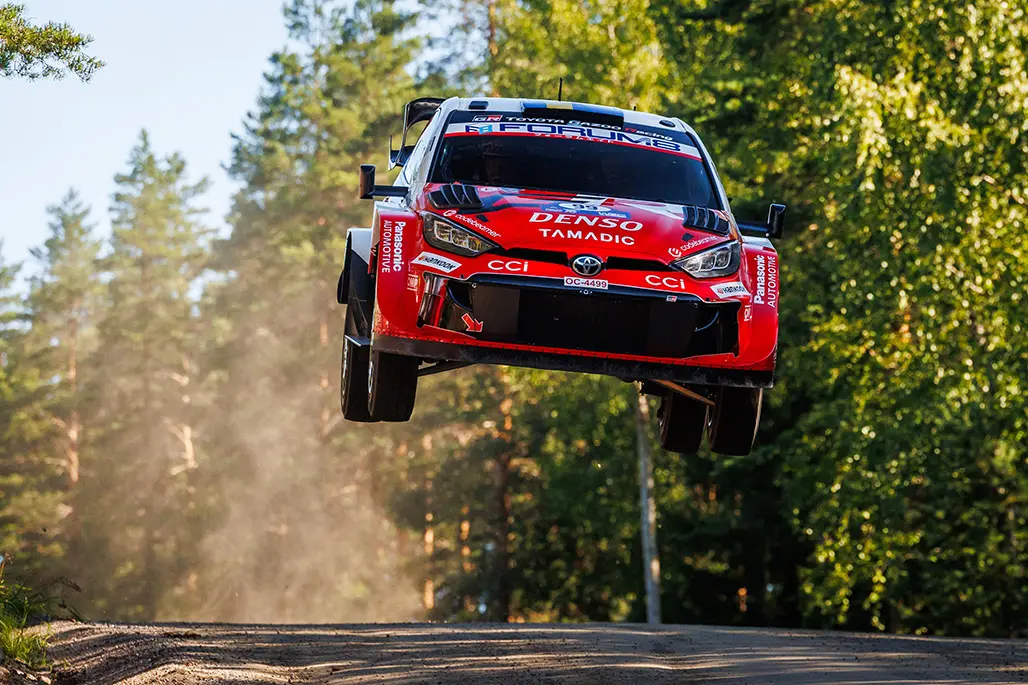
Fourmaux was one of the two drivers tied 0.9s behind Katsuta, and Lappi was also close to the benchmark. Neuville sat in the densely packed group behind. Again, the contemporary reports do not attach a major shakedown accident or mechanical problem to the Hyundai trio.
The evening then shifted the competitive story. Fourmaux won Harju and Neuville finished second, giving Hyundai the top two positions after SS1. That does not prove every component was perfect, but it is consistent with cars that arrived at the competitive start fully operational after shakedown.
M-Sport Ford: three Rally1 cars recorded in the shakedown order
Jon Armstrong, Josh McErlean and Mārtiņš Sesks represented M-Sport Ford. The three were grouped in the lower half of the Rally1 shakedown order, with Armstrong, McErlean and Sesks separated by very small margins. None was reported as a Ruuhimäki crash victim or mechanical retirement.
This is another place where Estonia can create false associations. Sesks had a genuine shakedown off at the previous WRC round. Finland’s reviewed shakedown coverage does not repeat that incident. Our Rally Estonia schedule guide helps anchor that separate event in the calendar.
This section covers the 11 Rally1 crews appearing in the major shakedown reports. Rally Finland had a much larger field across Rally2, Rally3 and other classes. Without a reliable incident log for every lower-category shakedown pass, this article does not label the entire 61-car entry “incident-free.”
Thursday Timeline: From Shakedown to the First Competitive Stage
The timeline shows why a clean shakedown matters operationally. Teams had hours rather than days to respond to anything discovered at Ruuhimäki. A minor setup concern could be managed. A damaged suspension corner, gearbox problem or heavy crash would have consumed time, parts and mechanics before the cars even reached SS1.
Championship context raised the stakes further. Evans arrived leading the drivers’ standings, while Toyota occupied the top five positions before Finland. A pre-rally mechanical failure would therefore have affected more than one weekend. Our guide to how racing championships are scored explains why avoiding a zero matters over a full season.
What the Lack of a Major Shakedown Incident Meant
Rally Finland’s full competitive distance was 316.04 km across 20 stages. Against that scale, Ruuhimäki was only a short systems check. Yet the value of completing it cleanly was substantial. Teams could begin the rally with real data from Finnish gravel instead of carrying unresolved questions into the first forest loop.
Katsuta’s pace offered Toyota a positive reference. Fourmaux and Solberg being only 0.9s away suggested the front of the field was tightly matched. Evans was close enough that his championship-leader road position, rather than a lack of speed, remained a bigger strategic concern for Friday.
The shakedown also gave drivers one final chance to synchronize with co-drivers at competition speed. That was especially relevant for Ogier and Ingrassia. Finland demands precise timing over blind crests, so communication quality matters even when the car itself is healthy.
Most importantly, the session produced no major Rally1 reliability headline before Harju. In an event where small mistakes can create large consequences, “nothing broke” is meaningful technical news. It means the focus can move from emergency repair to performance tuning.
That conclusion should not be stretched into a promise for the rest of the rally. Mechanical problems and crashes can appear later because competitive stages are longer, road conditions evolve and crews take larger risks once championship time is on the clock. Shakedown reduces uncertainty; it does not remove it.
Rally Finland 2026 Shakedown Incidents FAQ
Conclusion: The Verified Story Is a Clean Rally1 Shakedown
The most accurate conclusion from the Rally Finland 2026 shakedown incident review is that Ruuhimäki did not produce a confirmed major Rally1 crash or publicly reported mechanical failure in the main sources examined. Katsuta was fastest at 2m11.7s, Fourmaux and Solberg were only 0.9s behind, and the entire Rally1 group appeared in the published order.
That clean outcome is more meaningful than it sounds. Ruuhimäki contains high-speed crests, a technical sandy section and a large finish jump. Each run places real load on suspension, tyres, wheels, steering and drivetrain components. Teams wanted those loads before SS1 because a weakness found in shakedown can still be investigated in service.
At the same time, readers should not confuse “no major reported incident” with “nothing happened in the workshop.” Cars are inspected and adjusted after shakedown by design. Small setup changes, alignment corrections or routine component checks are normal motorsport work and should not be promoted as mechanical failures without evidence.
The incident headline therefore leads to a useful technical lesson. Rally reporting is strongest when it separates visible drama from confirmed damage, and when it separates a slow time from a mechanical problem. In Finland, where speed can turn a tiny error into a large accident, that standard of evidence matters even more.
Editorial scope
This report focuses on incidents documented in major Rally1 shakedown coverage. It does not claim that every lower-category car completed every Ruuhimäki pass without a minor technical issue. No driver-specific crash, damage or failure has been added unless the reviewed sources support it.