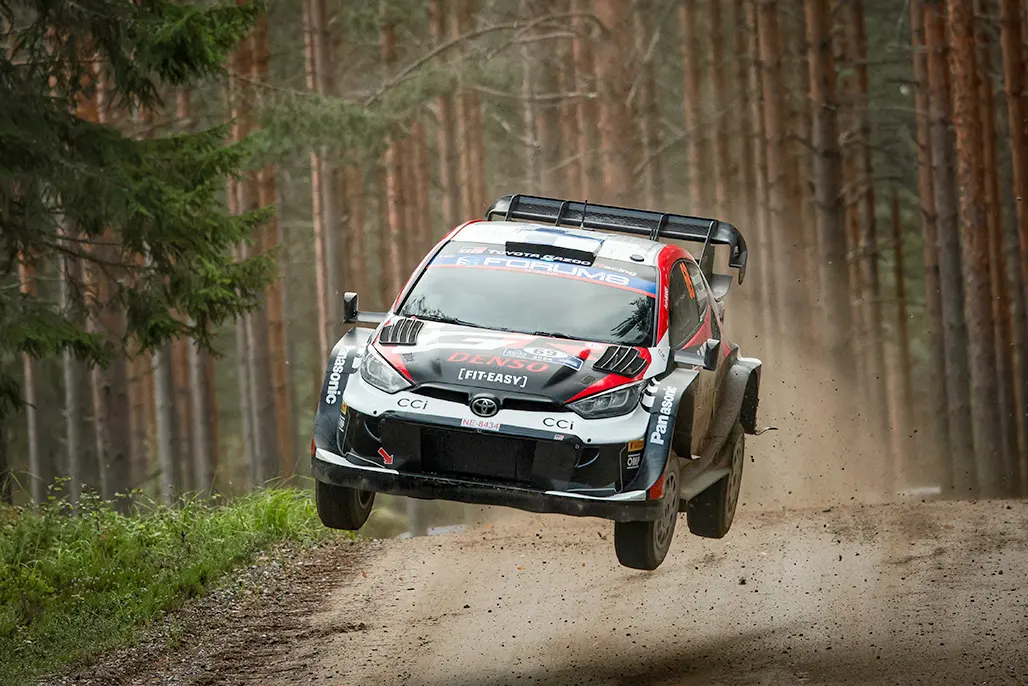
Rally Finland 2026 Strategy Analysis:
Road Order, Tyres & High-Speed Risk
Why the first car can lose grip on dry gravel, when a later road position becomes dangerous, how Hankook tyre rules shape each loop, and why Finland’s blind crests punish even tiny strategic errors.
Rally Finland 2026 strategy is less about choosing one conservative plan and more about deciding where commitment is worth the risk. The official WRC route contains 20 stages and 316.04 competitive kilometres. Average speeds routinely exceed 120 km/h, while blind crests, jumps and high-grip gravel leave very little time to correct a poor line.
Road position matters because the surface can change with every car. Tyre decisions matter because the FIA limits both the approved gravel specifications and the number of tyres available. Meanwhile, the 2026 route adds unfamiliarity: WRC says more than half of the competitive distance changed from 2025, including two new stages and several reversed or revised roads.
This analysis uses the FIA’s 2026 WRC Sporting Regulations, the official WRC itinerary and stage guide, plus pre-event technical comments from Toyota Gazoo Racing and Hyundai Motorsport. Where teams do not publish exact setup numbers, the article labels the discussion as strategy analysis rather than presenting private engineering settings as fact.
*FIA 2026 baseline including shakedown, unless event supplementary regulations state otherwise.
Rally Finland 2026 Strategy: The Five Variables That Matter
Finland looks simple from a distance. Drivers want a car that feels stable, they want a clean road, and they want to stay flat for as long as possible. In reality, each of those goals can conflict with another. A later road position can expose a cleaner line, but repeated running can also reveal rocks and damage the surface. A compliant setup helps over crests and compressions, yet too much movement can make a Rally1 car vague when it lands at speed.
The key is to treat the event as a sequence of changing grip states. The first pass of a dry stage may reward drivers who start later because loose gravel gets swept away. A damp or wet first pass can flip the equation. Hyundai Motorsport highlighted exactly that possibility before the rally, noting that its crews expected favorable sixth, seventh and eighth road positions in dry conditions but that rain could help earlier cars instead.
1. Road position
Dry loose gravel can punish the first cars. Rain, rutting or exposed stones can make a later slot less attractive.
2. Tyre condition
Grip must last through a loop. Avoiding a puncture can be worth far more than finding a few tenths on one crest.
3. High-speed confidence
At Finland speeds, confidence in the car and pace notes is a performance tool, not just a driver preference.
The fourth variable is route knowledge. New Sydänmaa and Hoho stages reduce the value of long-term memory, while reversed roads force crews to rebuild the mental picture of familiar territory. The fifth is championship context. Elfyn Evans arrived as the championship leader on 177 points, which placed him at the sharp end of the Friday road-order problem instead of giving him the cleaner line enjoyed by several rivals.
The previous round offered a useful comparison. Toyota reported that Evans could show stronger pace once he was no longer sweeping the loose gravel as the first car on Saturday. For a deeper look at that fast-gravel reference event, see our Rally Estonia 2026 strategy analysis and Rally Estonia results.
Why Road Order Matters at Rally Finland
Road order matters at Rally Finland because every Rally1 car changes the surface for the car behind. On a dry first pass, the early runners can push loose gravel away from the most-used line. Following crews may then find firmer material and more predictable lateral grip. However, that advantage is not guaranteed. Rain can bind the loose material, while repeated running can create ruts or expose stones that were previously buried.
The FIA’s 2026 regulations make Friday especially important for the P1 group because championship classification is central to the opening-day start order. That put Evans, the points leader before Finland, at the front of the strategic problem. Behind him were Takamoto Katsuta, Sami Pajari, Sébastien Ogier and Oliver Solberg in the top five of the championship. Hyundai’s Thierry Neuville and Adrien Fourmaux sat sixth and seventh on equal 111-point totals, while Hyundai publicly expected its three cars to run sixth, seventh and eighth.
Hyundai Sporting Director Andrew Wheatley called that road position positive in theory. His qualification was more important than the optimism: if the stages became wet, the early cars could gain an advantage. Sustained rain could also break the road surface and bring larger stones into the line, increasing puncture exposure for later crews. That is why “later is better” is an incomplete Rally Finland road-order rule.
| Surface situation | Likely road-order effect | Strategic response |
|---|---|---|
| Dry, loose first pass | Early cars can sweep gravel; later P1 cars may gain grip. | Front runners must limit wheelspin and avoid overdriving a low-grip line. |
| Damp, compact surface | Road cleaning can be smaller; high baseline grip reduces the penalty. | Prioritize rhythm and confidence rather than chasing a theoretical road advantage. |
| Consistent rain | Earlier cars may see a less damaged road; later cars can face standing water or degradation. | Reassess braking references and protect tyres from exposed rocks. |
| Second pass with ruts | The clean line may be faster, but surface damage and stones increase risk. | Use first-pass notes to identify cuts, compressions and puncture zones before attacking. |
Saturday and Sunday change the calculation
The FIA rules switch the strategic picture after Friday. P1 drivers generally run in reverse classification order on Saturday and Sunday, subject to restart provisions. That means the rally leader can move much farther back in the P1 sequence than on the championship-order Friday. It can reduce a sweeping penalty, but it also creates a different problem: the driver with the most to lose may encounter a more worked-over road.
Start spacing also matters. The 2026 FIA regulations require at least three minutes between P1 start times on gravel rallies, although live-TV arrangements can alter intervals with approval. Three minutes is enough for the dust cloud to change, but not enough to stop the surface from evolving. Every leading car becomes part of the track preparation for the next one.
This is a useful place to distinguish WRC road order from circuit-racing track position. In a rally, the road is not shared simultaneously. The competitive environment is sequential, so a driver can lose time without another car physically blocking the route. If you want the broader mechanics of rally timing and classification, our guides to how race timing works and how racing championships are scored provide the underlying framework.
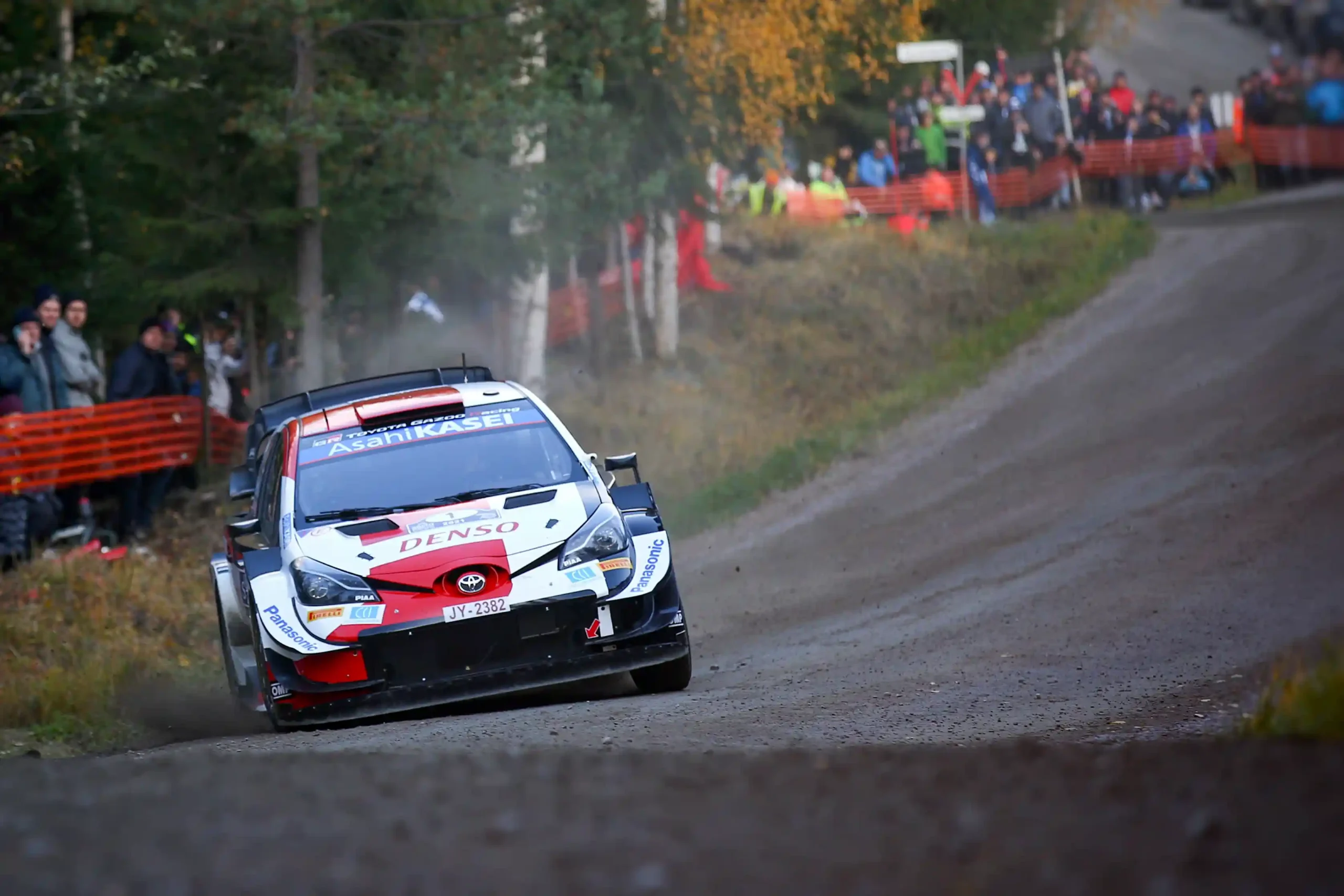
The best Rally Finland road position is the one that gives grip without inheriting the damage created by everyone in front.
Rally Finland Tyre Strategy: Grip Is Only Half the Job
Hankook is the FIA-nominated WRC tyre supplier for 2026, and its Dynapro R213 is the championship’s gravel tyre platform. The important rule for strategy is not simply the brand. FIA Article 13.2.5 states that two gravel tyre types are nominated for use through each rally, with the first-choice and alternative package defined by the supplementary regulations or bulletins.
That matters because crews cannot treat the service park like an unlimited tyre warehouse. The FIA baseline allows a maximum of seven tyre-change opportunities on one rally. For Rally1 cars, the maximum quantity is calculated at 28 new tyres including shakedown unless the event’s supplementary rules state otherwise after consultation with the tyre supplier. Every tyre therefore has an opportunity cost.
The 2026 regulations also allow a car to carry no more than two spare wheels, with at least one required when the relevant vehicle rules demand it. Carrying a second spare adds mass, yet it can protect a result if a loop contains a known puncture threat. Finland’s high speed makes that choice more subtle than on a slow, rough rally. A tyre failure does not only cost time during the change; it can occur where there is almost no safe margin to slow the car.
Why Finland is not simply a low-wear rally
Finland’s roads are smoother than events such as Acropolis, but “smooth” does not mean easy on tyres. High speed generates sustained load, while landing a car from a crest can create sharp vertical forces. Cuts can pull debris onto the road, and repeated passes can uncover stones. Hyundai’s pre-event comments specifically identified blind stones as a puncture risk if rain broke up the surface.
Thierry Neuville also described Finland as higher-grip than Estonia, sometimes close to a tarmac-like feeling. More grip lets drivers carry more speed, which raises the energy a tyre and suspension must absorb when the car hits a compression, lands from a jump or clips a hidden object. That is why a clean-looking road can still demand tyre discipline.
The FIA rules confirm two nominated gravel tyre types, while event bulletins define the Finland package. Hankook introduced a revised soft-specification Dynapro R213 in 2026 for cooler or damp conditions, but exact loop-by-loop selections depend on the official allocation, weather and team choice. This article does not invent a hard/soft split for a specific stage.
The 2026 soft R213 changes the decision tree
Hankook’s revised soft-specification Dynapro R213 debuted during the 2026 season. WRC reported that it retained the existing gravel tread pattern but changed internal construction and compound, with development aimed at better compliance and performance in cooler or damp conditions while retaining durability. That gives teams another known reference when the weather moves away from warm, dry gravel.
For Finland, the strategic question becomes grip versus robustness across an entire loop. A more compliant tyre can help a driver trust the front axle on a cool or damp road. However, the fastest option on one stage is not always the strongest option over several stages plus road sections. The FIA’s tyre limits reward crews that plan the whole loop rather than optimizing a single split time.
Pressure is part of the setup, but it is regulated
Tyre pressure affects response, carcass support and how the tyre handles impacts. Yet crews cannot simply stop anywhere and adjust it. FIA Article 13.8 permits pressure adjustment in specified circumstances, including when the waiting time between a time control before a stage and the stage start exceeds 13 minutes, and in certain regroups. This turns time-control architecture into a small but real part of tyre strategy.
For readers interested in how grip and drivetrain behavior connect, see our explainers on AWD vs RWD vs FWD, limited-slip differentials and torque. A Rally1 car’s traction is the product of tyres, differentials, suspension geometry and driver inputs rather than one isolated component.
High-Speed Risk: Why Tiny Errors Become Rally-Ending Errors
WRC’s official Rally Finland guide says average speeds routinely top 120 km/h. That number explains why the rally feels different from a rougher, slower gravel event. The car spends more time close to the limit of lateral grip, and the driver often commits before the next corner is visible. A pace-note error that would cost a few tenths elsewhere can become a major impact in Finland.
Speed also magnifies the cost of poor positioning. Kinetic energy rises with the square of velocity, so an increase in speed does much more than shorten reaction time. The car reaches crests with greater energy, suspension loads rise on landing, and a small steering correction can produce a larger change in trajectory. That is why teams chase stability even when a more aggressive setup might feel sharper in a slow corner.
The risk is not simply “drivers going too fast.” Rally Finland rewards high speed, so backing off everywhere is not a competitive strategy. The winning approach is selective commitment: identify the corners where the road width, camber and sightline support maximum attack, then preserve margin at blind crests, dirty cuts or landings where the consequence is disproportionate.
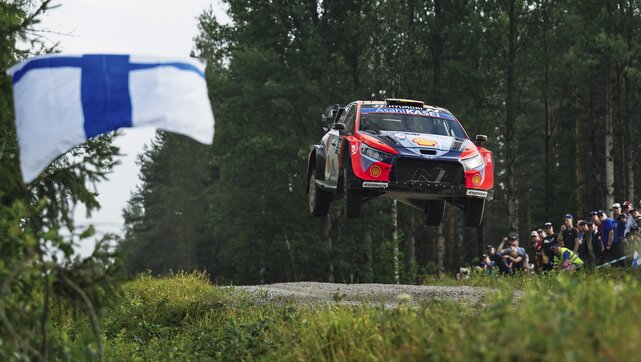
Jumps are a setup problem before they are a spectacle
A spectacular flight is not necessarily a fast flight. The ideal jump minimizes time in the air and places the car where the driver needs it for the next braking or cornering phase. If the nose angle, landing line or suspension recovery is wrong, the car can spend the next several seconds recovering instead of accelerating.
That is why Rally Finland car setup is a compromise. Toyota’s general Rally1 technical material explains that gravel cars run different suspension and ride-height settings from tarmac cars. Finland’s relatively smooth roads may allow a more precise platform than a rock-strewn rally, but the car still needs enough suspension travel and control for crests, compressions and landings.
Teams also need aerodynamic stability because many corners are taken at unusually high speed. Exact wing, damper and differential settings are team data and are not published in the official event documents, so any specific numerical setting would be speculation. The strategic principle is safer to state: the driver needs a platform that stays predictable when the car gets light over a crest and then loads up again on landing.
For the physics behind the risk, see what causes crashes in motor racing, what is downforce, and what is horsepower. They help separate raw engine performance from the grip and stability that actually convert speed into stage time.
Pace notes are part of the risk-control system
At Finland speed, the co-driver is effectively extending the driver’s vision beyond the crest. WRC describes accuracy, rhythm and absolute trust between driver and co-driver as essential. Takamoto Katsuta made the same point in Toyota’s preview, saying drivers need full commitment immediately and complete trust in both pace notes and the car.
The 2026 route makes that harder because familiarity is uneven. New stages give everyone less historical memory, while reversed stages can create false confidence. A corner that looks familiar in reconnaissance may arrive from a completely different approach speed when driven the opposite way. The best crews treat reversed roads as new information rather than recycled notes.
Route Strategy: Where the 2026 Rally Changes Character
The official WRC stage guide says more than half of Rally Finland’s competitive distance changed compared with 2025. That is strategically important even for experienced crews. Sydänmaa and Hoho are new stages, Laukaa runs in reverse, Päijälä is shortened and reversed, and Västilä also runs in the opposite direction to 2025. Familiar names therefore do not guarantee familiar braking points.
The event begins with Harju on Thursday evening after the Ruuhimäki shakedown in the morning. The FIA has a specific rule for a rally-opening super special: tyres for SSS1 may not be deliberately “scrubbed” beforehand. That makes Harju a small but unusual strategic island. It is short at 2.58 km, so a crew gains little by taking a large risk, yet a mistake can still damage the car before the first full forest day.
Friday: the road-order day
Friday is built around two passes of Laukaa, Saarikas, Sydänmaa and Hoho, followed by the second Harju run. For Evans and the other early championship runners, the opening loop is where dry sweeping could be most expensive. The later Hyundai road positions were attractive precisely because those cars could arrive after several Rally1 competitors had already worked the line.
The second pass changes the priorities. The crews now have real stage information from the morning, but the surface has also changed. A cut that was clean can contain dragged gravel, a soft edge can be broken, and a previously hidden stone can become exposed. The strategic value of first-pass learning is therefore tied to how well the crew updates the notes rather than simply repeating the morning.
Rally Estonia provides a useful high-speed comparison. If you want the build-up and road-character context from that round, read our Rally Estonia 2026 preview, Rally Estonia shakedown report and Rally Estonia schedule guide.
Saturday: speed plus accumulated information
Saturday uses Parkkola, Päijälä, Västilä and Leustu twice. WRC describes Leustu’s opening as almost entirely flat-out on a wide road before the character becomes narrower and more technical. Västilä begins on open, wide and fast roads, then narrows in the forest while staying quick. Those changes reward a car that can transition from high-speed stability to precise rotation without making the driver rebuild confidence every few kilometres.
Saturday is also when championship strategy can start to diverge from rally-winning strategy. A driver sitting comfortably in a points-paying position may choose a small margin at a blind compression. A driver trying to recover from Friday can accept more risk. Because the P1 order is based on reverse classification principles, the leading crews also face a road that has been used by more competitors than the Friday opener.
Setup priorities by strategic objective
| Objective | What the driver needs | Main trade-off |
|---|---|---|
| Maximum first-pass pace | Immediate front-end confidence on loose or changing gravel. | A very sharp car can become nervous on landings or broken surfaces. |
| Jump stability | Controlled compression and predictable recovery after landing. | Too much compliance can reduce precision in fast direction changes. |
| Tyre protection | Stable loads, disciplined cuts and avoidance of exposed rocks. | Leaving margin can cost tenths on every fast corner. |
| Second-pass attack | Updated pace notes and confidence in the evolved racing line. | Ruts and debris can invalidate the cleaner-line assumption. |
Drivetrain behavior also matters when the road alternates between wide flowing sections and slower junctions. For a broader mechanical background, see how car engines work, turbo vs naturally aspirated engines, and how paddle shifters work. Those systems do not decide Finland by themselves, but they shape how quickly a driver can reconnect the car to the road after a slow junction or landing.
Himos-Jämsä Strategy: A 30.02 km Sunday Test, Twice
Sunday is unusually concentrated. The itinerary contains only Himos-Jämsä, run twice at 30.02 km. The second pass is SS20 and the Wolf Power Stage. WRC’s stage guide says the route combines roads from the former Vaheri-Himos test, Patajoki and the 2023 Himos-Jämsä Power Stage, moving between wide, flowing roads, narrow forest sections, repeated crests and a steep descent to the finish area.
That structure creates a direct learning loop. SS19 is not practice—the time counts fully—but it gives crews the freshest possible information about the same 30.02 km they will face again. Drivers can confirm grip, identify any surface breakup, correct pace notes and understand where tyres were loaded hardest. The challenge is using that information without overreacting to one isolated moment.
The long distance also changes the Power Stage mentality. A short Power Stage can reward an all-or-nothing sprint. Thirty kilometres demands a more complete run. The driver needs tyres that remain consistent, brakes that feel predictable through the descents, and enough margin to survive blind crests before attacking the sections where the road is visible and the car is settled.
Use SS19 to confirm the road, not to assume SS20 will be identical. Check how the line has changed, where rocks have appeared and which jumps alter the car’s landing attitude. Then build the Power Stage attack around the safest high-value sections instead of trying to gain time everywhere.
Power Stage start order can also differ from a normal road section because FIA rules allow the FIA and WRC Promoter, in discussion with the Clerk of the Course, to determine the order and intervals for cars covered by live television. That is a sporting and broadcast detail rather than a free strategic choice for teams, but it reinforces a broader point: crews must be ready for conditions that may not match the standard daily order.
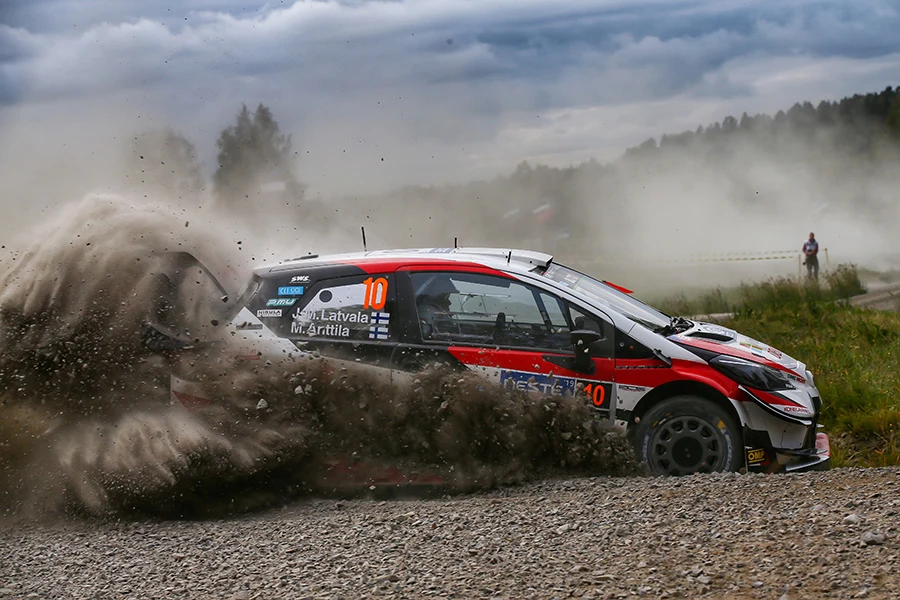
Toyota vs Hyundai: Different Road-Order Problems
Toyota entered its home rally from a position of enormous strength. Its five Rally1 drivers occupied the top five places in the championship before Finland, separated by 47 points. The team had also won seven of the eight Rally Finland editions it had contested and swept the top five positions in 2025. That depth is an advantage, but it concentrated Toyota cars near the front of Friday’s P1 order.
Evans faced the most obvious road-order burden because he led the championship by 25 points. He also brought strong Finland history, having won in 2021 and 2023. Katsuta had two recent Finland podiums, Pajari arrived fresh from winning Rally Estonia, Ogier was a two-time Finland winner, and Solberg had just finished second in Estonia. Toyota therefore had multiple drivers capable of turning a small road-condition shift into a tactical advantage.
Hyundai’s problem was almost the reverse. Its recent fast-gravel pace looked stronger after Fourmaux’s Estonia podium, and the team expected Neuville, Fourmaux and Esapekka Lappi to start sixth, seventh and eighth. In dry conditions, that could mean a cleaner line than Toyota’s early starters. Yet the team itself emphasized that weather could erase or reverse the benefit.
That makes manufacturer strategy less about team orders and more about preparing several cars for different grip states. A team with cars spread through the order gains information from the first crew, but Rally1 start gaps mean later cars cannot wait for a full engineering debrief. The co-driver, approved weather information, onboard data from earlier stages and service-park analysis all become pieces of a fast-moving decision process.
For readers following the broader championship consequences, our how car racing works primer and racing flags guide cover the basic sporting context that sits underneath more specialized WRC strategy.
Rally Finland Risk Matrix: Where Time Is Worth Chasing
Rally Finland rewards commitment, but not every tenth has the same value. A crew can use a simple risk hierarchy: attack when the road is predictable and the consequence of a small mistake is limited; preserve margin when the line is blind, the landing is loaded, or a puncture would destroy an entire loop. This is not a literal team formula, but it reflects the event characteristics described by WRC and both manufacturer previews.
| Scenario | Potential gain | Potential loss | Strategy bias |
|---|---|---|---|
| Wide, visible high-grip sequence | High | Moderate | Attack if the car is settled. |
| Blind crest into direction change | Small to medium | Very high | Trust notes, but keep a defined margin. |
| Second-pass cut with exposed stones | Small | High puncture risk | Avoid unnecessary cut depth. |
| Final kilometres of Himos-Jämsä | Depends on time gap | Championship points or rally result | Match aggression to the actual gap. |
This is where championship awareness matters. A driver chasing a first victory can rationally accept more exposure than a championship leader protecting a large points margin. Conversely, an early road position can force the leader to push harder than desired simply to stay in contact. Strategy is therefore not separate from speed. It determines where speed is spent.
Rally Finland 2026 Strategy FAQ
Conclusion: Finland Rewards the Crew That Reads the Road Fastest
The central lesson from this Rally Finland 2026 strategy analysis is that road order, tyres and high-speed risk cannot be separated. Friday’s championship-based running order can create a sweeping penalty for the leaders. Later cars can gain grip, yet rain or road damage can turn that advantage into puncture exposure. The correct strategy changes with the road rather than following a fixed “later is always faster” rule.
Tyre management is equally nuanced. FIA rules cap the available Rally1 tyre pool and tyre-change opportunities, while only nominated gravel types can be used. That makes every choice part of a weekend budget. The fastest tyre for one stage has little value if it leaves the car vulnerable for the rest of the loop.
Finally, Finland’s defining speed makes trust the most important performance asset. The driver must trust the pace notes, the co-driver, the landing behavior and the tyre beneath the car. With more than half of the 2026 competitive distance changed from the previous year, that trust had to be rebuilt quickly. The crews that balance commitment with information—not simply those willing to take the biggest risks—have the strongest strategic foundation.
Editorial note
This article separates published rules and manufacturer comments from engineering interpretation. Exact damper, differential, tyre-pressure and aerodynamic settings are proprietary team data and are not presented as official values.