Formula DRIFT Indianapolis 2026 Practice Report: Driver Form, Car Setup & Qualifying Predictions
The first PRO practice session on Indianapolis Raceway Park’s new drift course produced contact, a safety-led zone revision and a revealing qualifying order headed by Jack Shanahan.
The Formula DRIFT Indianapolis 2026 practice report is less about a conventional timing sheet and more about adaptation: drivers had to learn a newly paved course, manage a changed clipping reference and rebuild confidence before solo qualifying.
Formula DRIFT does not publish a fastest-lap leaderboard for practice because drifting is judged on line, angle and style rather than elapsed time. The useful evidence therefore comes from the official event notes, the incidents reported by the series, the qualifying scores that followed, and the technical characteristics of the cars that adapted most successfully.
The headline facts are confirmed. Adam LZ and Matt Field were involved in a heavy practice collision. Formula DRIFT changed an Outside Zone to an Inside Clip, partly to reduce the probability of further incidents while preserving shortened track time. Qualifying was shifted one hour later. Jeff Jones crashed his Nissan 370Z during practice and was unable to complete a successful qualifying run. Jack Shanahan then took the top qualifying position with 84.63 points.
Reporting position: Practice and qualifying are complete. This article explains what practice suggested, compares those expectations with the official qualifying outcome, and looks ahead to the PRO main event scheduled for Saturday afternoon and evening.
What Happened in Formula DRIFT Indianapolis 2026 Practice?
Official session facts and the order of eventsFormula DRIFT Indianapolis practice featured several incidents as drivers learned the new course, including heavy contact between Adam LZ and Matt Field. The series changed an Outside Zone to an Inside Clip, delayed qualifying by one hour and lost Jeff Jones from Saturday competition after his practice crash prevented a successful qualifying run.
Indianapolis was never going to behave like a normal fifth round. It is the first Formula DRIFT event at the venue, and the route is not simply an established corner with temporary markers. Formula DRIFT worked with Indianapolis Raceway Park to add pavement and create a dedicated drift layout. Driver Liaisons Ryan Litteral, Ken Gushi and Matt Field helped develop the course alongside the judging panel and the competition department.
The development process included site visits and drift-simulator testing. That gave the organizers a planned line, but it could not reproduce every detail of real competition cars on fresh asphalt. A simulator does not fully recreate tire pickup, surface temperature, smoke visibility, wall perspective or the way thirty different chassis deliver torque through the same transition. Thursday practice was therefore the first true stress test.
The original public schedule listed PRO practice from 11:15 a.m. to 12:45 p.m. ET, followed by a later PRO warm-up and qualifying. Formula DRIFT’s post-session report said PROSPEC activity ran over and reduced the available learning time. The series then used the incident pattern and shortened session as reasons to make a course-reference change and move qualifying one hour later.
PRO practice opens on the new Indianapolis course
Teams begin building real-world notes for a route that combines oval speed, new pavement and a tighter infield finish.
Drivers encounter a steep learning curve
Formula DRIFT reports multiple incidents, including heavy contact involving Adam LZ and Matt Field.
Outside Zone becomes an Inside Clip
The change is made to lower the likelihood of further incidents and help drivers use the remaining track time more effectively.
Qualifying moves one hour later
The delay gives the PRO and PROSPEC fields additional onboarding time after the course adjustment and schedule overrun.
Jack Shanahan takes first with 84.63
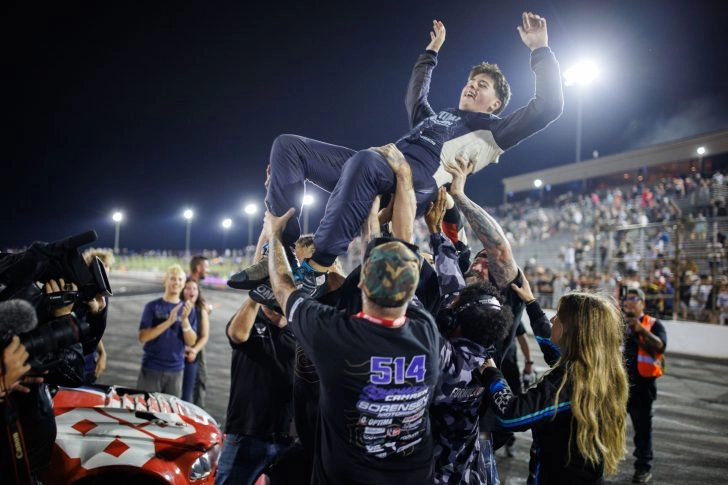
Shanahan’s second run beats Matt Field by 1.08 points, with Aurimas Bakchis and James Deane completing the top four.
Why the LZ–Field contact mattered
Practice contact is not automatically evidence of reckless driving. On a new course, two experienced drivers can reach the same space with different assumptions about deceleration, transition timing or the speed required to fill a zone. The official report did not assign fault in the LZ–Field collision, so a responsible analysis should not invent blame.
What the collision did reveal was the size of the learning problem. Matt Field was one of the Driver Liaisons involved in the layout’s development, yet even he was not protected from the uncertainty of real tandem practice. That difference between course design and competition reality is important. Theoretical line knowledge helps, but the driver still has to judge a moving car through smoke while the lead vehicle changes speed and angle.
The broader mechanics of contact are explained in our guide to what causes crashes in motor racing. In drifting, the chase driver must also react to the lead driver’s line and deceleration while maintaining proximity. That creates a narrow operating window: leave too much space and the chase looks weak; close too aggressively and the available reaction time disappears.
Why Formula DRIFT changed the clipping reference
An Outside Zone asks the driver to place the rear of the car within a marked area, usually while carrying angle and speed toward the outside boundary. An Inside Clip asks the front of the car to pass close to a defined point. Changing one to the other can alter the shape of the run because the driver’s visual target, steering timing and throttle commitment all shift.
The official explanation focused on preserving time and reducing incident probability. That decision should be understood as a competition-management response, not proof that the original geometry was outside accepted safety tolerances. Formula DRIFT specifically stated that the wall geometry, speeds and direction of travel were within certified safety tolerances.
Even so, the revision forced teams to update their reference points. Drivers had spent part of practice learning one target, then had to prepare for qualifying with another. The fastest adapters were not necessarily the drivers with the most outright power. They were the ones who could translate the new visual cue into repeatable steering, angle and throttle commands.
listed in qualifying
schedule shift
winning score
Matt Field
from line and angle
Jeff Jones paid the largest competitive price
Jeff Jones crashed his Big Drift Energy / Prisma Lab Nissan 370Z during practice. Formula DRIFT reported that he could not successfully complete a qualifying run afterward, leaving him on 0.0 and out of Saturday’s competition. Because only 29 drivers were contesting a 32-car field, every driver who completed at least one valid run could advance. Jones did not need a spectacular score; he needed one completed run.
That makes his outcome especially painful. His official driver profile lists a 1,000-horsepower, LS-powered 2020 Nissan 370Z on Kumho tires with Parts Shop MAX suspension and Link ECU management. None of that performance matters when the car cannot return in a condition that allows the driver to complete the required judged run.
The situation is a reminder that practice is not free of strategic cost. Teams need enough commitment to learn the track, but they also need a car for qualifying. On a new course, the acceptable risk level changes from run to run. Early practice may justify a larger margin. The final warm-up may justify a more complete qualifying simulation. Finding that balance is part of professional drifting.
Driver Form: Who Adapted Best at FD Indy?
Practice evidence interpreted through the official qualifying resultThere is no official practice leaderboard, so statements such as “fastest in practice” would be misleading. The stronger method is to look at what happened immediately afterward. Qualifying required each driver to deliver a solo run against a defined line, angle and style standard. It does not tell us everything about tandem form, but it is the clearest public measure of how well each driver and car absorbed the practice lessons.
Jack Shanahan
Precise placement and a committed second run turned strong recent form into the first qualifying victory at Indianapolis.
Matt Field
Field recovered from heavy practice contact and led most of qualifying before Shanahan’s final improvement.
Aurimas Bakchis
The Orlando winner continued adapting to his new BRZ and stayed close to the top on a second new venue.
Jack Shanahan: precision translated into the top score
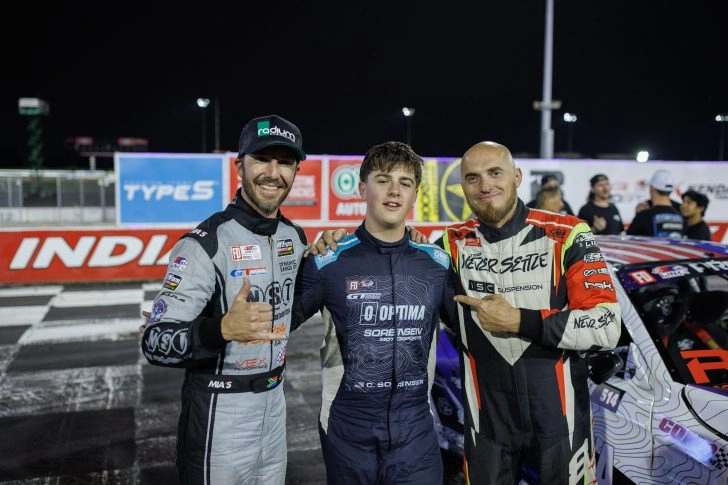
Shanahan’s result was not a surprise when placed against his 2026 form. He finished third at the Long Beach opener and second at Stafford. Indianapolis qualifying added another front-running result, this time in a solo-run format. Formula DRIFT credited his second run to precise car placement and flair.
His official car profile lists a 900-horsepower BMW 1 Series using Feal suspension, Kumho tires and ECU Master control. That power figure is lower than several rivals, but Indianapolis showed why horsepower alone does not decide qualifying. A predictable torque curve, stable front axle and clean transition can deliver a higher score than a more powerful car that misses the desired line.
Shanahan’s E82 also represents a compact platform relative to some of the larger American chassis. A shorter, more agile-feeling car can help in the compressed infield section, provided it remains settled during the faster opening phase. His score suggests the team found that compromise.
Matt Field: the most impressive recovery of Thursday
Field’s second place may be the strongest evidence of team execution in the entire session. He was involved in the heavy collision reported during practice, yet the Drift Cave Motorsports Corvette returned with enough accuracy for an 83.55. Field led the field for most of qualifying before Shanahan improved on his second attempt.
The official profile lists a 1,050-horsepower 2013 Corvette on GT Radial tires, Parts Shop MAX suspension and Link ECU management. A Corvette platform can provide substantial torque and a broad footprint, but it must still transition cleanly through the technical finish. The result suggests that post-contact checks restored the alignment and steering geometry well enough for a near-winning run.
A serious practice impact can create hidden problems: bent toe links, shifted subframes, damaged wheel bearings, altered steering-center position or a body panel rubbing a tire under lock. Teams do not only replace visible parts. They compare measurements, inspect data and ask the driver whether the car feels symmetric. Field’s performance indicates that his crew completed that work under pressure.
For readers interested in why drivetrain response matters after a repair, our explainers on how a clutch works and how a manual gearbox works provide useful background. Drift drivers rely on immediate, repeatable response because a small delay in wheel speed can change the car’s position through a zone.
Aurimas Bakchis: the new BRZ continues to mature
Bakchis qualified third on 82.7. Formula DRIFT noted that he continues to settle into his new car. That phrase carries weight because the Subaru BRZ replaced the Nissan platform he had used for many years. A new chassis changes the driver’s seating references, steering response, weight transfer and the way the rear tire loads under throttle.
The 2025 BRZ is officially listed at 900 horsepower with a Hustler Race Engines powerplant, Feal Suspension 443 coilovers, a Wisefab angle kit, GT Radial tires and Haltech control. Bakchis also owns Feal Suspension, so his understanding of damping and chassis response is central to the program.
Third at Indianapolis follows his victory in Orlando, where he defeated James Deane in the final. That win proved the BRZ could succeed under changing conditions. Indianapolis added evidence that it can qualify near the front on a newly paved, geometry-sensitive course.
James Deane: championship form without unnecessary drama
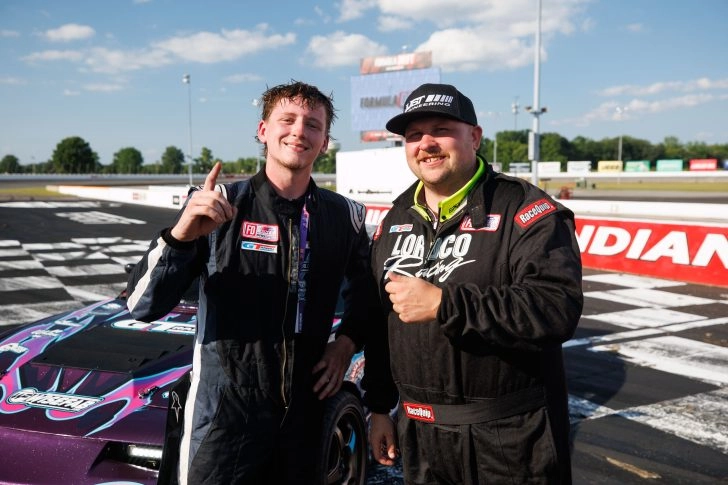
Deane qualified fourth with 82.53. That may look quiet compared with Shanahan’s win, but it was exactly the kind of session a championship leader needs. Deane secured a top-four bye position, added one championship point and avoided the practice damage that ended Jones’ weekend.
His Mustang RTR Spec 5-FD is officially rated at 1,249 horsepower. It uses a Ford Racing and Wilkins Racing Engines RY45 V8, BC Racing custom coilovers, Nitto tires and a MoTeC M150. That package has the greatest listed power among the leading Indianapolis qualifiers, but Deane’s advantage is not simply output. His team has built a car around controllable delivery, data and repeatability.
Deane’s Stafford weekend showed why his form should never be judged only by qualifying. He started twelfth after a spin, then won the event. Indianapolis gave him a much cleaner starting position. The main-event question is whether he can use that control to extend his 22-point championship lead over Bakchis.
Chris Forsberg, Tommy Lemaire and Branden Sorensen
Forsberg placed fifth with 82.5, only 0.03 behind Deane’s published precise score. His 1,200-horsepower Nissan Z uses BC Racing coilovers, Wisefab steering components, Kenda tires and MoTeC control. The three-time champion remains a difficult opponent whenever the new Z delivers consistent front grip.
Tommy Lemaire’s sixth place was one of the session’s notable surprises. An 81.7 placed him ahead of several established title contenders. Qualifying at a new venue often rewards drivers who quickly accept the required line rather than trying to force their usual style onto the course.
Branden Sorensen finished seventh with 81.6. He entered Indianapolis third in the championship and needed a clean session because Jack and Conor Shanahan were close behind. The qualifying bonus points compressed that fight further, leaving Branden, Jack and Conor separated by only two championship points.
Cole Richards: rookie form that looked fully professional
Formula DRIFT identified Cole Richards as the leading rookie. His official score was 80.66, which placed him eighth. The Richards Racing Toyota GT86 is listed at 750 horsepower with an LS engine, Feal suspension, GT Radial tires and Link ECU management.
Richards’ result is valuable evidence for the car-setup discussion. His power figure is hundreds below the Mustang, Nissan Z and several other entries. Yet he reached the top eight. The course rewarded placement and usable grip, not a dyno-sheet contest. A lighter or less powerful package can remain competitive when it carries speed efficiently and gives the driver confidence.
Adam LZ: ninth after the practice collision
LZ’s 80.1 was another strong recovery. His official profile lists a 1,100-horsepower, Toyota-engined 1995 BMW E36 on Tire Streets tires, BC Racing suspension and Link ECU management. After contact with Field in practice, ninth place showed that the LZMFG team returned the car to a competitive state.
LZ is known for aggressive entries, but Indianapolis demanded restraint in the right places. A driver can be spectacular without being wasteful. The best qualifying run places the car where the scoring system expects it, then adds speed and commitment without sacrificing the line.
Drivers carrying concerns into Saturday
Fredric Aasbo qualified twentieth with 74.3. Aasbo is one of the most successful drivers in series history, so twentieth should not be read as a lack of ability. It does indicate that the Papadakis Racing GR Supra did not maximize the qualifying phase. A lower seed creates a more difficult path through the bracket.
Jeff Jones is the clearest loss because he cannot compete. Drivers near the bottom of the qualifying order also face stronger early opponents. However, Formula DRIFT regularly produces bracket upsets. A lower qualifying score does not guarantee an early exit once tandem proximity and opponent mistakes become part of the decision.
Formula Drift Indianapolis Car Setup Analysis
What the new pavement and revised line demanded from the carsThe ideal Indianapolis setup needs high-speed entry stability, strong front grip during transitions, manageable rear-tire bite and repeatable power delivery. Teams also need damping that works across the oval-to-infield change and an alignment stable enough to score the revised clipping reference without constant steering correction.
Exact spring rates, tire pressures, differential settings and alignment values are closely guarded. Formula DRIFT teams do not publish a complete setup sheet after each run. The analysis below therefore explains the technical priorities supported by the course design and official car specifications. It does not claim access to confidential team numbers.
High-speed stability
The car must accept a committed initiation without becoming nervous under deceleration. Rear stability gives the driver confidence to carry speed while still reaching the first target at angle.
Front grip and steering speed
The infield sequence rewards immediate front response. Excess understeer widens the line; an overly sharp front axle can make the transition snappy and difficult to repeat.
Rear grip versus wheel speed
The driver needs enough forward bite to carry momentum, but not so much rear grip that the car resists rotation or forces a violent clutch input.
Predictable torque delivery
Usable power matters more than a peak figure. Smooth delivery lets the driver adjust angle and distance without a sudden surge that pushes the car off line.
1. Suspension: controlling two different course personalities
Indianapolis links a faster opening section to a more compact infield. A setup optimized only for the entry may feel lazy later. A setup optimized only for rotation may become unstable at speed. Teams must choose damping and roll control that let the platform settle before each direction change.
Compression damping controls how quickly the suspension accepts load. Rebound damping influences how the chassis releases that load. In a drift transition, both ends of the car are moving through a rapid weight transfer. If rebound is too restrictive, the car may remain loaded on the wrong side. If damping is too soft, the platform may oscillate and delay the driver’s next command.
The leading qualifiers used several suspension brands, including Feal, Parts Shop MAX and BC Racing. That variety shows there is no single hardware answer. The decisive factor is how the team tunes the package around its wheelbase, weight distribution, tire and driver style.
Our guide to what downforce is explains aerodynamic load in general racing. Drift cars generate and use aero differently from circuit cars because they travel at large yaw angles. Even so, body stability and aero balance can influence confidence during the faster entry.
2. Steering angle and front-end grip
Professional drift cars use modified steering geometry to achieve far more lock than a road car. More angle is useful, but maximum lock is not the same as an effective setup. The driver needs a predictable relationship between steering input, front-tire grip and chassis rotation.
At Indianapolis, the revised Inside Clip increased the importance of front placement. A car that washes wide cannot simply hide the error with smoke. The driver must point the nose toward the reference while keeping the rear at useful angle. That demands front grip without making the steering overly reactive.
Alignment settings such as caster, camber and toe affect how the front tire behaves through lock. Caster can help the steering self-align, while camber influences the contact patch. Toe settings can change initial response and stability. Teams adjust these values in small increments because a change that helps one transition may hurt the opening section.
3. Differential behavior and wheel-speed control
A drift car’s differential helps the rear tires rotate together under power. The exact design and locking behavior influence how easily the car initiates, holds angle and drives forward. Our article on the limited-slip differential covers the road-car principle, although professional competition systems are set up for far more aggressive operation.
Indianapolis required the rear axle to do two jobs. It needed enough wheel speed for smoke and angle, yet enough forward bite to keep the car moving through the infield. Excess wheel speed can make the car look busy while losing momentum. Too much grip can straighten the chassis or force the driver into repeated clutch kicks.
This is why torque and horsepower should not be treated as interchangeable. Torque describes rotational force; horsepower describes the rate of doing work. The driver feels both through gearing, throttle mapping and tire grip. A 900-horsepower car can outperform a 1,200-horsepower rival when it applies its output more precisely.
4. Gearing and power delivery
Teams choose a gear that keeps the engine inside a responsive operating range without forcing an upshift at the wrong point. A gear that is too short can hit the limiter and interrupt acceleration. A gear that is too tall can leave the engine below its strongest range and reduce wheel speed.
Turbocharged cars also need manageable boost response. The comparison in our turbo versus naturally aspirated engine guide explains the basic differences. In drifting, a sudden boost step can increase angle quickly but also move the car beyond the intended line. Teams use engine mapping, gearing and driver technique to smooth that response.
The modern field contains very different engine concepts. Deane’s Mustang uses a large-displacement racing V8 with nitrous. LZ’s E36 uses a Toyota engine. Bakchis’ BRZ uses a purpose-built V8 package. Conor Shanahan’s GT86 uses a Nissan VR38. The common requirement is not engine identity; it is a predictable connection between throttle position and rear-tire behavior.
Readers interested in those differences can also see our guides to how car engines work, transmission types and how engine oil protects an engine.
5. Tire pressure, temperature and usable grip
Tire pressure changes the size and behavior of the contact patch. Lower pressure can increase compliance and grip, but it can also raise deformation and heat. Higher pressure may reduce grip and increase wheel speed, yet too much can make the rear axle difficult to control.
Teams adjust pressure around vehicle weight, power, tire construction, ambient conditions and the number of consecutive runs. Fresh pavement adds uncertainty because rubber builds on the surface as sessions continue. A setting that works early may become too aggressive when the track gains grip.
The most important word is usable. Maximum rear grip is not always the goal. The driver needs enough grip to move forward while maintaining the slip angle required by the judged line. This is also why cold-weather street-car advice such as our low tire-pressure guide should not be copied directly into a race setup. Competition teams operate within a completely different temperature and load range.
6. Cooling and reliability during repeated runs
Practice is mechanically demanding because cars may complete several runs with limited cooldown. Engine coolant, oil, differential fluid and power-steering systems all absorb heat. The new course also encouraged repeated experimentation, which can increase the number of hard accelerations and transitions.
A team chasing setup must decide whether another run is worth the heat cycle. Data can answer some questions without sending the car back immediately. Temperatures, steering position, throttle position and wheel-speed traces help engineers compare runs and identify where the driver lost line or angle.
Reliability was especially important after contact. A car may appear straight while carrying a damaged cooling duct, hose, sensor or wheel. The team has to make a rapid decision: repair, replace, or stop before a small problem creates a larger failure.
7. Why UDSM changes the setup target
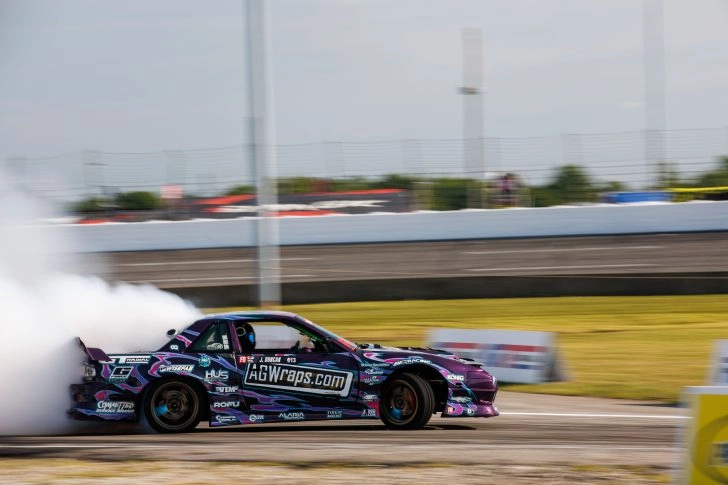
Formula DRIFT uses the Universal Drift Scoring Method from Race Data Labs in PRO qualifying. The official Indianapolis report states that up to 80 percent of the score comes from objectively measured line and angle, while the three judges award the remaining 20 percent for driving style.
This system encourages repeatability. A driver cannot rely on smoke, sound or reputation to hide a missed line. The car needs to arrive at the scoring areas with the expected angle and placement. Setup therefore becomes a scoring tool: front grip, damping and power mapping help the driver reproduce the geometry that the system measures.
Style still matters. Speed, commitment, fluidity and confidence distinguish a technically correct run from a leading run. Shanahan’s official description combined precise placement with flair. That is the ideal outcome: objective accuracy without making the run look cautious.
Qualifying Predictions: What Practice Suggested
A forecast checked against the result rather than rewritten after itThe event has already advanced beyond the prediction stage, so an article published now should not pretend qualifying is still in the future. The useful exercise is to reconstruct the sensible pre-session forecast from practice conditions, then compare it with the official order.
Prediction 1: Matt Field would be a top-five threat
Field helped develop the course and had a car suited to a combination of speed and technical transitions. The collision created uncertainty, but a team capable of completing a clean repair could still use his layout familiarity. The prediction was correct: he qualified second and led most of the session.
Prediction 2: Jack Shanahan would carry Stafford momentum
Shanahan arrived after finishing second at Stafford, where he had already shown strong form on a new venue. His compact E82 and controlled style made him a logical top-five candidate. The result exceeded that forecast because he won qualifying outright.
Prediction 3: Deane and Bakchis would remain the safest championship picks
Deane and Bakchis entered Indianapolis first and second in the standings. Both have teams with deep setup experience, and both had already won a 2026 round. They qualified fourth and third. That is almost the exact outcome expected from drivers who prioritize championship control without giving away speed.
Prediction 4: a rookie could use the reset to surprise
A new course reduces the value of old setup books. Everyone starts with fewer venue-specific notes, which can narrow the experience gap. Cole Richards became the leading rookie in eighth, supporting the idea that a disciplined young driver could capitalize on the reset.
Prediction 5: practice damage would decide at least one weekend
This was the least desirable forecast but the most realistic. Walls, new references and limited learning time increase the risk that one team will not recover. Jeff Jones’ crash and failed qualifying attempt confirmed the danger.
Practice correctly pointed toward adaptable cars and disciplined drivers. The qualifying winner was not the most powerful entry; it was the driver who combined placement, angle and style most effectively.
Official Formula DRIFT Indianapolis Qualifying Results
The top 16 and what the numbers revealJack Shanahan won Formula DRIFT Indianapolis qualifying with 84.63 points on his second run. Matt Field finished second, 1.08 points behind. Aurimas Bakchis placed third with 82.7, while championship leader James Deane took fourth with 82.53.
| Position | Driver | Official displayed score | Championship bonus |
|---|---|---|---|
| 1 | Jack Shanahan | 84.6 | 4 points |
| 2 | Matt Field | 83.5 | 3 points |
| 3 | Aurimas Bakchis | 82.7 | 2 points |
| 4 | James Deane | 82.5 | 1 point |
| 5 | Chris Forsberg | 82.5 | 1 point |
| 6 | Tommy Lemaire | 81.7 | 1 point |
| 7 | Branden Sorensen | 81.6 | 1 point |
| 8 | Cole Richards | 80.9 | 1 point |
| 9 | Adam LZ | 80.1 | 1 point |
| 10 | Conor Shanahan | 79.9 | 1 point |
| 11 | Ryan Tuerck | 79.8 | 1 point |
| 12 | Ben Hobson | 79.6 | 1 point |
| 13 | Dylan Hughes | 79.0 | 1 point |
| 14 | Ken Gushi | 77.6 | 1 point |
| 15 | Wataru Masuyama | 76.3 | 1 point |
| 16 | Trenton Beechum | 76.0 | 1 point |
The official results page rounds several scores to one decimal, while the Formula DRIFT news report gives precise figures for the leading drivers. That is why Shanahan appears as 84.6 in the table but 84.63 in the official session notes.
A tight top group
Only 2.13 points separated Shanahan’s precise score from Deane’s. Forsberg was effectively level with Deane on the rounded display. The first ten drivers were separated by less than five points. That compression suggests the leading teams reached a similar understanding of the revised line.
Small details therefore became decisive. A slightly deeper zone, cleaner transition or stronger style impression could move a driver several positions. This is where UDSM matters. When line and angle are quantified, the scoring gap can reflect a collection of small placement differences rather than one obvious mistake.
How Formula DRIFT qualifying works in 2026
The PRO Championship returned to solo qualifying for 2026 after a driver vote. Each driver receives two attempts, and the best score counts. For rounds after the opener, the running order is based on the reverse of the current championship standings. That means the leading championship drivers run later.
The top qualifier receives four championship points, second gets three and third gets two. Other successful qualifiers receive one. At Indianapolis, the top four also earned bye runs into the Top 16 because only 29 drivers were competing for a 32-car bracket.
For a broader comparison with conventional motorsport, see how racing drivers qualify and how racing championships are scored. Formula DRIFT’s judged solo runs differ from lap-time qualifying, but the starting-order and bonus-point consequences are equally important.
Saturday Predictions After Practice and Qualifying
Who is best positioned for the Round 5 battles?The official schedule lists PRO warm-up from 12:30 to 2:00 p.m. ET. The Top 32 livestream is scheduled from 2:30 to 5:30 p.m. ET, with the opening ceremony and Top 16 session from 7:00 to 10:00 p.m. ET. The final result remained undecided when this article was prepared.
Favorite: Jack Shanahan
Shanahan starts with the cleanest combination of qualifying position, recent form and a top-four bye. His BMW looked accurate enough to win the solo session, and Stafford showed that he can carry a new-venue setup into deep tandem competition. The risk is that qualifying control does not automatically create chase proximity. He still has to adapt to opponents with different pace.
Most dangerous challenger: Matt Field
Field demonstrated pace and resilience. A driver who can recover from heavy practice contact and qualify second is difficult to dismiss. His Corvette also has the forward drive to pressure opponents in chase. The key question is whether the repaired package remains consistent through repeated battles and tire changes.
Championship battle: Bakchis versus Deane
Bakchis and Deane qualified third and fourth, so both receive byes and can focus on the Top 16. Deane leads the championship by 22 points. Bakchis needs to finish ahead of him to reduce that gap meaningfully. Equal results favor Deane because fewer rounds remain.
Bakchis may have the slightly stronger Indianapolis qualifying evidence, but Deane has the most powerful official package and a record of improving during competition. The outcome may depend less on their solo scores and more on which driver produces the cleaner chase under smoke.
Upset candidate: Cole Richards
Richards is the leading rookie and starts eighth. His lower-power GT86 looked efficient rather than overworked. A rookie can still be vulnerable to the psychological pressure of a big tandem moment, but his qualifying run showed the car is capable of following the required geometry.
Recovery candidate: Adam LZ
LZ’s ninth-place score after the practice collision suggests the E36 is healthy enough to contend. His aggressive style can be an advantage in chase if he controls the closing rate. It can also increase risk on a course that already produced contact. A disciplined first battle will tell us whether the team found the right balance.
High-risk champion: Fredric Aasbo
Aasbo’s twentieth seed creates an early challenge. His experience means he can outperform the number, but a lower bracket position removes margin. He may encounter a leading championship contender before the final rounds. The three-time champion needs the GR Supra to produce stronger tandem form than its solo score suggested.
- Best qualifying form: Jack Shanahan and Matt Field.
- Best championship position: James Deane.
- Closest title challenger: Aurimas Bakchis.
- Leading rookie: Cole Richards.
- Strongest repair comeback: Matt Field, followed by Adam LZ.
- Driver unable to start Saturday: Jeff Jones.
Fans new to judged drifting can use our how car racing works guide for broader context, but they should watch FD battles differently from a timed race. The lead driver establishes the expected line and pace. The chase driver is judged on proximity, angle and imitation while remaining responsible for adapting to the lead car’s movement.
Formula DRIFT Indianapolis Practice FAQ
Four direct answers for fans following FD IndyConclusion: Practice Rewarded Adaptation More Than Raw Power
Formula DRIFT’s Indianapolis debut created exactly the kind of technical test expected from a new venue. Fresh pavement and a purpose-built route removed the comfort of an established setup book. The LZ–Field collision and Jones crash showed the cost of learning at the limit. The zone revision and delayed qualifying showed the series responding to real track behavior rather than refusing to adjust.
Jack Shanahan produced the best answer. His 900-horsepower BMW did not have the largest number in the field, but it delivered the placement, angle and style required for 84.63 points. Matt Field’s second place was a team achievement after the practice contact. Bakchis continued the development of his new BRZ, while Deane protected his championship position with a clean top-four result.
The car-setup lesson is equally clear. Indianapolis requires stability and agility in the same run. Teams need front grip without nervousness, rear bite without resistance to rotation, and power delivery that the driver can meter precisely. UDSM makes those qualities visible because line and angle form most of the qualifying score.
Qualifying has now replaced speculation with an official order, but tandem competition remains a different challenge. Shanahan starts as the form favorite, Field as the strongest recovery story, and Bakchis and Deane as the championship center. Saturday will reveal whether the practice lessons survive smoke, proximity and direct pressure from another car.
Sources
- Formula DRIFT: PRO and PROSPEC qualifying results from Indianapolis — official practice notes, incidents, course change, scoring details and leading results.
- Formula DRIFT: 2026 Indianapolis PRO results — complete displayed qualifying order and scores.
- Formula DRIFT: Indianapolis Raceway Park course redesign — paving, development group and simulator-testing background.
- Formula DRIFT: Midwest Mayhem event schedule — practice, warm-up and competition times.
Official driver pages were also consulted for published 2026 car specifications. Setup discussion is analytical interpretation based on the course, scoring system and those public specifications; private team settings are not presented as fact.