What Is a Dual-Clutch Gearbox (DCT)?
Two clutches, two gears already loaded, and a shift so fast you barely feel it happen. Here’s exactly how a DCT works, where it came from, and whether it actually belongs in your next car.
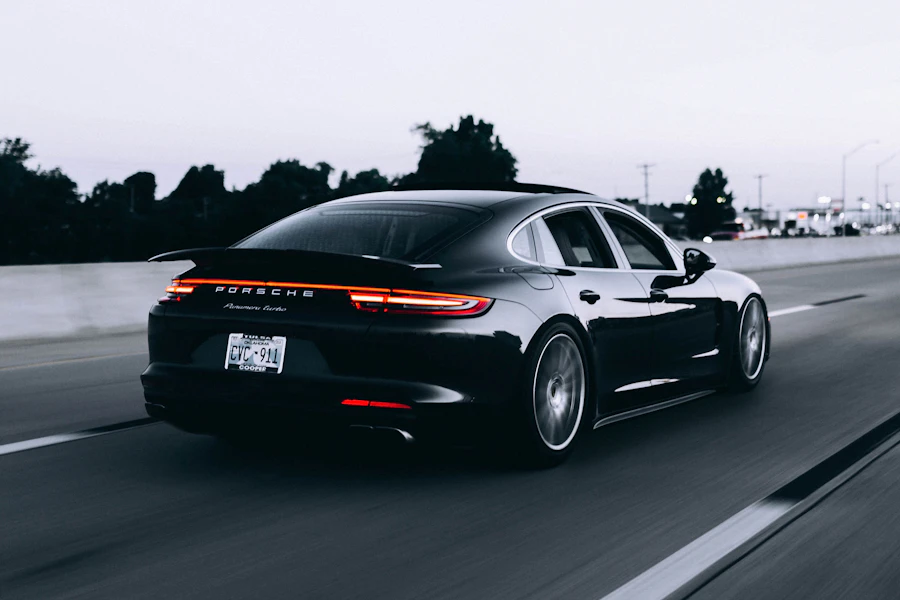
What Is a Dual-Clutch Gearbox (DCT)?
Two clutches, two gears ready at once, and shifts so fast you barely feel them. Here’s exactly how it works.
Pop the hood vocabulary question to most drivers — “manual, automatic, or something else?” — and a growing number will answer with a letter combination instead of a word: DCT, DSG, PDK, S tronic, PowerShift. They’re all marketing names for the same underlying idea, and that idea has quietly become one of the most important pieces of engineering in modern performance cars.
A dual-clutch transmission isn’t a tweaked automatic and it isn’t a manual with a robot’s foot on the clutch pedal. It’s a genuinely different architecture — two manual gearboxes sharing one housing, each with its own clutch, taking turns so that the next gear is already spinning and ready before you’ve even asked for it. That’s the trick that lets a DCT-equipped car snap through gears almost without a flicker of hesitation. Let’s open it up and see exactly how that trick works.
A dual-clutch gearbox (DCT) is an automated transmission built from two separate manual gearboxes in one housing — one handling odd gears, one handling even gears — each with its own clutch. While you’re driving in one gear, the next gear is already pre-selected on the other clutch. Shifting just means swapping which clutch is engaged, which is why DCTs change gear with almost no interruption in power, faster than a human could ever move a manual lever.
What Is a Dual-Clutch Gearbox, Exactly?
Strip away the badge on the gear selector and a dual-clutch transmission (DCT) is, mechanically, much closer to a manual gearbox than to a traditional automatic. There’s no torque converter, no fluid coupling, and no planetary gearset doing the heavy lifting. Instead, there are real gear sets and shift forks, just like the manual in an older hot hatch — except there are two complete gearboxes built into one casing, and a computer does all the clutch and gear-selection work that a driver’s hand and left foot would normally handle.
One of those internal gearboxes controls the odd gears — first, third, fifth, seventh — and the other controls the even gears — second, fourth, sixth. Each has its own clutch and its own input shaft, and the two input shafts are nested concentrically, one spinning inside the other. Only one clutch is ever transmitting power to the wheels at a time. The other sits in reserve, with the next likely gear already selected and waiting.
Why bother with this added complexity? Because of one specific weakness shared by every regular manual transmission and most older automatics: the moment a gear change happens, power flow to the wheels has to pause, however briefly. A driver has to push the clutch in, slide the lever, then let the clutch back out. An old-style automatic has to release one set of clutches inside its planetary gearset and apply another. Either way, there’s a small but real interruption in torque delivery — a tiny stumble in acceleration you can feel as a “shift shock,” and a small loss of momentum that matters enormously when you’re trying to win a race by tenths of a second.
A DCT removes that pause almost entirely. Because the next gear is already loaded onto the standby clutch before you need it, changing gear becomes a simple handover: open one clutch and close the other, virtually simultaneously. The engine never disconnects from the driveline for any meaningful length of time, so there’s no real lull in acceleration. That single idea — pre-selecting the next gear on a second clutch — is the entire reason a DCT exists, and it’s the foundation for everything else in this guide.
How a Dual-Clutch Transmission Actually Works
It helps to walk through what’s physically happening inside the casing every time the gearbox shifts. None of this requires the driver to do anything beyond pressing the accelerator or, in manual mode, tapping a paddle — the entire sequence below happens automatically, coordinated by the gearbox’s onboard computer.

The mechatronic unit bolts directly onto the side of the gearbox and combines the electronics, solenoids, and hydraulic pump that control both clutches and every gear selector. It’s effectively the nervous system of a DCT, making dozens of micro-decisions a second about clutch pressure, shift timing, and gear pre-selection — all invisible to the driver.
This pre-selection logic is also why a DCT can feel uncannily intuitive. If you’re accelerating hard, it pre-loads the next higher gear. If you suddenly lift off the throttle approaching a corner, the system reads that and pre-selects a lower gear instead, anticipating a downshift. It’s effectively running a constant prediction model on your driving, one gear-change ahead of where you actually are.
Where the Dual-Clutch Gearbox Came From
Engineers had sketched out dual-clutch concepts on paper since well before the Second World War, and a few crude two-speed examples even reached production on simple machines like the three-wheeled Morgan in the early twentieth century. But a true automotive dual-clutch transmission needed something that didn’t exist yet: electronic control systems precise enough to manage two clutches and their handover without jarring the driver. That piece of the puzzle didn’t arrive until the early 1980s.

Porsche got there first. Engineer Rainer Wüst led development of what Porsche called the Doppelkupplungsgetriebe — “double-clutch transmission,” shortened to PDK — through the early 1980s, first testing the concept in a 944 Turbo before moving it into competition. Porsche’s Group C endurance racer, the 956, and later the 962, carried the PDK into real racing, and in 1986 it scored its first win at Monza with Derek Bell behind the wheel, going on to help secure that year’s World Sports-Prototype Championship alongside Hans-Joachim Stuck. Audi tested a related dual-clutch system in its Sport Quattro S1 rally car around the same period, with Walter Röhrl driving.
For all its track success, the PDK stayed a motorsport-only technology for more than two decades. The control electronics simply weren’t reliable or affordable enough for everyday road cars yet. It wasn’t until 2008 that Porsche finally brought PDK to a production car, fitting it to the 911 (the 997.2-generation Carrera and Carrera S), followed in 2009 by the Panamera as the first Porsche offered with PDK as standard equipment.
Volkswagen brings the dual clutch to the masses
While Porsche was refining PDK for its own sports cars, the Volkswagen Group took a parallel path aimed squarely at mainstream buyers. Working with transmission specialist BorgWarner, Volkswagen developed the DSG — Direct-Shift Gearbox, or Direktschaltgetriebe — and launched it in 2003 in the Mk4 Golf R32, badged with a six-speed, wet-clutch unit known internally as the DQ250. It was the world’s first dual-clutch transmission fitted to a genuinely mass-market passenger car, and Volkswagen’s own figures at the time showed the DSG-equipped R32 reaching 62 mph noticeably quicker than its manual-gearbox sibling. The Audi TT 3.2 and the New Beetle TDI picked up the same gearbox shortly afterward, with Audi marketing its version under the name S tronic.
From there, the technology spread quickly across the industry. Within a decade, dual-clutch gearboxes — under brand names like Ford’s PowerShift, Hyundai and Kia’s DCT, BMW’s M DCT, and Ferrari’s dual-clutch automated manual — had moved from racetrack curiosity to one of the default choices for any manufacturer chasing both quick shifts and good fuel economy.
Wet Clutch vs Dry Clutch DCT
Not every DCT is built the same way internally, and the most important difference is whether its clutches run wet (bathed in oil) or dry (open to air, like a manual car’s clutch). This single design choice shapes how much torque the gearbox can handle, how it behaves in heavy traffic, and how it’s serviced.
Wet-clutch DCTs use multiple clutch plates submerged in a constantly circulating bath of transmission fluid. That fluid does double duty: it lubricates the plates and, critically, carries heat away from them. Because the clutches can shed heat so effectively, wet-clutch DCTs can handle far more torque without overheating, which is why they show up in higher-output performance cars, larger SUVs, and Porsche’s own PDK. The trade-off is a heavier, more complex unit, and a larger volume of specialised fluid — sometimes around seven litres when hydraulics and lubrication are combined — that needs to be serviced.
Dry-clutch DCTs skip the oil bath around the clutch plates entirely, relying on the same kind of friction material you’d find in a manual car’s single clutch disc. With no fluid to drag against, dry-clutch units are lighter, slightly more efficient, and cheaper to manufacture — Volkswagen’s seven-speed DQ200, launched in 2008, was built this way specifically for smaller-displacement, lower-torque engines, using barely over a litre of specialised fluid for its hydraulics. The catch is heat management: stop-and-go traffic, hill starts, and repeated low-speed clutch slip can heat the plates faster than they can cool, which is the root cause behind most of the reliability complaints associated with early dry-clutch DSG units.
Neither design is objectively “better” — they’re simply optimised for different jobs. A small hatchback rarely needs to handle big torque, so a lighter, cheaper dry-clutch DCT makes sense. A turbocharged sports car generates far more heat and torque at the clutch, so a wet-clutch design is the safer engineering choice, even at the cost of extra weight.
DCT Gearbox Advantages and Disadvantages
Like every transmission design, a DCT is a set of engineering trade-offs, not a free upgrade. Here’s the honest balance sheet.
Genuinely Fast Shifts
With the next gear already pre-selected, a DCT can complete a gear change far quicker than a driver could move a manual lever, and with virtually no interruption to acceleration.
No Mis-Shifts
Because gear selection is computer-controlled, there’s no risk of grinding into the wrong gear or missing a shift entirely — a real concern in motorsport history that helped justify the technology’s racing debut.
Strong Efficiency
Without a torque converter slipping fluid between engine and gearbox, a DCT transmits power more directly than an older-style automatic, which can translate into real fuel economy gains.
Low-Speed Awkwardness
Because the system relies on clutch slip rather than a fluid coupling to creep forward, very low-speed manoeuvres — parking, crawling in traffic — can feel slightly hesitant or jerky compared with a torque-converter automatic.
Costly to Repair
A DCT’s mechatronic unit, dual clutch packs, and precision electronics are genuinely complex. When something does go wrong, repairs and replacement parts tend to cost more than fixing a conventional automatic.
Heat-Sensitive (Especially Dry Clutch)
Dry-clutch variants in particular can suffer from clutch judder or premature wear if repeatedly heat-soaked in stop-and-go traffic, towing, or hill starts.
For a performance-focused driver who mostly accelerates, brakes, and corners — exactly the use case a DCT was engineered around — the advantages dominate. For someone who spends most of their driving time in heavy urban traffic, the low-speed trade-offs are worth weighing more carefully, which is part of why manufacturers still offer torque-converter automatics and CVTs alongside DCT options in many model ranges.
DCT vs Automatic vs CVT vs AMT
“Automatic” has become a catch-all word for “no clutch pedal,” but underneath that label sit several genuinely different mechanical designs. Understanding where a DCT sits among them clears up a lot of confusion.
| Transmission | Core Mechanism | Shift Feel | Typical Strength |
|---|---|---|---|
| Dual-Clutch (DCT) | Two manual gearboxes, two clutches, pre-selected gears | Fast, sharp, almost no power interruption | Performance driving, quick acceleration |
| Torque-Converter Automatic | Fluid coupling plus planetary gearsets | Smooth, gradual, very easy at low speed | Comfort, towing, low-speed manoeuvring |
| CVT | Steel belt or chain riding on variable-diameter pulleys | No distinct “gears” — continuous, seamless ratio change | Fuel economy, smoothness in everyday driving |
| Automated Manual (AMT) | A standard manual gearbox with one robotic clutch | Can feel jerky — no pre-selected gear waiting | Low cost, simple mechanical layout |
The easiest way to separate these is the clutch count. A DCT and a torque-converter automatic both shift quickly, but for different reasons — the DCT pre-selects gears mechanically, while the torque converter never fully disconnects engine and gearbox in the first place. A CVT sidesteps the whole question by not having fixed gears at all. And a single-clutch automated manual — the technology DCTs were largely designed to improve upon — shares a DCT’s mechanical simplicity but lacks the pre-selection trick, which is exactly why early automated manuals in road cars often felt noticeably less smooth than a true dual clutch.
Think of a single-clutch automated manual as someone changing gear with one hand tied behind their back. A DCT is the same job done with both hands free — the next gear is already in position before the old one lets go.
DCT Reliability and Maintenance

A well-maintained dual-clutch transmission, wet or dry, is a genuinely durable piece of engineering — Porsche’s PDK and Volkswagen’s wet-clutch DSG units in particular have built strong long-term reputations. Reliability concerns in this category tend to cluster around three specific causes rather than the fundamental concept being flawed.
- Skipped fluid services. Unlike a torque-converter automatic, a DCT’s fluid isn’t a “lifetime” item in most manufacturer schedules. Clutch material wear and heat cycling break the fluid down over time, and skipping the recommended interval accelerates wear on the clutch packs and mechatronic unit.
- Sustained heat exposure on dry-clutch units. Dry-clutch DSG transmissions, such as Volkswagen’s early seven-speed DQ200, drew documented manufacturer recalls in several markets after a hydraulic fault tied to repeated heat cycling caused rough or delayed engagement. It’s a well-known case study in why dry clutches need careful thermal management.
- Software calibration. Because so much of a DCT’s behaviour is dictated by its control software, a surprising number of “rough shifting” complaints are resolved with a transmission control unit software update rather than any hardware repair.
Shuddering or juddering from a standstill, a noticeable delay or “clunk” when pulling away, warning lights related to the transmission, or gear changes that suddenly feel harsh rather than smooth are all signs a DCT needs attention. Catching these early is almost always cheaper than waiting for a full clutch pack or mechatronic unit failure.
The practical takeaway for owners is straightforward: follow the manufacturer’s fluid-change interval without exception, avoid prolonged clutch slip such as holding the car on a hill using throttle alone, and treat any change in shift feel as worth investigating rather than ignoring. Compared with the cost of a full mechatronic unit or clutch pack replacement, routine DCT maintenance is inexpensive insurance.
Where You’ll Find a Dual-Clutch Gearbox Today
One reason DCTs can feel confusing is that almost no manufacturer calls it a “DCT” on the showroom floor. Each brand markets its own version under its own name, even though the underlying two-clutch architecture is fundamentally the same idea everywhere.
| Manufacturer | Marketing Name | Notes |
|---|---|---|
| Porsche | PDK | Wet clutch, motorsport-derived, used across the 911, Cayenne, Panamera, and Taycan |
| Volkswagen | DSG | Offered in wet- and dry-clutch versions, used across the Golf, Polo, and Tiguan ranges |
| Audi | S tronic | Shares core DSG architecture with Volkswagen, badged differently |
| Ford | PowerShift | Dry-clutch design used on smaller, front-wheel-drive models |
| BMW | M DCT | High-torque wet-clutch unit reserved for M-division performance cars |
| Hyundai / Kia | DCT | Both wet- and dry-clutch versions across turbocharged models |
The pattern is consistent: brands chasing outright performance — Porsche, BMW’s M division, Ferrari — lean on wet-clutch DCTs that can shrug off serious torque and heat. Brands optimising for everyday efficiency in smaller cars have historically leaned more on dry-clutch units, accepting their lower torque ceiling in exchange for less weight and lower cost.
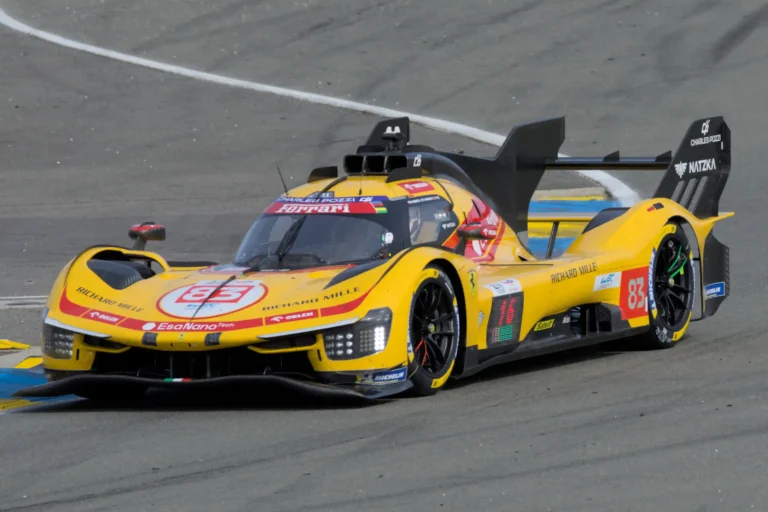
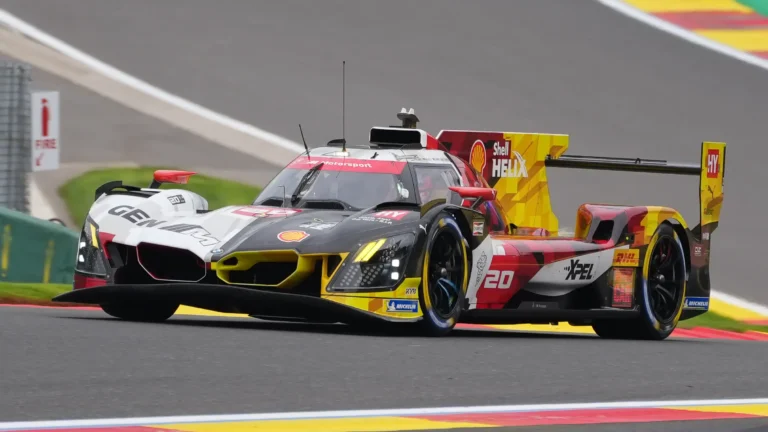
Motorsport, naturally, never left the picture either. The same fundamental advantage that won Porsche races at GT3 level in the 1980s — instant, uninterrupted gear changes — is exactly why paddle-operated sequential and dual-clutch-derived gearboxes remain standard equipment from Formula 1 down through modern endurance racing.
Frequently Asked Questions
The Bottom Line on Dual-Clutch Gearboxes
A dual-clutch transmission earns its reputation honestly. By splitting the gearbox into two halves, each with its own clutch, it can pre-select the next gear before you ever ask for it — turning a gear change into a quick handover instead of a pause in power delivery. That single piece of engineering, proven across a decade of endurance racing before it ever reached a road car, is why DCTs remain the default choice anywhere outright shift speed matters.
It isn’t a perfect solution for every situation — low-speed crawling and long-term maintenance discipline both matter more with a DCT than with a conventional automatic. But for drivers who want manual-style control with automatic-style convenience, and shifts quick enough to disappear into the background of a hard launch or a fast corner exit, it’s hard to beat two clutches working in disciplined rotation.