Scarab Formula 1 Car:
The American Dream That Defied Europe in 1960
Lance Reventlow built it from scratch in California, aimed it at Ferrari and Cooper, and sailed it across the Atlantic. It was beautifully made, technically sound — and it arrived one full era too late.
Scarab Formula 1 Car:
The Dream That Defied Europe
America’s first serious Formula One constructor — beautifully built, perfectly timed for the wrong era.
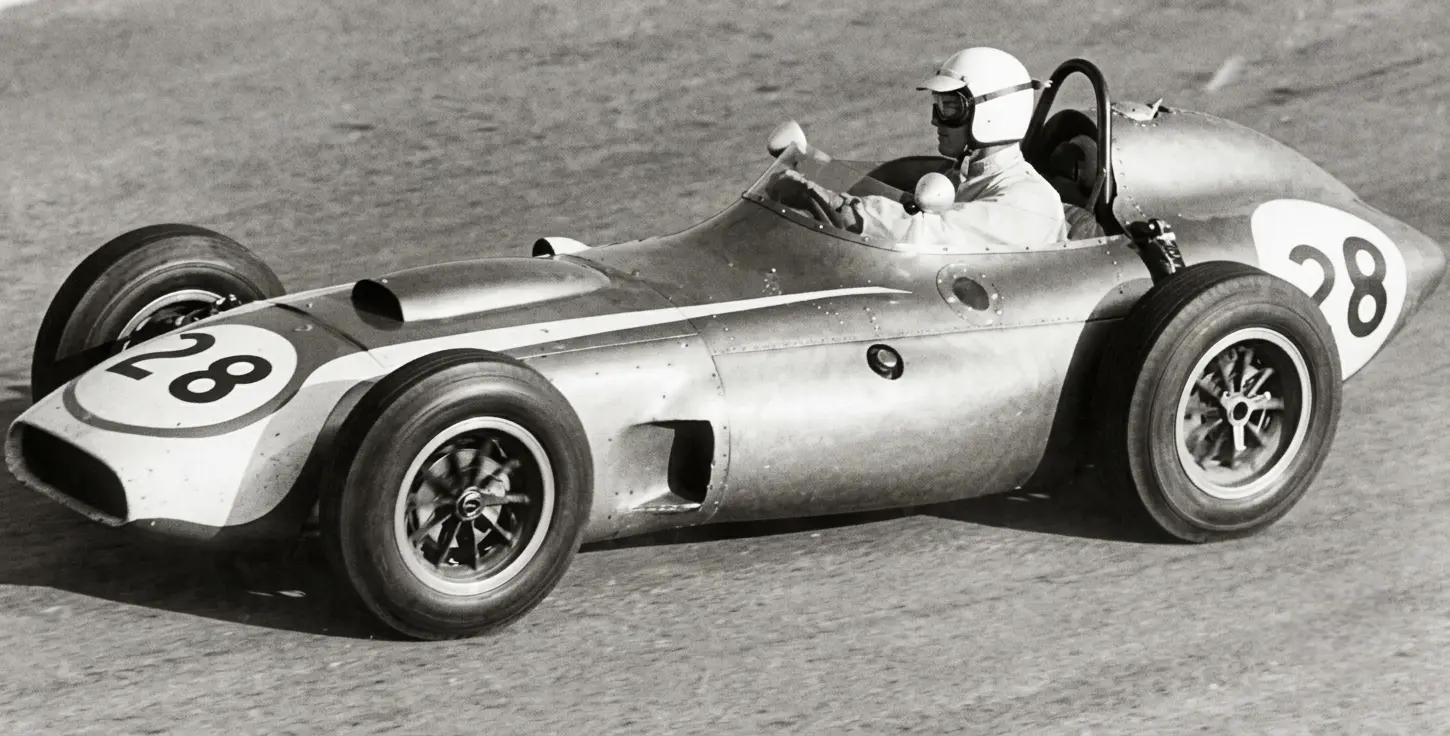
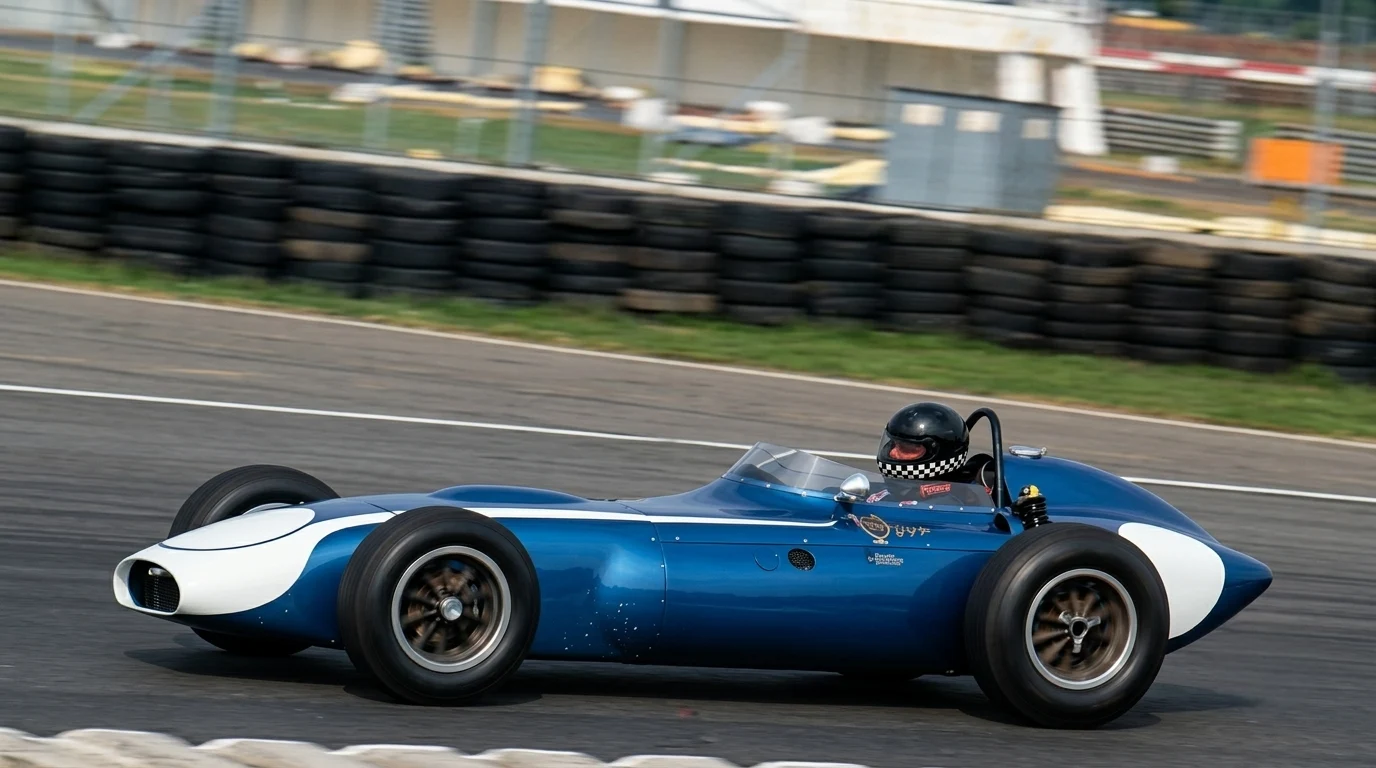
In 1960, an American constructor called the Scarab shipped two Formula 1 cars to Europe with genuine ambitions of beating Ferrari, Cooper, and Lotus at their own game. The project was funded entirely by Lance Reventlow — the heir to a Woolworth fortune and a talented racing driver in his own right — and the cars were built by hand in a Los Angeles workshop with a level of craft that put many factory teams to shame.
The Scarab never started a championship race. Not once. Across the entire 1960 season, both cars failed to qualify at every circuit they entered. This is the full story of what happened, why it happened, and why the Scarab still matters to anyone serious about the history of Formula One and American motorsport.
The Scarab at a Glance
The Scarab Formula 1 car was designed and built by Reventlow Automobiles Inc. (RAI) in Los Angeles, California, and represents the first genuinely American attempt to build a Formula One car from scratch and compete in the FIA World Championship. It was not a kit car, not a modified European design — it was conceived, engineered, and fabricated in the United States, funded entirely by one man’s fortune and his belief that American engineering could hold its own in Grand Prix racing.
The car used a front-mounted Offenhauser-based four-cylinder engine, a multi-tubular steel space frame chassis, double wishbone front suspension, and disc brakes at all four corners. By the technical standards of 1957–58, when the design was conceived, it was a serious and well-executed racing car. By the time it arrived in Europe in the summer of 1960, the mid-engine revolution had already rendered front-engine Formula 1 cars obsolete. Jack Brabham had won the 1959 and 1960 World Championships in mid-engine Coopers. The Scarab’s architecture was settled before that revolution was complete.
Why It Matters
The Scarab didn’t win. It didn’t qualify. Measured by points and finishes, its record is a blank page. But it matters because it was the first. No American constructor before Reventlow had built a car specifically for Formula One World Championship competition from the ground up. The ambition was real. The execution was serious. The timing was cruel. Understanding the Scarab is understanding something essential about motorsport: being right about everything except one thing — in this case, where to put the engine — can still mean failure.
For museum context on this era of mid-century motorsport, the World of Speed Museum holds exactly the kind of material that puts machines like the Scarab in their proper historical frame.
Lance Reventlow: The Man Behind the Machine
Lance Reventlow was born in 1936, the son of Barbara Hutton — the Woolworth department store heiress and one of the wealthiest women of her generation. He could have done nothing for his entire life. He chose instead to race cars, and then to build them.
By the mid-1950s Reventlow was competing seriously in American sports car racing, and by 1957 he had assembled a small group of genuinely talented engineers and fabricators — including Warren Olson, who led the chassis work, and Traco Engineering’s Jim Travers and Frank Coon, who prepared the engines — and put them to work on a sports racing car. The Scarab sports car, finished in 1957 and raced through 1958, was legitimately quick on American circuits and earned real victories. Confidence grew.
The Formula 1 project followed as what felt like a natural progression. Reventlow had seen American racing — particularly at Indianapolis — hold its own against European machinery for decades. He believed, reasonably, that with sufficient money and talent, an American constructor could take that step into Grand Prix racing and be competitive. He was not wrong about the money, the talent, or the seriousness of purpose. He was wrong about the moment.
RAI operated from a workshop in Los Angeles and was entirely privately funded by Lance Reventlow — no manufacturer backing, no corporate sponsorship, no government support. Everything that went into the Scarab F1 project — design fees, raw materials, fabrication, transport to Europe, race entry fees — came from Reventlow’s personal fortune. For context on the American racing tradition he was drawing from, see the American muscle cars archive and the story of Mario Andretti, who would later carry the American flag at the highest level of the sport.
Chuck Daigh: The Racing Driver
Reventlow raced one of the two Scarab F1 cars himself, but the more accomplished racer in the outfit was Chuck Daigh — an experienced American driver who had been involved with the Scarab project from its earliest days and understood the car from the inside out. Daigh was the faster of the two drivers and the one most likely, in any optimistic scenario, to have qualified. That he never managed it either tells you something clear about the car’s fundamental deficit against the field it was facing.
How the Scarab Was Built: Design & Engineering
How It Got Its Name
The name Scarab was chosen deliberately and carries symbolic weight that Reventlow understood well. The scarab beetle was sacred in ancient Egypt — a creature associated with the sun, with transformation, and with the image of something small pushing an enormous weight uphill against all odds. Reventlow identified with that image: a small California team rolling their machine against Ferrari and the European establishment. There was also a practical continuity argument — the Scarab sports car had already raced and won under that name, and carrying it into Formula One gave the project a clear brand identity, which was unusual thinking for an independent constructor in 1959.
Chassis and Structure
The Scarab’s chassis was a multi-tubular steel space frame — a structure of small-diameter steel tubes welded together to form a rigid cage around the driver. This was the engineering consensus of the late 1950s, and the Scarab’s execution of it was clean and precise. The bodywork panels were hand-formed aluminium, carefully shaped and beautifully finished. The suspension used double wishbones at the front and a de Dion rear axle arrangement. Disc brakes were fitted at all four corners — technically progressive for an independent constructor at the time.
Two chassis were built. Both were identical in layout. Both were eventually shipped to Europe for the 1960 campaign.
The Engine: Offenhauser Legacy, Wrong Position
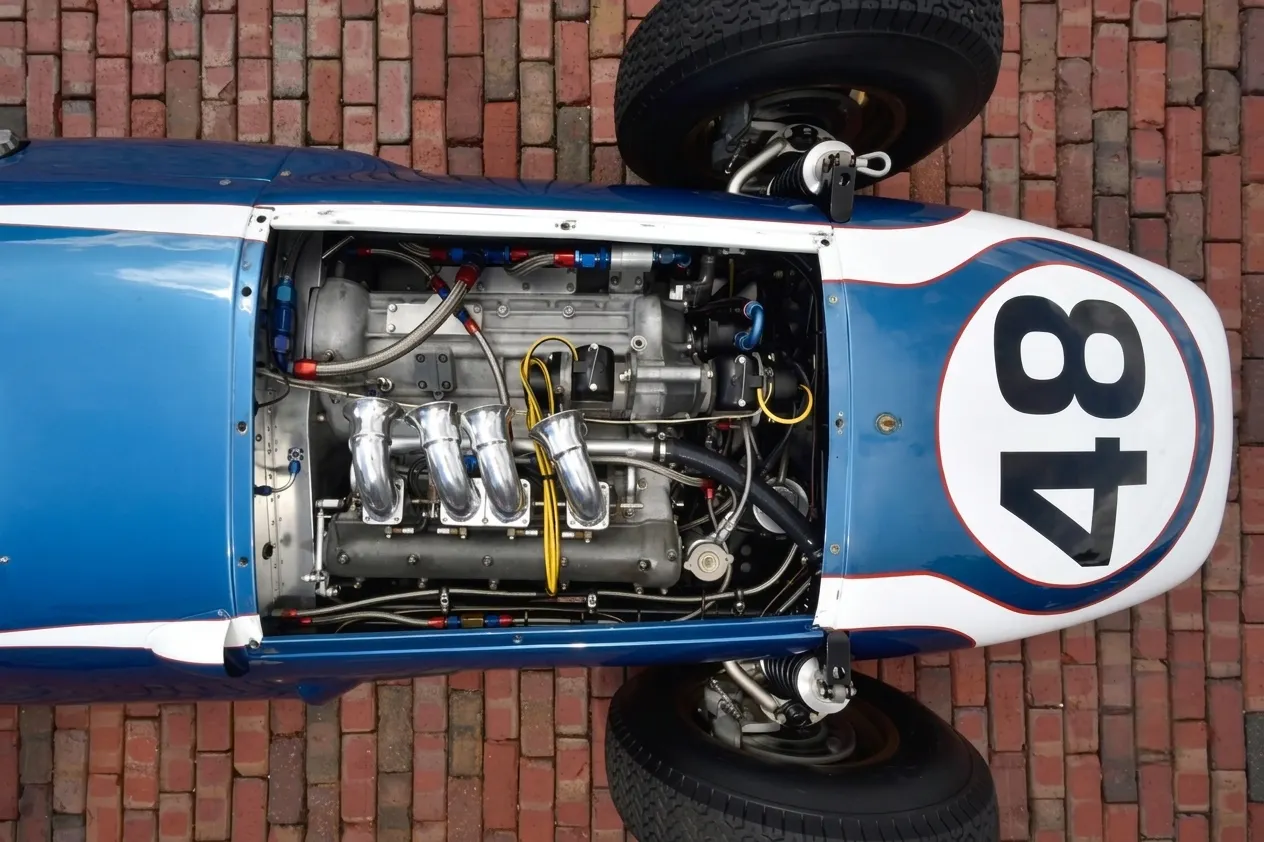
The powerplant chosen for the Scarab was a four-cylinder unit developed in collaboration with Traco Engineering, drawing on the Offenhauser lineage. The Offenhauser name was enormous in American motorsport — “Offy” engines had dominated Indianapolis for over a decade and were synonymous with durability, high-revving performance, and torque delivery that drivers trusted. For the Scarab, the engine displaced approximately 2.5 litres — the FIA’s Formula One limit of the period — and produced around 240 to 250 bhp in race trim. That figure was not embarrassing for 1960; some factory teams weren’t far ahead of it.
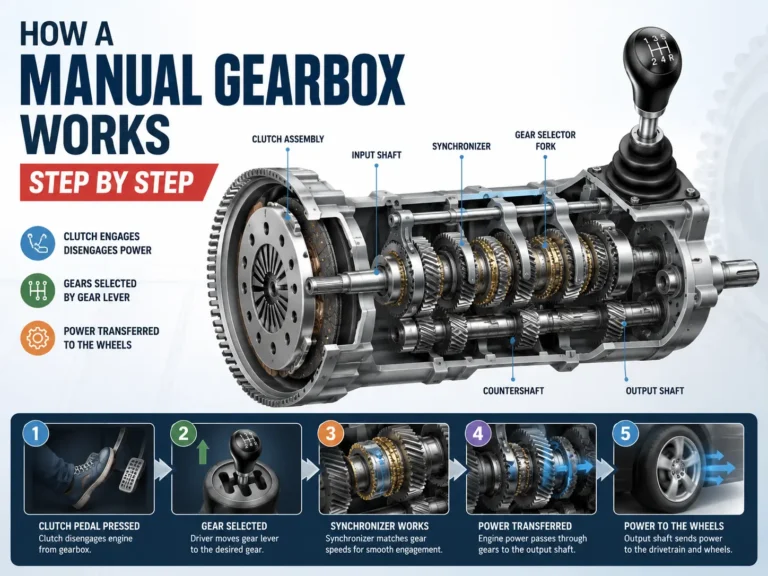
The problem was not the engine. The problem was where it sat. The engine was mounted in the nose, ahead of the driver, driving through a four-speed gearbox to the rear wheels. That was entirely conventional in 1957 when the drawings were made. But Formula One moved faster than almost anyone anticipated in those years, and by the time the Scarab reached Europe, the best cars on the grid had their engines behind the driver. To understand what that means for a racing car’s balance and behaviour, our engine explainer and the oversteer and understeer glossary cover the dynamics clearly.
When Reventlow’s team began designing the Scarab F1 car in late 1957, a front-mounted engine was the standard configuration for a Grand Prix car. Cooper had introduced a mid-engine layout in 1957–58 but it hadn’t yet proven decisive. By 1959, Brabham won the championship in a Cooper T51 with the engine behind him. By 1960, every competitive car on the grid was mid-engined. The Scarab’s architecture had been obsolete for roughly eighteen months before it turned a wheel in Europe.
Full Technical Specifications
| Component | Specification | Notes |
|---|---|---|
| Constructor | Reventlow Automobiles Inc. (RAI) | Los Angeles, California, USA |
| Season | 1960 Formula One | F1 World Championship |
| Chassis | Multi-tubular steel space frame | Hand-fabricated in California |
| Bodywork | Hand-formed aluminium panels | Custom shaped, no production parts |
| Engine | Scarab–Offenhauser 4-cylinder | Prepared by Traco Engineering |
| Displacement | ~2.5 litres | At the FIA Formula One limit |
| Power output | ~240–250 bhp | Estimated race trim; not embarrassing for the era |
| Engine position | Front-mounted, longitudinal | The critical design error by 1960 standards |
| Transmission | 4-speed manual gearbox | Rear-wheel drive |
| Suspension (front) | Double wishbones | Conventional and well-executed |
| Suspension (rear) | De Dion axle | Solid but heavier than contemporary rivals |
| Brakes | Disc brakes, all four corners | Progressive for an independent constructor in 1960 |
| Tyres | Dunlop | Standard supplier of the period |
| Chassis quantity | 2 | Both identical front-engine layout |
| Drivers | Lance Reventlow, Chuck Daigh | Owner-driver and development driver respectively |
The 1960 Formula One Campaign
The Scarab team departed Los Angeles in the spring of 1960 with two cars on a transporter and a great deal of confidence. The plan was a full European campaign — four Grands Prix at minimum — culminating in the United States Grand Prix at Riverside in California, where at least the home crowd would be on their side.
The confidence did not survive first contact with reality. At Spa-Francorchamps for the Belgian Grand Prix in June, both cars failed to qualify. The session was not close. The Scarabs were not within striking distance of the cut-off time. The mid-engine Coopers, Lotuses, and BRMs simply moved through corners differently — with less weight over the front axle, more traction at the rear, and a balance that allowed the drivers to carry speed through the long, fast sweeps that defined Spa. The Scarab pushed. It understeered. Technique could manage it but not eliminate it.
The Scarab was not a bad car. It was a 1957 answer to a 1960 question — beautifully engineered, carefully finished, and obsolete from the moment it rolled off the transporter at Spa.
At Reims for the French Grand Prix in July, the result was identical: both cars DNQ. Silverstone for the British Grand Prix brought the same outcome. By this point the team understood, without needing to say it directly, that the front-engine layout was not something they could engineer around on the circuits they were visiting. The problem was architectural, not mechanical.
The United States Grand Prix at Riverside in November — held on American soil, before a crowd that included many people who knew and admired the Scarab project — produced one entry, Daigh in the second car. He too failed to qualify. On home ground, in front of home supporters, the 1960 campaign ended as it had begun.
Full Race Entry Record — 1960 World Championship
| Grand Prix | Circuit | Driver | Result |
|---|---|---|---|
| Belgian Grand Prix | Spa-Francorchamps | Lance Reventlow | DNQ |
| Belgian Grand Prix | Spa-Francorchamps | Chuck Daigh | DNQ |
| French Grand Prix | Reims | Lance Reventlow | DNQ |
| French Grand Prix | Reims | Chuck Daigh | DNQ |
| British Grand Prix | Silverstone | Lance Reventlow | DNQ |
| British Grand Prix | Silverstone | Chuck Daigh | DNQ |
| United States Grand Prix | Riverside, California | Chuck Daigh | DNQ |
The 1960 FIA Formula One World Championship was won by Jack Brabham in a Cooper T53 — a mid-engine car that had made the front-engine layout definitively obsolete. The full history of F1 constructors and how the championship evolved from this era is covered across our F1 archive. For a broader picture of the drivers who shaped this period, see our all-time rankings.
What Beat It: Cooper, Lotus, and the Mid-Engine Revolution
To understand what the Scarab was up against in 1960, you need to understand the two cars that made it obsolete before it even arrived.
The Cooper T53 — Jack Brabham’s championship-winning machine — had its engine mounted behind the driver and ahead of the rear axle. The weight distribution was fundamentally better balanced. Under braking, the front end loaded up precisely. Under acceleration, the rear tyres had traction the Scarab’s rear wheels, starved of weight by a heavy engine up front, simply couldn’t match. The Cooper steered with precision where the Scarab pushed wide. It wasn’t a small difference. It was measurable in seconds per lap.
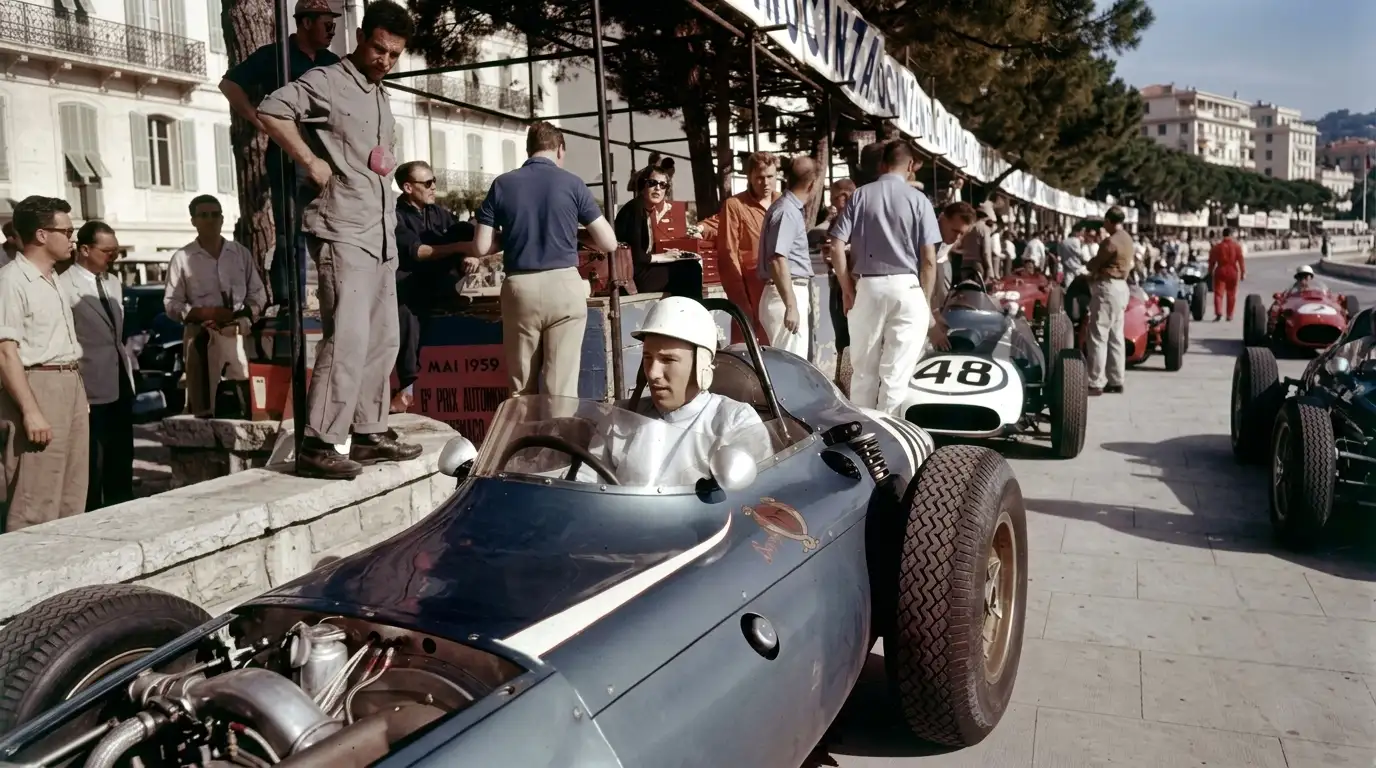
Colin Chapman’s Lotus 18 took the concept further. Chapman had stripped every gram he could find from the design — the car was extraordinarily light, incredibly nimble, and demanded a level of driver skill that few could fully exploit but that paid dividends on any circuit where fast direction changes mattered. Stirling Moss won the Monaco Grand Prix in the Lotus 18 that year. On the tightest, most technical circuit on the calendar, the mid-engine Lotus was faster than anything with an engine in its nose.
The Scarab’s front-mounted engine caused structural understeer — the car wanted to push straight ahead through corners regardless of how much steering lock the driver applied. Reventlow and Daigh could manage it. They couldn’t eliminate it. And at circuits like Spa and Silverstone, where carrying speed through fast corners is a fundamental requirement of a competitive lap time, there was no technique sufficient to close the gap. For the full breakdown of oversteer and understeer in Formula 1, our glossary explains exactly what this means for a driver and a lap time.
Moving the engine behind the driver and ahead of the rear axle accomplishes three things at once: it moves mass closer to the centre of the car, improving rotational inertia; it puts weight over the rear tyres, where traction under acceleration is generated; and it allows the nose to be lower and lighter, helping the front end turn in more sharply. Cooper proved it worked in 1959. Lotus refined it. By 1960, no front-engine car could live with them. See our explainer on how car engines work and what downforce does for the aerodynamics side of the same picture.
The Scarab Story: A Timeline
Why the Scarab Still Matters: Legacy and Impact
The Scarab Formula 1 car started zero championship races. It won nothing. By the cold ledger of sporting results, it is a failure. So why does it appear in serious histories of Formula One? Why do motorsport museums exhibit it with care? Why does it matter to anyone who didn’t see it race — which is everyone, since it never actually raced?
Because it represents the first. Before the Scarab, no American constructor had attempted to build a Formula One World Championship car from scratch and take it to Europe to compete. Not a converted Indianapolis car. Not a modified design. A purpose-built Grand Prix car, conceived and fabricated in the United States, driven to the circuits by an American team. That is a genuinely significant historical fact regardless of what the lap times said.
The quality of the engineering was also real. Both Chuck Daigh and the mechanics who built the car maintained consistently that the Scarab was a well-made, properly engineered racing machine. It handled its front-engine layout as well as that layout could be handled in 1960. The problem was not sloppiness. The problem was that the correct answer to the question “where should the engine go?” had changed between when the drawings were made and when the cars arrived in Europe.
The Bigger Picture: America and Formula One
The Scarab didn’t exist in isolation. It was part of a broader American engagement with Formula One that would eventually produce Mario Andretti’s 1978 World Championship — the first and still only American-born F1 World Champion. It sits at the beginning of that lineage, the first serious attempt, the one that learned the hardest lesson possible about the cost of being one architecture behind.
The World of Speed Museum’s mission is precisely this: to preserve and tell the stories of machines and people that motorsport history might otherwise pass over. The Scarab belongs in that collection. It is physical evidence of courage, craft, and the particular cruelty of being right about everything except one thing. For anyone interested in this era and what came before and after it, the mid-century motorsports exhibit is the place to start. Check hours and admission before you visit.
The sport needed people like Reventlow. Formula One is built on the human material of people willing to risk embarrassment in pursuit of something they genuinely believed in. The Scarab earned its place in the history books. This is long overdue recognition.
Further reading: the original Scarab archive piece on World of Speed, the Ferrari through the decades feature for context on the European teams the Scarab was competing against, and the famous race car drivers collection for the full sweep of the personalities that define this era.
Frequently Asked Questions
One honest thought on the Scarab
Every serious motorsport historian eventually confronts the same uncomfortable question about the Scarab: was it a failure, or was it a beginning? The easy answer is both, but that’s too neat. The truth is more specific. The Scarab was a failure only because of a design decision made in 1957 that couldn’t be undone in 1960. Everything else about the project — the ambition, the funding, the craftsmanship, the courage to cross the Atlantic with two cars and face the European establishment — was admirable and real.
The sport was never the same after the mid-engine revolution that the Scarab’s designers couldn’t have fully anticipated. Within a decade, American drivers, American circuits, and American investment would become central to Formula One’s global expansion. The Scarab was the prologue to all of that. Not a footnote. A prologue.
For anything we’ve missed on this topic, or if you have archive material on the Scarab, the World of Speed archive programme is always looking to expand its records. These stories deserve to be preserved.