Shanghai E-Prix 2026 Strategy Analysis: Tyres, Pit Stops, Safety Cars & Overtaking Problems
Pascal Wehrlein seized the championship lead in a rain-hit Shanghai double-header that turned on Pit Boost timing, a shock last-to-first win for Lucas di Grassi, and two Safety Cars that reshaped both races.
Shanghai E-Prix 2026 Strategy Analysis: Tyres, Pit Stops & Safety Cars
Wehrlein took the points lead in a rain-hit double-header decided by Pit Boost timing and a shock last-to-first win.
Pascal Wehrlein is Formula E’s new championship leader after a Shanghai E-Prix double-header that swung on strategy far more than raw pace. He converted pole into a pole-to-flag win in Saturday’s rain-soaked Race 1, then held on for fourth on Sunday as Lucas di Grassi produced one of the most unlikely wins of the season from the back of the grid. Between the two races, Formula E threw everything at the field: a mandatory Pit Boost stop, two separate Safety Car periods, a standing restart, and conditions that swung from downpour to drying line inside the same forty minutes.
This is a full breakdown of how Shanghai 2026 was actually won and lost — the tyre and energy calls, the Pit Boost windows, the Safety Car timing that punished drivers who’d just spent their Attack Mode, and why a circuit famous for overtaking suddenly turned into a track where clean passes were hard to find.
Shanghai E-Prix 2026 — Weekend at a Glance
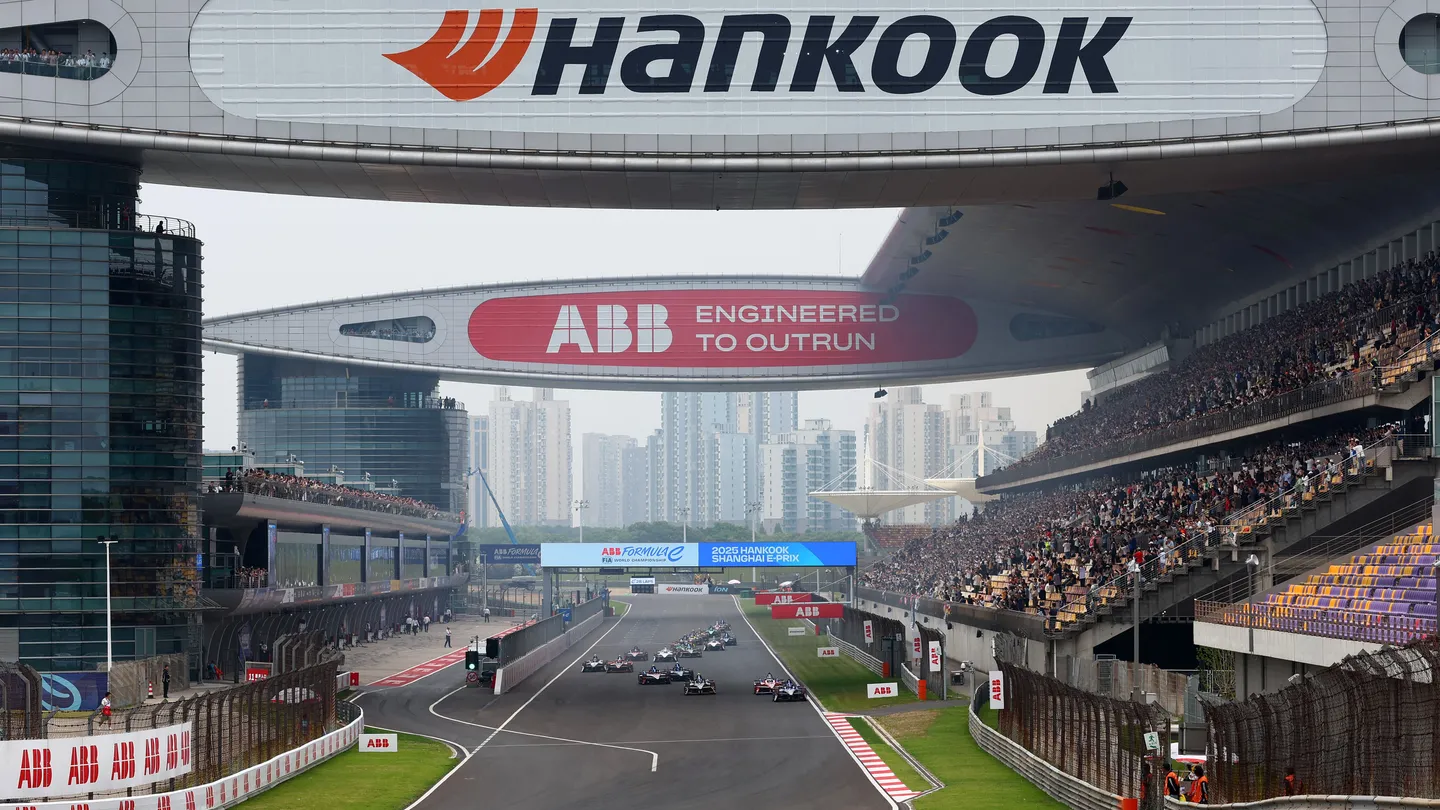
Formula E’s China swing landed on the 3.051km Jiading layout of the Shanghai International Circuit, a shortened version of the venue that has also hosted Formula 1’s Chinese Grand Prix. Race 1 ran under mandatory Pit Boost; Race 2 did not. Both sessions were affected by rain before the lights went out, and both were interrupted mid-race — the first by a downpour-triggered Safety Car, the second by a wet start that forced a standing restart on Lap 4 and a further stoppage before racing resumed on Lap 25.
| Race | Pole | Winner | P2 | P3 | Safety Car |
|---|---|---|---|---|---|
| Race 1 (Round 12) | Pascal Wehrlein 1:09.260 | Pascal Wehrlein | António Félix da Costa | Jake Dennis | Lap 20 (heavy rain) |
| Race 2 (Round 13) | Felipe Drugovich 1:10.609 | Lucas di Grassi | Jean-Éric Vergne | Joel Eriksson | Started behind SC; stoppage before Lap 25 restart |
Wehrlein’s Race 1 victory, his tenth Formula E win, came by 1.6 seconds after he led the majority of the 30-lap race and survived the late Safety Car restart. Race 2 belonged to di Grassi, who started at the back of the grid for Lola Yamaha and ended a four-year winless run — the team’s first win since joining the championship — while championship leader Mitch Evans failed to take the start after Jaguar TCS Racing found a suspected DC/DC converter issue on his car during the build-up.
Qualifying: Two Very Different Stories
Qualifying for Race 1 came down to the closing Duels, where Wehrlein edged out championship leader Mitch Evans by 0.203 seconds with a lap of 1:09.260. It was Evans’ strongest qualifying position of the weekend and, in hindsight, as good as his Shanghai got — he would fall away in both races that followed. Jake Dennis and Maximilian Günther completed the top four, while title contenders Oliver Rowland and Edoardo Mortara both qualified deep in the field, a setback that would cost them heavily once the races went green.
Qualifying for Race 2 flipped the script entirely. Felipe Drugovich, mastering a track that was drying rapidly after standing water in earlier sessions, beat DS Penske’s Taylor Barnard by 0.497 seconds to claim his first career Formula E pole. It capped a session in which lap times tumbled by several seconds as the racing line dried, rewarding drivers who timed their runs late. Wehrlein and reigning champion Rowland rounded out the top four. The bigger story, though, was at the back: Evans failed to progress out of the group stage and could only start 14th, two spots behind Dennis — a poor grid slot that turned out to be the least of his problems once Sunday’s technical issue ruled him out of the race entirely.
In a normal Formula E race, track position out of qualifying is close to decisive because overtaking on a compact street-style layout is hard-won. Shanghai 2026 broke that pattern in both directions: Wehrlein’s pole held up into a comfortable win, but Race 2’s actual outcome was decided by drivers who started nowhere near the front. For more on how the knockout qualifying system works, see our pole position explainer.
Tyre Strategy in Shanghai: What It Actually Means in Formula E
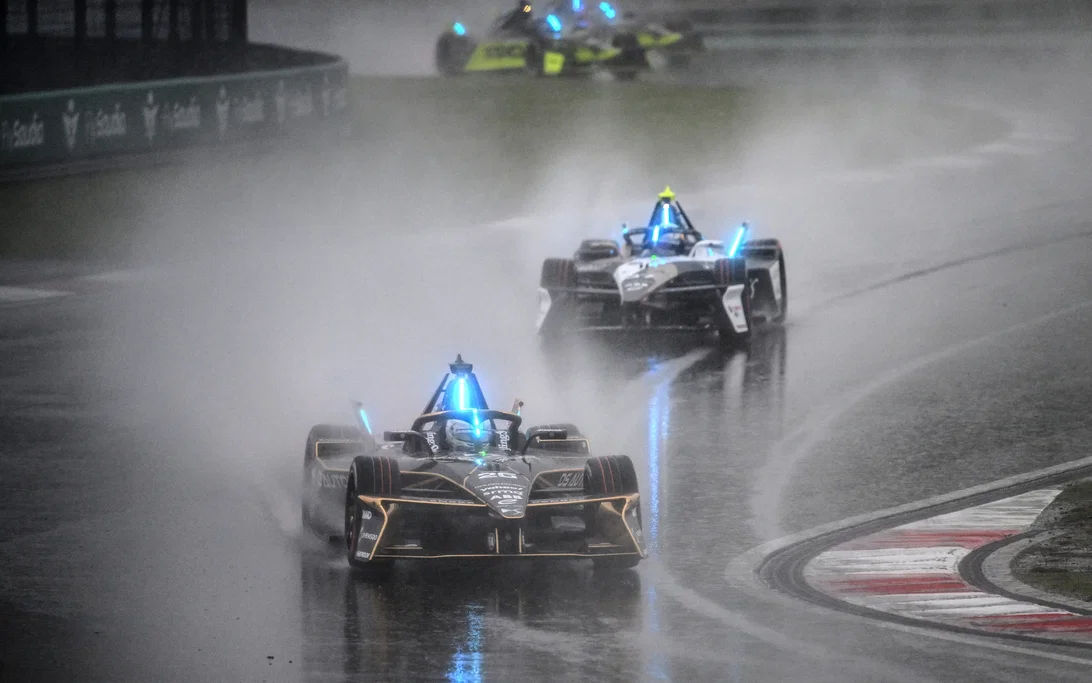
Anyone reading Shanghai’s results through a Formula 1 lens will look for undercuts, compound gambles, and pit-stop tyre changes. Formula E doesn’t work that way. Every Gen3 Evo car runs the same single-specification Hankook tyre, in the same construction, whether the track is bone dry or standing in water. There is no soft, medium, or hard compound to choose, and no in-race tyre change. So the “tyre strategy” story in Shanghai wasn’t about when to pit for fresh rubber — it was about extracting temperature and grip from one tyre across conditions that changed lap to lap.
That distinction shaped both races. In Race 1, drivers who got heat into the tyre early through the opening laps had the confidence to run committed lines through the flowing middle sector, while those who were still building temperature were vulnerable to the spray kicked up by cars ahead. In Race 2, the story flipped completely: as the rain eased and the racing line began to dry mid-race, drivers who had set their cars up with a drier bias — most notably di Grassi and Vergne — found grip nobody else had, because the single-spec tyre behaves very differently on a drying line than it does in standing water.
Why Di Grassi’s Dry Gamble Worked
Di Grassi started Race 2 from the back of the grid and was, by his own team’s read of the conditions, set up for a drier track than the rest of the field expected. As the surface dried through the second half of the race, that setup started paying dividends other cars simply didn’t have access to. He caught and passed the leading pack in the closing laps and took the lead with a decisive move before the flag — Lola Yamaha’s first win in Formula E, and di Grassi’s first victory in four years. Vergne, running a similar dry-leaning setup from a low grid slot, rose to second for the same reason.
The single-tyre rule means Shanghai’s “strategy” was never about pit stops for rubber — it was about which teams read the drying line correctly and built their setup around a track condition that hadn’t arrived yet.
Pit Boost Strategy: The Real Pit-Stop Story of Race 1
If Shanghai had a genuine “pit stop strategy” element, it was Pit Boost, not tyres. Introduced as a mandatory mid-race feature for double-header weekends, Pit Boost sends each car into the pit lane for a fixed 30-second stop where a 600kW charger adds roughly 10% extra usable energy — about 3.85kWh — to the battery. Drivers must take the stop inside a State of Charge window set by the FIA, typically once the battery has dropped between 60% and 40%, and every team has only one charging rig, so there’s no way to double-stack teammates through it.
Pit Boost applied to Race 1 only. Porsche’s timing of Wehrlein’s stop, completed before the heaviest rain arrived, is widely credited as the difference-maker in his win — teams that delayed their stop were caught trying to balance a wet, low-grip in-lap with a strategy call made under worsening visibility. Andretti’s Jake Dennis felt the opposite side of that coin: he emerged from his own mandatory stop in fourth, only to drop further back after rivals who had banked an early Attack Mode activation used it to leapfrog him in the laps that followed.
| Element | Detail |
|---|---|
| Stop duration | 30 seconds, mandatory |
| Energy added | ~10% of usable battery, approx. 3.85kWh |
| Charge rate | 600kW fast-charge rig |
| Timing window | Set by State of Charge, generally 40–60% remaining |
| Used in | Race 1 (Round 12) only, not Race 2 |
Because each team gets one charger and one window to use it in, Pit Boost forces a genuine trade-off: stop early and you commit to a State of Charge plan for the rest of the race; wait too long and a Safety Car — exactly what happened on Lap 20 — can catch you still needing to take it, costing track position at the worst possible moment.
Safety Cars & Full Course Yellows: The Real Momentum Killers
Both Shanghai races were shaped more by Safety Car timing than by any single overtake. Race 1’s defining moment came on Lap 20, when a sudden downpour brought the Safety Car out and added a lap to the race. The timing punished drivers unevenly: those who had already burned their Attack Mode activation in the laps before the Safety Car gained nothing from the neutralisation, while a handful of cars that hadn’t yet taken it were able to use the restart to jump forward. Dennis, running fourth after his Pit Boost stop, was one of the drivers caught on the wrong side of that split and slipped further down the order before recovering to the podium.
The bigger consequence of both interruptions was strategic rather than dramatic: neither Safety Car produced a flurry of position changes on track so much as it reset the gaps that drivers had spent laps of Attack Mode and energy management building. In a series where every position gained usually costs measurable battery percentage, having that investment erased by a neutralisation is often more painful than losing the place outright in a straight fight.
Why Overtaking Was Harder Than Shanghai’s Reputation Suggests
Shanghai has built a reputation as one of Formula E’s friendlier circuits for overtaking. Its wide, sweeping layout — adapted from the Formula 1 Chinese Grand Prix track and shaped like the Chinese character for “up above” — gives drivers multiple lines through several corners, and the venue’s 2024 debut produced well over 400 overtakes across its first double-header. Attack Mode activation on the exit of Turn 1 was designed specifically to create passing chances into the braking zones that follow, at Turn 6 and through the flowing Turns 7 and 8.
None of that showed up the way it usually does in 2026. Rain and spray cut visibility to the point where drivers were forced into defensive, track-holding lines rather than committed passing moves, particularly in the opening and closing stages of both races. The Safety Car periods compounded the problem: rather than racing their way past a rival, several drivers effectively inherited or lost positions through neutralisation timing instead of wheel-to-wheel combat. Race 2’s headline overtakes — di Grassi and Vergne both climbing from the back — happened almost entirely through tyre and setup advantage on a drying track rather than through direct passing moves in the braking zones the circuit is designed around.
Shanghai’s layout isn’t the issue — the circuit remains one of the calendar’s better venues for passing in dry conditions. The 2026 double-header was a weather story more than a track-design story: heavy rain, low visibility, and two Safety Car periods suppressed the kind of racing this circuit normally produces.
Energy Management & Attack Mode: The Hidden Battle
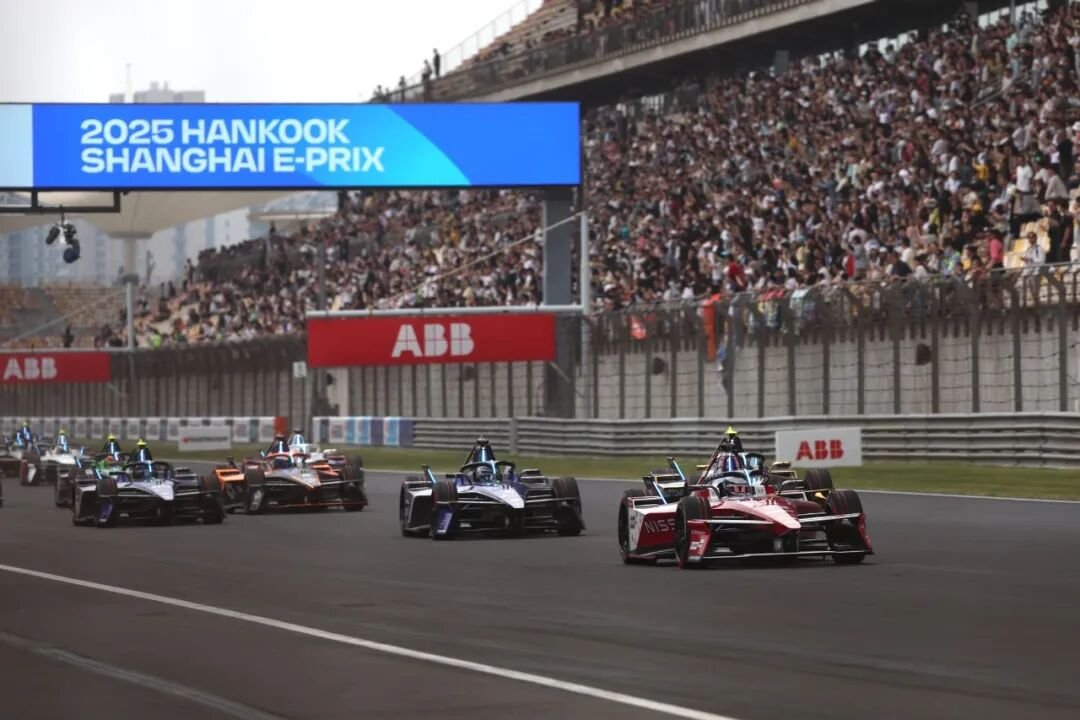
Underneath the headline results, Shanghai was won and lost through energy discipline. Formula E drivers manage a fixed energy allowance across the race through regenerative braking, lift-and-coast, and the strategic use of Attack Mode — a temporary power boost activated by driving through a designated off-line zone, positioned this weekend on the exit of Turn 1. Every activation costs time on the racing line in exchange for extra power later, which means the decision of when to take it, and how many times, is one of the most consequential calls a driver makes all race.
The wet conditions made that calculation harder than usual. Regenerative braking depends on tyre grip to load the rear axle predictably, and standing water reduces that consistency, making energy recovery less reliable exactly when drivers most needed to bank it. Several drivers who activated Attack Mode just before the Race 1 Safety Car effectively wasted the tactical value of the boost, since the neutralisation erased the track-position gain they were chasing. That mistimed sequencing — more than outright pace — is what separated the podium finishers from drivers who were competitive on raw speed but got their energy and Attack Mode calls wrong.
Race 2’s Shock Result, Explained
Race 2 delivered the strangest result of Formula E’s season so far. Mitch Evans, arriving in Shanghai as championship leader, was ruled out before the formation lap even began after Jaguar TCS Racing discovered a suspected DC/DC converter issue during the pre-race build-up — a technical failure with no fix available in the time remaining, handing him a scoreless weekend at the worst possible moment.
The race itself began behind the Safety Car because of standing water, before a standing start was given on Lap 4. Drugovich, starting from his maiden pole, got away cleanly while several rivals used an early Attack Mode activation at Turn 2 to briefly swap the lead. Wehrlein worked his way back to the front with Porsche teammate Nico Müller in tow, before the race was paused again and resumed on Lap 25 with the lead group tightly bunched.
That restart is where di Grassi made his move. Starting from the back of the grid in the Lola Yamaha, he had appeared to run a drier setup than most of the field through a race that began wet and dried out as it went on. As the track came to him, he closed on the lead pack and lunged past for a win that ended a four-year drought and delivered Lola Yamaha’s first Formula E victory. Jean-Éric Vergne, on a similar dry-leaning setup, rose from near the back to second. Rookie Joel Eriksson completed the podium in third — a breakthrough result for Envision Racing’s first-year driver. Wehrlein brought his Porsche home fourth, a result that looked modest on paper but was worth more to the championship than anyone else’s afternoon.
Championship Impact: Wehrlein Takes the Lead
Wehrlein’s weekend transformed the title fight. His Race 1 win cut Evans’ championship advantage to just three points. When Evans then failed to start Race 2 while Wehrlein finished fourth, that three-point gap swung all the way into a nine-point lead for the Porsche driver — the first time all season he has held the top spot in the standings. Oliver Rowland sits third, separated from Edoardo Mortara in sixth by only eleven points, keeping the midfield of the title fight unusually tight heading into the final third of the season.
| Pos | Driver | Team | Shanghai Result |
|---|---|---|---|
| 1 | Pascal Wehrlein | Porsche | Win, P4 — takes points lead |
| 2 | Mitch Evans | Jaguar TCS Racing | P8, DNS — lead lost |
| 3 | Oliver Rowland | Nissan | Outside the points both races |
| 6 | Edoardo Mortara | Mahindra | Under investigation, Race 1 |
In the teams’ standings, Jaguar TCS Racing retained a narrow lead over Porsche, while Nissan’s difficult weekend — Rowland scored nothing across either race — dropped the team to sixth in the constructors’ order. With Tokyo’s double-header and the London season finale still to come, Formula E now has the closest three-way title picture it has produced all year, and Shanghai’s strategy calls are exactly the kind of margins that could decide it.
Formula E heads to Tokyo for its next double-header before the season concludes in London in August. Five rounds remain, and with only nine points separating the top two drivers, every Pit Boost window and Safety Car restart between now and then carries championship weight.
Frequently Asked Questions — Shanghai E-Prix 2026
Conclusion: Shanghai Was a Strategy Race Dressed Up as a Weather Story
Strip away the rain and the drama, and Shanghai 2026 was a weekend decided by the details that separate good Formula E teams from great ones: reading a Pit Boost window correctly, timing an Attack Mode activation so a Safety Car doesn’t erase it, and having the nerve to set a car up for conditions that haven’t arrived yet. Wehrlein’s title lead and di Grassi’s improbable win both came from exactly that kind of calculated risk-taking rather than outright speed.
With the championship now separated by single-digit points between the top contenders and five rounds still to run, Tokyo’s double-header arrives as the next test of whether Shanghai’s swing was a genuine shift in form or a one-off produced by weather. Either way, Formula E’s title fight is now as tight as it has been all season — and the strategy lessons from Shanghai will matter at every remaining round.
Sources
- ABB FIA Formula E World Championship — official results and standings, fiaformulae.com/en/results and fiaformulae.com/en/standings
- RacingNews365 — Shanghai E-Prix I & II race and qualifying reports, racingnews365.com
- Andretti Global — official team race report, andrettiglobal.com
- Motorsport Week and Read Motorsport — race analysis and championship implications coverage of the 2026 Shanghai E-Prix double-header