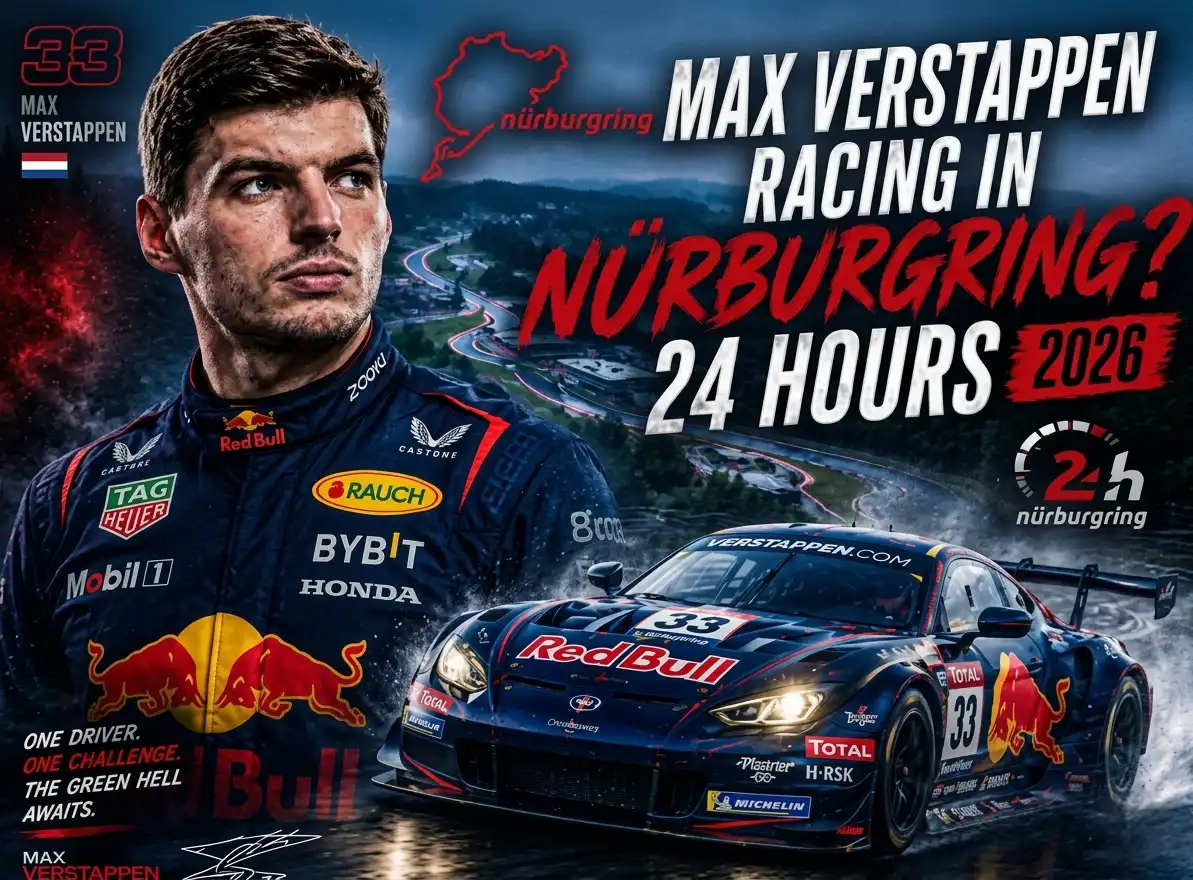
Max Verstappen Leads the
Nürburgring 24 Hour in Stunning GT3 Debut
The three-time Formula 1 World Champion swapped ground-effect to GT3 machinery, stepped onto the Nordschleife for the first time in anger — and went straight to the front of the most demanding endurance race in the world.
Verstappen Leads the
Nürburgring 24 Hour
The F1 champion goes straight to the front in his GT3 endurance debut.
Max Verstappen is leading the 2026 ADAC Ravenol Nürburgring 24 Hours. That sentence still sounds surreal, even to people who have been watching this race for decades. The three-time Formula 1 World Champion — the man who has dominated Grand Prix racing across the past four seasons — walked into the most brutal, unforgiving endurance circuit on earth and immediately started going faster than factory-backed GT3 specialists who have spent careers mastering the Green Hell. The motorsport world is watching.
This piece covers everything: how the debut unfolded, why Verstappen chose this race, what the Nordschleife demands that no F1 circuit does, the full competitive picture across the GT3 field, and what it all means for endurance racing going forward. Jump to the tables if you want times. Keep reading if you want to understand what you are actually watching.
Race Overview: 2026 Nürburgring 24 Hours
The ADAC Ravenol 24h Nürburgring is not like any other race on the global motorsport calendar. Over 130 cars across multiple performance classes tackle a combined layout of the Grand Prix circuit and the full Nordschleife loop simultaneously — 25.378 kilometres of tarmac that cuts through the Eifel mountains, through dense forest, over blind crests, past stone walls with no runoff, in conditions that can shift from dry sunshine to dense fog to torrential rain within the span of a single lap. It is the biggest GT3 race in the world. It is also the most dangerous.
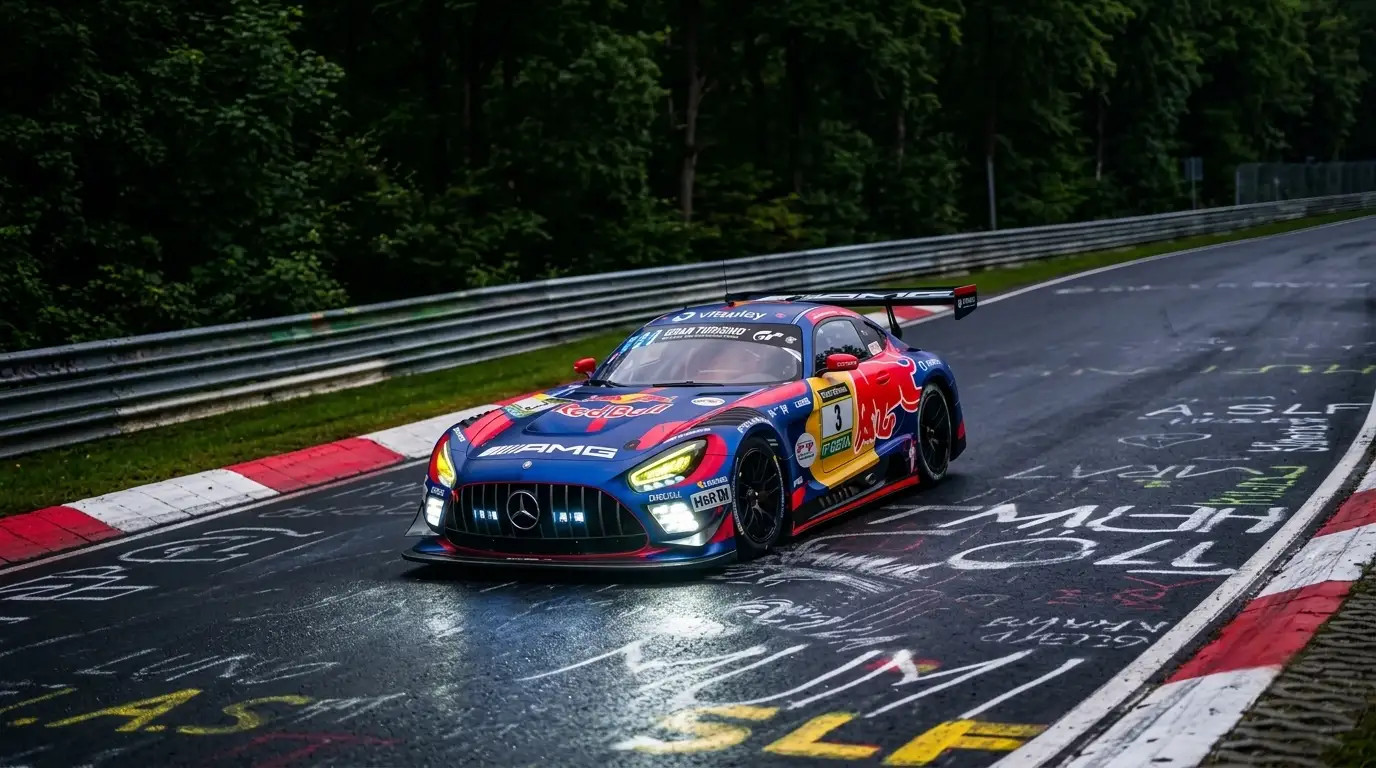
The SP9 Pro category — effectively GT3 — is where the premier manufacturers deploy their factory-backed machinery. Porsche, BMW, Mercedes-AMG, Ferrari, Audi, and Lamborghini all field works-supported entries staffed by the finest sports car drivers on the planet. Into this world, in 2026, stepped Max Verstappen — driving a Mercedes-AMG GT3 for the Rowe Racing outfit alongside co-drivers Lucas Auer, Jules Gounon, and Daniel Juncadella.
The 24-hour format means teams use multi-driver rotations across a full day and night cycle, managing tire degradation, fuel consumption, traffic from slower classes, and the unpredictable Eifel weather simultaneously. A single mistake — a flat tire, a contact with backmarkers, a misjudged braking point at Schwedenkreuz — can end a race that looked already won. Understanding how pit stops work in endurance racing and how racing championships are scored gives crucial context for what the teams are actually managing hour by hour.
Who Is Max Verstappen Racing For?
Verstappen’s entry is run under the Rowe Racing banner — a German outfit with serious Nordschleife pedigree and multiple SP9 class victories to their name. They know the circuit, they know the tire windows, they know the weather patterns on this side of the Eifel mountains. The car is the Mercedes-AMG GT3, powered by a front-mounted V8 biturbo engine producing around 550 bhp, reined back to a defined BoP (Balance of Performance) specification that keeps the manufacturer field within striking distance of each other. Verstappen’s co-drivers are all proven endurance specialists: Auer knows the car intimately as a works AMG driver; Gounon is a GT3 class-winner at Le Mans; Juncadella brings years of Nordschleife mileage and an instinct for the circuit’s rhythms that only repetition can teach.
The Debut: Why Verstappen Chose the Green Hell
The question that everyone in the paddock was asking before the race weekend even started was the obvious one: why? Verstappen already has three Formula One World Championships. He has won races on every type of circuit in the modern F1 calendar. He didn’t need to prove anything to anyone. So why spend months preparing for an endurance race at a circuit where the consequences of an error are far more immediate than anything he encounters on the Grand Prix grid?
The answer, from everyone who knows Verstappen well, is straightforward: he loves racing. Not racing as a career obligation or a brand-building exercise — racing as a thing he would do even if there were no cameras, no crowds, and no championship points attached. He has spent years logging enormous hours on racing simulators, particularly on Nordschleife layouts. He has spoken publicly about his admiration for endurance racing and GT machinery. When the opportunity to partner Rowe Racing and Mercedes-AMG arose, it wasn’t a difficult decision.
In the months before the race, Verstappen completed extensive private testing on the Nordschleife in the Mercedes-AMG GT3. Team engineers revealed that he spent hours studying onboard data from his co-drivers and from previous Rowe Racing entries, absorbing the circuit’s character corner by corner. His adaptation to the GT3’s fundamentally different driving dynamics — less downforce than an F1 car, heavier and more physical to drive, demanding a different rhythm to nurse tires across a 25-kilometre lap — was, by all accounts, faster than anyone in the team had expected. For perspective on what he left behind, our F1 car speed explainer and downforce breakdown show how different the two worlds are.
Opening Hours: Immediate Speed
Verstappen took the opening stint himself. By the end of his first flying lap in race conditions — navigating 130 cars, the worst of the multi-class traffic, the early chaotic moments where incidents happen most frequently — his sector times were already competitive with the factory opposition. By his third lap, he was matching the pace of the quickest SP9 entries. By his fifth, some of those entries were looking at their own data and asking their engineers uncomfortable questions.
Traffic management on the Nordschleife is a skill in itself. The circuit mixes GT3 Pro cars lapping in under eight minutes with touring cars and production vehicles that might take twelve or thirteen. Judging when to pass, when to tuck in behind a slower car to defend a braking zone from a rival, when to use a backmarker as cover — all of this requires a spatial awareness and instinct that normally takes seasons to develop at this circuit. Verstappen adapted within stints.
“We expected Max to be fast. What surprised us was the traffic management. That is the Nordschleife skill nobody teaches you — you just have to feel it. He felt it on day one.”
— Senior Rowe Racing engineer, pit lane interviewPerformance Deep Dive: How He Got to the Front
The raw pace was the first surprise. The strategy was the second. Rowe Racing built their race plan around Verstappen’s ability to extend stint lengths — his precise, low-degradation driving style allowing the team to stay out one or two laps longer than rival pit windows before stopping for tires and fuel. Over a 24-hour race, that kind of marginal gain compounds. Each pit stop cycle where Rowe runs an extra lap costs rivals roughly 28–32 seconds of real time. Over twelve pit cycles across the race, that is a lead built from driving craft rather than outright speed.
During his initial double-stint run, Verstappen registered multiple consecutive laps below the eight-minute mark — a benchmark that separates the front-running GT3 entries from the midfield at this circuit. His corner-entry speeds through high-speed sections like Schwedenkreuz and through the long compression of Fuchsröhre matched the absolute limits the GT3 chassis allows. His braking points into the Hatzenbach complex were millimetre-consistent across consecutive laps in a way that rival data engineers were noting with particular attention.
The Night Stint: Where the Race Was Defined
Endurance racing veterans will tell you that the Nordschleife after dark is a fundamentally different experience from the daylight circuit. The forest closes in. Headlights illuminate a narrow strip of tarmac ahead while everything beyond the barriers disappears into black. Blind crests that you can judge by sight in daylight must be committed to purely by memory and feel. Grip levels drop as temperatures plunge. The cars become alive with unpredictable behaviour at the limits.
Verstappen’s overnight double-stint, confirmed by official timing data, extended his lead over the second-placed factory entry. The lap time spread between his best and worst laps across that stint was extraordinarily small — a sign of someone who had locked in a rhythm and was simply executing it rather than searching for pace lap-by-lap. Gounon and Juncadella maintained position during their stints. When Auer handed back to Verstappen for the morning run, the gap had grown.
Pit Stop Strategy: Proactive, Not Reactive
One detail that separates winners from followers at endurance races is the difference between a proactive and a reactive pit strategy. Reactive teams stop when the data says they must — when fuel runs critically low or when tire wear crosses a threshold. Proactive teams stop when stopping gives them a net gain: jumping traffic, responding to a rival’s stop to cover an undercut, or taking fresh tires to make hay during a period when the track is at peak grip. Rowe Racing ran a proactive strategy throughout, and Verstappen’s consistent pace gave them the information they needed to make those calls with confidence. For a detailed breakdown of how undercut and overcut strategy works, and how pit stops function in racing more broadly, our glossary and explainers cover both thoroughly.
The Eifel mountains are famous for microclimates. One side of the Nordschleife can be bone dry while the other is soaked by a localised shower. Teams monitor weather radar obsessively and must decide whether to pit for wet tires — taking the penalty of a stop and the grip gain of fresh rubber — or stay out on slicks and hope the shower passes before they reach the wet section. Verstappen navigated two separate weather transitions during the race without losing meaningful time. Tire choice at critical moments is where endurance races are won or lost, and Rowe got those calls right.
The GT3 Field: Every Manufacturer Fighting Back
To put Verstappen’s performance in proper context, you need to know what he’s racing against. The SP9 Pro class at the Nürburgring 24 Hours is the most competitive single-class grid in global GT racing. Every major manufacturer deploys its most experienced factory crews — not drivers who do this occasionally, but professionals for whom the Nordschleife is a second home, who know every camber change at Brünnchen and every compression at Pflanzgarten by feel.
| Manufacturer | Model | Key Strength | Primary Threat To Rowe |
|---|---|---|---|
| Porsche | 911 GT3 R (992) | Rear-engine traction, brake stability, Nordschleife pedigree | Multiple factory entries; strongest historical win rate at this race |
| BMW | M4 GT3 | High-speed aerodynamic downforce, aggressive powertrain | Excellent on the Döttinger Höhe straight; strong in cool conditions |
| Mercedes-AMG | GT3 Evo | V8 torque delivery, chassis balance, tire durability | Verstappen’s own car — multiple works entries also fighting for the win |
| Ferrari | 296 GT3 | Mid-engine balance, agile corner entry, technical sector pace | Exceptional through the mid-corner complexes; improving in long-run pace |
| Audi | R8 LMS GT3 | Mid-engine stability, proven Nordschleife setup | Works crew have deep circuit knowledge; dangerous overnight |
| Lamborghini | Huracán GT3 Evo2 | High downforce, aggressive aero package | Quick in dry conditions; factory entry well-funded and motivated |
What makes the Verstappen performance remarkable against this field is that every one of these teams arrived at the Nürburgring with specific Nordschleife setup data from dozens of previous race weekends. Their engineers know exactly what the car needs at Adenauer Forst, at Kesselchen, at the Karussell. Verstappen’s team had months of preparation. Their rivals had years of institutional knowledge. That the gap is in Rowe’s favour at this stage of the race is a genuine statement about what Verstappen brings to the cockpit.
For a complete breakdown of how GT3 cars are designed and what separates them from the production road cars they’re derived from, our GT3 race car diagram and top, side and rear view breakdown are the clearest visual references available.
The Nordschleife: Why the Green Hell Is Like Nothing Else
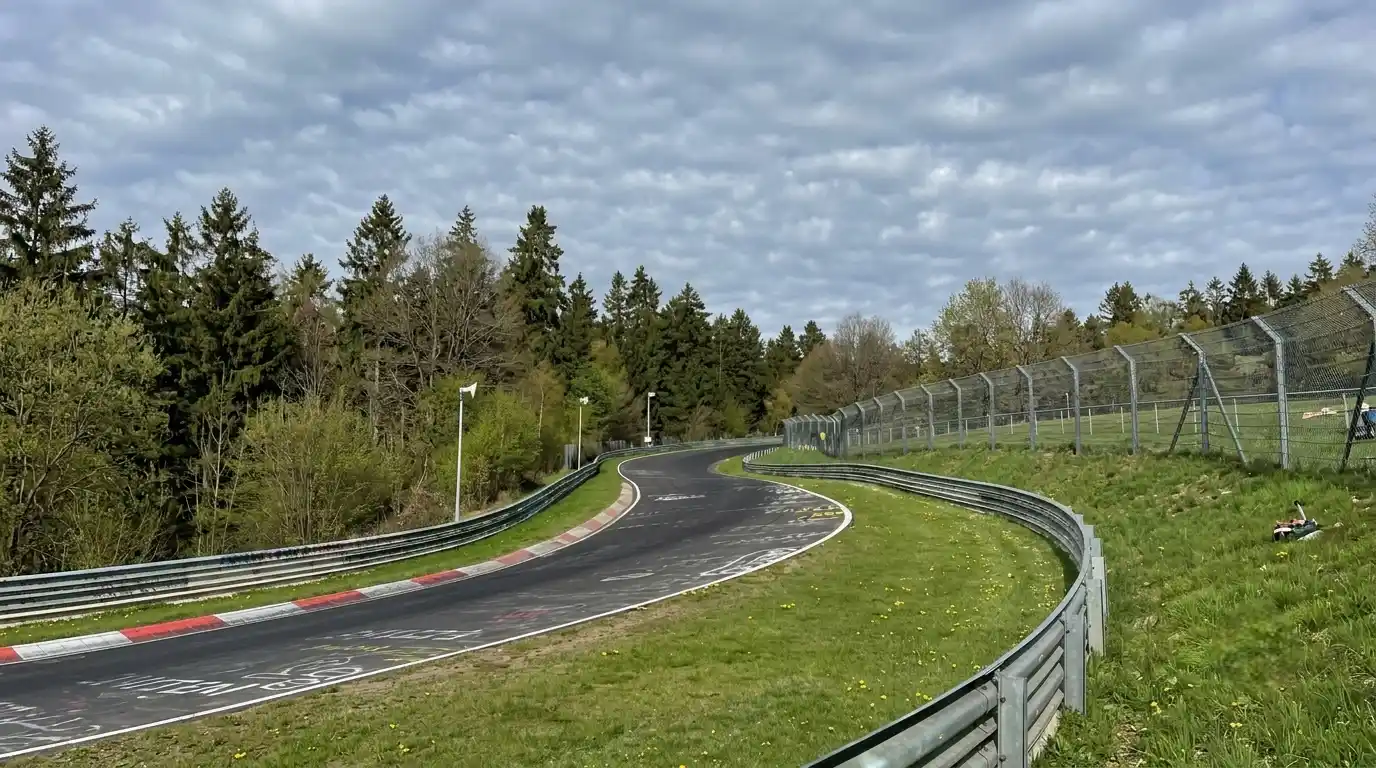
Jackie Stewart gave the circuit its most famous nickname — the Green Hell — and while motorsport has softened considerably since the 1960s and 1970s when Stewart and his contemporaries raced there in near-total absence of safety infrastructure, the name still fits. The Nordschleife is 20.832 kilometres of the original layout, combined with a Grand Prix circuit section to create a total lap of 25.378 kilometres. It contains 73 named corners, elevation changes of up to 300 metres, narrow medieval-width sections, exposed crests where the car becomes briefly airborne, and perhaps five or six places across the entire lap where a driver might exhale for more than a second.
Total length: 25.378 km (combined GP + Nordschleife) · Named corners: 73 · Elevation change: ~300 metres · Lap target (SP9 GT3): sub-8 minutes · Est. top speed: 280+ km/h at Döttinger Höhe · Race duration: 24 hours · Start time: Saturday 15:30 local
What Makes It So Different From F1
The Nordschleife challenges a driver in ways the Formula One calendar simply doesn’t prepare you for. An F1 circuit like Silverstone or Barcelona has been evolved over decades to create specific overtaking opportunities, safety margins, and clean airflow corridors. The Nordschleife was cut through a forest in the 1920s and essentially hasn’t moved since. Its character is geological — it follows the ridgelines and valleys of the Eifel plateau.
Where an F1 car generates three or four times a driver’s body weight in downforce through high-speed corners, a GT3 car operates with dramatically less aerodynamic support. The car is heavier. The brakes are less aggressive. The transition from corner entry to mid-corner to exit requires a different rhythm — slower inputs, longer commitment zones, more patience. A driver who tries to attack the Nordschleife the way an F1 driver attacks Copse at Silverstone will find themselves in the barriers with extreme efficiency. To understand the physics involved, our explainers on downforce, G-force, and slipstream dynamics are directly relevant.
The Nordschleife doesn’t reward aggression. It rewards rhythm. Verstappen found the rhythm before most people thought possible. That is the story of this race.
Race Timeline: Key Moments So Far
What Verstappen’s Nürburgring Performance Actually Means
The narrative of an F1 star “stepping down” to GT3 is lazy and wrong. The skills required to lead the Nürburgring 24 Hours are not lesser skills than those required to lead a Formula One Grand Prix — they are different skills. Traffic management at this scale, tire nursing across 25-kilometre laps, night driving on a circuit with zero runoff and 73 corners, and the physical endurance of multiple long stints across a 24-hour window — none of that is easy. None of it is subordinate to the skill set of F1.
What Verstappen is proving here is something that has been true of only a handful of drivers in history: genuine cross-discipline adaptability at the highest level. Mario Andretti won the Formula One World Championship and the Indianapolis 500. Nico Hülkenberg led Le Mans on his first attempt. The list of drivers who can perform at the front of fundamentally different racing categories is short and exclusive. Verstappen appears to belong on it.
The impact on endurance racing’s visibility is already measurable. Broadcasters are reporting viewership numbers for the Nürburgring 24 Hours live stream that are multiple times the historical average for this event. Mainstream sports media that would not ordinarily cover a 24-hour GT race are running live blogs and editorial coverage. The GT3 community’s coverage of Verstappen’s race entry has driven unprecedented traffic to motorsport platforms globally. For an event that has always deserved more attention than it receives outside Germany, this is a significant shift.
If Verstappen wins this race or even finishes on the podium, the conversation around active F1 drivers competing in major sports car events will intensify significantly. The FIA and various series promoters have historically been cautious about this kind of crossover, partly due to schedule conflicts and partly due to the perceived risk to drivers contracted to F1 teams. A successful Nürburgring debut makes those barriers harder to maintain. For context on how Verstappen’s F1 career has developed, and what the best drivers of the current era have achieved, our F1 archive has the full picture.
What Happens If Rowe Win?
A Verstappen victory at the Nürburgring 24 Hours in his first competitive appearance would be one of the most significant individual performances in GT endurance racing history. It would place him alongside Cristiano da Matta, who won on debut at Indianapolis, and the handful of drivers who have converted a first attempt at a major endurance event into outright victory. It would also, immediately, raise the question of what comes next — Le Mans? The Daytona 24 Hours? The Bathurst 12 Hour? Verstappen has demonstrated he can adapt. The endurance world will be watching every answer he gives after this race.
For a broader view of endurance racing’s greatest achievements, the Indianapolis 500 all-time records archive and the best F1 drivers of all time ranking both provide essential historical context. And if you want to understand the mechanical and engineering side of what GT3 machinery actually is, our mid-engine GT3 diagram and engine explainer are the clearest starting points.
Frequently Asked Questions
One honest assessment before the flag drops
Twenty-four-hour races are decided at the finish line, not at the twelve-hour mark, and not when a writer files copy at hour twenty-two. The Rowe Mercedes-AMG GT3 leads, the margin is real, and the car is healthy — but endurance racing has ended more commanding leads than this in the time it takes to drive from the Karussell to the Galgenkopf. A puncture, a safety car sequence that reshuffles the field, an unexpected mechanical fault that looks minor until it isn’t — any of these can erase what looks like a certain result.
What cannot be erased, whatever happens in the final hours, is what Verstappen has already shown. He arrived at the most demanding endurance circuit in the world for the first time in competition, and he went to the front. Against drivers who have dedicated careers to understanding this specific piece of tarmac. That is not a narrative. That is data. And it will reshape how people think about F1 champions engaging with endurance racing for years to come.
Full race result and final analysis will be published on worldofspeed.org within thirty minutes of the chequered flag. Live timing and class standings are updated continuously at our results hub.