Who Won Nürburgring 24 Hours 2026?
Full Results, Standings & Highlights
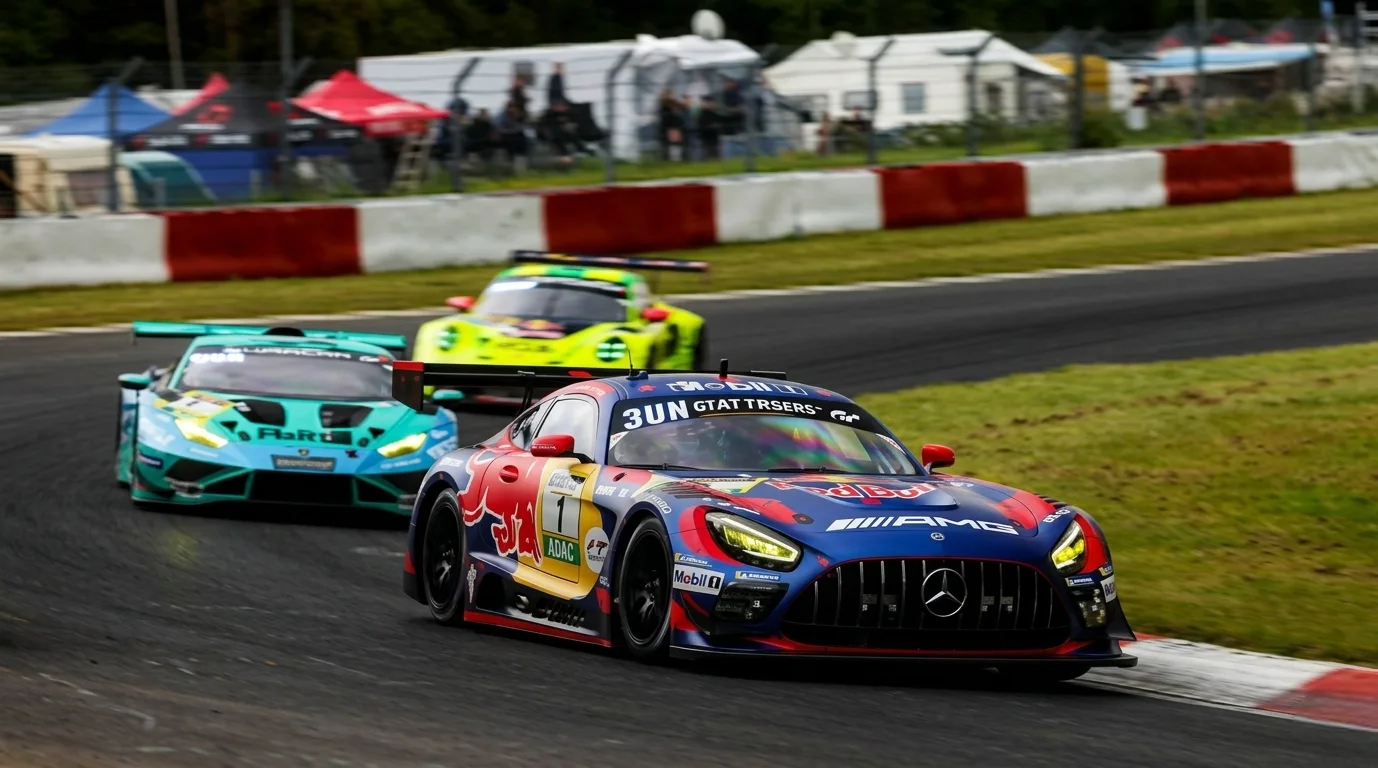
The #3 Mercedes-AMG Team Verstappen Racing conquered the Green Hell after 158 laps of the Nordschleife. Max Verstappen, Lucas Auer, Jules Gounon and Daniel Juncadella delivered one of the most dramatic victories in the 54th running of this legendary race.
Who Won Nürburgring
24 Hours 2026?
Full Results & Highlights
#3 Mercedes-AMG wins · Verstappen leads from Hour 3 · 158 laps completed
The #3 Mercedes-AMG Team Verstappen Racing won the Nürburgring 24 Hours 2026 — the 54th edition of the Eifel classic — after 158 laps of the 25.378-kilometre Nordschleife circuit. The winning crew of Max Verstappen, Lucas Auer, Jules Gounon, and Daniel Juncadella crossed the finish line 11.452 seconds ahead of their sister car, the #80 Winward Mercedes-AMG GT3, making it a historic one-two for the Silver Arrows in one of motorsport’s most unforgiving environments.
The race delivered on every expectation: unpredictable weather across the Eifel mountains, multi-class traffic that turned the night stints into a survival exercise, factory-backed GT3 machinery from nine manufacturers fighting for position on 73 corners of asphalt that hasn’t fundamentally changed since the Nordschleife opened in 1927. And through all of it, one four-time Formula 1 World Champion made his endurance racing debut in a manner that will be discussed in motorsport paddocks for years.
This is the complete race report — the result, the podium, the full classification, Verstappen’s performance hour by hour, the critical moments that shaped the race, qualifying, and everything that made the 2026 running a landmark edition of the Green Hell classic.
Nürburgring 24 Hours 2026 — Full Results & Final Classification
The final hours of the Nürburgring 24 Hours 2026 produced exactly the kind of intra-team drama that only a 24-hour race at the Nordschleife can deliver. The #3 and #80 Winward Mercedes-AMG GT3 Evos spent most of Saturday night trading the lead through pit stop cycles, with the gap between them at times measured in single-digit seconds. When Verstappen handed the car to Gounon for the final stint, the margin was fine enough that a single fuel-flow anomaly or a slow backmarker at the wrong moment could have reversed the result. It didn’t. Gounon brought the car home cleanly, and Mercedes-AMG locked out the top two steps of the podium for the first time in this race’s modern history.
Lucas Auer
Jules Gounon
Daniel Juncadella
Luca Stolz
Fabian Schiller
Vincent Abril
Nicolás Varrone
Dylan Pereira
Charlie Eastwood
| Pos | Car / Entry | Car | Laps | Gap / Status |
|---|---|---|---|---|
| 1 | #3 Mercedes-AMG Team Verstappen Racing | Mercedes-AMG GT3 Evo | 158 | 🏆 Winner |
| 2 | #80 Winward Racing | Mercedes-AMG GT3 Evo | 158 | +11.452s |
| 3 | #34 Walkenhorst Motorsport | Aston Martin Vantage AMR GT3 Evo | 157 | +1 Lap |
| 4 | #99 ROWE RACING | BMW M4 GT3 Evo | 157 | +1 Lap |
| 5 | #84 Red Bull Team ABT | Lamborghini Huracán GT3 Evo 2 | 156 | +2 Laps |
| 6 | #24 Lionspeed GP | Porsche 911 GT3 R (992.2) | 156 | +2 Laps |
A 1-2 finish at the Nürburgring 24 Hours is extraordinarily rare. The top two positions going to the same manufacturer — and the same team operation — reflects not just outright pace, but a level of strategic discipline and mechanical reliability that sets a new benchmark for the modern GT3 era. The Walkenhorst Aston Martin P3 result was the story of the weekend outside the Winward garage: they started outside the top ten and climbed to the podium through patience, tire management and execution. For more on how endurance racing results feed into championship points, see our scoring explainer.
Max Verstappen at the Nürburgring 24 Hours — The Debut Deconstructed
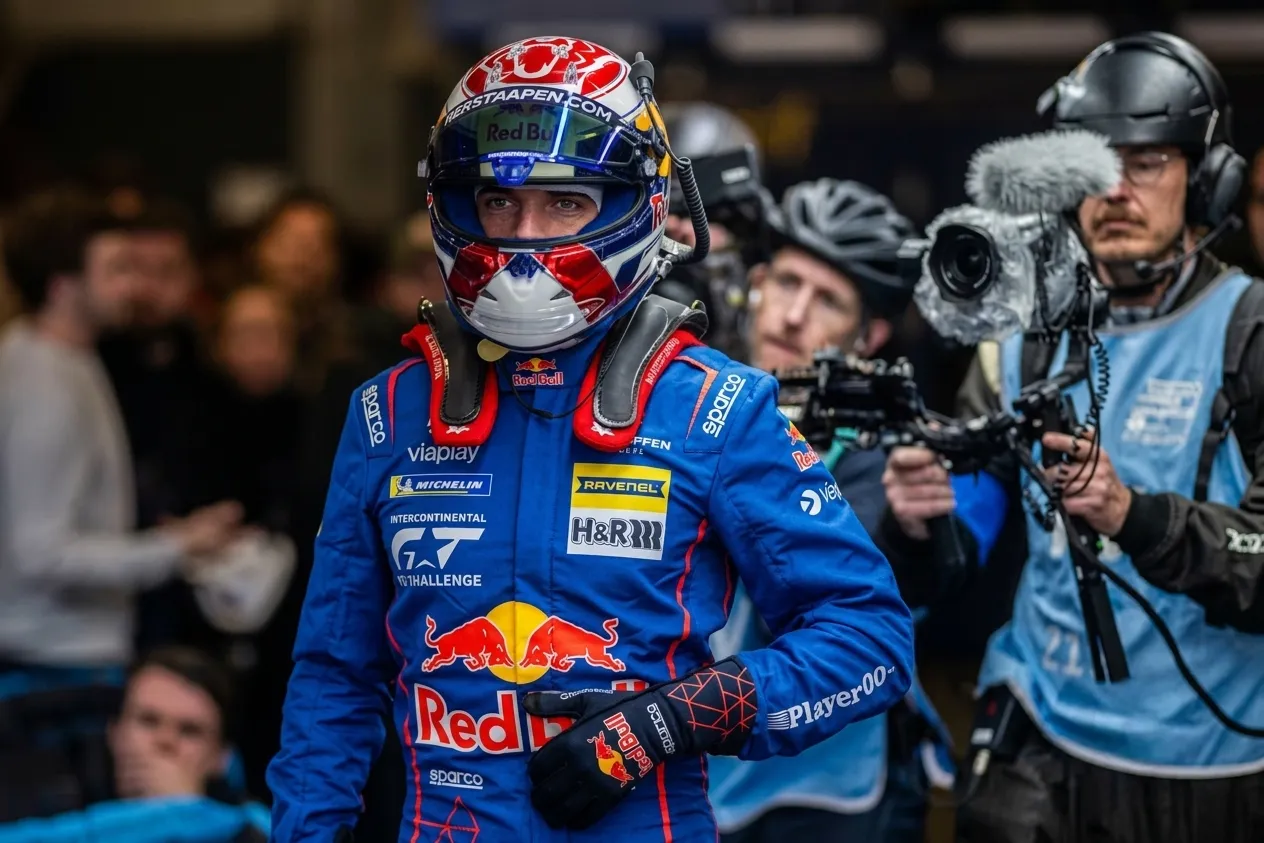
The central narrative of the 2026 Nürburgring 24 Hours was always going to be Max Verstappen’s debut, and from the moment he climbed into the #3 Mercedes-AMG GT3 Evo for the opening stint, he made it clear that this wasn’t a celebrity appearance. Four Formula 1 World Championships require a different set of skills to a 25-kilometre Nordschleife lap in a 550-horsepower GT3 car at 2 a.m. — but the core of elite racing talent transfers. Verstappen demonstrated that within his first hour at the wheel.
The Opening Stint — Hour 1 to Hour 3
Daniel Juncadella launched the #3 car from fourth on the grid, picking his way through the early chaos on the Grand Prix loop before handing over to Verstappen. The Dutchman inherited the car in tenth position due to the strategic variation in early pit stop windows across the field — a position that, on the Nordschleife, requires patience and precision rather than aggression.
He delivered both. Working methodically through multi-class traffic — the Nordschleife’s notorious demand, where a GT3 at 250 km/h arrives on the tail of a production-class entry doing 150 km/h with virtually no warning — Verstappen climbed the order lap by lap. His simulator hours on the circuit were immediately visible in his corner commitment. The Kinks at Pflanzgarten and the compression at Bergwerk are corners where experience on the real circuit matters enormously; Verstappen carried speed through both sections from his second lap onwards.
At Hour 3, Verstappen pulled off a stunning double overtake at Tiergarten — past a leading Aston Martin and a Ford Mustang GT3 simultaneously — to seize the absolute lead of the race.
The Night Shift — Hour 11 and the Engel Duel
Verstappen’s mandatory late-night stint produced the image of the entire weekend. During the 11th hour, in complete darkness on the Döttinger Höhe straightaway — the fastest section of the Nordschleife, where cars reach close to 270 km/h — Verstappen found himself door-to-door with Maro Engel in the #80 sister car. Both drivers knew that a touch at that speed, with those guardrails, would end both cars and potentially the race for the entire Winward programme. Neither lifted. The moment lasted approximately four seconds. Both cars stayed on the road. The crowd — spread across campsites for miles around the circuit — heard about it within minutes via the livestream and the reaction was instantaneous.
That moment exemplified what made Verstappen’s debut at the Nürburgring so compelling. He wasn’t managing a safe, controlled race. He was racing. His GT3 race career now includes a win at the highest level of the format, and his race-leading performances during the 24-hour stint showed a driver who understood the unique demands of endurance racing — pace management, traffic reading, communication with the team — from the first hour to the last. For full context on his Formula 1 career trajectory, our Verstappen F1 profile covers his journey from Toro Rosso debutant to four-time champion.
Stints completed: Double stint in opening hours + mandatory late-night double shift · Position on car handover (first stint): 10th → lead · Overtake of the race: Double pass at Tiergarten, Hour 3 · Most intense moment: 270 km/h side-by-side with Engel (#80), Hour 11 · Result: Race winner — first attempt
Race Highlights — Hour by Hour Turning Points
A Nürburgring 24 Hours race is not a linear story. It’s twenty-four simultaneous stories happening across a 25-kilometre circuit, most of them invisible to any single camera angle. What cuts through the noise — what defines the eventual narrative — is the sequence of moments where the race changed irrevocably. The 2026 edition had several.
The Walkenhorst Aston Martin — P3 Against the Odds
The story that deserves more attention than it received in Verstappen’s shadow is the #34 Walkenhorst Motorsport Aston Martin Vantage AMR GT3 Evo. Starting outside the top ten, crew of Ben Tuck, Nicolás Varrone, Dylan Pereira, and Charlie Eastwood ran a race of extraordinary composure. They benefited from the Hour 6 rain call — staying on slicks when rivals pitted — and then protected their resulting track position with a tire management strategy that kept their Aston Martin’s rear-end compliance over the bumps of Pflanzgarten working harder than the entries around them. Their P3 is one of the most earned podium positions in recent Nürburgring history. Understanding what causes crashes in motorsport explains why their clean, incident-free race was as impressive as the pace they showed.
Qualifying & Top Qualifying Shootout
The Nürburgring 24 Hours qualifying structure is unlike anything else in motorsport. The competitive sessions across Thursday and Friday determine which cars earn the right to display blue flashing windshield lights during the race — a signal to slower traffic that a fast GT3 car is arriving at pace. But the headline session is Top Qualifying: a Friday individual shootout where each driver gets two completely clear flying laps on the Nordschleife to set their absolute benchmark time.
In 2026, it was the #84 Red Bull Team ABT Lamborghini Huracán GT3 Evo 2 that claimed pole position. Luca Engstler set a lap of 8:11.123 in the Top Qualifying session, a time that placed the Lamborghini ahead of its sister entry and sent a clear message about the Italian manufacturer’s pace over a single lap. The irony of the weekend — and something that defines the Nordschleife better than any other fact — is that the pole-sitting car finished fifth in the race. Qualifying pace and race-distance execution are two entirely different disciplines on this circuit, and 2026 proved it once again.
Pole position: #84 Red Bull Team ABT — Luca Engstler — Lamborghini Huracán GT3 Evo 2 · Pole time: 8:11.123 · Second on grid: Sister Lamborghini entry · Format: Two clear flying laps, individual shootout on Friday · Blue lights (top qualifiers): Awarded to the fastest cars as traffic-signalling privilege during the 24-hour race · Pole finisher in race: P5 — the defining illustration of endurance racing’s complexity.
The gulf between qualifying pace and race pace at the Nordschleife is explained by the circuit’s unique demands over distance. A single flying lap on cold tires in perfect conditions rewards commitment, late braking, and willingness to run the absolute limit of the guardrails. A 24-hour race on the same circuit rewards tire management, fuel calculation, traffic discipline, team communication, and the ability to maintain 95% pace for 24 consecutive hours without accumulating risk. For an explanation of how qualifying works across different racing formats, our guide covers the key differences between single-lap shootouts, timed sessions and endurance-specific qualifying.
The Green Hell — Understanding the Nordschleife
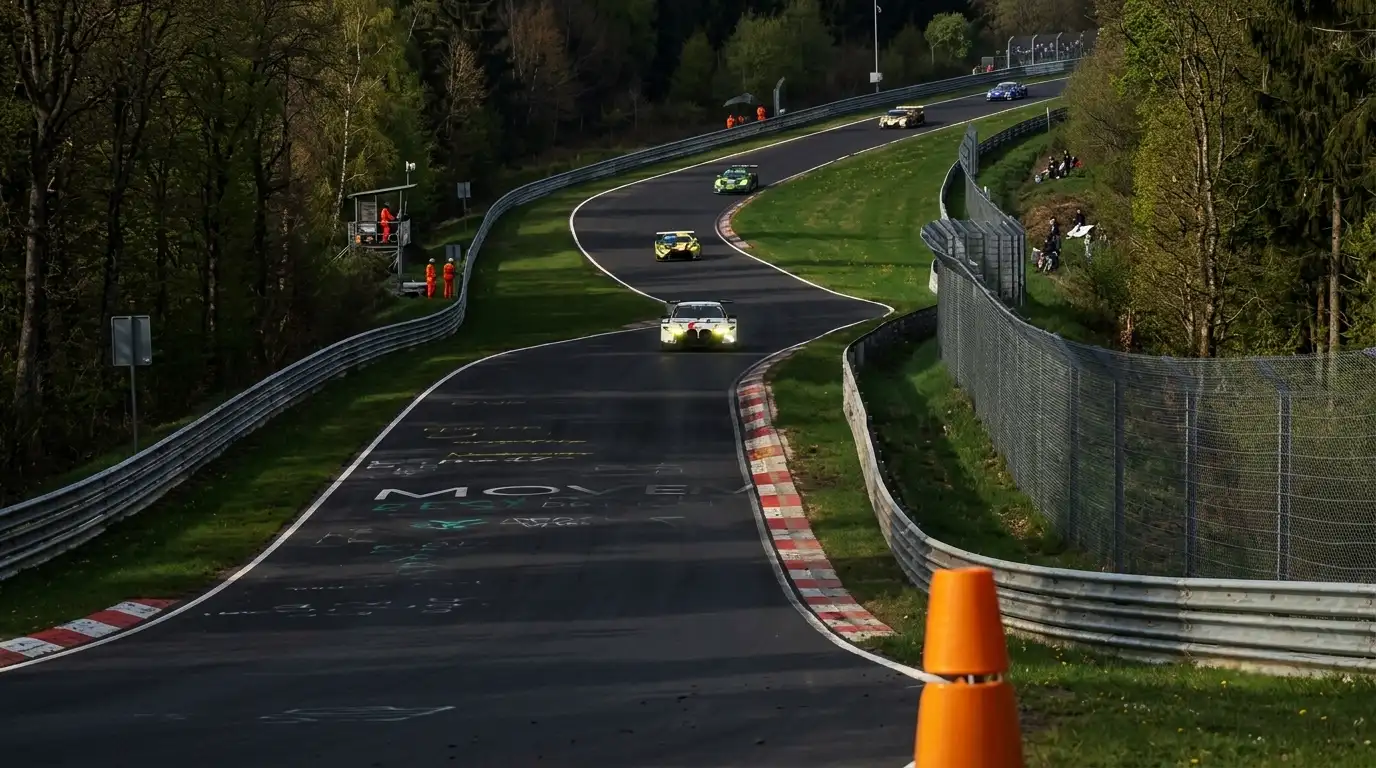
Jackie Stewart coined the nickname “The Green Hell” during his F1 racing years and it has never been replaced, because nothing more accurate has been suggested since. The Nordschleife — “North Loop” — is the original Grand Prix circuit built in the hills of the Eifel region in 1927. It winds for 20.8 kilometres through forest, farmland, and dramatic elevation change before rejoining the modern Grand Prix circuit for the final 4.5 kilometres. The combined 25.378-kilometre layout used for the 24-hour race is the longest circuit in regular competitive use anywhere in world motorsport.
Why This Circuit Is Different to Everything Else
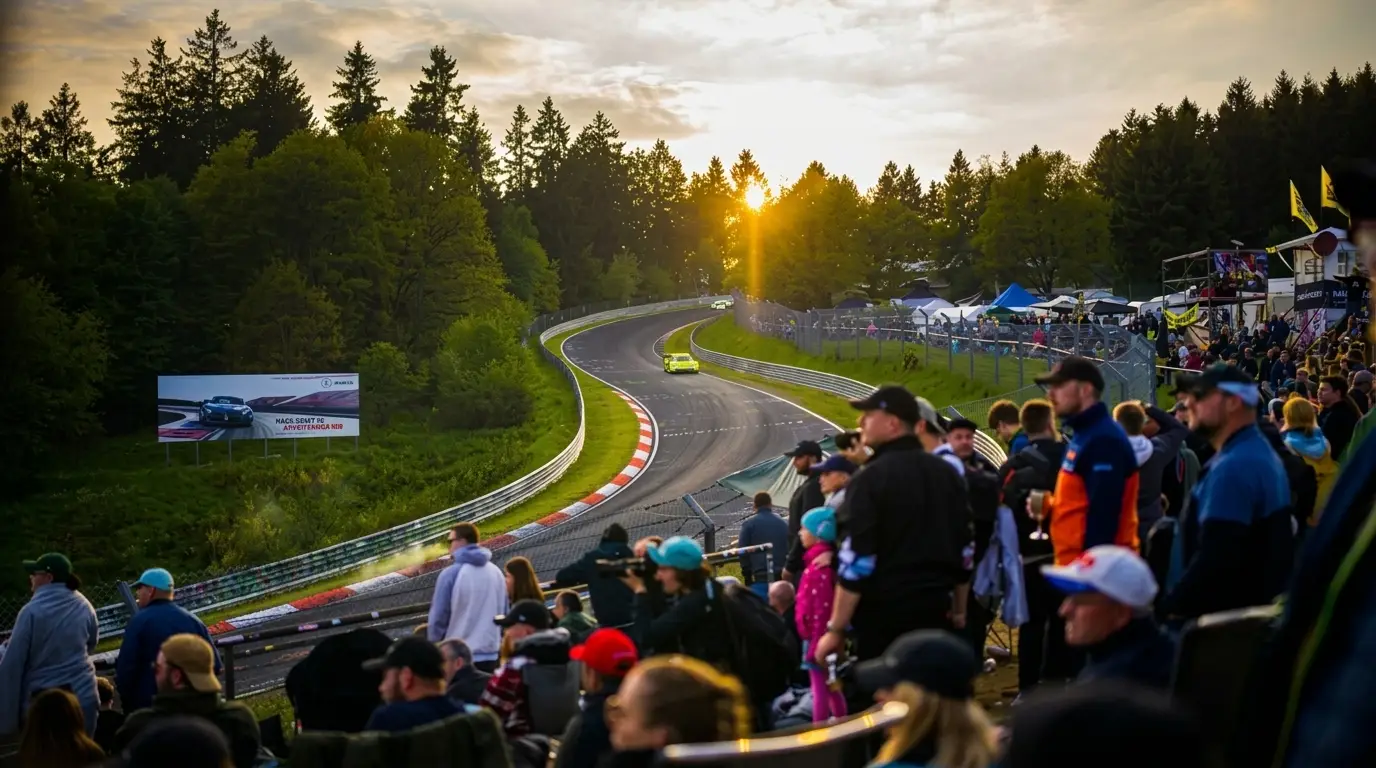
The 24-hour race puts over 160 cars on the same 25-kilometre piece of tarmac simultaneously. The fastest SP9 GT3 cars lap at around 8 minutes; the slowest production-class entries lap at 12 minutes or more. That means every 60-second stretch of the circuit contains cars travelling at speeds that differ by 80 km/h or more, approaching blind corners at 250 km/h with virtually no traditional runoff area. The aerodynamic demands alone — high-speed stability through compressions that generate enormous vertical loads, combined with the need to pass slower traffic without the safety margin of a conventional circuit — make it technically unlike any other race in the world.
Full layout length: 25.378 km (15.77 miles) · Nordschleife only: 20.832 km · Corners: 73 official · Elevation change: 300 metres across the lap · Opened: 1927 (Nordschleife) · Race lap record: 8:08.006 — Daniel Keilwitz, Ferrari 296 GT3, 2023 · Green flag 2026: 15:00 CEST, Saturday 15 May · Race start: 60-second national anthem, then lights out
The weather element is entirely separate from circuit difficulty. The Eifel mountains create their own micro-climate, and it is genuinely common — as it was in Hour 6 of the 2026 race — for heavy rain to fall on one section of the Nordschleife while another 10 kilometres away remains completely dry. Teams watching their in-car cameras, weather radar, and timing screens simultaneously try to make tire calls on a track that doesn’t have uniform conditions. It is the ultimate test of race timing and strategy management under genuine uncertainty.
GT3 Manufacturers — How Each Brand Fared
The 2026 entry list featured SP9-class GT3 machinery from nine world-class manufacturers — a depth of competition that makes the Nürburgring 24 Hours the most representative single-event test of GT3 machinery in the world. The result was, on its surface, a complete Mercedes-AMG story. But the manufacturer battle beneath the podium was fought fiercely, and the individual performances tell a more nuanced story.
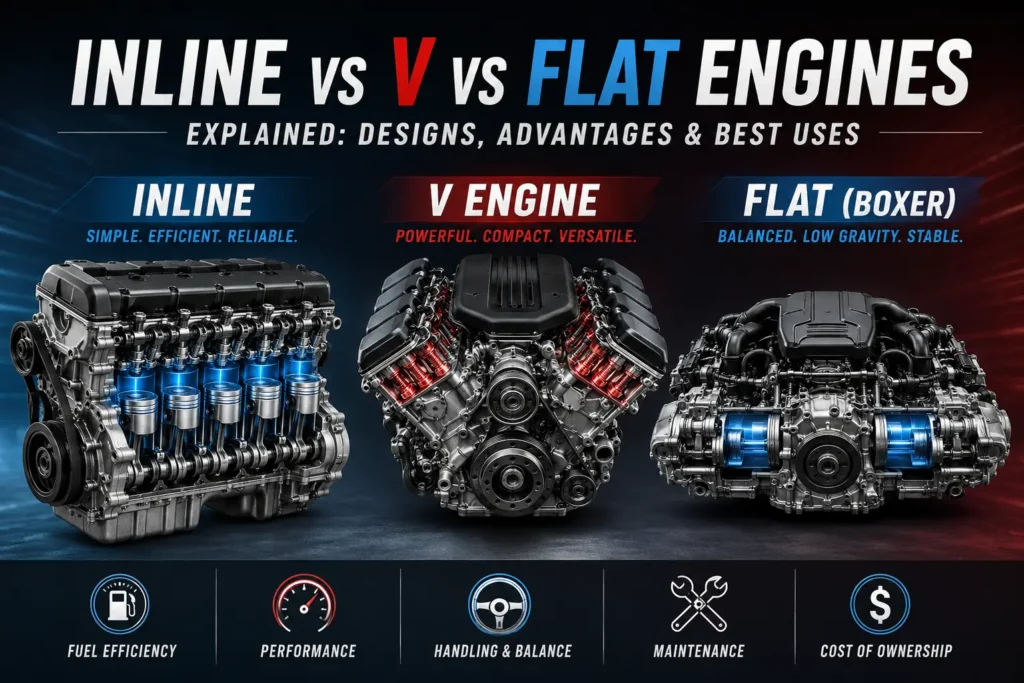
The front-engine V8 platform of the Mercedes-AMG GT3 Evo has historically excelled on the Nordschleife’s violent bumps — particularly through the Carousel and Pflanzgarten sections where the suspension articulation demands are extreme. When track temperatures dropped in the early hours of Sunday morning, the Mercedes’ inherent stability at lower grip levels was the decisive technical advantage over its mid-engine rivals. This is the kind of circuit-specific engineering insight that separates the teams who study the Nordschleife year-round from those who arrive with a generic setup. For a deeper understanding of how car engine configurations affect handling, our engineering explainer covers the front-engine vs mid-engine dynamics in detail. Our GT3 race car diagram also illustrates exactly how these cars are built for exactly this kind of punishment.
Frequently Asked Questions — Nürburgring 24 Hours 2026
The Green Hell delivered again
The 54th Nürburgring 24 Hours gave the world every element it promised: an F1 world champion winning on debut, a 1-2 finish for the same manufacturer that defied probability, an Aston Martin team that nobody predicted on the podium, rain that changed the race in Hour 6, a 270 km/h side-by-side duel in pitch darkness, and a final stint that kept the result in genuine doubt until the last lap. That is not a coincidence. That is what the Nordschleife does every single year — and why the 24-hour race held on its tarmac remains, after 54 editions, the most honest test of driver and machinery in world motorsport.
Max Verstappen came to the Green Hell and won it. The question this result leaves the motorsport world asking isn’t whether he was good enough for endurance racing. It’s whether endurance racing will get another chance to test him before Formula 1 pulls him back completely. Based on what he showed across 24 hours in the Eifel mountains — the answer probably depends on whether he enjoyed it as much as it looked like he did from the outside.